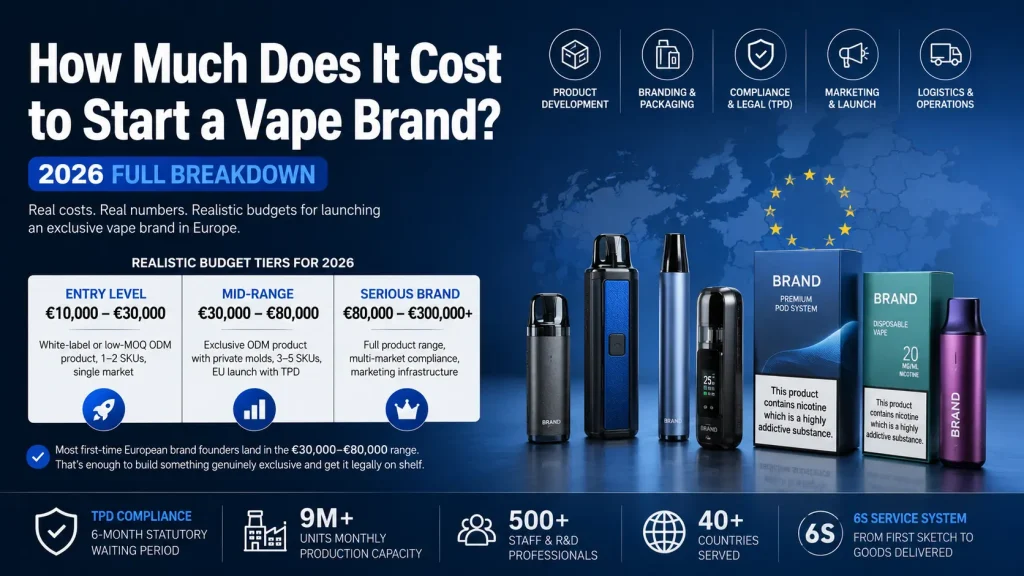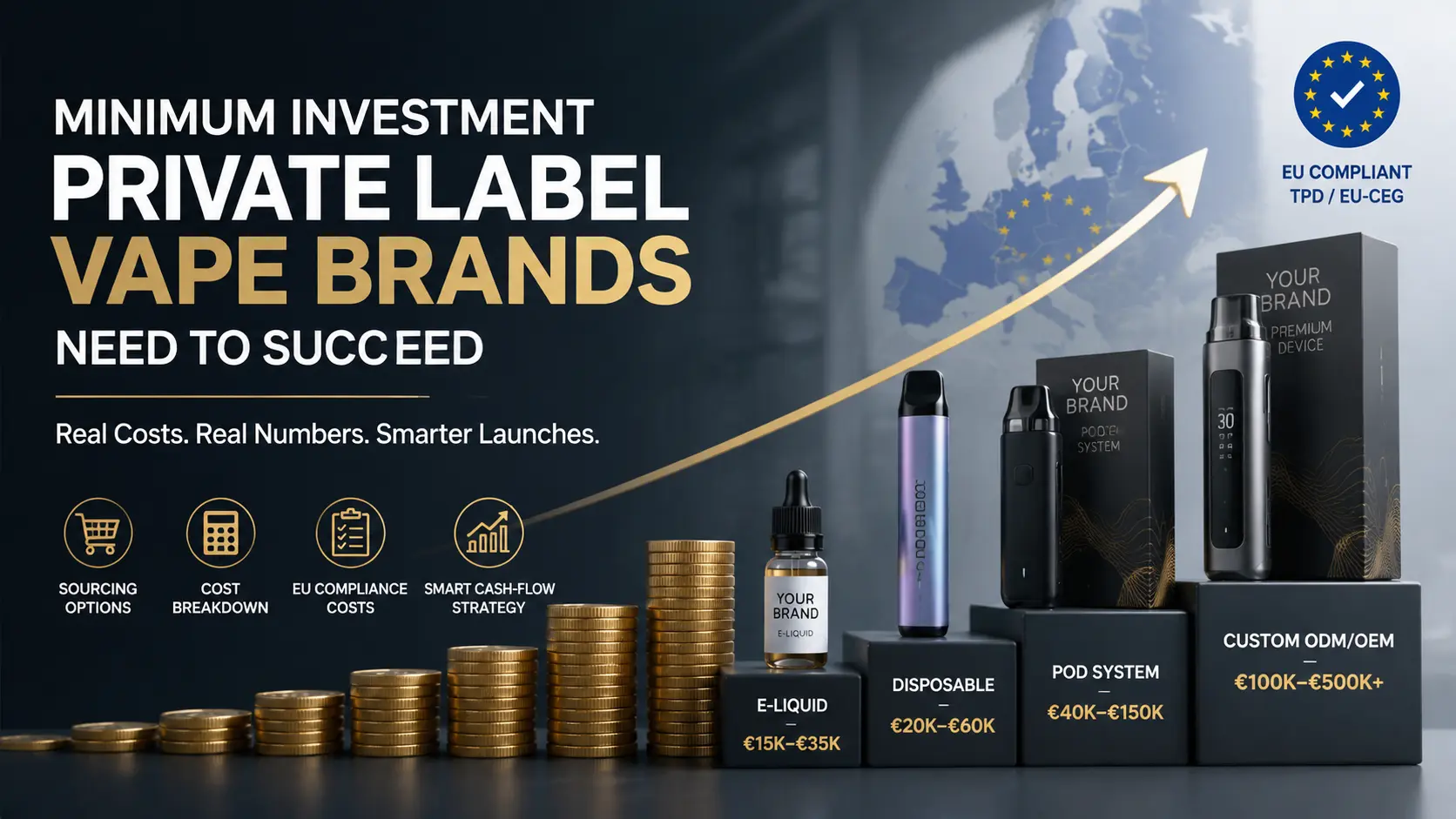
Ask ten manufacturers for the minimum investment private label vape brands should plan for, and you will get ten different answers. That is not because the industry is being evasive. It is because the minimum investment private label vape brands need changes completely depending on whether you are testing a market with branded stock, launching a private label line on an existing device, or commissioning a fully custom product. The range across those options is roughly €15,000 to more than €500,000 — and most of the difference is not product cost, it is product architecture.
If you are reading this, you are probably in the camp that wants the leanest possible path to a branded product. Good. That is exactly the segment of the market this guide covers. We will walk through the sourcing ladder from cheapest to most expensive, give you a realistic minimum investment private label vape table by product type, add the European compliance costs that most budget articles forget, and finish with a cash-flow framework that keeps a small budget alive. Our full cost-to-start breakdown goes even deeper on the overall launch math, but this article is specifically about the floor — the smallest amount that still gives you a real chance of success.
One principle before the numbers: the minimum investment private label vape brands can get away with is not the same as the amount they should plan. Under-capitalization is one of the most common reasons new vape companies fail — they spend everything on inventory and have nothing left to tell anyone the product exists. So treat every figure below as the realistic low end, and hold back a buffer on top for the launch itself.
What Actually Determines the Minimum Investment Private Label Vape Brands Need
The minimum investment private label vape brands need is set by four variables that interact with each other. Change any one of them and the total shifts by thousands of dollars. Understanding the levers is more useful than memorizing a single headline number, because it tells you where you can cut and where you cannot.
First, the sourcing model. Branded stock — buying finished goods from a factory or warehouse and reselling them — has a minimum order quantity as low as 50 to 500 pieces per flavor and requires almost no setup investment. Private label, where you take an existing device and control the packaging, logo, flavors and SKU range — a step up from plain white-labeling, which only swaps the logo — typically starts at 1,000 to 3,000 pieces per flavor. Full ODM, where the factory’s R&D team designs a new product with private molds for your brand — molds that are exclusive to your brand and market, so no competitor can sell the same hardware — commonly runs 2,000 to 5,000 pieces per flavor. OEM, where you bring production-ready design files and the factory manufactures them, starts around 3,000 to 10,000 pieces per flavor — and if your design needs new tooling, the mold cost is yours. Each step up the ladder raises both the minimum investment private label vape projects carry and the control you get over the product.
Second, the product line. A disposable vape has a short bill of materials and one box. A pod system adds a rechargeable device plus replaceable pods — two SKUs, two packaging designs, more complexity. E-liquid, by contrast, is the lightest category to start because it is just bottled liquid with a label. These differences show up directly in the numbers later in this article.
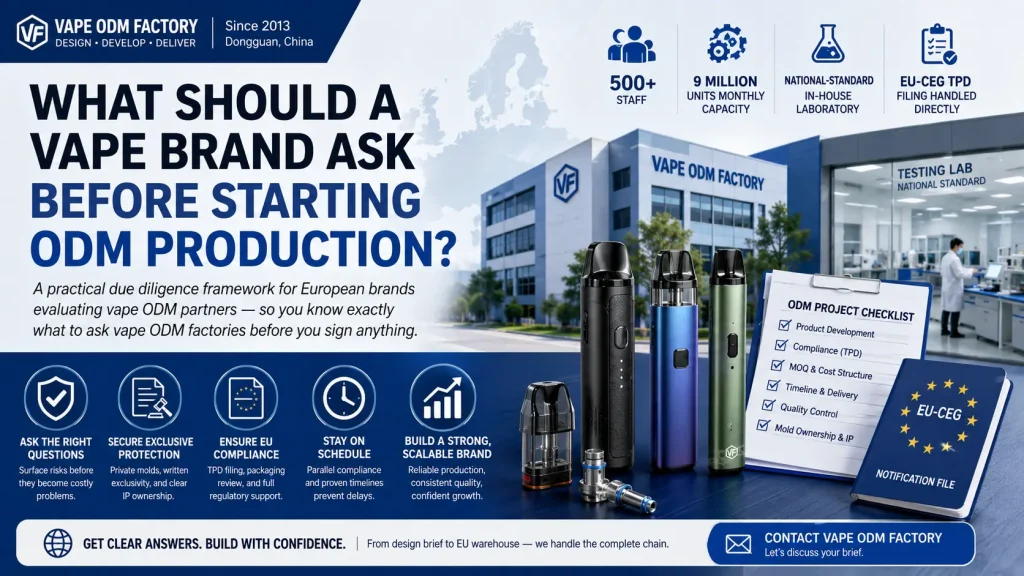
Third, your target market. Selling into the European Union adds notification fees, testing requirements, and a six-month timeline that a domestic market does not. The minimum investment private label vape brands need for an EU launch is genuinely higher than for the same product in a market with lighter regulation — and we will price that gap explicitly below.
Fourth, the packaging and brand work. The minimum investment private label vape brands must commit to branding — logo design, box artwork, regulatory labeling, and printing plates — is a fixed cost that does not scale down. This is why small private label runs can feel expensive per unit: the fixed costs of printing and compliance are spread over fewer pieces.
The Sourcing Ladder and the Minimum Investment Private Label Vape Models Require
The most useful way to frame the minimum investment private label vape brands should expect is to look at the four sourcing models side by side. This table is based on published figures from vape manufacturers and reflects real project ranges, not marketing numbers. The minimum investment private label vape column is the setup and first-batch cash you should have available.
| Sourcing Model | Typical MOQ (per flavor) | Lead Time | Setup Investment | What You Control |
|---|---|---|---|---|
| Branded Stock | 50 – 500 pcs per flavor | 1 – 15 days | EUR 0 – 1,000 | Device and flavor selection only |
| Private Label | 1,000 – 3,000 pcs per flavor | 15 – 30 days | EUR 2,000 – 6,000 | Packaging, logo, some flavor choices |
| ODM (Factory Design) | 2,000 – 5,000 pcs per flavor | 3.5 – 5 months | EUR 10,000 – 30,000+ | Factory R&D designs from scratch; private mold, market exclusivity; mold in project |
| OEM (Your Design) | 3,000 – 10,000+ pcs per flavor | 5 – 12 months | EUR 10,000 – 25,000+ | You bring the design (CAD, firmware, BOM); factory produces; mold cost yours |
Two things stand out in this table. First, the minimum investment private label vape projects need for setup — packaging design, printing plates, sample approval, regulatory labeling — sits in the two to eight thousand euro range for light customization, and climbs steeply once tooling enters the picture. Second, the MOQ jump is not the factory trying to extract more money. Every layer of customization triggers a separate supplier with its own minimum viable batch: the e-liquid tank needs a minimum volume to mix consistently, the printing press needs a minimum run length to be economical, and the assembly line needs enough volume to justify stopping other work.
A real example makes this concrete. One buyer wanted a custom logo on 500 pieces of a single flavor and was told it could not be done economically — the e-liquid batch alone required roughly 3,000 units per flavor to keep nicotine concentration and flavor consistent. The workable solution was an existing device with custom box artwork at 2,000 units per flavor, which brought the minimum investment private label vape figures back into a realistic range. If you are planning a very small first run, expect to be steered toward an existing device and a lighter customization level — that is not a compromise on quality, it is the economics of production lines.
There is one more reason the sourcing ladder matters, and it has nothing to do with unit price. It is the cash cycle. A cheaper unit cost means nothing if your money sits in a warehouse for six months while the trend moves on. The minimum investment private label vape brands should think about is not just “how much do I spend,” but “how fast does my money come back.” Branded stock and light private label runs turn cash fast; deep OEM projects tie it up for months. Our guide on OEM versus ODM explains which model fits different stages of business — and it is worth reading before you commit capital to any single approach.
Minimum Investment Private Label Vape by Product Line — Disposable, Pod and E-Liquid
Now we get to the question most readers actually want answered: what is the minimum investment private label vape brands need for each product category? The table below lays out realistic floors for a European launch, combining inventory, branding, compliance and the first marketing push. Figures are in euros and based on industry data current to mid-2026.
| Product Line | Typical MOQ (per flavor) | First-Batch Cost | Total Realistic Budget | Notes |
|---|---|---|---|---|
| E-Liquid (Bottled) | 500 – 1,000 bottles per flavor | EUR 3,000 – 8,000 | EUR 8,000 – 15,000 | Lightest to start; compliance and labeling per SKU |
| Disposable Vape (Private Label) | 1,000 – 3,000 pcs per flavor | EUR 8,000 – 20,000 | EUR 15,000 – 30,000 | Fastest route to a branded device |
| Pod System (Closed) | 2,000 – 5,000 sets per flavor | EUR 15,000 – 30,000 | EUR 25,000 – 50,000 | Two SKUs; higher setup, stronger repeat sales |
E-liquid is the true entry point. The minimum investment private label vape e-liquid brands need is the lowest of the three, because there is no device to tool, no battery to source, and no electronics to certify. A 500 to 1,000 bottle first run with basic branding can sit in the €8,000 to €15,000 total range. The catch is the ceiling: margins are thinner, the market is crowded, and you are competing on flavor and branding rather than hardware differentiation.
Disposable vapes are the classic private label entry product. A private label disposable run of 1,000 to 3,000 pieces per flavor on an existing device typically lands a total budget of €15,000 to €30,000. That includes inventory, custom packaging, logo work, compliance paperwork and a modest launch marketing budget. Unit costs for wholesale disposable hardware commonly fall in the €2 to €3 range, which means inventory itself can be under €8,000 at the low end — the rest goes to branding and the fixed costs of getting to market. For most new brands, this is the most balanced minimum investment private label vape figure to plan around: real enough to test the market properly, small enough not to bet the company.
Pod systems cost more to enter but reward you differently. A closed pod system means a rechargeable device plus replaceable pods — two production lines, two packaging designs, and a more complex compliance story. Expect the minimum investment private label vape pod brands need to start around €25,000 to €50,000. The reason brands still choose it is the economics of the consumable: every device sold creates a stream of pod reorders, and the recurring revenue changes the business model entirely. If your product plan is built around repeat purchase, the higher entry cost buys you a fundamentally better business structure. Our private label disposable supplier guide covers the disposable route in depth, and our launch checklist helps you sequence the spend so you do not run out of cash before your first reorder.
The European Compliance Costs Most Budget Articles Forget
If you are selling into the European Union or the United Kingdom, the minimum investment private label vape brands need goes up — and most generic budget articles leave this part out. European regulation is not an optional line item; it is a precondition for the product to be legal at all.
The baseline is the EU Tobacco Products Directive (TPD). Every product must be notified through the EU-CEG system at least six months before launch, with a dossier of ingredients, emissions data and toxicological information. Member states charge fees for processing these notifications, and they vary by country: Germany charges roughly EUR 165 per SKU, Belgium around EUR 200 per new notification plus EUR 100 for substantial changes, and Latvia about EUR 125 per product. Across a typical flavor range of five to ten SKUs, the minimum investment private label vape notification costs alone add several hundred to over a thousand euros — before you count lab testing, which many authorities expect as part of the dossier.
The United Kingdom runs a separate notification system through the MHRA, and a TPD-compliant 2 ml tank limit and 20 mg/ml nicotine ceiling constrain the product itself, not just the paperwork. Two design implications follow. First, your packaging must carry EU-standard health warnings, child-resistant closures and ingredient lists — costs that belong in your packaging budget. Second, if you are launching a disposable or pod, the product must be designed to the 2 ml standard from the start, because you cannot retrofit compliance onto a high-capacity device. Our TPD compliance guide for Europe walks through the full notification and documentation process, and it is worth reading before you commit to a product spec.
Add the six-month notification window to your timeline as well as your budget. If you plan a launch for the spring, the paperwork should be submitted in the autumn of the previous year. The minimum investment private label vape brands need is therefore partly a timing question: money that has to sit in pre-launch compliance for half a year is cash that cannot be used for anything else. This is one of the most common reasons new European brands run tight — they budget the fees but not the timeline.
Where the Minimum Investment Private Label Vape Money Goes — A Lean Startup Budget
To make the minimum investment private label vape figures usable, here is how a realistic lean budget for a private label disposable launch breaks down. The categories are drawn from published startup budgets in the industry and adjusted for the European compliance context we just covered.
| Expense Category | Estimated Range | What It Covers |
|---|---|---|
| First Inventory (Private Label) | EUR 8,000 – 20,000 | MOQ stock, sample approval, freight |
| Branding & Packaging | EUR 2,000 – 7,000 | Logo, box design, printing plates, regulatory labeling |
| Legal & Compliance | EUR 2,000 – 6,000 | Registration, trademark, EU-CEG fees, lab testing |
| Website & Setup | EUR 1,000 – 5,000 | E-commerce build, age verification, payment gateway |
| Marketing & Launch | EUR 3,000 – 10,000 | Content, influencer outreach, launch campaign |
| Total | EUR 16,000 – 48,000 | Lean European private label launch |
Read the total column carefully. The minimum investment private label vape brands need for a genuinely workable European launch sits between roughly €16,000 and €48,000 — with €20,000 to €25,000 as a sensible planning target for a single disposable SKU line. Notice that inventory is the single biggest line item, but it is not the only one. Brands that spend everything on stock and nothing on branding or marketing are the ones that end up with a warehouse of products nobody has heard of.
Two ways to trim the minimum investment private label vape budget stand out. First, choose an existing white-label device rather than a custom design — you eliminate tooling costs and compress the timeline, at the price of sharing the base design with other brands. Second, start with a single strong SKU and three to five flavors instead of a full range. Depth costs money; a narrow, well-executed first line tests the market at a fraction of the cost of a wide one. When you are ready to get a concrete number for your exact product, the practical next step is to prepare your specification and request a vape ODM quote — the quote will replace every estimate in this article with a number specific to your project.
How to Launch Lean — Cash Flow and Staged Investment
Knowing the minimum investment private label vape figures is only half the job. The other half is managing the money so the project survives its first year — and the way to do that is to stage your investment rather than committing everything to the first production run.
Stage one is validation. Use branded stock or a small private label sample batch to test demand before you commit to a full private label line. A reseller-scale test — 50 to 200 units in a few markets — can be run for under €2,000 and tells you which flavors and price points actually move. The minimum investment private label vape brands need for validation is deliberately tiny, because the goal is information, not revenue.
Stage two is the first branded run. Once the test signals work, commit to your first private label batch at the 1,000 to 3,000 pieces per flavor level, built around the SKUs that sold. This is where the €15,000 to €30,000 figures from this article apply. Keep the range narrow, keep the reorder interval short, and let the first batch pay for the second.
Stage three is scale — but only after repeat orders. Reorder at a level your cash flow can sustain, add flavors in response to actual sales data, and only then consider moving up the sourcing ladder toward ODM or a fully custom project. Every step up the ladder raises the minimum investment private label vape projects require, so it should be funded by profit, not borrowed money. That sequencing is how a small budget survives: it never risks more than the last successful sale justified.
There is one cash-flow rule that applies at every stage: do not confuse a cheaper unit price with a safer bet. A slightly more expensive private label run that sells out in six weeks is a better business than a cheap OEM project that sits in a warehouse for six months. The minimum investment private label vape brands should plan is measured in cash cycle, not just euro signs. Fast, small, repeatable — that is the formula for entering this market without burning out.
The Realistic Minimum Investment Private Label Vape Answer for 2026
So what is the minimum investment private label vape brands actually need in 2026? The honest summary: about €8,000 to €15,000 gets you a serious e-liquid test, roughly €15,000 to €30,000 launches a private label disposable line on an existing device, and €25,000 to €50,000 is the realistic entry for a pod system with a repeat-purchase model. For a European launch, add the EU-CEG notification fees, lab testing, and the six-month timeline to each of those numbers. Every estimate in this article is a floor, not a target — treat the upper end of each range as your planning figure and hold a buffer on top.
The minimum investment private label vape brands need is lower than most people fear and higher than most people hope. The good news is that the low end is genuinely accessible to a disciplined founder: an existing white-label device, a single SKU, a narrow flavor range, and a lean launch. The discipline — not the euros — is what separates the brands that survive the first year from the ones that quietly run out of cash.
If you are ready to turn these numbers into a real plan, the most useful thing you can do is get a quote for your specific product. Share your target product line, your first-batch volume, and your market, and a good manufacturer will give you the exact MOQ, unit price, setup costs and timeline that apply to your situation. That quote turns this article’s ranges into your minimum investment private label vape plan — and it is the only number that truly matters for your decision.