Choosing a private label disposable vape supplier is one of the fastest ways to enter the vape market without building your own factory, engineering team, or production line. For new brands, the real challenge is not only finding a device to print a logo on. It is building a product range, packaging system, compliance pathway, and supply chain that can support retail growth.
A good private label disposable vape supplier helps you move from idea to shelf-ready product with less trial and error. A weak supplier may offer low pricing but leave you exposed to poor product consistency, delayed production, unclear compliance responsibility, or packaging that cannot enter your target market.
This guide explains how private label disposable vape projects work, how to choose your first product, what costs to expect, what European brands must know about TPD, and how to grow from private label into deeper ODM development when your brand is ready.
What Is a Private Label Disposable Vape?
A private label disposable vape is a ready-developed disposable device manufactured by a factory and sold under your own brand name. You do not design the full device from zero. Instead, you choose an existing product platform, customize visible brand elements, confirm flavors and nicotine options, approve packaging, and place a production order.
This model is popular because it reduces development time. A new brand can launch faster than a full ODM or OEM project because the core hardware, battery, coil structure, airflow system, and production process are already validated by the factory.
The key point is this: private label is not just “logo printing.” A serious private label disposable vape supplier should help you match the product format, puff count, e-liquid capacity, compliance pathway, packaging language, and retail positioning to your target market.
For European brands, the private label model usually starts with a TPD-ready 2ml disposable or closed-system device. For non-EU markets, product capacity and puff count may differ depending on local rules and channel preferences.
| Model | What It Means | Best For | Typical Speed |
|---|---|---|---|
| White Label | Existing product with basic logo and packaging changes | Fast market testing | Fastest |
| Private Label | Existing platform with deeper brand, flavor, and packaging customization | New brands building identity | Fast |
| ODM | Factory develops product structure based on your brief | Brands needing differentiation | Medium |
| OEM | Factory produces according to your complete design and specifications | Mature brands with technical files | Slower |
A private label disposable vape supplier usually sits between white label and ODM. It gives more brand control than simple white label, but it does not require the investment level of full custom product development.
Why Private Label Is the Fastest Way to Launch a Vape Brand
Private label works well for new brands because it removes the highest-friction parts of early product development. You do not need to fund mold development, engineer internal components, or build a production team before validating demand.
The model is especially useful when your strengths are sales, channel access, retail relationships, or brand marketing. Instead of spending months learning manufacturing, you can work with a private label disposable vape supplier that already understands device structure, production scheduling, quality control, and export documentation.
The main advantages are clear:
- Faster launch compared with full ODM development
- Lower starting investment than exclusive mold projects
- Easier SKU testing across flavors and packaging styles
- Lower technical risk because the device platform already exists
- Better focus on sales, distribution, and brand positioning
For example, a new European distributor may want to test three flavors in two countries before building a full product family. Private label allows that distributor to launch a controlled first batch, measure sell-through, collect retailer feedback, and then decide whether to expand into ODM.
This is why private label should be viewed as a market entry tool. It is not always the final stage of brand development. The strongest brands often start with private label, learn what sells, then invest in exclusive ODM product design once they understand their audience better.
How a Private Label Disposable Vape Supplier Works With Your Brand
A professional private label disposable vape supplier should follow a structured process. If the process feels vague, the project will likely become difficult once sampling, packaging, or compliance begins.
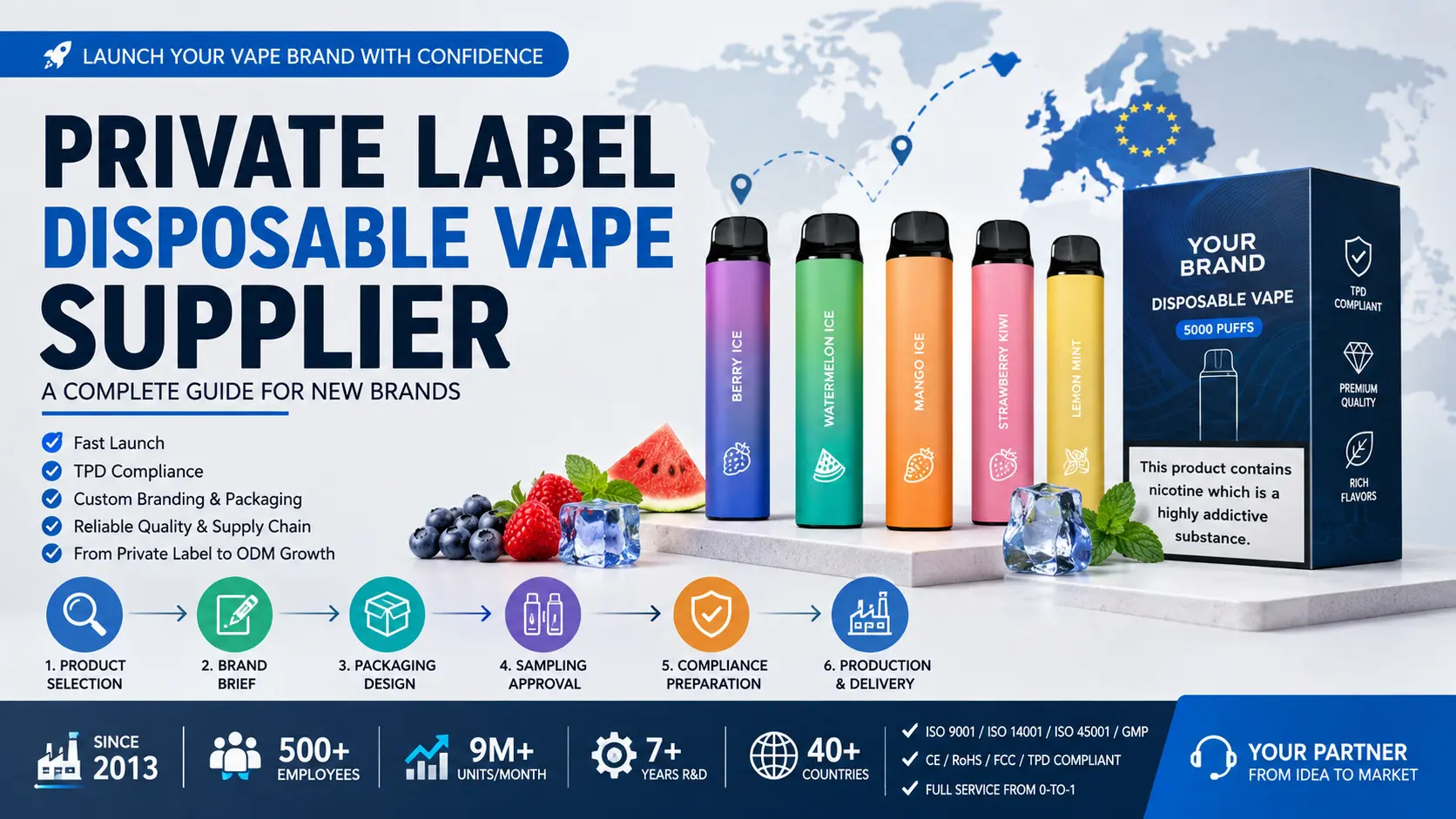
The typical process includes six stages: product selection, brand brief, packaging design, sampling, compliance preparation, production, and delivery. Each stage affects cost, timing, and launch readiness.
Stage 1: Product Selection
You start by choosing the product type. For Europe, this often means a TPD-compliant disposable vape with 2ml e-liquid capacity and nicotine strength aligned with local market requirements. For other regions, the options may include higher-capacity formats or larger puff-count devices.
A capable private label disposable vape supplier should not simply push the highest-margin device. The supplier should ask about your target country, retail channel, price point, customer profile, and expected order volume before recommending a product.
You can review available device platforms through the Vape ODM Factory product catalogue when comparing suitable formats for your first private label launch.
Stage 2: Brand Brief
Your brand brief defines the visual direction, target channel, flavor positioning, packaging style, and commercial goal. A discount-store product should not look the same as a premium tobacconist product. A petrol station range may need clearer flavor communication than a DTC-focused product.
This is where many new brands make mistakes. They choose colors and logos before defining the audience. A private label disposable vape supplier with brand experience should help you translate market positioning into product and packaging choices.
Stage 3: Packaging and Label Design
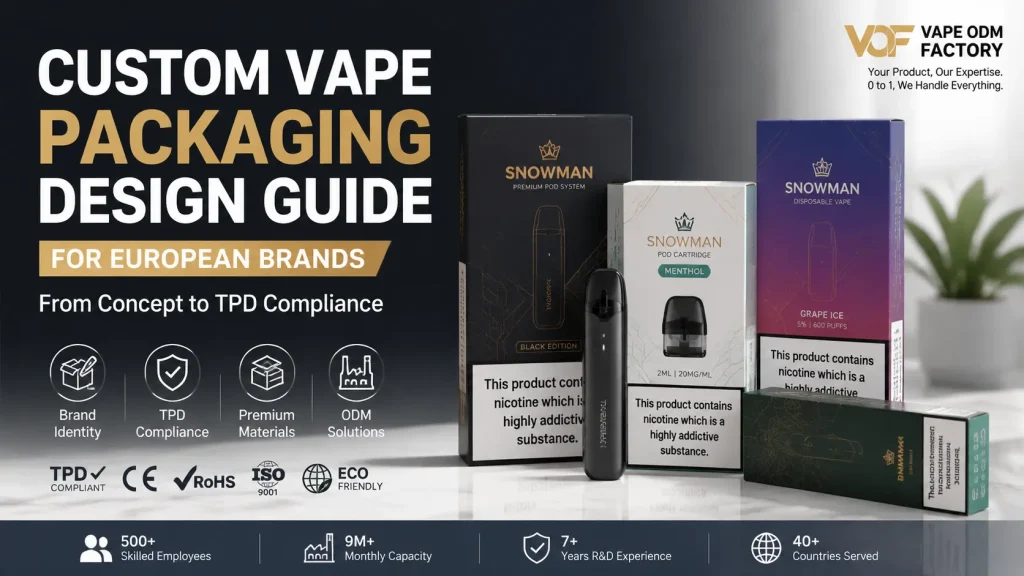
Packaging is not only a branding asset. In Europe, it is also a compliance surface. Warning placement, language, nicotine declaration, importer information, batch coding, recycling marks, and country-specific text must be considered before printing.
For EU launches, packaging review should happen before mass production. Reprinting packaging after a compliance issue is expensive and can delay the entire launch. The TPD compliant vape packaging guide explains the key label and warning requirements for European markets.
Stage 4: Sampling
Sampling lets you confirm flavor, draw resistance, mouthpiece feel, airflow, device color, logo placement, and packaging finish. A serious supplier should provide pre-production samples before you approve mass production.
For most projects, brands should test samples with internal decision-makers and selected channel partners. Do not approve production based only on photos or digital mockups. Physical product feel matters in disposable vape retail.
Stage 5: Compliance Preparation
European projects require early compliance planning. TPD notification, emissions testing, technical documentation, packaging checks, and EU-CEG submission timing should be clarified before mass production begins.
Vape ODM Factory’s 6S service system is built around this need. The team directly supports TPD compliance operations rather than only advising brands to arrange it separately.
Stage 6: Production and Delivery
Once samples, packaging, purchase order, and compliance route are confirmed, the factory schedules production. Delivery planning should include production lead time, inspection, export documents, freight method, customs clearance, and warehouse arrival date.
A reliable private label disposable vape supplier gives you a timeline by stage, not just a general promise. Ask for written dates for packaging confirmation, production start, inspection, shipping, and expected arrival.
How to Choose the Right Disposable Vape for Your Brand
Choosing the first product is more important than many new brands realize. The wrong product may look attractive in a catalogue but fail in your channel because the format, price point, or compliance setup does not match the market.
A private label disposable vape supplier should help you choose based on market fit, not only appearance. The right device depends on where you sell, how retailers price the product, and what regulatory limits apply.
For European Retail Channels
European brands should prioritize TPD-ready products, clear packaging compliance, stable batch documentation, and flavor ranges that can be notified correctly. A 2ml format is usually the starting point for EU markets.
If your channel includes convenience stores, tobacconists, or vape specialty shops, shelf clarity matters. Packaging should communicate flavor quickly, look professional in display units, and meet local language requirements.
For Distributor-Led Launches
Distributors usually need products that are easy to explain, easy to reorder, and suitable for multiple retailers. In this case, choose a mature platform with stable production history rather than an experimental design.
A private label disposable vape supplier should be able to provide reorder planning, flavor extension options, and batch traceability. This helps distributors maintain continuity when retailers place repeat orders.
For Brand-Led DTC or Social Commerce Models
Brands selling through direct channels often care more about visual identity, packaging design, and differentiation. Private label can still work, but you may need stronger design direction and a tighter flavor story.
This is where a brand should think beyond the first order. If the first range performs well, you may later move from private label to ODM for a more distinctive device shape, mouthpiece, or packaging system.
For Price-Sensitive Channels
If your sales channel is highly price-sensitive, do not over-customize the first launch. Complex packaging, too many flavors, or low-volume special finishes can raise unit cost before you have stable demand.
A good private label disposable vape supplier will help you keep the first product commercially realistic. The goal is not to create the most customized product on day one. The goal is to enter the market with a product your channel can sell repeatedly.
What Can You Customize With a Private Label Disposable Vape Supplier?
Customization is the main reason brands choose private label instead of simple wholesale. The level of customization depends on the device platform, MOQ, printing method, and packaging type.
A private label disposable vape supplier usually offers the following customization options:
- Brand logo on the device body
- Device color or surface finish
- Packaging artwork and box structure
- Flavor names and flavor portfolio
- Nicotine strength options where legally permitted
- Barcode, batch code, and importer information
- Display boxes for retail shelves
- Multilingual packaging for target markets
Device Branding
Device branding includes logo placement, color matching, surface finish, and sometimes small design accents. For a first launch, keep the device design clean and readable. Overcrowded printing often looks less professional.
Ask your supplier for real production samples, not only 3D mockups. Print color can look different on plastic, metal, or coated surfaces.
Packaging Customization
Packaging is where your brand identity becomes most visible. You can customize the outer box, inner tray, display carton, flavor icons, product claims, and retail coding.
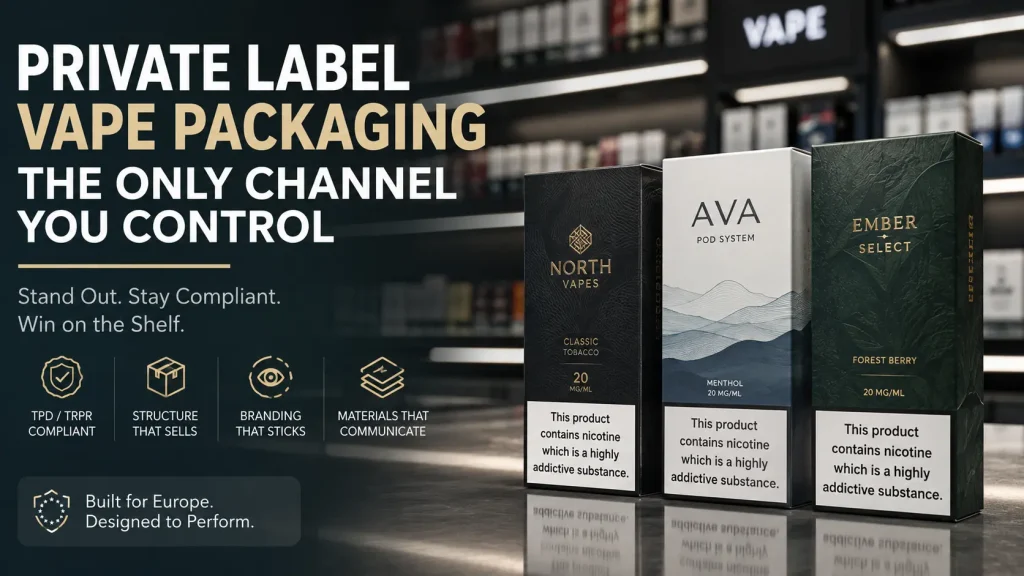
And because hardware across European brands increasingly converges on the same platforms, packaging is where real differentiation happens — our guide to private label vape packaging shows how to stand out on shelves within the rules.
For European launches, packaging design must balance brand appeal with regulatory requirements. Do not approve artwork until the compliance team checks warning placement, language, nicotine information, and importer details.
Flavor Portfolio
New brands often want to launch too many flavors. A focused first range is usually better. For example, 5–8 flavors can cover core demand without splitting MOQ across too many SKUs.
A practical starting mix may include fruit, mint, ice, and one or two distinctive signature options. Your private label disposable vape supplier should help you build a balanced portfolio rather than simply offering a long flavor list.
Nicotine Strength and Market Fit
Nicotine strength depends on local regulation and market expectations. In the EU, TPD limits nicotine-containing e-liquids to 20mg/ml. Other markets may have different limits.
Before confirming strength, ask your supplier which versions are supported by testing data and compliance documentation for your target market.
How Much Does It Cost to Start a Private Label Disposable Vape Brand?
Cost transparency is one of the biggest gaps in most supplier content. A private label disposable vape supplier may quote a low unit price, but your real launch budget includes samples, packaging, compliance, inventory, shipping, and sometimes retailer materials.
The numbers below are practical estimates. Actual costs vary by device type, order volume, packaging complexity, compliance scope, and shipping method.
| Cost Item | Typical Range | Notes |
|---|---|---|
| Sample development | €100–€500 | Will refundable against bulk order |
| Packaging design setup | Included or separate | Depends on artwork and structural needs |
| First inventory order | €10,000–€80,000+ | Depends on MOQ, SKU count, and unit cost |
| Compliance testing and documents | €2,000–€3,000+ | Higher for multiple flavors and markets |
| Packaging production | Included or separate | Depends on supplier quotation model |
| Freight and logistics | Varies widely | Air freight is faster; sea freight is lower cost |
| Retail display materials | €300–€2,000 | Useful for distributor and store launches |
For a small controlled launch, a brand may start with 50,000 units across 5 flavors. If the average landed cost is 1.50–2.50 per unit after packaging, compliance allocation, and freight, the working capital requirement can increase quickly.
This is why SKU planning matters. Ten flavors may look attractive, but if MOQ applies per flavor, your inventory cost doubles before you have sales data. Many new brands are better served by a focused launch, then expanding after reorder demand appears.
Ask your private label disposable vape supplier for a full quotation table, not a single unit price. The table should separate product cost, packaging cost, compliance cost, sample cost, freight estimate, payment terms, and reorder pricing.
What European Brands Need to Know About Compliance
Compliance is not an optional add-on for European vape brands. It is part of the product launch timeline. If you choose a private label disposable vape supplier without strong EU compliance experience, your launch may be delayed even if production is complete.
The EU Tobacco Products Directive sets requirements for nicotine-containing e-cigarette products, including notification obligations, volume limits, labeling, and information reporting. The official directive can be reviewed through EUR-Lex Directive 2014/40/EU.
TPD and EU-CEG Notification
For EU markets, products generally need to be notified through the EU-CEG system before they can be placed on the market. The notification timeline can involve a 6-month waiting period depending on the market and product category.
Ask your private label disposable vape supplier whether they only provide documents or directly support submission. This difference matters. A supplier that only gives you files may still leave you responsible for submission, follow-up, corrections, and local requirements.
Packaging Rules
Packaging must include required warnings, nicotine information, product details, and local language elements. Some countries have strict enforcement around display panels, wording, and importer identification.
Before printing, request a packaging compliance review. Once boxes are printed, every correction becomes a cost and timing issue.
Testing and Technical Files
Compliance support should include emissions testing, formulation information, product technical files, toxicology-related documentation where required, and batch traceability.
Ask who owns the documentation, who updates it when flavors change, and who pays for re-notification if the product range expands. These questions prevent confusion after the first launch.
Country-by-Country Planning
Europe is not one uniform retail market. A product prepared for one EU country may still need language, importer, or notification adjustments for another.
A reliable private label disposable vape supplier should help you map target countries before production, not after goods arrive at the warehouse.
The Biggest Mistakes New Vape Brands Make
Private label makes launching easier, but it does not remove the need for commercial discipline. Many new brands fail because they treat private label as a shortcut instead of a structured market entry strategy.
Mistake 1: Launching Too Many SKUs
A large flavor range looks impressive but creates inventory pressure. If you launch 12 flavors and only 4 sell quickly, your cash is tied up in slow-moving stock.
Start with a focused range, measure sales, then expand. A private label disposable vape supplier should help you plan reorder-friendly SKUs, not push maximum variety from day one.
Mistake 2: Choosing Price Over Reliability
The lowest quote can become expensive if it leads to inconsistent batches, slow communication, weak packaging support, or unclear compliance responsibility.
Compare total project value, not only unit cost. Ask about certifications, testing capability, monthly capacity, reorder lead time, and batch reports.
Mistake 3: Treating Packaging as Decoration Only
Packaging must sell, inform, and comply. A visually attractive box that fails warning label requirements can block market entry.
Always review packaging with compliance in mind. This is especially important for multilingual European launches.
Mistake 4: Ignoring the Growth Path
Private label is a strong starting point, but it may not provide enough differentiation forever. As competitors appear, your brand may need exclusive design, better device ergonomics, or proprietary product features.
Plan the first launch as stage one. Keep notes on retailer feedback, flavor performance, complaint patterns, and reorder timing so you can brief an ODM project later.
Mistake 5: Not Asking Who Handles Compliance
Many brands assume the supplier handles everything because the supplier says the product is “TPD-ready.” That phrase can mean different things.
Ask whether the private label disposable vape supplier handles testing, document preparation, EU-CEG submission, packaging review, and updates after product changes. Get the answer in writing.
How to Choose a Reliable Private Label Disposable Vape Supplier
The right private label disposable vape supplier should be more than a catalogue seller. Your supplier should act like a launch partner across product selection, compliance, packaging, quality control, and repeat production.
Use the following checklist when comparing suppliers:
- Factory established history and export experience
- Production capacity that matches your order plan
- ISO 9001 or equivalent quality management certification
- In-house testing capability or verified laboratory process
- TPD, CE, RoHS, and FCC documentation support
- Clear MOQ, pricing, and lead-time structure
- Packaging compliance review for target markets
- Batch traceability and inspection reports
- Responsive English-speaking project management
- Ability to support future ODM development
Vape ODM Factory is based in Dongguan and has operated since 2013, with 500+ employees, 9 million units monthly capacity, 7+ years of R&D experience, and service coverage across 40+ countries. The company supports ISO 9001, ISO 14001, ISO 45001, GMP management systems, and product compliance pathways including CE, RoHS, FCC, and TPD.
These credentials matter because private label projects can become complex quickly. A simple first order may later require flavor expansion, new packaging language versions, market-specific compliance updates, or a transition into ODM.
You can learn more about the company background on the Vape ODM Factory about page before comparing supplier qualifications.
Private Label Disposable Vape Supplier Checklist for New Brands
Before signing with any private label disposable vape supplier, ask questions that reveal how the company will actually support your launch. Do not rely only on product photos or price lists.
Product Questions
- Which device platforms are suitable for my target market?
- What is the production history of this device?
- What flavors are already validated for this platform?
- What nicotine strengths are supported for my region?
- Can I receive physical samples before bulk order approval?
Compliance Questions
- Do you support TPD and EU-CEG submission directly?
- Who owns the testing reports and technical files?
- Can you review packaging before printing?
- What happens if we add new flavors later?
- Which countries have you supported for similar products?
Commercial Questions
- What is the MOQ per SKU and per flavor?
- What is the reorder MOQ?
- What costs are separate from the unit price?
- How long is the quotation valid?
- What are the payment terms?
Production Questions
- What is the production lead time after packaging approval?
- What inspection process is used before shipment?
- Can you provide batch reports?
- What is the current monthly production capacity?
- How do you handle urgent reorder demand?
Growth Questions
- Can this product line expand into more flavors?
- Can we move from private label to ODM later?
- Can you support exclusive molds in the future?
- What development timeline applies to custom ODM products?
- How do you protect brand confidentiality?
These questions help you compare suppliers by capability, not only by price. A private label disposable vape supplier that answers clearly, with documents and timelines, is usually a stronger partner than one that only offers fast quotes.
From Private Label to Long-Term Brand Growth
Private label is often the fastest entry point, but strong brands do not stop at entry. They use the first launch to learn which flavors sell, which channels reorder, which price point works, and what customers expect from the next generation.
A practical brand growth path looks like this:
- 1.Start with private label disposable vape products to test market demand.
- 2.Build a focused flavor and packaging identity.
- 3.Use sales data to identify winning SKUs.
- 4.Move into customized ODM when differentiation becomes important.
- 5.Develop proprietary product structures for long-term brand value.
This path prevents overinvestment at the wrong stage. You do not need an exclusive mold before proving demand. You do need a supplier that can grow with you when your brand is ready for deeper customization.
The vape OEM ODM manufacturer comparison guide explains how private label, ODM, and OEM differ when your brand moves beyond its first launch.
A private label disposable vape supplier with ODM capability gives you a smoother growth path. You can begin with existing platforms, then develop exclusive designs, proprietary packaging, and market-specific product lines without changing your entire supply chain.
Final Thoughts: Is Private Label Right for Your Brand?
Private label is right for your brand if you want to enter the market quickly, test demand, control your brand presentation, and avoid the cost of building a product from zero. It is especially useful when your team already has distribution access but needs a reliable manufacturing and compliance partner.
It may not be the right model if your brand already requires a proprietary device shape, exclusive internal structure, or unique technical platform from day one. In that case, ODM may be a better starting point.
The best approach is to treat private label as the first step in a brand roadmap. Start focused, launch with compliant products, collect sales feedback, and then expand into deeper customization when the market proves demand.
If you are comparing a private label disposable vape supplier for a European launch, Vape ODM Factory can support product selection, packaging, production, and direct TPD compliance operations through its 0-to-1 service model. To discuss your project requirements, contact the team through the Vape ODM Factory contact page.