Most vape brands that end up with the wrong ODM partner didn’t fail because they asked bad questions. They failed because they didn’t ask enough of the right ones — or didn’t know what a strong answer was supposed to sound like.
Knowing what to ask vape ODM manufacturers separates brands that launch on schedule with compliant, exclusive products from brands that spend months fixing avoidable problems. This guide covers the questions that matter, why each one matters, and what separates a credible answer from a red flag.
Why These Questions Matter Before You Start
By the time a brand reaches out to an ODM factory, the core decision — to go to market with a custom product — is already made. The questions at this stage aren’t exploratory. They’re filters.
Every question below is designed to surface a specific risk: fake ODM capability, weak compliance infrastructure, mold ownership traps, or production instability. Skipping these questions doesn’t speed up the process. It front-loads problems that will surface later at significantly higher cost.
For European brands specifically, the stakes are higher than most markets. TPD notification has a statutory 6-month lead requirement. Packaging must meet multilingual health warning specifications. A compliance failure discovered after production is a serious commercial problem — not a minor delay.
Questions About Product Development Capability
This is where many brands get misled. A large number of factories describe themselves as ODM partners while offering nothing more than a catalog of existing devices with logo placement options. Knowing what to ask vape ODM factories about their actual R&D capability is the first filter.
Do you provide true ODM or catalog customization?
A genuine ODM manufacturer starts every project with an industrial design brief — concept sketches, structural engineering proposals, and a product development process tied to your market requirements. A catalog supplier starts by sending a PDF of existing SKUs and asking you to choose.
Ask directly: “Can you show me three products your R&D team developed from scratch for clients, with the brief, the design process, and the final device?” A real ODM partner can answer this with specifics. A catalog supplier cannot.
Can I request exclusive private molds?
Exclusivity in ODM comes from private tooling. Your mold is assigned to your brand in your territory — no other brand’s production runs on your tooling. Ask: “Is the mold exclusively mine for my market, and is that documented in the contract with geographic scope and breach terms?”
Weak answer: “We don’t sell to your direct competitors.”
Strong answer: “Your mold is registered to your brand for [specific countries], with a minimum three-year exclusivity term and documented breach penalties.”
How many sample revisions are included?
Sample development rarely lands perfectly on the first iteration. Ask how many revision rounds are included before additional costs apply, what the revision process looks like, and typical mold-to-approved-sample timeline. A factory with genuine ODM experience will quote approximately 35 days from tooling start to finalized samples — and will include 2–3 revision cycles as standard.
Questions About Compliance Support
Compliance is the section where most ODM content underdelivers. Most articles write “ask if they support TPD” without explaining what a complete answer looks like. For European brands, this module is decisive.
Who files the TPD notification — you or us?
There is a significant operational difference between a factory that says “we can provide documentation support” and one that files EU-CEG notifications directly on the brand’s behalf as an executed service.
Ask specifically: “Does your team submit EU-CEG notifications for our products directly, or do you hand us a document package to file ourselves?” For brands without in-house regulatory staff, only the first answer removes the compliance bottleneck. Vape ODM Factory’s 6S service system handles TPD submissions directly — the brand does not need a separate compliance consultant.
Who owns the testing reports and regulatory files?
After the initial launch, the brand may want to update flavors, change nicotine concentrations, or enter new EU markets. Every change may trigger a new notification. Ask: “If we update a flavor or change a formulation, who owns the existing compliance data, and who is responsible for re-notification?”
Weak answer: “We’ll handle that when it comes up.”
Strong answer: “The emissions test data is shared with you in the technical file. Flavor updates trigger a new EU-CEG notification, which we file within [X days] at [quoted cost].”
Can packaging be reviewed for EU compliance before print?
TPD Article 13 requires health warnings to cover at least 30% of both principal display panels, in the language(s) of the target market. CLP hazard labeling applies to refill containers. Child-resistant packaging is mandatory.
Ask if the factory provides pre-print packaging compliance review as part of the service. If they do, confirm which specific standards they check against and whether they flag country-specific requirements — for example, France and Germany have distinct labeling enforcement patterns.
For a detailed breakdown of what EU-compliant vape packaging must include, the TPD compliant vape packaging guide covers health warning dimensions, language requirements, and CLP labeling specifications.
Questions About MOQ, Pricing, and Cost Structure
Cost questions are straightforward to ask but easy to misread. The goal is not to find the lowest number — it is to understand the full cost structure before committing.
What is the minimum order quantity, and what drives it?
MOQs in vape ODM vary by product type. A rechargeable pod system typically has a higher MOQ than a simple disposable due to production line setup costs. Ask for MOQ by SKU, by flavor variant, and for reorders after the first batch. A typical production run for a European market launch sits between 50,000–200,000 units.
Are tooling costs separate from unit pricing?
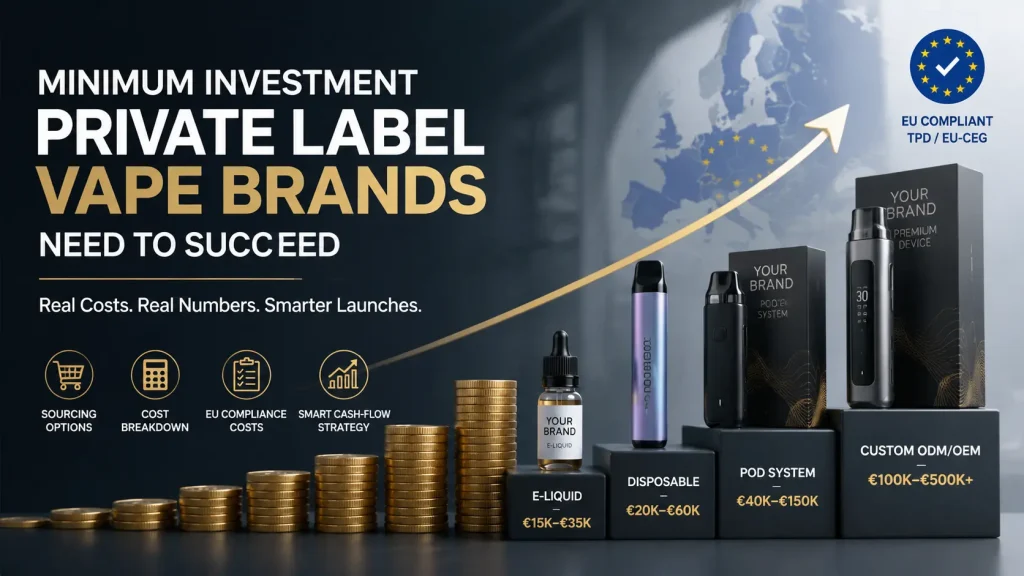
Mold and tooling development is almost always quoted separately from per-unit production cost. A simple pod device typically runs 8,000–15,000 in tooling. A multi-component system runs15,000–35,000. These are one-time costs — subsequent orders run on the same tooling at the production unit rate.
Ask for a full cost breakdown: tooling, unit cost, packaging, flavor development, compliance, and logistics. Hidden cost additions after contract signing are a common friction point.
What factors can change the unit price after the initial quote?
Commodity prices, component availability, and shipping conditions can affect final unit cost. Ask what the price lock mechanism is — how long the quoted price holds, under what conditions it can be revised, and what the communication process is if changes occur mid-production.
Questions About Timeline and Delivery
Timeline questions are often asked vaguely — “how long does it take?” — and answered vaguely. Ask in phases.
What is the sample and tooling lead time?
From tooling start to approved samples is approximately 35 days with a capable ODM partner. E-liquid flavor tuning runs in parallel with this phase, completing within the same window. Ask for the specific timeline per phase: concept approval to tooling start, tooling start to first sample, first sample to final approved sample.
When should compliance testing begin relative to production?
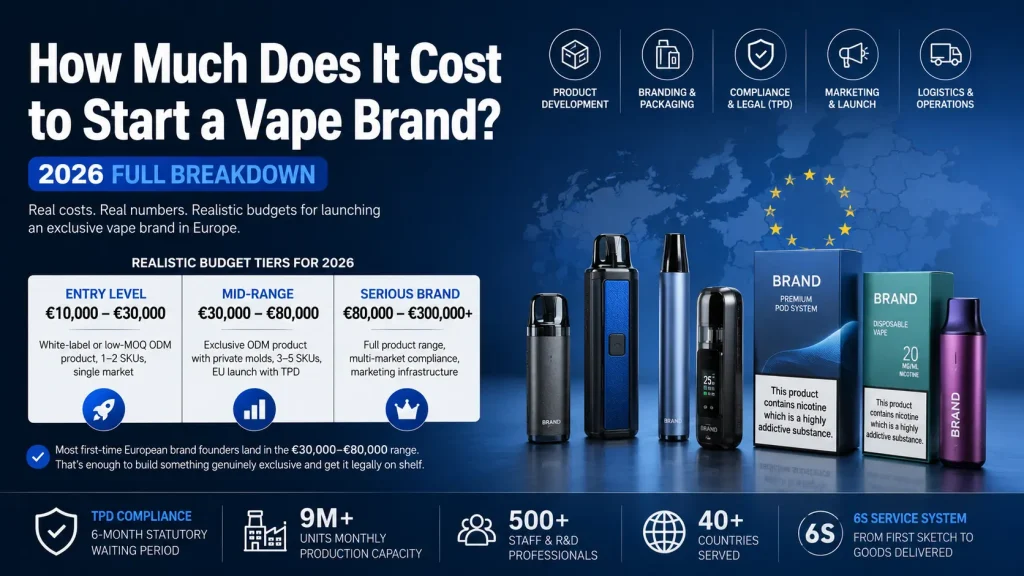
This is the question most brands don’t ask — and the one that causes the most expensive delays. TPD notification requires a statutory 6-month waiting period per EU member state from submission date. If compliance testing starts after production completes, the brand will have finished goods they cannot legally sell.
Ask specifically: “At what stage of development do you begin compliance documentation and testing, and how do you run this in parallel with mold development?”
What is your production capacity, and how does it affect our lead time?
A factory producing 9 million units per month can fulfill an order of 50,000–200,000 units in 2–3 weeks. A smaller operation may require 6–8 weeks for the same volume. Ask for current capacity utilization and confirmed production scheduling before contract signing.
Questions About Quality Control
What QC system is used during production?
Ask for the specific QC methodology: inline inspection frequency, AQL sampling standard, and who conducts final batch inspection. ISO 9001 certification is a baseline indicator. Ask whether the factory operates a national-standard testing laboratory in-house or sends samples to third parties for every test.
Can you share defect benchmarks and batch reports?
A credible factory can quote its current defect rate and provide sample batch inspection reports from past production runs. Ask: “What is your typical defect rate on [product type], and what is the process when a batch fails inspection?” Factories that deflect this question with general assurances rather than documented figures are a signal worth noting.
Questions About Mold Ownership and IP Protection
This is the module most brands skip — and the one that creates the most significant long-term exposure.
Who owns the mold after development?
In most ODM arrangements, the brand pays for tooling and holds a usage right tied to their exclusivity agreement. Some factories retain physical custody of the mold. Ask: “If I move production to a different factory, can I take the mold, and what is the process for doing so?”
Without a clear answer and documented terms, a brand can find itself locked into a factory relationship by virtue of the tooling — unable to switch suppliers without rebuilding the tooling from scratch.
Is exclusivity territory-based, and how is it enforced?
Ask for the specific exclusivity terms in writing: which countries are covered, for how long, and what the penalty is for breach. “We won’t sell your design to competitors” is not a contractual protection. A written territorial exclusivity clause with specific penalties is.
For a full overview of what genuine ODM exclusivity entails versus white-label arrangements, the vape OEM ODM manufacturer comparison guide covers the difference in detail.
Red Flags: What to Ask Vape ODM Partners — and What Bad Answers Look Like
Knowing what to ask vape ODM factories only matters if you can recognize a weak answer when you hear one. These are the responses that should give you pause:
- “We’ll discuss compliance later” — Compliance must start in parallel with development. A factory that defers this has either limited compliance infrastructure or is hoping you won’t push on it.
- “Our MOQ depends” — without a number tied to your specific product type, this is not an answer.
- “Tooling ownership is internal” — ownership terms must be explicit and documented. “Internal” is not a contractual position.
- “We can do TPD” — ask what “can do” means operationally. Saying yes is different from having a team that files EU-CEG notifications directly.
- “Here’s our catalog — what do you like?” — this is a white-label supplier, not an ODM partner, regardless of how they describe themselves.
Pre-Meeting Checklist: What to Ask Vape ODM Partners by Stage
Organizing questions by stage makes the evaluation process systematic rather than reactive.
Initial screening (before you share your brief):
- Do you develop products from scratch or from existing catalog SKUs?
- Can you provide three client examples with documented development processes?
- What certifications does your facility hold? (ISO 9001, GMP, CE capability)
- Do you file TPD notifications directly or provide documentation support only?
Sampling stage (after concept approval):
- What is the tooling timeline and revision count included?
- At what stage does compliance testing begin?
- Who owns the mold, and what are the exclusivity terms?
Pre-production (before final PO):
- What is the confirmed production schedule and capacity allocation?
- What is the full cost breakdown including tooling, compliance, and packaging?
- What are the batch inspection and defect rate benchmarks?
Launch preparation:
- Has TPD notification been submitted, and what is the submission date per target market?
- Has packaging been reviewed against TPD Article 13 requirements for each launch country?
- What is the reorder process, and how are flavor or formulation updates handled?
To review the range of product categories available for ODM development — including rechargeable pod systems and closed-pod configurations built for European TPD compliance — the Vape ODM Factory product catalogue covers current platform options.
The Right Questions Build the Right Partnership
Knowing what to ask vape ODM partners is not a procedural exercise. Each question in this framework is designed to surface a specific risk before it becomes a production, compliance, or commercial problem. The questions that feel inconvenient to ask — about mold ownership, about who files TPD, about what exclusivity actually means contractually — are precisely the ones that distinguish a reliable ODM partner from one that will create problems twelve weeks into your launch timeline.
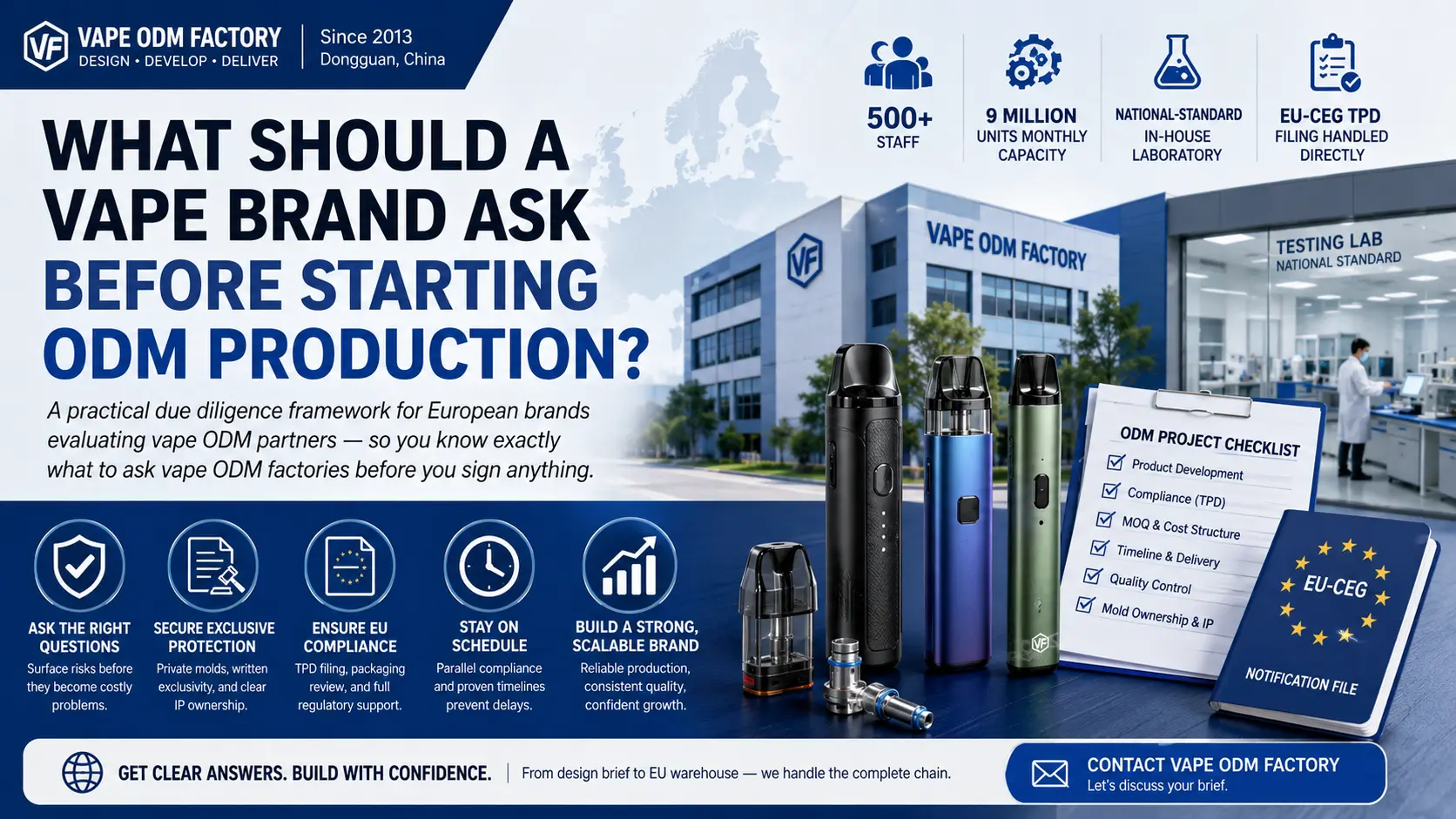
Vape ODM Factory has operated from Dongguan since 2013, with 500+ staff, 9 million units monthly production capacity, and a national-standard in-house laboratory. Every project covers the complete chain from design brief through EU-CEG TPD filing — handled directly by the team, not delegated to the brand. To discuss your brief and get specific answers to the questions in this guide, contact Vape ODM Factory directly.