Starting a private label vape brand sounds straightforward — pick a product, slap on a logo, and sell. But most new brands fail within the first year, not because the market is too competitive, but because they skipped the fundamentals.
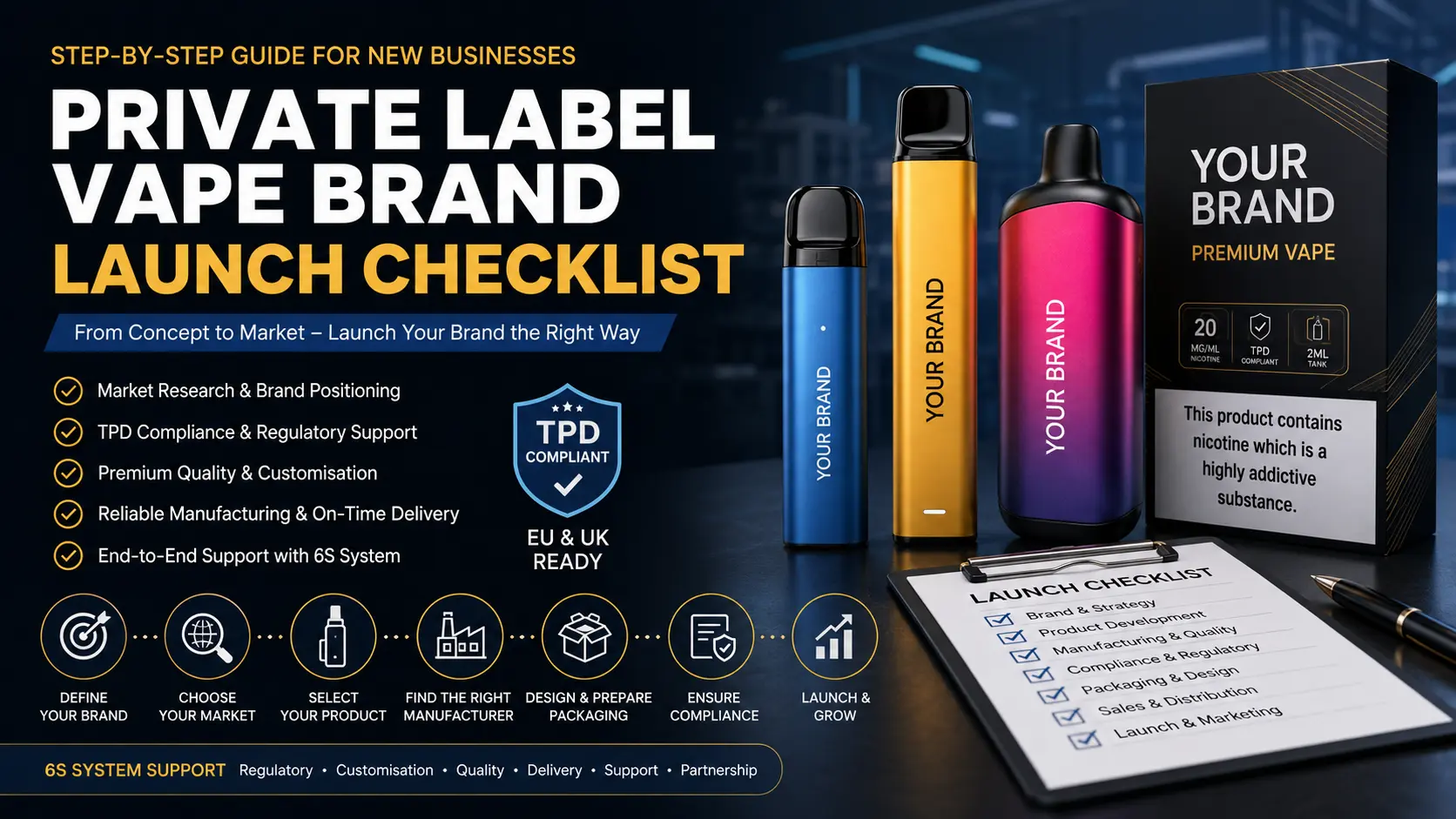
This checklist covers every step you need to launch a private label vape brand the right way — from brand positioning and product selection to compliance, packaging, and your first sales channel. Whether you’re entering the EU, UK, or Middle East market, this guide gives you a real execution roadmap, not just theory.
What Is a Private Label Vape Brand?
Before diving into the checklist, it’s worth clarifying the terminology — because a lot of new entrants confuse these four models:
| Model | What It Means | Your Control Level |
|---|---|---|
| White Label | Pre-made product, your logo only | Low |
| Private Label | Existing base product, customised branding + minor spec changes | Medium |
| OEM | You provide the design, factory manufactures | High |
| ODM | Factory designs + manufactures, you brand it | Medium–High |
For most new businesses, private label is the fastest entry point. You’re not building from scratch, but you’re not selling a generic product either. You get speed, cost efficiency, and enough customisation to build a real brand identity.
Step 1 — Define Your Private Label Vape Brand Positioning
This is the step most people skip — and it’s why most brands look identical.
Before you choose a product or contact a factory, answer these four questions:
- Who is your target customer? (Age group, lifestyle, price sensitivity)
- What market are you entering? (EU, UK, Middle East, Southeast Asia)
- What price tier are you targeting? (Budget, mid-range, premium)
- What’s your brand personality? (Bold, minimal, lifestyle-driven, clinical)
Your answers will directly determine your product specs, packaging direction, and marketing tone. A premium EU brand targeting adult smokers switching from cigarettes needs a completely different approach than a budget disposable brand targeting convenience stores in Eastern Europe.
Step 2 — Choose Your Target Market Before Product Development
Market selection isn’t a marketing decision — it’s a compliance and product decision. Different markets have completely different rules.
| Market | Key Regulation | Nicotine Limit | Difficulty |
|---|---|---|---|
| EU | TPD (Tobacco Products Directive) | 20mg/ml | High |
| UK | TRPR (post-Brexit TPD equivalent) | 20mg/ml | Medium–High |
| Middle East | Varies by country | Varies | Medium |
| USA | FDA PMTA required | No federal limit | Very High |
| Africa / Southeast Asia | Minimal regulation | Varies | Low–Medium |
If you’re targeting Europe, TPD compliance is non-negotiable. That means 2ml tank limits, 10ml e-liquid bottle limits, nicotine capped at 20mg/ml, and mandatory health warnings in the local language of each country you sell in.
Choosing your market first saves you from building a product that can’t legally be sold where you want to sell it.
Step 3 — Select the Right Vape Product Strategy
Not all vape products are equal from a launch perspective. Here’s how the main categories compare for new private label brands:
| Product Type | Launch Speed | MOQ | Compliance Complexity | Best For |
|---|---|---|---|---|
| Disposable (TPD) | Fast | Low–Medium | Medium | EU/UK entry |
| Pod System | Medium | Medium | Medium–High | Brand building |
| Refillable Device | Slow | High | High | Premium positioning |
| E-liquid Only | Fast | Low | Medium | Existing device users |
For most new private label brands entering Europe, TPD-compliant disposables or pod systems offer the best balance of speed, cost, and market fit.
Key product decisions to lock in at this stage:
- Puff count (<1000 for TPD-compliant EU market)
- Nicotine strength (typically 10mg or 20mg for EU)
- Flavour direction (tobacco, menthol, fruit — check local flavour restrictions)
- Battery capacity and charging type
- Device size and form factor
Step 4 — Find a Reliable Private Label Vape Manufacturer
This is the most critical decision you’ll make. The wrong factory will cost you time, money, and your brand reputation.
What to Look for in a Private Label Vape Factory
- Compliance capability: Can they handle TPD registration directly, or do they just “advise” you?
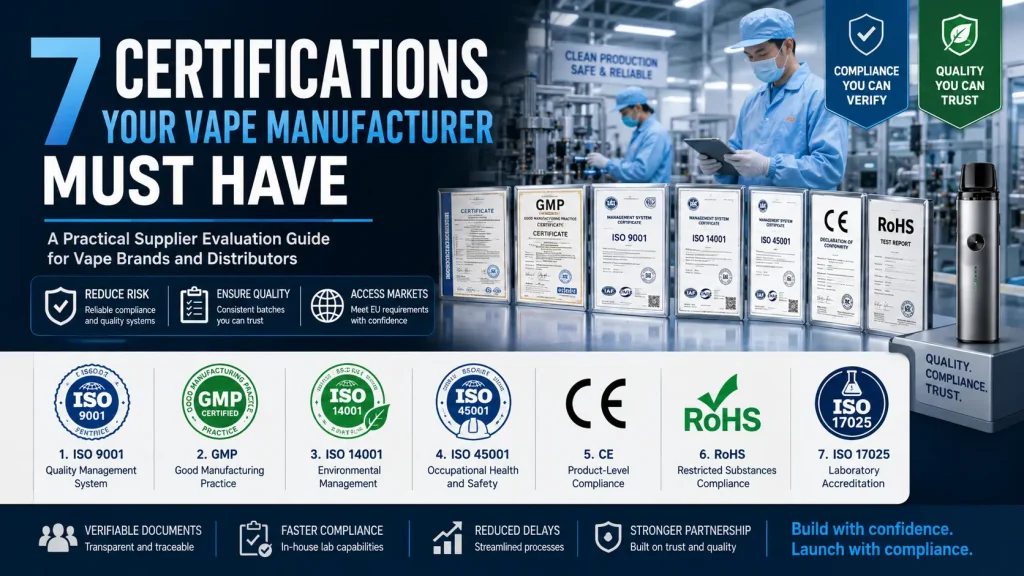
- Certifications: ISO 9001, ISO 14001, ISO 45001, GMP, CE, RoHS — these aren’t optional for EU market
- MOQ flexibility: Can they work with your launch volume, or do they push you into 50,000+ units?
- In-house R&D: Do they have their own lab and development team, or are they just a trading company?
- QC process: What’s their defect rate? Do they have a national-standard testing lab?
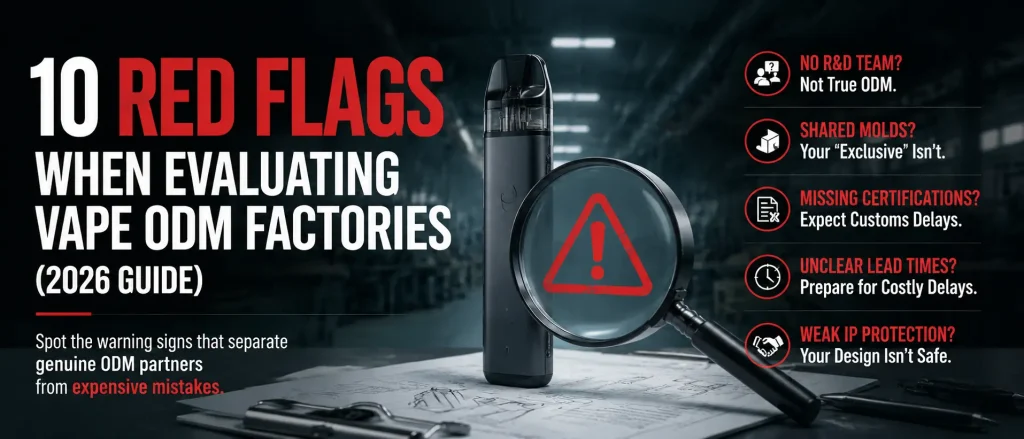
Red Flags to Avoid
- No certifications but claims “full compliance”
- Can’t provide test reports on request
- Pushes you to order before sampling
- No dedicated account manager or support structure
- Vague answers about TPD registration process
A factory like Vape ODM Factory — with 500+ staff, 9M+ monthly production capacity, and direct TPD filing support — is the kind of partner that removes the compliance burden entirely. You focus on brand and sales; they handle the rest.
Explore the full product catalogue to understand what’s available for private label customisation.
Step 5 — Prepare Branding and Packaging for Your Private Label Vape
Branding is more than a logo. For a vape brand, your packaging is also a compliance document.
It is also the only advertising channel European law still allows — our guide to private label vape packaging explains how brands turn the box into the core of the go-to-market plan.
Brand Identity Checklist
- Brand name (check trademark availability in your target market)
- Logo (vector format, works at small sizes on device and packaging)
- Colour palette and typography
- Brand tone of voice
Packaging Compliance Requirements (EU/UK)
- Health warning: minimum 30% of two largest surfaces
- Nicotine content clearly stated
- Ingredients list
- Batch number and manufacturer details
- Multilingual labelling if selling across multiple EU countries
- Child-resistant and tamper-evident packaging
Most new brands underestimate packaging lead time. Budget 3–4 weeks for design approval and 2–3 weeks for print production. Rushing packaging is one of the most common reasons launch timelines slip.
Step 6 — Calculate Your Private Label Vape Startup Budget
Budget planning is where most new brands either over-commit or get caught off guard. Here’s a realistic breakdown.
Tooling & Mould Cost (Private Mould)
If you want a truly unique product — your own device shape, custom mouthpiece, or exclusive hardware design — you’ll need a private mould. This is a one-time tooling investment that gives you a product no competitor can copy.
Private mould costs typically range from €5,000 to €20,000, depending on:
- Product complexity (simple disposable vs. pod system with multiple components)
- Number of mould cavities
- Material requirements
- Level of structural customisation
There are three standard arrangements for mould cost — each with a different deposit structure:
| Mould Cost Model | Who Pays for Mould | Deposit Required | MOQ Implication |
|---|---|---|---|
| Brand pays in full | Brand covers 100% of tooling | 10% of production order | Lower MOQ acceptable |
| 50/50 split with factory | Shared equally | 50% of mould cost + 10% of production order | Medium MOQ required |
| Factory absorbs cost | Factory covers 100% of tooling | 30% of production order | Higher MOQ commitment needed |
The 50/50 split is the most common arrangement for new brands. You share the tooling risk with the factory, and your upfront deposit is manageable — half the mould cost plus 10% of the production order value.
If the factory absorbs the full mould cost, expect a higher MOQ — they’re recovering that investment through volume. Your deposit in this case is 30% of the production order, with no separate mould payment.
Which model makes sense depends on your launch budget and how confident you are in initial sell-through. Discuss this directly with your factory before committing — most will be open to negotiation on the structure.
Full Launch Budget Breakdown
Beyond tooling, here’s what a realistic first launch costs:
| Cost Item | Estimated Range | Notes |
|---|---|---|
| Private Mould (if applicable) | €5,000–€20,000 | One-time, product-dependent |
| Product Sampling | €200–€800 | 3–5 rounds typical |
| Packaging Design | €500–€2,000 | Freelancer vs. agency |
| Packaging Print (MOQ) | €800–€3,000 | Quantity and complexity dependent |
| TPD Registration | €300–€1,500 per SKU | Per flavour/variant for EU/UK |
| MOQ Production | €3,000–€15,000 | Varies by product type and volume |
| Logistics & Customs | €500–€2,000 | First shipment estimate |
| Marketing (launch phase) | €1,000–€5,000 | Social, samples, distributor outreach |
If you’re using an existing platform product (no private mould), your total launch budget can be significantly lower. Private mould is an investment in long-term brand differentiation — it makes sense once you’ve validated your market.
Starting with 2–3 SKUs, a shared or factory-funded mould arrangement, and a lean marketing budget is a sensible way to enter the market without overexposing your capital on day one.
Step 7 — Handle Compliance Before You Launch
Compliance is not a post-launch task. It’s a pre-launch requirement — especially for the EU and UK.
TPD Compliance Checklist (EU/UK)
- Submit product notification to MHRA (UK) or relevant EU member state authority
- Confirm nicotine concentration ≤ 20mg/ml
- Confirm e-liquid volume ≤ 10ml per bottle
- Confirm tank/cartridge capacity ≤ 2ml
- Ensure child-resistant packaging
- Include all required health warnings
- Confirm no prohibited ingredients (vitamins, caffeine, taurine, colourants)
TPD notification typically takes 6 months to process in the EU. You cannot legally sell notified products until the waiting period has passed. Plan this into your timeline — not as an afterthought.
For the full official TPD requirements, refer to the EU Tobacco Products Directive.
The 6S system at Vape ODM Factory includes direct TPD filing support — meaning the factory handles the submission process on your behalf, not just advises you on it.
Step 8 — Build Your Sales and Distribution Channels
You can have the best private label vape product in the market and still fail if you don’t have a clear path to the customer.
Channel Options for New Vape Brands
Direct-to-Consumer (D2C)
- Your own e-commerce website
- Age verification required
- Higher margin, slower to scale
Wholesale / Distributor
- Approach regional vape distributors
- Lower margin, faster volume
- Requires minimum stock commitment
Retail (Vape Shops / Convenience)
- Physical placement in stores
- Requires strong packaging and brand recognition
- Often needs a local distributor as intermediary
B2B / White Label Resellers
- Sell your private label product to other businesses
- Works well if you have strong compliance documentation
Most new brands try to do all four at once. Pick one primary channel for launch, execute it well, then expand.
Step 9 — Follow a Realistic Vape Brand Launch Timeline
Here’s a 90–105 day launch roadmap that reflects how the process actually works — not how you wish it worked.
| Week | Action |
|---|---|
| 1–2 | Brand positioning, market selection, product strategy |
| 2–3 | Factory shortlisting, RFQ submission, initial contact |
| 3–4 | Sample request, sample review, spec finalisation |
| 4–5 | Packaging design, compliance label review |
| 5 | Mould deposit paid — 50% of mould cost + 10% of production order (50/50 split), or 30% of production order (factory-funded mould) |
| 5–10 | Mould development & adjustment — approx. 35 days; TPD notification submission (EU/UK) |
| 10–11 | Mould sample review & sign-off; production order confirmed, packaging print; production deposit settled |
| 11–12 | Production, QC inspection |
| 12–13 | Balance payment, shipment, customs clearance |
| 13–14 | Warehouse receipt, sales channel setup |
| 14+ | Launch, marketing activation |
Note: TPD notification adds a mandatory 6-month waiting period for EU sales. Plan your EU launch timeline accordingly — the 90–105 day roadmap above gets you to production-ready; EU market entry requires the additional compliance window.
Common Mistakes New Private Label Vape Brands Make
These are the patterns that consistently derail new brand launches:
1. Choosing the cheapest factory Low price usually means no compliance support, inconsistent QC, and no accountability when things go wrong. The cost of a product recall or a failed TPD submission far exceeds any savings on unit price.
2. Launching with too many SKUs New brands often want 10 flavours and 3 nicotine strengths from day one. This multiplies your MOQ cost, compliance cost, and inventory risk. Start with 2–3 SKUs.
3. Treating compliance as optional Selling non-compliant products in the EU or UK isn’t a grey area — it’s illegal. Customs seizures, retailer refusals, and regulatory fines are real consequences.
4. Weak packaging In a retail environment, your packaging competes with dozens of other brands on the same shelf. Generic packaging with a logo slapped on it won’t convert.
5. No clear distribution plan Having stock in a warehouse with no confirmed buyers is a cash flow crisis waiting to happen. Lock in at least one distribution channel before you place your production order.
6. Ignoring post-launch support What happens when a batch has a defect? What’s your factory’s response time? What’s the warranty process? These questions matter more after launch than before.
The Complete Private Label Vape Brand Launch Checklist
Use this as your master reference before, during, and after launch:
Brand & Strategy
- Target market defined
- Customer profile documented
- Price positioning confirmed
- Brand name checked for trademark conflicts
- Brand identity (logo, colours, tone) completed
Product
- Product type selected (disposable / pod / e-liquid)
- Nicotine strength confirmed for target market
- Flavour range finalised (2–3 for launch)
- Samples ordered and approved
- Spec sheet signed off
Manufacturing
- Factory evaluated (certifications, QC, compliance capability)
- MOQ confirmed and budgeted
- Production timeline agreed
- QC inspection process confirmed
- Packaging print files submitted
Compliance
- TPD notification submitted (EU/UK)
- CE / RoHS documentation obtained
- Health warnings on packaging verified
- Multilingual labelling confirmed (if multi-country)
- Age verification process in place (for D2C)
Sales & Distribution
- Primary sales channel confirmed
- Distributor or retail partner identified
- Website / online store live (if D2C)
- Launch stock quantity confirmed
- Reorder lead time documented
How Vape ODM Factory’s 6S System Supports Your Private Label Vape Brand
Most factories will manufacture your product. Fewer will help you launch it properly.
The 6S system at Vape ODM Factory is built specifically for brands that want to go from zero to market-ready without managing six different suppliers and consultants.
| 6S Pillar | What It Covers |
|---|---|
| Regulatory | Direct TPD filing, CE/RoHS documentation, compliance support |
| Customisation | Full ODM capability — hardware, flavour, packaging, branding |
| Quality | ISO 9001/14001/45001, GMP, national-standard lab testing |
| Delivery | 9M+ monthly capacity, reliable production scheduling |
| Support | Dedicated account management, post-launch QC support |
| Partnership | Long-term brand growth focus, not just transactional orders |
The core idea is simple: you handle brand and sales. Vape ODM Factory handles everything else.
If you’re ready to start, contact the team to discuss your product requirements and get a tailored RFQ.
Learn more about the company — including production capacity, certifications, and the markets they serve.
Ready to Launch Your Private Label Vape Brand?
The brands that succeed in this market share a few common traits: they start focused, they take compliance seriously from day one, and they choose manufacturing partners who understand the full launch process — not just production.
A well-executed private label vape brand launch doesn’t require a massive budget or years of industry experience. It requires the right checklist, the right factory, and the discipline to follow the process in the right sequence.
Start with 2–3 SKUs. Get your compliance in order before you order stock. Build a brand that can scale — not just a product that ships.