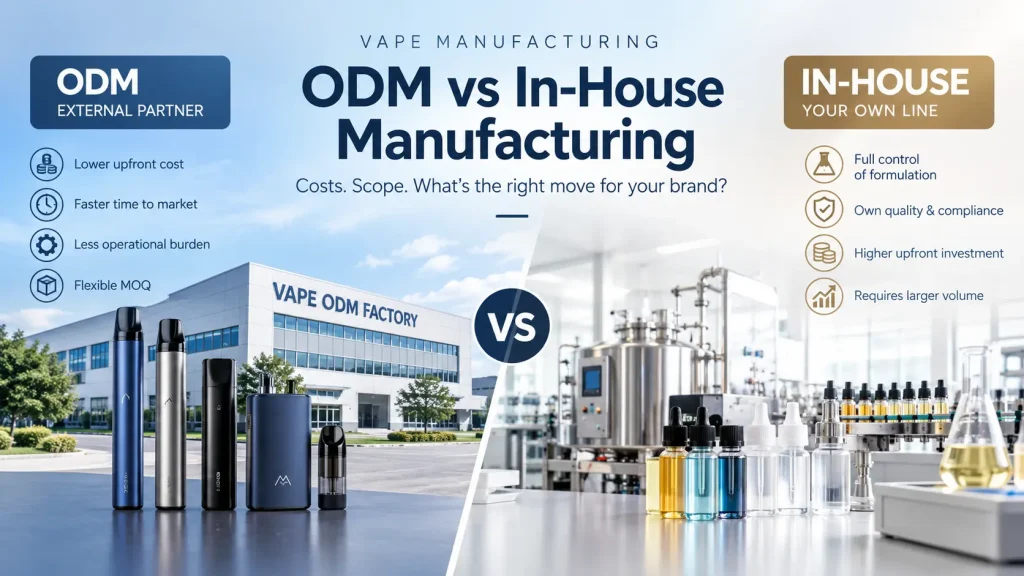
When evaluating a vape OEM ODM manufacturer, most brands hit the same wall: the terminology sounds clear until you realize two factories using the same words can offer completely different things. One factory’s “ODM” is a genuine from-scratch product development service. Another’s is a catalog with a logo placement option. One factory’s “OEM” requires you to arrive with production-ready CAD files. Another uses the term loosely to mean almost anything.
This guide cuts through the confusion. It covers what ODM and OEM actually mean in vape manufacturing, how the two models compare across cost, timeline, IP ownership, and EU compliance burden — and which model fits your brand based on where you are right now.
Why the Definition of ODM Matters More Than You Think
The most common mistake European brands make when sourcing a vape manufacturer is conflating three different things: white-labeling, ODM, and OEM. These are not interchangeable. They involve fundamentally different levels of product development, exclusivity, and investment — and choosing the wrong one based on a misunderstood label costs brands months and significant capital.
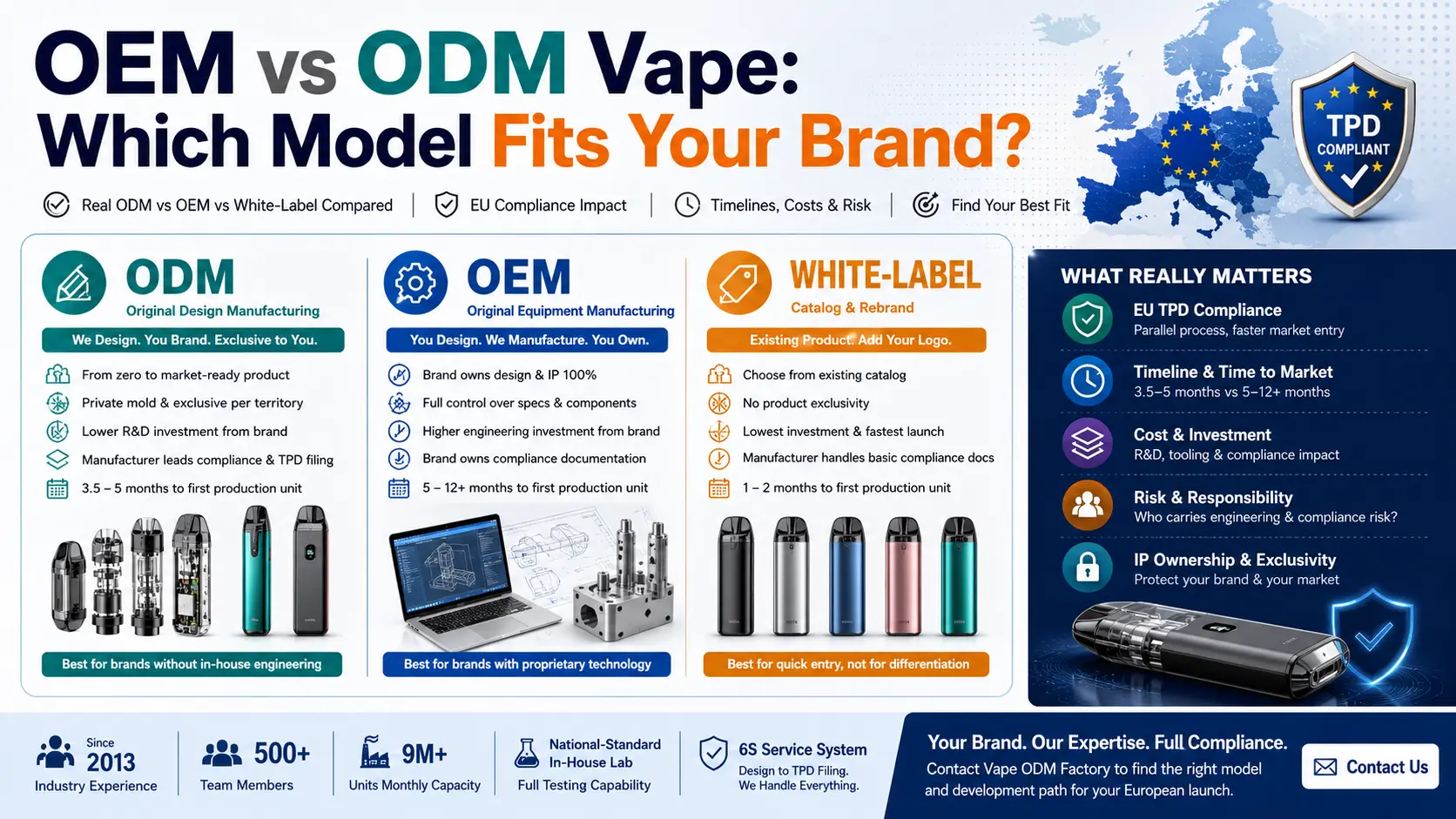
White-labeling means selecting an existing product from a manufacturer’s catalog and applying your branding. The device already exists. Other brands can order the same one. You own nothing except your packaging artwork.
ODM — real ODM — means the manufacturer’s R&D team designs a completely new product from scratch, specifically for your brand. New industrial design. New private molds. A product that doesn’t exist anywhere until you commission it. One mold per client per market — no competitor in your territory sells the same hardware.
OEM means you bring the design. Your in-house engineering team or an external agency has already produced the product specification — CAD files, firmware requirements, component specifications — and the manufacturer’s role is to produce it accurately at scale.
These are three structurally different arrangements. Understanding which one you’re actually being offered is the starting point for every other decision.
What Is ODM Vape Manufacturing?
ODM stands for Original Design Manufacturing. In the vaping industry, a genuine vape ODM manufacturer takes a brand from zero — no product, no engineering, no tooling — to a finished, market-ready device. The factory’s R&D team handles the full development cycle: industrial design, structural engineering, private mold creation, electronics and firmware, e-liquid formulation, testing, and mass production.
The defining characteristic of true ODM is that the product is new and exclusive. It does not exist before you commission it. When development is complete, the mold is assigned to your brand for your territory — no other brand in your market can sell the same hardware, because the tooling is yours.
What the ODM development process looks like
A full ODM development engagement runs through the following phases:
- Market brief and product positioning — the factory’s team defines what to build based on your target market, consumer profile, and competitive landscape
- Industrial design — 2–3 concept directions, 3D renders, ergonomics, surface treatment, dimensions
- Structural engineering — internal architecture: battery, reservoir, airflow, coil positioning, component integration
- Private mold development — approximately 35 days from tooling start to approved samples
- E-liquid formulation — flavor development running in parallel with mold development, completing within the same window
- PCBA and firmware — circuit board design, draw activation, power output, safety protections
- Compliance and certification — CE, RoHS, TPD notification filing, emissions testing, packaging compliance
- Production and QC
Total timeline from first brief to goods at a European warehouse: 3.5–5 months. The compliance phase runs in parallel with development — not after it — which is why experienced ODM partners compress the overall timeline significantly compared to brands that treat compliance as a post-production step.
What makes ODM the right model for most European brands
ODM fits brands whose core competency is brand-building, marketing, and distribution — not hardware engineering. This covers the majority of European vape brands: companies entering the market without an in-house R&D team, distributors launching private-label lines, brands pivoting from disposables to rechargeable systems, and established consumer goods companies entering the vaping category.
The structural advantage of ODM is that the technical risk sits with the manufacturer, not the brand. The factory’s R&D team has built hundreds of devices. They know which coil geometries work, which airflow configurations avoid leak issues at 2ml capacity, which materials pass REACH testing without surprises. A brand commissioning ODM is accessing that accumulated engineering expertise without building it from scratch internally.
What ODM is not
If a manufacturer shows you a catalog of existing devices and asks you to select one, that is not ODM. That is white-labeling. The distinction matters commercially: a white-label product can be ordered by any other brand from the same catalog. It offers no hardware exclusivity, no private tooling, and no product differentiation beyond packaging.
A reliable signal: a genuine ODM partner starts every project with a market brief and a design process. A white-label supplier starts by showing you what’s already in stock. If your supposed “ODM partner” cannot show you products they developed from scratch for other clients — with private molds and documented exclusivity agreements — look elsewhere.
What Is OEM Vape Manufacturing?
OEM stands for Original Equipment Manufacturing. In OEM, the brand owns the product design. A brand with an in-house engineering team — or one that has commissioned design work from a specialist agency — arrives at the manufacturer with a complete product specification: CAD files, mechanical drawings, firmware requirements, BOM, and performance criteria. The manufacturer’s role is production: manufacturing the brand’s design accurately, at scale, to the specified quality standard.
IP ownership in OEM is straightforward: the brand owns the design, owns the tooling, and owns the product. The manufacturer is a production resource. The brand’s engineering work, its proprietary technology, and its product architecture remain entirely with the brand.
What OEM actually requires from the brand
Working with a vape OEM manufacturer as the sourcing brand typically requires:
- Production-ready CAD files for all components
- Mechanical engineering specifications and tolerances
- Firmware requirements and any proprietary software elements
- Component specifications and approved supplier lists
- Performance validation criteria
- Compliance testing responsibility (the brand owns the device design, so emissions testing and TPD documentation are the brand’s responsibility to commission)
The brand carries the engineering risk in OEM. If the design requires revisions after initial tooling — a common occurrence with complex devices — the tooling cost is the brand’s exposure. If compliance testing reveals a performance issue tied to the design, the engineering fix is the brand’s responsibility. The manufacturer executes; the brand owns the consequences of the design.
Where OEM makes commercial sense
OEM is the right model when a brand has developed proprietary technology that requires a specific manufacturing implementation. A brand that has engineered a patented heating system, developed a novel pod architecture, or created a device interaction mechanism that cannot be achieved within an ODM partner’s existing platform capabilities needs OEM to realize that design.
OEM also fits brands with established in-house R&D teams that already produce production-ready engineering specifications as a standard workflow. For these brands, the question is not whether to design internally — they already do — but which manufacturer can produce their designs to the required quality and volume at the right cost.
OEM vs ODM Vape Manufacturer: Direct Comparison
| Factor | ODM | OEM |
|---|---|---|
| Who designs the product? | Manufacturer’s R&D team | Brand’s in-house or contracted team |
| Product exclusivity | Private mold, one client per market | Full — brand owns design and tooling |
| R&D investment from brand | Low — included in ODM partnership | High — brand funds all design and engineering |
| IP ownership | Negotiable — typically shared or transferred to brand | Brand owns 100% |
| Time to first production unit | 3.5–5 months | 5–12 months |
| Upfront tooling cost | Mold and tooling included in project cost | Full mold and tooling at brand’s expense |
| Compliance documentation owner | Manufacturer leads, brand co-signs | Brand generates from scratch |
| TPD notification complexity | Manufacturer supports directly | Brand arranges independently |
| Engineering risk | Manufacturer absorbs | Brand carries |
| Best fit | Brands without in-house engineering | Brands with existing R&D teams |
The compliance documentation row deserves more attention than it typically receives in standard comparisons. For EU market entry, the TPD notification technical file looks substantially different depending on which model you’re using.
In ODM, the manufacturer has already engineered the device. Their R&D team understands the product’s emissions profile, can provide the ingredient declarations, and — if they handle TPD filing directly — can assemble the technical file from institutional knowledge of the platform. The brand is not starting from a blank documentation set.
In OEM, the brand owns the design and therefore owns the compliance documentation burden. Emissions testing must be commissioned from scratch on the production-intent device. Toxicological assessment, ingredient declarations for any proprietary formulation, and packaging compliance review all fall to the brand. If design revisions occur after initial testing — which they do — the testing restarts.
For brands without dedicated regulatory teams, this difference can represent 8–14 weeks of additional pre-launch preparation and material third-party testing costs.
How EU Compliance Shapes the ODM vs OEM Decision
Under EU Tobacco Products Directive Article 20, every nicotine-containing product must be notified in each EU member state before it can be placed on market. The notification requires a complete technical file — and the composition of that file differs significantly between ODM and OEM projects.
TPD compliance in ODM
In a genuine ODM partnership, the manufacturer has designed the device. They hold the engineering data, understand the materials, and have experience preparing the technical documentation their platform generates. An ODM manufacturer that handles TPD filing directly — as an executed service, not advisory guidance — can run the EU-CEG notification process in parallel with production, preventing the common scenario where goods are ready but the brand cannot legally sell them.
At Vape ODM Factory, TPD notification filing is part of the core delivery rather than an add-on. The 6S service system handles technical file assembly, per-market EU-CEG submissions, and compliance documentation directly — the brand does not need to coordinate a separate compliance consultant alongside the manufacturing relationship.
TPD compliance in OEM
In OEM, the compliance documentation load sits primarily with the brand. A novel device requires fresh emissions testing on the production-intent hardware, a new toxicological risk assessment, full ingredient declaration for any custom formulation, and packaging compliance review against TPD Article 13 requirements. All of this must be completed before the first unit can legally reach a European retailer.
The timeline implication is significant. TPD notification has a statutory 6-month waiting period in most EU member states from submission to legal market entry. Brands that treat compliance as a post-production step — rather than running it in parallel with engineering — routinely find themselves with finished goods in a warehouse, waiting for a notification clock they should have started months earlier.
For a detailed breakdown of TPD packaging requirements applicable to both models, the TPD compliant vape packaging guide covers labelling specifications, health warning dimensions, language requirements, and pre-print review processes that apply regardless of manufacturing model.
Which Model Fits Your Brand?
Brands without in-house engineering
ODM is the correct model. If your organization’s strengths are brand development, channel management, marketing, and distribution — rather than hardware engineering — ODM gives you a product that competes on the shelf as if you had your own R&D department, without the cost or timeline of building one.
The typical European brand in this category: an importer launching a private label range, a consumer goods company extending into vaping, a distribution business building its first proprietary product line. None of these organizations have mechanical engineers on staff. All of them can access genuine ODM development through the right manufacturing partner.
Brands with proprietary technology
OEM becomes relevant when a brand has developed technology that is genuinely proprietary — a patented mechanism, a unique hardware architecture, a device experience that cannot be achieved by adapting an existing ODM platform. At this point, the brand needs a manufacturer that can execute their specification, not one that offers its own design platform.
The important qualifier: this applies to brands that have completed design work, not brands that intend to develop a design. A brand that wants a unique product but doesn’t have engineering capability is an ODM candidate — the manufacturer’s R&D team can create exclusivity without the brand needing to generate the engineering itself.
Brands at different stages of growth
The right model often shifts as a brand develops. Many successful European vape brands start with ODM — accessing the manufacturer’s R&D expertise to build an exclusive, compliant product for initial market entry. As the brand scales, develops its own technical team, and accumulates the market intelligence to specify exactly what a next-generation product requires, OEM becomes viable.
This progression is common: ODM to build brand presence and validate the market, OEM to extend into fully proprietary product development when the commercial case is established. Both models can work with the same manufacturing partner — continuity in the manufacturing relationship carries significant operational value as the brand grows.
To review the vape products available for ODM development — including existing platform categories with EU compliance documentation — the full range covers pod systems, rechargeable devices, and closed-pod configurations relevant to the current European regulatory landscape.
Questions to Ask Any Vape OEM ODM Manufacturer
The right questions distinguish a genuine development partner from a catalog supplier describing itself as one. Before committing to a manufacturing relationship, ask the following:
For ODM evaluation:
- “Show me three products your R&D team developed from scratch for European clients — with the brief, the industrial design process, and the final device.” A genuine ODM manufacturer can answer this with specifics.
- “What is your mold exclusivity policy, and how is it enforced contractually?” Territorial exclusivity should be documented with specific geographic scope, duration, and breach penalties.
- “Do you handle TPD notification filing directly, or do you provide documentation for us to file independently?” There is a significant difference between a manufacturer that files on the brand’s behalf and one that hands over a document package.
- “What happens if the product fails compliance testing — who carries the cost of retesting?”
- “How many of your current production SKUs are for European markets with active TPD notifications?”
For OEM evaluation:
- “What file formats do you accept for engineering specifications, and what review process do you run before tooling begins?”
- “Who owns the tooling produced under this agreement, and what is the process if the relationship ends?”
- “What is your defect rate on OEM production runs, and what is your process for handling non-conformance?”
- “What compliance support do you offer for OEM products entering EU markets — do you have regulatory staff, or does the brand arrange this externally?”
A manufacturer that cannot answer the ODM questions with documented examples is not a genuine ODM partner regardless of how they describe their services. A manufacturer that cannot answer the OEM questions clearly is one that will leave production risk and compliance burden with the brand. For a complete overview of what European compliance requires across either model, the TPD vape compliance guide for European market entry provides the full documentation framework.
The Right Vape OEM ODM Manufacturer for Your Stage
The choice between OEM and ODM is not a question of which model is better — it is a question of where your organization’s capabilities currently sit. A brand with a marketing team, a distribution network, and a clear product vision but no hardware engineering function is an ODM candidate. A brand whose competitive advantage is proprietary technology developed by an in-house engineering team is an OEM candidate.
What a vape OEM ODM manufacturer that does both models well gives brands is flexibility: the ability to use ODM to build brand presence with exclusive, compliant products, and to transition into OEM as the brand’s technical capability and commercial scale develop. The manufacturing relationship grows with the brand rather than requiring a supplier change at each stage.
Vape ODM Factory has operated from Dongguan since 2013, with a 500+ person team, 9 million units monthly capacity, and a national-standard in-house laboratory. The 6S service system covers the full development and compliance chain — from first design brief through TPD notification filing — so brands handle sales while the manufacturing partner handles everything else.
If you’re working through the ODM vs OEM decision for an upcoming European launch, contact Vape ODM Factory to discuss which model and which development path fits your current brief, team, and target markets.