The Tobacco Products Directive, Directive 2014/40/EU, has governed e-cigarettes and refill containers under Article 20 since May 2016. The rules have not changed since then, they are public, and the enforcement patterns are well documented. Yet brands still lose months and container-loads of inventory to the same TPD compliance mistakes, quarter after quarter. After supporting dozens of EU-bound hardware programs, we can usually predict which mistake a new client is about to make.
This article is written for brand owners preparing a European launch of e-cigarettes or refill containers: hardware brands, e-liquid brands, and the white label or private label programs that combine both. It lists the five TPD compliance mistakes we see most often, explains why each happens, and gives the fix. One boundary note first: this is a manufacturing perspective on a legal framework, not legal advice, and the full directive text on EUR-Lex, together with our guide to TPD notification for vape brands entering Europe, always beats any summary including this one.
There is also a reason these errors keep repeating. The directive reads like a laboratory protocol, the launch reads like a marketing plan, and nobody schedules the first against the second. The brands that avoid TPD compliance mistakes are rarely the ones with bigger legal budgets; they are the ones where somebody owns a document that lists, in dates, what must be true before the container moves. The five sections below are that document.
The Five TPD Compliance Mistakes at a Glance
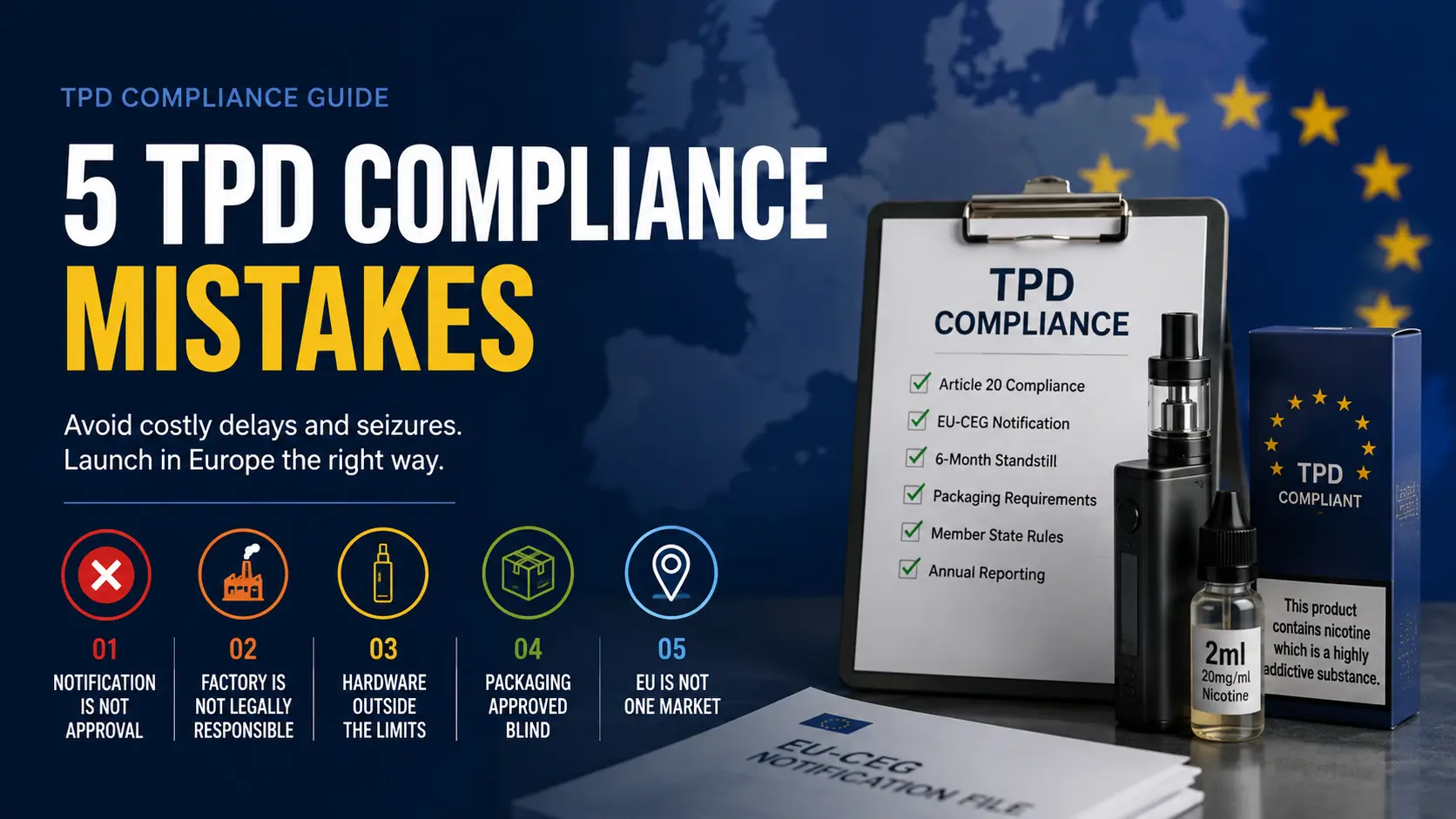
Each of the five TPD compliance mistakes has the same shape: a reasonable shortcut at the start, a hard cost at the end. The table below is the whole article in one screen; the sections after it explain where each mistake comes from and how to close it.
| Mistake | Where it bites | The fix |
|---|---|---|
| 1. Treating notification as approval | Launch dates planned around a submission ID | Six-month calendar starting from a complete file |
| 2. Responsibility pushed onto the factory | Gaps discovered at inspection, not before | Written split: brand files, factory documents |
| 3. Hardware outside the limits | Late tooling, re-testing, re-notification | 2 ml / 20 mg/ml native platforms, variant list first |
| 4. Packaging approved blind | Container-loads of non-compliant print | Regulatory review of artwork before pre-press |
| 5. EU treated as one market | Seizures and bans in specific member states | Market-by-market check before notification |
Mistake 1: Treating the Notification as an Approval
The most common of the five TPD compliance mistakes is a mental one. Article 20 sets up a notification regime, not an authorization regime. No authority reviews your file and stamps it approved. You submit a complete notification through the EU Common Entry Gate (EU-CEG) six months before the intended placing on the market, you wait out the standstill period, and then you, not the portal and not a consultant, bear full responsibility for the product’s conformity. EU-CEG is a technical delivery platform; a submission ID is a receipt, not a sign-off.
The six-month clock deserves respect. It runs from a complete notification, so a launch date set before the dossier exists is where the first of these TPD compliance mistakes begins. The file itself is substantial: ingredients with quantities, emissions data, toxicological information, nicotine dose and uptake data, a description of the production process, and declarations that the manufacturer bears full responsibility for quality and safety. The official EU-CEG portal publishes the submission templates, and Article 20(2) of the directive lists every required element — there is no version of this that can be assembled in a week. Be equally careful with the service pitch that promises “EU-CEG approval”: the portal validates formatting, the member state may request completion of the information, but no EU-CEG response certifies conformity, and consultants whose role drifts from preparing the file to vouching for the product are manufacturing the TPD compliance mistakes of tomorrow.
Two follow-on rules multiply the cost when this mistake lands. Any substantial modification of the product (a new flavor, a changed coil, a different tank capacity) requires a new notification, which restarts the process. And there is an annual reporting obligation covering sales volumes by brand, product type and member state. Brands that learn these rules from an enforcement letter instead of the directive pay for the lesson in market time, which is why any honest review of TPD compliance mistakes starts with the notification calendar rather than the product itself.
Mistake 2: Pushing Legal Responsibility Onto the Factory
A quieter cousin of the five TPD compliance mistakes hides inside the word “outsourcing.” The directive is explicit about who holds the duty: the manufacturer and, where applicable, the importer into the Union. A factory can prepare test reports, ingredient documentation and emissions data, and a good one will, but it cannot carry the legal responsibility for a product it does not place on the European market. When a brand assumes “the factory handles TPD,” responsibility has not been transferred. It has been abandoned.
That said, the factory you choose decides how hard the notification work actually is. Hardware suppliers differ enormously in what they can hand over: emissions test reports per variant, tank capacity documentation, child-resistance and leakage test evidence, and production process descriptions written for regulatory use rather than for trade-show brochures. Our earlier piece on whether a Chinese vape factory can support TPD notification work walks through what to ask for and what a credible answer sounds like. Suppliers who answer compliance questions with price lists are quietly announcing the TPD compliance mistakes their clients will make for them.
The division of labor we see work in practice is simple. The brand, or its responsible person inside the Union, owns the notification, the labeling decisions and the annual reports. The factory owns the hardware conformity evidence: drawings, capacity documentation, material specifications, emissions support and batch traceability. When this split is written into the supply agreement, TPD compliance mistakes stop falling into the gap between the two parties. When it is not written down, each side assumes the other holds the file, and the gap usually opens six months after launch, at inspection.
Mistake 3: Designing Hardware Against the Limits
The third of the TPD compliance mistakes is choosing hardware first and checking the limits afterward. Article 20 fixes hard product parameters: nicotine-containing liquid in cartridges or tanks cannot exceed 2 ml, dedicated refill containers cannot exceed 10 ml, and nicotine concentration cannot exceed 20 mg/ml. Devices must also deliver nicotine doses at consistent levels under normal conditions of use, be child- and tamper-proof, be protected against breakage and leakage, and refill without leakage where they are refillable. These are engineering requirements, not labeling preferences, and they shape device selection from the first quotation onward.
The 2 ml tank limit is where hardware programs go wrong most often. Devices engineered for other markets arrive with 4, 6 or 10 ml reservoirs, and adapting late means new tooling, new emissions testing and a new notification window. The same logic applies to the nicotine cap: a platform built around 50 mg/ml formulations may deliver inconsistent doses when filled at 20 mg/ml or below, which is a conformity problem, not a tuning detail. Checking the compliance ceiling on high-puff disposable configurations before committing to a device saves both the tooling budget and the calendar, and skipping that check is how TPD compliance mistakes turn into tooling invoices.
Emissions deserve their own warning. The notification must include the emissions resulting from the use of the product, and emission profiles change with nicotine strength, PG/VG ratio, coil type and power output. In practice, each product variant needs its own emissions testing: every flavor and every nicotine strength is a separate file feeding a separate notification. Brands that treat emissions as a one-time formality discover that a ten-SKU launch means ten test cycles. A factory that understands this builds the variant list with you before quoting, whether the program is a white label run quoted per flavor or a private label line with your own formulation work.
Device selection and notification planning belong to the same meeting for one more reason: capacities. A 2 ml platform filled at 20 mg/ml carries a fixed nicotine inventory per unit, which shapes flavor counts, pack sizes and the variant list itself. Brands that freeze hardware before counting variants often end up notifying SKUs they never sell, or selling SKUs they never notified, and both outcomes are TPD compliance mistakes with the same paperwork at the center. Decide the assortment and the device together.
One more hardware trap is the additive list. Article 20 restricts what the nicotine-containing liquid may contain: colorings, caffeine, taurine and additives classified as carcinogenic, mutagenic or reprotoxic are prohibited, and only high-purity ingredients are permitted, with anything else present only in technically unavoidable traces. For a hardware brand this reads like someone else’s problem, until the chosen device’s wick, cotton or reservoir materials interact with the liquid in ways the toxicological file cannot support. Involving the formulation side and the hardware side in the same conversation before either signs is the fix. TPD compliance mistakes are rarely divided as neatly as the supply chain is.
Mistake 4: Losing the Launch on Packaging
Packaging is the fourth of the five TPD compliance mistakes, and the most photogenic one to get wrong. Unit packets and any outside packaging must carry the health warning covering 30 percent of the two largest surfaces, using the prescribed wording in the language of the market. In Germany the warning must appear in German, not in English. The packet must also list all ingredients in descending order by weight, the nicotine content and delivery per dose, the batch number, and a recommendation to keep the product out of the reach of children.
Inside the box, the requirements keep going: a leaflet covering instructions for use and storage, contraindications, warnings for specific risk groups, possible adverse effects, addictiveness and toxicity, plus contact details for the manufacturer and a responsible person within the Union. Add child-resistant and tamper-evident closures, and the whole thing fills a full checklist: our TPD compliant packaging guide walks through it item by item, and walking through it once costs less than paying for the TPD compliance mistakes it prevents. The mistake is not that brands never learn the checklist exists. It is that artwork gets approved for design reasons, printed in container quantities, and only then shown to someone who knows the rules.
The financial asymmetry here is brutal and worth stating plainly. Fixing a packaging file costs one day and a designer’s time. Fixing printed packaging costs the print run, the schedule and sometimes the retail slot, and repackaging product in a bonded warehouse somewhere in Europe is nobody’s idea of a good quarter. Of all five TPD compliance mistakes, this is the one where the cost of prevention and the cost of failure are furthest apart, so put the regulatory review of artwork into the pre-press gate, before the printer sees anything.
Promotional restrictions ride along with packaging and are easier to miss. The directive’s presentation rules prohibit elements that suggest the product is not harmful or offers health advantages, and member states add their own restrictions on promotional elements at point of sale. Names like “light” or “ultra,” health-adjacent imagery, and vitamin or energy associations all sit in the danger zone. Rechecking naming and artwork against these rules before notification avoids the awkward position of relabeling a notified product, which is how TPD compliance mistakes get expensive twice.
Mistake 5: Treating Twenty-Seven Countries as One Market
The fifth of the TPD compliance mistakes is assuming the directive is the whole rulebook. It is the floor, not the ceiling. Member states transpose it into national law and routinely add stricter layers, so a product that passes the EU baseline can still be illegal in a specific market. The notification itself is filed per member state, each national transposition carries its own inspection culture, and each authority charges its own fees.
Notification fees deserve a line of their own. Member states may charge proportionate fees for receiving, storing, handling and analyzing notifications, and the amounts differ sharply between countries, from tens of euros to several hundred euros per variant in some markets. Multiply that by flavors, strengths and countries and the totals stop being trivial. Budgeting euros per notification, per variant, per country is part of avoiding TPD compliance mistakes, because the brands that forget the fees are the brands that quietly drop markets to save cost.
The disposable category shows how sharp the differences have become. Belgium banned disposable e-cigarettes from January 2025, France followed in February 2025, and Romania added its own ban in January 2026. The Netherlands restricts e-liquids to tobacco flavors only, which removes most disposable assortments at a stroke. Poland restricts online sales to consumers. Germany layers an excise regime on top, taxing e-liquid by volume with mandatory tax stamps. None of these national rules contradicts the directive; they sit on top of it, which is exactly why checking your market list country by country before you notify is the cheapest way to avoid TPD compliance mistakes.
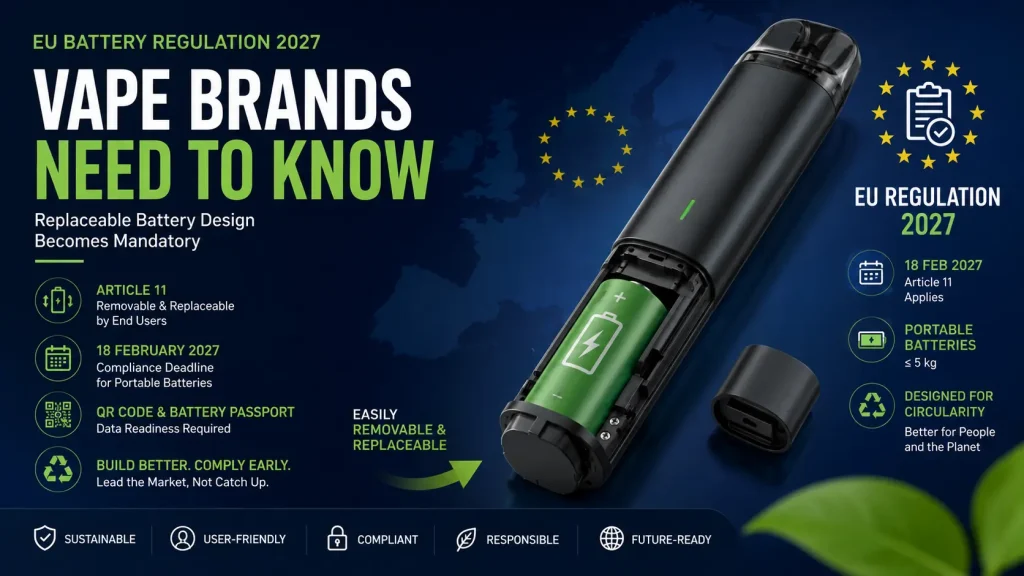
The battery rules are the next wave to plan for, and they cut across every category. Under the EU Battery Regulation, portable batteries in consumer products must be removable and replaceable by the end user from February 2027, a direct structural challenge to sealed disposable formats across the whole EU. Our EU Battery Regulation 2027 guide explains what the deadline means for device design. Brands choosing platforms in 2026 should weigh battery architecture in the same breath as tank capacity, because the platform you pick now decides how painful 2027 becomes, and the next round of TPD compliance mistakes will come from the battery file, not the liquid file.
A Sequence That Avoids All Five
The five TPD compliance mistakes share one root: compliance enters the project too late. The sequence that avoids them is unglamorous and effective. Choose the market list first: the countries, their national additions, their fees. Choose hardware that meets the 2 ml, 20 mg/ml and leakage requirements natively, from a factory that supplies conformity documentation as standard. Freeze the variant list (every flavor and every nicotine strength) before quoting, because each variant is a separate notification file with separate emissions testing.
Then run the calendar backward from the launch date. Six months out, the complete notification goes in through EU-CEG for each target member state. Around the same window, packaging artwork goes through a regulatory review against the warning, ingredient list, leaflet and closure requirements, in the language of each market. The standstill period becomes your production window, not a buffer to compress. A white label program quoted per flavor on a proven platform keeps this timeline realistic; a fully custom ODM project, or an OEM build on your own design, should add months for tooling and first-round emissions testing on top. Timelines built this way are what separate the brands that avoid TPD compliance mistakes from the brands that fund them.
Finally, assign the responsibilities in writing: who files, who reports annually, who answers the authority, who holds the technical file. The brands that follow this sequence treat the directive as an input to product planning, and their launches look boring — which is the compliment. The brands that repeat the five TPD compliance mistakes treat the directive as a hurdle at the end, and their launches look like the enforcement statistics.
If you are planning an EU launch and want the hardware side of this checklist handled from the first quotation, send us your target markets, variant list and volume. We will respond with a concrete proposal: devices built inside the 2 ml and 20 mg/ml limits, conformity documentation per variant, and a timeline that respects the six-month notification window. Start from a compliant platform instead of retrofitting one; the calendar you save is your own.
Closing note: the Tobacco Products Directive and its national transpositions are legal obligations that change over time and vary by member state, and enforcement practice differs accordingly. Nothing in this article constitutes legal advice. Confirm current requirements with the competent authorities of your target markets or a qualified adviser before committing budget or inventory, and treat this article as a manufacturing-side checklist for that conversation.