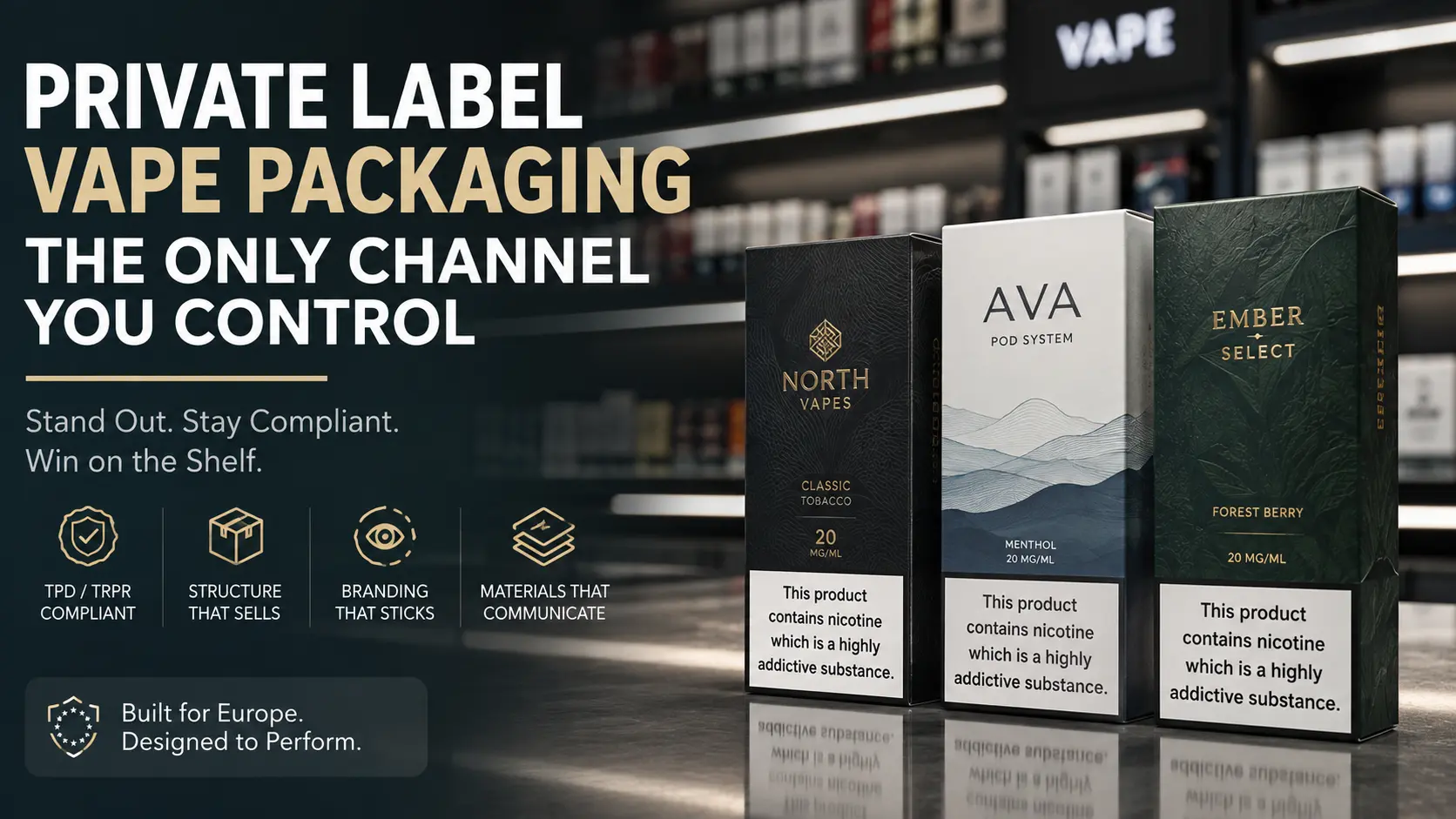
Europe has banned almost every other way of telling a customer your brand exists. Television, radio, print, paid online placement, influencer campaigns aimed at the general public: all closed, in the EU under the Tobacco Products Directive and in the UK under the TRPR regime. Germany went as far as banning outdoor advertising outright in 2024. What remains, for a vape brand selling through retail, is the shelf. The box on the counter in a Manchester vape shop or a Berlin tobacconist is not just containment. It is the last media buy you are legally allowed to make, and private label vape packaging is the only channel left that a new brand controls outright. That is why private label vape packaging has stopped being a procurement line item and become the core of the go-to-market plan.
We sit on the factory side of this conversation, supporting European brands that buy hardware and build their identity around it. The pattern we see in every strong private label program is the same: the brand treats packaging as the product, budgets for private label vape packaging accordingly, and works the problem inside the rules instead of pretending the rules are optional. The pattern we see in weak programs is the mirror image, with private label vape packaging decided in the final week, quoted as an afterthought, and redesigned twice at the brand’s own cost. The sections below are the playbook the strong ones follow, dimension by dimension.
Where Private Label Packaging Sits: The Control You Actually Buy
It helps to be precise about terms, because the industry uses them loosely. White label is the entry tier: you take a proven, existing device and put your logo on it, usually with the supplier’s standard box. Private label is the tier above: you still start from a proven platform, but you take control of the packaging, the logo execution, the flavor lineup and the SKU mix. Full ODM, where the hardware itself is designed from scratch around your brief, sits further up again and takes months of tooling. For most new and mid-size European brands, private label is the sweet spot, and private label vape packaging is the single largest surface that tier actually controls.
This matters commercially. When ten brands sell the same well-known device category, the hardware inside the box converges: the same nicotine strength cap, the same 2 ml tank, the same price band. What a shopper can compare before buying is the box, which is why private label vape packaging decides how the category feels at the fixture: how it looks, how it feels, how it opens. Shopper studies in retail environments consistently suggest that a majority of purchase decisions at the fixture are made in seconds, and that products which get picked up convert at far higher rates than those only seen. In practice, private label vape packaging is what earns the pickup.
If you are still deciding which tier fits your launch, our guide to custom disposable vapes with logo branding covers the white label baseline, and the rest of this article covers what the private label tier adds on top.
The Canvas TPD Leaves You: Constraints That Apply to Everyone
Before talking about how private label vape packaging can stand out, be honest about the frame. Article 20 of the TPD requires a combined health warning covering 30 percent of the front and back surfaces, printed in the language of each market. It mandates child-resistant and tamper-evident closures on nicotine-containing products. It prohibits promotional elements and any presentation that could appeal to minors. On top of that baseline, member states add their own layers: the Netherlands has banned non-tobacco flavors and online sales, Denmark restricts flavors to tobacco and menthol, Germany layers an excise tax of around €0.26 per ml onto e-liquids. The UK has gone further than anyone: since June 2025 disposables are banned outright, and new plain-packaging style rules prohibit colorful, cartoon-themed and toy-like presentation, pushing all brands toward neutral, adult-oriented design.
Read as a list, that sounds like the death of design. It is not, for one simple reason: these constraints apply to every competitor on the same shelf. The brand next to you lives under the identical 30 percent warning, the identical language requirement, the identical bans. Differentiation in private label vape packaging does not come from escaping the frame; it comes from working the surfaces and qualities the frame does not touch. And it turns out the directive says very little about structure, material, texture, or how the box behaves in the hand. Two shelves in the same market can hold one box that feels like a pharmacy own-brand and another that feels like a fragrance house, both fully compliant. Our TPD compliant packaging guide covers the legal baseline item by item; the rest of this article is about what you build inside it.
Dimension One: Structure and Box Format
Structure is the most underused differentiator in private label vape packaging because it is invisible in a WhatsApp artwork file and only reveals itself in the hand. Two boxes can carry identical artwork and still feel like different companies: one a standard reverse-tuck carton that snaps open like a cigarette pack, the other a slide drawer with a soft resistance, or a magnetic-closure flip case for a premium SKU. The open is a moment of theatre, and theatre is legal. The shape of that moment, the weight of the board, the sound the closure makes, all of it registers with the customer as quality, and it is the cheapest quality upgrade available in private label vape packaging.
Structure also does quiet commercial work. A custom-cut insert that holds the device without rattle signals manufacturing care the first time the customer opens the box, and it protects the product through the long, vibrating journey from a production line in Dongguan to a shelf in Rotterdam, through container loading, customs inspection and last-mile delivery. A box designed with a hanging tab or a stackable geometry makes life easier for the shop owner who restocks twice a week, and shop owners remember suppliers whose packaging does not fight them; they reorder from those suppliers and give their facings better placement. None of this requires breaking a single rule, and none of it shows up in a competitor’s screenshot of your artwork, which is exactly the point: structure is differentiation a rival cannot copy from a photo, so good private label vape packaging keeps some of its advantage even after the category copies the look.
The practical route for any private label vape packaging program is a dieline review with your supplier early, before artwork locks. Changing the box format after printing is the expensive kind of change, involving a full reprint and a slipped launch; changing it at dieline stage costs one sample cycle and a courier.
Dimension Two: Touch, Material and Finish
If structure is the quiet differentiator, finish is the visible one that stays compliant. The current European shelf trend runs away from high-gloss neon toward restraint: soft-touch matte lamination that gives the carton a velvet feel, spot UV that raises the logo in gloss against a matte ground, embossing and debossing that put the brand name into the material itself, and foil stamped in small accents rather than covering surfaces. Industry trend write-ups from packaging suppliers on both sides of the Atlantic, like this 2026 packaging trends overview, converge on the same observation: texture sells the pickup, and the pickup sells the product. A warning block occupies 30 percent of your panel, but it says nothing about what the other 70 percent feels like under a thumb, and that unseen majority is where private label vape packaging wins or loses the three-second test.
Material choice carries the same power with a cleaner story. Recycled kraft board with water-based inks has moved from niche to mainstream as retailers adopt sustainability requirements, and it photographs and feels unmistakably different from bleached cardstock. It also aligns with the direction of regulation: the EU’s environmental agenda, from WEEE obligations on devices to the Battery Regulation that bans most non-rechargeable disposables from February 2027, rewards brands whose packaging narrative is already about responsible materials. A kraft box cannot save a non-compliant product, but compliant private label vape packaging in a generic box wastes an easy brand win that costs cents per unit at volume.
One caution from the factory floor: finishes interact with compliance artwork. Soft-touch lamination over a warning panel can soften contrast and readability, and some markets inspect warning legibility closely. Spec private label vape packaging finish by zone, not by box, and proof the final laminate, not just the flat artwork. The finishes also carry real cost differences: lamination is modest, foil and embossing each add a die and a setup, and a four-finish stack on a ten-SKU range multiplies fast. Rank finishes by the return each earns and spend where the thumb goes.
Dimension Three: Color Discipline and SKU Recognition
The American shelf runs on color-coded flavor systems: green for mint, red for watermelon, a rainbow wall that reads from three meters. Much of that playbook is closed in Europe. The UK’s plain-packaging rules for vapes actively push against bright, youth-coded palettes, and across the EU the promotional-elements restriction punishes presentation that looks like confectionery. The winning adaptation is not to abandon color but to discipline it: a restrained base palette that carries the brand, plus a single, systematic accent that codes the flavor or strength. A thin colored band, a consistent icon slot, a colored inner edge that shows when the drawer opens. The shopper learns your system in one purchase and can find their SKU among fifteen in the next visit, without your private label vape packaging ever printing anything that resembles a cartoon.
This system-level thinking is what separates private label vape packaging from logo stamping. A logo alone gives you one box; a color and icon system gives you a family that blocks out a shelf section, and blocking is how small brands look established. When you plan the system, plan it across the whole variant list before quoting, because every flavor in the lineup is a separate SKU with its own print run, and suppliers quote MOQ per flavor, not per range. A twelve-flavor private label vape packaging program with five spot colors each is a different commercial proposition from a twelve-flavor lineup sharing one disciplined palette, and the second one looks better on the shelf too.
Dimension Four: Sustainability and Traceability
European retail buyers increasingly ask two questions beyond compliance: what is the box made of, and can the customer verify the product. Both are private label vape packaging answers, and both are answerable. On materials, the honest moves are recycled and recyclable board, soy or water-based inks, and structural design that avoids plastic windows and foam where a molded fibre tray will do. Brands should claim only what their supply chain documents can support, because greenwashing claims in a regulated category invite exactly the scrutiny a small brand cannot afford.
On traceability, the QR code has quietly become standard equipment. A code that resolves to lab results, batch information and an authenticity check serves three masters at once: the consumer who wants proof, the retailer who wants to avoid counterfeits, and the brand that gains a legitimate, compliant surface for information that cannot go on the box as marketing. Trend reports across the industry rank interactive verification among the fastest-growing packaging features of the past two years, and unlike decoration, it reads as responsibility rather than promotion. If your development timeline runs through product design anyway, our product development process guide shows where private label vape packaging proofing slots into the wider program.
Dimension Five: Retail Operations and the Shelf Itself
Packaging that wins the shelf is designed for the person who maintains the shelf. In specialist vape shops across Europe, counter displays do the selling, and the brands that supply clean, easy-to-assemble display units get better placement than brands that ship cartons alone. In convenience and tobacconist channels, where a separate display is not always possible, the pack itself must stack, face and survive handling by staff who are not brand ambassadors. Private label vape packaging that arrives crushed, fades under shop lighting, or takes a degree in origami to assemble quietly loses its retail home, and no amount of design talent saves a SKU the shop has stopped stocking.
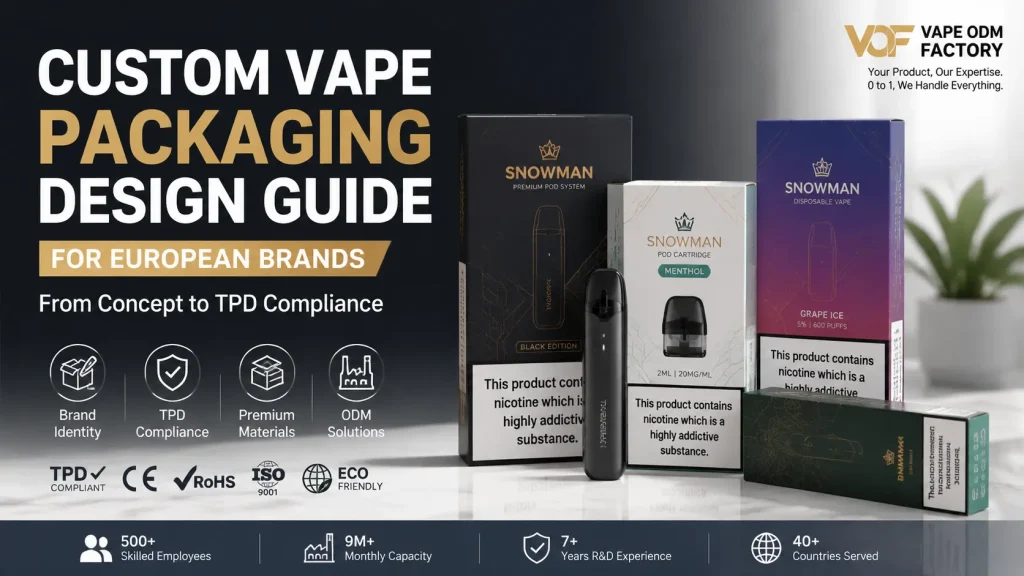
Channel also shapes format decisions. A premium rigid case might delight in a specialist shop and simply waste cost in a convenience chain; a hanging tab that is essential in one market’s fixture might be useless in another. The fix for private label vape packaging is unglamorous: decide the channel list before the dieline, the way you decide the market list before the notification. Our custom vape packaging design guide for European brands walks through channel-to-format matching in detail, and our packaging 101 overview covers the four jobs every box must do at once.
Making It Real: The Factory-Side Workflow
None of the five dimensions survives contact with reality without a disciplined workflow. The sequence we run with private label vape packaging clients looks like this. First, freeze the market list and the channel list, because they determine language versions, warning layouts and format constraints. Second, choose the platform device and lock the variant list; private label vape packaging is quoted per flavor, and a variant frozen after printing is a reprint you pay for twice. Third, dieline and structural sample: touch the box before you love the artwork. Fourth, artwork with the compliance layer in place from the first proof, never overlaid later; for a two-market launch that means two artwork masters, for example a UK version under TRPR rules and a German version with German-language warnings and German-market tax details. Fifth, a printed proof approved under shop lighting, with color tolerance agreed in numbers rather than adjectives. Sixth, production against the locked variant list, with batch coding and QR destinations tested before the container ships.
Budget for this honestly. Packaging for a European private label program typically runs to a real share of landed cost, in euros that vary with board grade, finish count and run size, and brands that discover this after the tooling deposit are the ones who cut the finish that made them different. Ask for the private label vape packaging quote as its own line, not bundled into device pricing, and you will keep the negotiating position to decide which dimension of difference is worth its cost.
The Short Version
Europe has taken away the megaphone and left the shelf. Private label vape packaging is where a brand without an advertising budget still gets to speak, and the rules that constrain it constrain every rival equally. Work the surfaces the rules leave open: structure that feels considered in the hand, finishes that earn the pickup, a color system that makes fifteen SKUs read as one family, materials and traceability that answer the retail buyer’s new questions, and display logic that makes shop staff allies rather than obstacles. Freeze markets and variants early, proof in the real lighting, and treat the box as the product it has legally become.
Brands that do this do not look like they are complying with the TPD. They look like the established option on the shelf, which is the only look that was ever worth buying.