A CBD vape puff count is the most quoted number on the shelf and the least understood number in the supply chain. Retailers compare products with it, consumers compare value with it, and brands print it with a confidence the math rarely deserves. The arithmetic itself is simple; what makes printed counts misleading is everything they leave out. If you are speccing a CBD line, the puff count is not a marketing decision you hand to a designer; it is an engineering output of four earlier decisions: who the user is, how much oil the device carries, how the coil is built, and how the battery matches the fill.
A scope note first, because it changes how this guide reads. We build hardware, not oil: everything on our side is empty all-in-one hardware, shipped with no fill, so the numbers below describe what a platform can deliver once a filler loads it. Where this article talks about filled, finished devices, that is the other side of the market, included so the two paths can be compared honestly; the same CBD vape puff count means different things on each side of that line, and most shelf confusion starts there.
Two ground rules before the numbers. Everything below is a benchmark from published testing and industry guides, not a promise; your own formulation, at its own viscosity, on the exact platform you choose, is the only count that counts. None of this is legal advice: cannabinoid rules vary by state and keep moving through 2026, so confirm anything compliance-related with counsel before a number goes on a box.
What a CBD Vape Puff Count Actually Measures
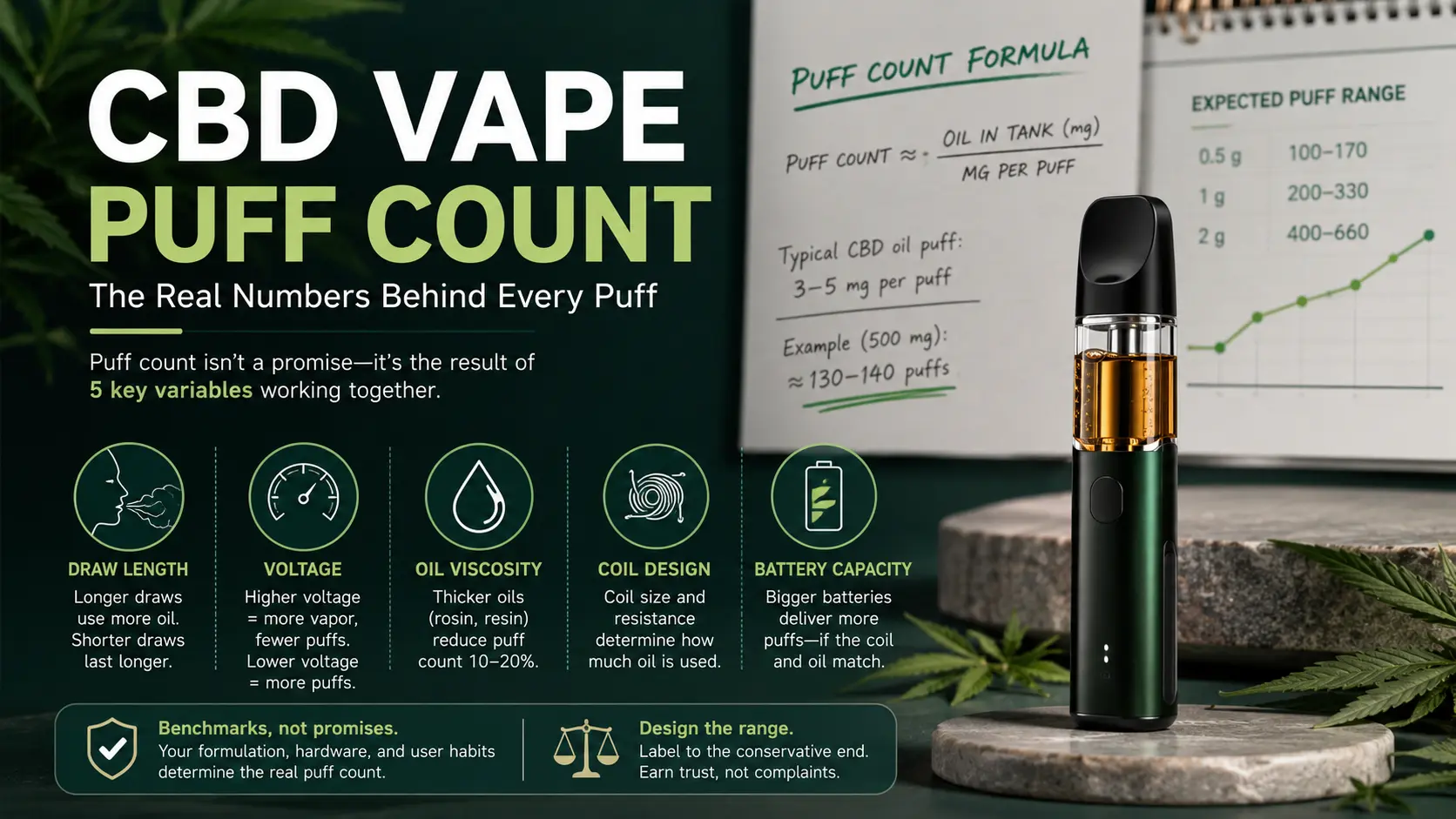
Strip away the marketing and the math underneath every estimate is one division: the oil mass in the tank, divided by the oil each puff consumes. Published research puts a typical cannabis oil puff at 3 to 5 mg, and a 2025 National Academies workshop summary sets the CBD vape puff count of a 500 mg fill at roughly 130 to 140 puffs. A laboratory study of California cartridges measured 3 to 6.2 mg per machine puff, with substantial variation between cartridges and between puffs: no two units behave identically. Divide 500 mg by 3 and you get about 167 puffs; by 5, you get 100. Same cartridge.
Run the same division across the common fill sizes and the planning ranges fall out. A 0.5 g fill yields roughly 100 to 170 puffs. A 1 g fill yields 200 to 330. A 2 g fill yields 400 to 660. Retail guides quote slightly wider CBD vape puff count windows depending on the draw length they assume, and one widely cited breakdown puts a 1 g cartridge anywhere from 200 to 400 puffs before it even mentions hardware. The midpoint of a CBD vape puff count is useful for planning, not for promising. Nobody vapes like a laboratory syringe pump, and the spread between the ends is not error; it is the product.
That is the first honest statement a brand can make about a CBD vape puff count: it is a distribution, not a digit. Two buyers with the same device and the same fill can land 40 percent apart, and both will report their experience as “normal.” Spec around a single printed number and you bet your review score on which end of that distribution your average customer lives on; spec around the range, label to its conservative end, and the math starts working for you.
The Five Variables That Move the Number
Draw length is the biggest lever, and it belongs entirely to the user. A small study of medical cannabis users recorded an average puff near four seconds, with individuals from about two to seven. Puff-count estimates conventionally assume a 2 to 3 second draw, so any CBD vape puff count you read was built on that assumption unless someone says otherwise; a consistent five-second pull on the same hardware can cut the total by a third or more, while short sips stretch it well past the estimate. Ten short draws and ten long draws drain the same tank at different rates, which is why two honest reviews can disagree by half.
Voltage is next, and unlike draw length, this one is a hardware decision. Benchmarks split batteries into low (2.0 to 2.8 V), mid (2.8 to 3.4 V) and high (3.4 to 4.2 V) bands, and running at the top of the range versus the bottom can swing a CBD vape puff count by 30 to 50 percent. Higher voltage produces denser vapor and burns oil faster; lower voltage sips oil. Push voltage high enough and the wick scorches, and a scorched wick does not recover. On fixed-voltage devices, the factory-set pairing of coil and battery does this job silently, which is why it should be specified deliberately rather than inherited from a catalog.
Oil viscosity moves the number from the formulation side. Thick live resin or live rosin needs more heat to wick properly, and industry guides put the CBD vape puff count of those oil classes 10 to 20 percent below thin distillate for the same fill. Cold weather thickens oil, slows wicking, and pushes users toward preheat cycles, and each cycle spends battery and a little oil without producing a full puff. A brand formulating in rosin should expect a lower count than the same volume in distillate, and should spec hardware that was tested on that oil class, not on a proxy.
Coil design and airflow sit underneath all of it. Two 1 g carts on the same battery can produce different CBD vape puff counts because intake size, wick material and chamber geometry all shape how readily oil reaches the coil. The cartridge matters as much as its printed capacity, and one level up, the device decides whether the fill gets used evenly or stranded at the bottom of the tank.
Finally, user frequency turns puffs into days, which is the number consumers actually feel. Published planning tables make the pattern plain: on a 1 g fill, a light user at 3 puffs a day stretches 67 to 111 days, a moderate user at 10 puffs a day gets 20 to 33 days, and a heavy user at 20 puffs a day is done in 10 to 17. A CBD vape puff count that ignores the user is a guess with a decimal point in it. The user profile, not the competitor’s box, is the right starting point for capacity decisions.
Matching Capacity to the Target User
Capacity choice is really a user-model decision wearing a spec-sheet costume. Small fills suit occasional users, because oil that sits in a tank for a season oxidizes and loses flavor long before the tank runs dry. Mid fills fit the daily moderate user, which is why the 1 g format became the reference point of the cart market, and the anchor most buyers use to sanity-check any CBD vape puff count they are quoted. Large fills suit heavy, multi-week users and price-driven shoppers, with one catch most guides mention and fewer brands design around.
The catch is battery-before-oil. On a large fill, a non-rechargeable cell can die with oil still in the tank, and stranded oil is the single most reliable generator of one-star reviews in this category. Industry guides flag it directly: the battery on a 2 g disposable often gives out before the oil does, and the fix is recharging. This is why every platform in our CBD family charges through Type-C, and why rechargeability is a spec requirement on anything above 1 mL, not a feature. A CBD vape puff count only counts if the battery outlives the fill.
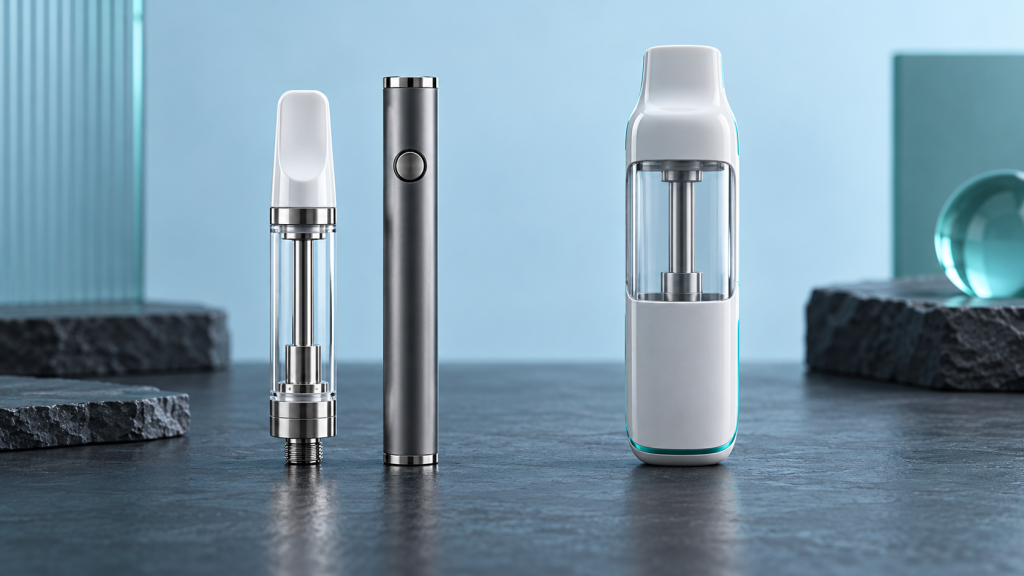
Our own platforms span the range so brands can match the CBD vape puff count to the segment instead of forcing one form factor onto every user: 0.5 and 1 mL slim pen formats for entry lines and trial sizes, 2 mL box formats for mainstream SKUs, dual-chamber 2+2 mL designs for brands selling flavor variety inside one device, and 4 mL flagships for multi-week users. Battery cells run 280 to 400 mAh across the family, and coil options run from 1.2 to 2.7 ohms. The spread is deliberate: a weekend dispensary shopper and a daily concentrate user should never end up on the same SKU.
Resistance ties capacity and experience together. Lower-resistance coils vaporize more oil per second: denser vapor, more flavor, fewer total puffs. Higher-resistance coils sip: lighter vapor, more puffs, cooler draw. Neither is better; they translate the same milliliters differently. When a brand asks us for the CBD vape puff count of a platform, the honest answer starts with “on which coil option, at which voltage, on which oil class,” because those three choices can move the answer by a factor of two before the user takes a single draw.
The Compliance Layer Around Puff Counts
Capacity stopped being purely commercial the moment the rules started counting containers. Section 781, effective November 12, 2026, caps total THC at 0.3 percent dry weight and 0.4 milligrams per finished container, counting THCA and other intoxicating cannabinoids. The container is the unit the law counts in, which makes tank capacity, and with it the CBD vape puff count a brand prints, a compliance parameter: a THC-adjacent line built on large fills concentrates more regulatory exposure per unit than the same oil across smaller containers. Hemp-derived CBD-only lines sit in a different position, but delta-8, HHC and similar product lines read the 0.4 mg container cap as a hard design constraint, and capacity belongs in that conversation from day one.
A printed CBD vape puff count is also a claim, and claims attract scrutiny. The number on the box is an estimate of an average, generated by a method nobody standardized, printed next to a batch number it may not match. Conservative labeling costs little: state the fill volume and the assumptions, print a range, and keep the batch documentation behind it. The brands that get burned are rarely the ones whose counts were low; they are the ones whose counts were indefensible when someone asked how the number was produced.
The hardware side carries its own paper. Materials documentation, battery safety files and batch-level hardware COAs are the device-side evidence that a platform is sound; the framework for vetting a factory on those documents is in our manufacturer checklist. CBD vape puff count credibility is downstream of all of it: a count produced on a documented platform, at a stated viscosity, at a stated draw length, is a defensible number; the same figure produced on a spreadsheet is a liability waiting for a comment section.
Designing a CBD Vape Puff Count Spec the Factory Way
The sequence that works is the one that starts with the user, not the number. Define who draws on the device and how often. Choose the oil volume that matches that cadence, including oil aging for light users. Choose the coil resistance that translates the fill into the experience the segment expects. Size the battery, with rechargeability as a requirement on larger fills, so the cell outlives the tank. Then verify the whole stack with the actual formulation at its actual viscosity, and let the verified CBD vape puff count range, not a round number, become the spec. Run it backwards from a puff total you want to print, and every downstream decision gets distorted to hit the headline.
Variant discipline matters more here than in most hardware categories, because oil classes behave differently on identical platforms. Each flavor and viscosity class in a line is specced, tested and quoted per flavor, so freeze the variant list before quotes are issued, not after tooling is paid for. A rosin variant on a distillate-tuned coil will underperform the printed CBD vape puff count no matter what the box says, and the fix costs nothing at the spec stage and a recall at the production stage. The customization ladder, from logo-only programs to full ODM builds, is laid out in our private label guide.
Ask a supplier for the CBD vape puff count per gram at a stated draw length, on your viscosity class, on the exact platform being quoted. A factory that answers with test data has done the engineering; one that answers with a bigger number than the last quote is selling packaging, and the gap between the two is the gap between a spec and a story. This is also the moment to involve the formulation side and the hardware side in one conversation, because the CBD vape puff count lives at that seam: it belongs to neither party alone, and it fails when each assumes the other manages it.
Printed Counts Versus the Real CBD Vape Puff Count
Walk a US CBD shelf and the printed totals climb like altimeter readings. Four figures are common, five are appearing, and the migration continues because a brand that prints 3,000 next to a competitor’s 2,000 wins the first three seconds of the buying decision, and the inflated CBD vape puff count becomes the category norm. None of the numbers is measured the same way, few are measured at all, and the consumer who buys the biggest count and runs out first learns to distrust the category. Inflation is a one-way ratchet: no brand gets credit for printing a smaller, more honest number next to an inflated one.
An honest spec sheet reads differently, and consumers are learning to read it. Fill volume in milliliters. Coil resistance in ohms. Battery in mAh, with the charge port named. The viscosity class the hardware was tested on. A tested puffs-per-gram range at a stated draw length, instead of a single total at an unstated one. That is the information a CBD vape puff count should carry into the market, and brands that publish it find the numbers defend themselves in reviews, because a customer who understands the assumptions stops blaming the device for their own five-second pulls.
Repeat purchase, where every brand’s margin lives, is won on the finish rather than the headline. The devices that earn reorders have no dry hits in the last quarter of the tank, no stranded oil at the bottom, and a battery that outlasts the fill. The wholesale economics of building on that foundation are in our wholesale supplier guide, and the hardware fundamentals behind capacity, battery and viscosity matching are in our CBD disposable guide. Across all of them the pattern holds: the real CBD vape puff count is an output of engineering, and the printed one is only worth what the engineering behind it is worth.
Where to Start
The short version fits in five lines. Start with the user profile, not a competitor’s box. Pick the fill size the usage cadence justifies, and check the calendar math for light users. Choose resistance and voltage as a deliberate pair, spec rechargeability on anything above 1 mL, and verify the CBD vape puff count on the real formulation before anything is printed. Capacity counts as a compliance input on THC-adjacent lines. Label to the conservative end of the tested range, and keep the batch documentation that shows where the number came from.
If you are speccing a line now, send us the user profile and the oil class. We will come back with platform options across 0.5 to 4 mL, coil choices in the 1.2 to 2.7 ohm range, and the assumptions behind every number; our request-a-quote page starts that conversation. For the surrounding decisions, our comparison of CBD and THC hardware requirements covers how the two product lines diverge at the platform level. The puff count on your box should be the least surprising number in your launch. With the right sequence, it is.
This article is provided for general information about vape hardware specification and does not constitute legal advice. Cannabinoid product regulations vary by state and continue to change; consult qualified counsel before making compliance decisions for any product line. No statement in this article is a health claim or a statement about the effects of any substance.