Every serious research house has the disposable vape market trends 2026 pointing up. In the first market to ban the format, the share of vapers who mainly use disposables fell by two thirds in one year. Both statements come from published sources and both are true. They do not describe the same thing, and the gap between them is where brand plans go wrong this year.
We build the hardware. This site belongs to an ODM factory in Dongguan, and our customers are brands and distributors rather than consumers. Nothing below argues for or against disposable devices. It separates the layers that headline numbers mash together, names every source, and converts figures at the European Central Bank rate of EUR 1 to USD 1.16.
Where this touches the law it is general information. Nothing in it constitutes legal advice for any market, and it is no substitute for checking the national gazette you ship into. Two of our sources disagree on one country’s ban status, and we flag that rather than pick a side.
Trend articles this year agree on the mood and disagree on the arithmetic, because they fold three measurements into one sentence. Units leaving a Chinese factory gate, legal retail sales inside Europe and self-reported consumer use are three datasets. Read the disposable vape market trends 2026 one layer at a time and the year becomes readable.
Two Disposable Vape Market Trends 2026 Numbers, and Why Both Are True
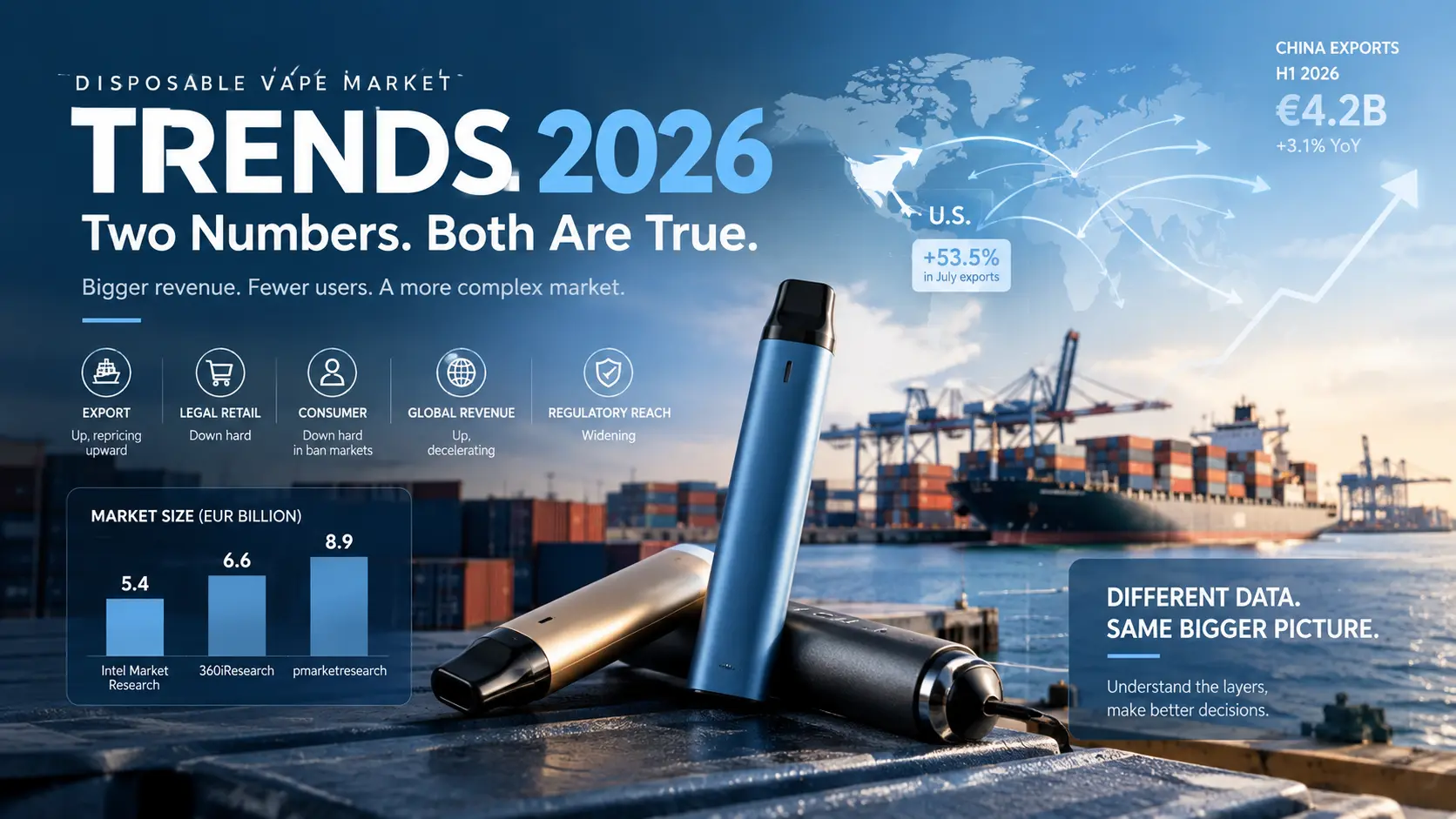
Start with size, because even that is unsettled. Three research houses published 2026 estimates for the disposable segment, and at the same exchange rate they land at EUR 5.4 billion, EUR 6.6 billion and EUR 8.9 billion. That is a 65 per cent spread for one category in one year, and all three place 2026 above their own 2025 figure, which is the first thing the disposable vape market trends 2026 get right.
| Source | 2025 | 2026 | Scope stated |
|---|---|---|---|
| Intel Market Research | EUR 5.0bn | EUR 5.4bn | Disposable e-cigarettes |
| 360iResearch | EUR 6.0bn | EUR 6.6bn | Disposable e-cigarettes |
| pmarketresearch | EUR 8.2bn | EUR 8.9bn | Disposable vape devices |
The spread is scope, not measurement error. One study counts the device, another adds the pre-filled liquid inside it, and a third folds rechargeable single-use hybrids into the total. Anyone quoting a single disposable vape market trends 2026 figure should say which of the three they mean.
Now put survey data beside that table. Action on Smoking and Health commissioned YouGov fieldwork published on 29 May 2026, covering 13,259 adults and 2,926 respondents aged 11 to 17. Among UK adults who vape, the share mainly using disposables fell from 24 per cent to 8 per cent in a year. Among 11 to 17 year olds it fell from 42 per cent to 13 per cent.
Revenue growth and user collapse are compatible. Revenue is counted globally, including markets with no ban. The decline is counted in one market with the strictest ban in Europe. The disposable vape market trends 2026 look contradictory only if you flatten five layers into one line.
| Layer | What it measures | 2026 direction |
|---|---|---|
| Export | Value and units leaving China | Up, repricing upward |
| Legal retail | Sales in ban markets | Down hard |
| Consumer | Self-reported main device | Down hard in ban markets |
| Global revenue | Value across all markets | Up, decelerating |
| Regulatory reach | Markets where the format is illegal | Widening |
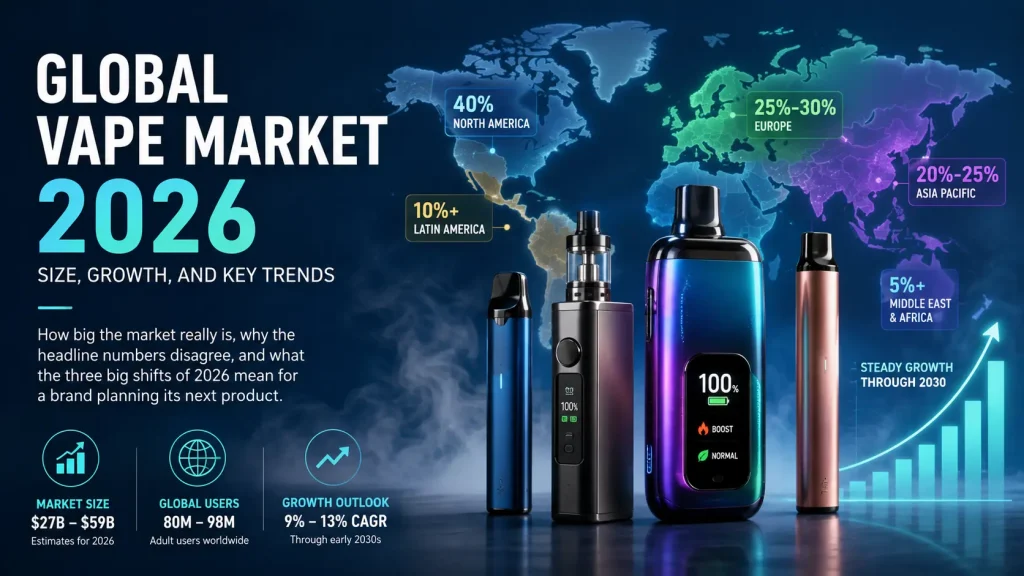
A brand reading only the revenue line builds for a market it is not selling into. The global vape market overview covers the top-line figures. What follows is the disposable layer underneath them.
What Left the Factory Gate: The Export Layer
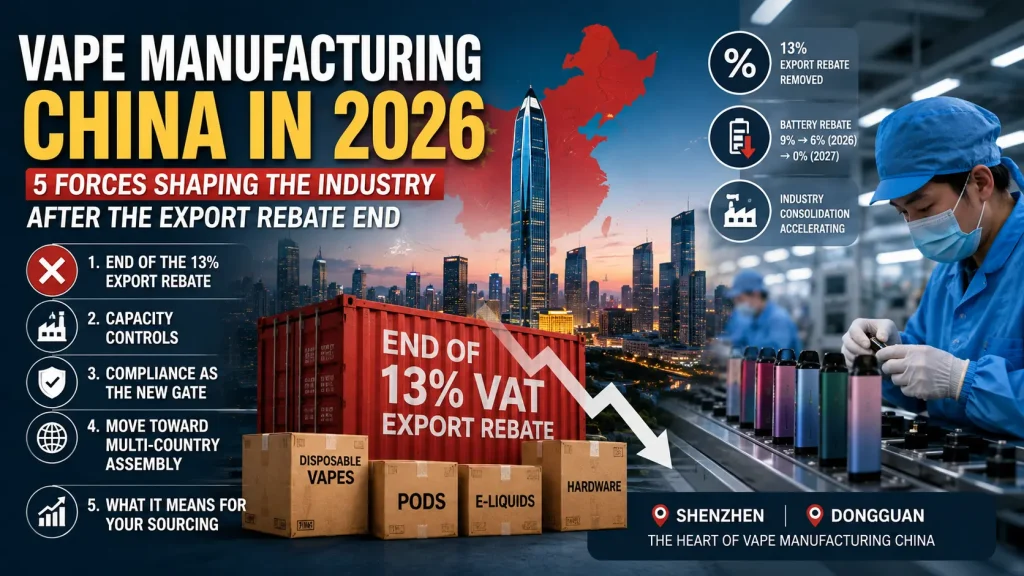
China Customs data analysed by 2Firsts puts core vape exports at about EUR 4.2 billion in the first half of 2026, 3.1 per cent above 2025. Devices under HS 85434000 grew 8.9 per cent and contributed most of the increase. Nicotine-containing non-combustible products under HS 24041200, where pre-filled disposables and pods mostly sit, grew 0.5 per cent.
The most instructive month was the worst one. April exports fell to roughly EUR 600 million, down 20.9 per cent year on year, in the first full month after China removed export VAT rebates on vape-related products. May, June and July then recovered to EUR 420 million, EUR 530 million and EUR 900 million. Read that rebound as a cost reset rather than a demand signal, and much of the disposable vape market trends 2026 stops looking confusing.
Look at what drove July and the picture narrows. Exports to the United States rose 53.5 per cent to about EUR 350 million, or 94.9 per cent of the year-on-year increase, while every other destination combined grew 1.2 per cent. Cumulative January to July exports reached EUR 5.2 billion, up 5.8 per cent. The year is not contracting, it is concentrating, and that concentration is among the more consequential disposable vape market trends 2026 for a brand choosing a market.
One detail matters more than the totals. In January to May, device export volume rose 4.73 per cent while the weighted average export price rose 7.89 per cent, as 2Firsts reported. Price now does the work volume used to do, and that is the quietest of the disposable vape market trends 2026.
The Retail Layer: A Ban Map With More Gaps Than the Headline Counts
Three countries had a full commercial ban in force at the start of 2026, and that count is what most disposable vape market trends 2026 summaries lead with. Belgium went first on 1 January 2025 and also prohibits online consumer sales. France followed with Law 2025-175 from 26 February 2025, covering pre-filled devices that cannot be refilled even when the battery recharges, while separately replaceable cartridges sit outside the ban. The United Kingdom banned single-use device sales from 1 June 2025.
Beyond those three the calendar is mixed. Bulgaria’s measure cleared EU notification in March 2026 and Austria’s was approved the same way. Ireland’s act was signed on 15 July 2026, but section 7 defers the sales ban six months to 24 January 2027. Poland’s draft has cleared the Council of Ministers, so hardware lead times make each of these dates a decision point inside the disposable vape market trends 2026 rather than a legal footnote.
Spain is where our sources disagree, and the disagreement is itself one of the disposable vape market trends 2026 worth naming. A wholesale legal summary current to 30 July 2026 lists no blanket Spanish ban, while a September 2026 country review reports the ban as implemented. Market status has to be confirmed at national gazette level before you commit tooling, not from a blog table, including ours.
Where there is no ban there is usually a flavour rule. The Netherlands permits tobacco flavour only and Denmark permits tobacco and menthol. Czechia’s Decree No. 429/2025 Coll. bars any cannabinoid from entering a vape or refill container from 1 July 2026. Germany has no sales ban and obliges every point of sale to take end-of-life devices back free of charge. The formats that grew around these limits are covered in our guide to compliant high puff disposable vapes.
Enforcement is thinner than the statutes suggest, and that gap is among the disposable vape market trends 2026 buyers price correctly and brands often do not. In the first full week after the UK ban, more than GBP 1 million of prohibited stock was still sold through convenience stores, and Yorkshire disposables still took 18 per cent of vape revenue. Channel revenue nevertheless fell from about GBP 23 million a week to GBP 17.8 million, with Scotland down 36 per cent.
The Consumer Layer: Where the Disposable Vape Market Trends 2026 Volume Went
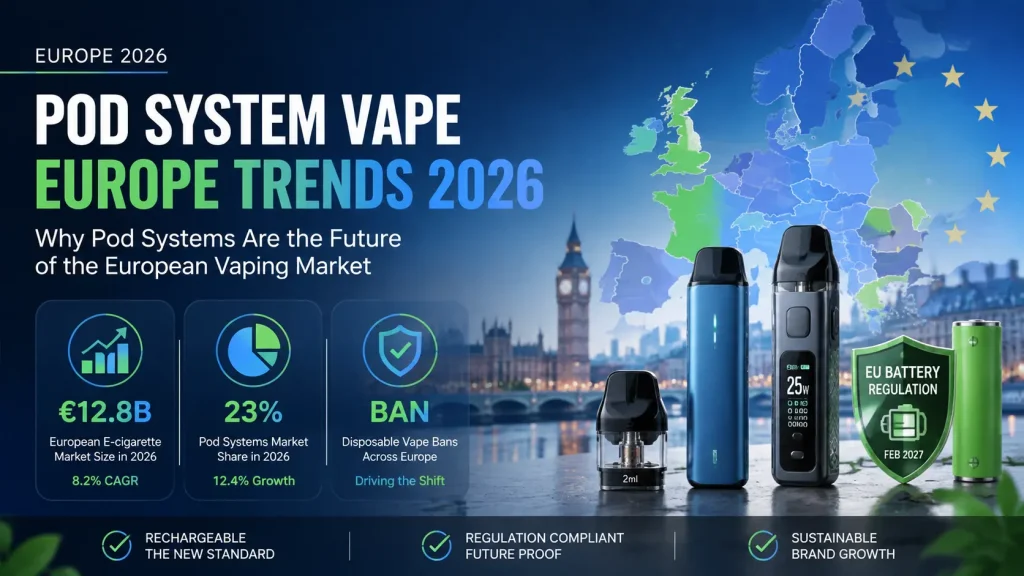
Demand did not disappear when the format became illegal. It changed container, which is the most important of the disposable vape market trends 2026 for a product team. Sales of smaller 2 ml reusable devices rose 11 per cent in the weeks after the UK ban, and pre-filled pod systems became the convenience-channel default in the space disposables vacated. The mechanism is the one we set out in our analysis of pod system vape Europe trends.
The behaviour data holds one uncomfortable figure. Sixty per cent of adult vapers report reusing their devices and 46 per cent reuse them ten times or more, but 18 per cent say they rarely or never reuse. Roughly one in five consumers buys a rechargeable product and treats it as disposable, which is the number inside the disposable vape market trends 2026 that most changes a revenue forecast.
The health question deserves the same discipline. An interrupted time-series study by Tattan-Birch and colleagues, posted as a preprint in June 2026, compared English vaping and smoking prevalence from 2022 to February 2026 against a no-ban counterfactual. Adult vaping prevalence stood at 13.6 per cent against a counterfactual of 18.8 per cent, and among young adults the gap was 11.3 percentage points.
Young-adult smoking ran 3.3 percentage points higher with a confidence interval of minus 0.5 to plus 7.1, which crosses zero. That is neither a clean null nor a demonstrated harm, and the disposable vape market trends 2026 deserve that restraint in both directions.
The Environmental Layer: The Problem the Bans Did Not Solve
The bans were sold on two promises, youth uptake and waste, and the second is where the disposable vape market trends 2026 get uncomfortable. Material Focus reported in June 2026 that 6.3 million vapes and pods are still discarded in the UK every week. That is 23 per cent below the pre-ban level and still an enormous waste stream, while purchases of disposable-style products fell 31 per cent.
Handling got harder before it got easier. Biffa recorded a 7 per cent rise in incorrect vape disposals at material recovery facilities in June and July 2025, and 232,500 prohibited devices were pulled from the recycling stream at its Teesside site alone. More than 1,200 battery fires were recorded in UK waste facilities in 2023 and 2024. Rechargeable devices arrive with charge still in the cell, so they carry a higher fire risk than a depleted disposable, a reversal among the least reported disposable vape market trends 2026.
Deposit return is the mechanism gaining ground. Eighty-five per cent of respondents said they would be more likely to return a vape with a financial incentive, and the same research put the acceptable deposit at roughly GBP 4. Against the revenue line, the disposable vape market trends 2026 stop looking like a transition: they look like a heavier device thrown away slightly less often.
The Backstop: 18 February 2027, and Six Exemptions That Miss Vapes
National bans are market by market, so a brand can route around them. Regulation (EU) 2023/1542 cannot be routed around. Article 11 requires batteries in portable products placed on the EU market to be readily removable and replaceable by the end user, and Article 96 sets the application date at 18 February 2027. The regulation never says “vape”. A device with a cell soldered into a sealed shell does not meet the test, and that is the disposable vape market trends 2026 item with the longest shadow.
The official text defines readily removable through four tests, stricter than most product teams assume. The battery must come out with commercially available tools, with no specialised tools unless one is supplied free with the product, with no proprietary tools that are not fairly obtainable, and with no thermal energy or solvents. Adhesive and heat-gun disassembly fail on the fourth test alone, a detail most disposable vape market trends 2026 coverage skips. The full timeline is in our EU battery regulation analysis.
Industry has looked for a carve-out and has not found one. A delegated act in July 2026 added six exemption categories to the two original ones, covering wearables, electric toys, food temperature probes, ATEX equipment, subcutaneous delivery systems and agricultural remote terminals. None covers electronic cigarettes, and an IP rating does not turn a vape into the wet-appliance category.
Two adjacent duties matter for tooling: replacement batteries must stay available for at least five years after the last unit is placed on the market, and software must not block compatible replacement cells. Some manufacturers argue removability will be applied through national interpretation in a way that leaves sealed devices on sale. No brand should commit tooling on that assumption, which is the difference between reading the disposable vape market trends 2026 and betting on them.
Tax Becomes the Second Price Setter
The other force that is not a ban and behaves like one is excise duty. Eighteen European countries already taxed e-liquid, and the United Kingdom joins them on 1 October 2026 at GBP 2.20 per 10 ml, with a duty stamp scheme and a sell-through window closing on 31 March 2027. Because VAT applies on top of duty, duty and VAT alone set a floor of roughly GBP 2.64 per 10 ml, and the disposable vape market trends 2026 have to be read against that floor.
| Market | Rate per ml (EUR) | In force |
|---|---|---|
| Lithuania | 1.56 | 1 Jan 2026 |
| Slovenia | 0.75 | 1 Jun 2025 |
| Ireland | 0.50 | 1 Nov 2025 |
| Finland | 0.40 | 1 Jan 2026 |
| Latvia | 0.35 | 1 Jan 2026 |
| Poland | 0.34 | 1 Jan 2026 |
| Germany | 0.32 | 1 Jan 2026 |
| Croatia | 0.25 | Jan 2026 |
| Estonia | 0.25 | Current |
| Austria | 0.20 | 1 Apr 2026 |
| Italy | 0.17 | 1 Feb 2026 |
| Belgium | 0.15 | Since 2024 |
| Spain | 0.15 | 1 Apr 2025 |
| Netherlands | None | Not foreseen |
Rates are as published by national tax authorities and assembled by TrustiCert. Lithuania’s figure is the one to check against an older table: lists still circulating from early 2026 show EUR 0.63 per ml, the January 2025 rate before a 147.6 per cent increase, and stale tables are one more reason the disposable vape market trends 2026 get misread.
Two readings of that table matter for a disposable line. The tax is per millilitre and applies to nicotine-free liquid in most of these markets, so it lands hardest on the large-format product the disposable era was built on; German data shows the 10 ml retail price moving from about EUR 6.99 in 2024 to EUR 9.52 in 2026 on tax and VAT alone. A pre-filled disposable also carries its full volume inside a device that must carry a stamp, and that double exposure pushes brands toward private label packaging built to survive a stamp and a warning panel at once.
Tax produces a second-order effect that bans do not. A study by Fraunhofer IIS and MRU GmbH put the EU illegal e-cigarette market at EUR 6.6 billion, with roughly one in two products failing to qualify for tax treatment, and an industry estimate in Germany puts the illicit share moving from about 40 per cent to about 50 per cent after the 2026 increase. That is an estimate rather than a measurement and still the number legitimate buyers compete against. The disposable vape market trends 2026 are fiscal before they are regulatory.
What a Brand Should Do With These Disposable Vape Market Trends 2026
Five questions decide whether a disposable line survives the next eighteen months, and the disposable vape market trends 2026 shrink the answers fast.
- Which layer is my revenue in? Export volume into markets without bans is a price competition where the average export price is already rising 7.89 per cent. Legal European retail has roughly eighteen months of runway, and that asymmetry is the most useful thing the disposable vape market trends 2026 tell a brand.
- Does my device pass the four removability tests? Not “is the battery accessible in service”, but can a consumer remove it with a screwdriver, no adhesive, no heat and no proprietary tool. If not, the EU market closes on 18 February 2027.
- Which gazette governs my SKU, and when does the stamp lead time start? Stamps come from a single national authority in most markets and lead times run into weeks, so a duty starting on 1 October had to be planned in July.
- How many markets can one SKU serve after February 2027? A removable-battery device with a pre-filled pod covers more of Europe than any sealed format. The variant list still has to be frozen per flavor before quoting, and any MOQ you are given is quoted per flavor rather than per order.
- What is my pod-platform pivot, tooled and sampled, before the deadline? Not planned. Tooled. The factories that captured UK replacement demand in 2025 were already running pod lines when the ban landed, as our guide to choosing a disposable vape manufacturer for Europe sets out.
We are a hardware factory, so read our interest honestly. A brand that launches a compliant platform in 2026 buys more tooling and more SKU engineering than one that relabels a sealed bar, and that is our commercial interest. It is also why the honest reading of the disposable vape market trends 2026 matters more than the convenient one. They do not say the category is finished. They say it is being repriced, re-routed and re-specced, and that the layer a brand sits in decides whether that reads as a warning or an opening.
Nothing here is legal, tax or regulatory advice, and it constitutes legal advice for no market. Ban dates, excise rates and exemption lists change. Confirm your own market’s rules with a qualified adviser before you commit tooling, because the disposable vape market trends 2026 will keep moving after this page is published.