The pod system vape Europe trends in 2026 are not a minor shift in consumer taste. They are a structural rewiring of the entire European vaping market — and every brand that sells into Europe needs to understand where the momentum is heading before they commit their next production run.
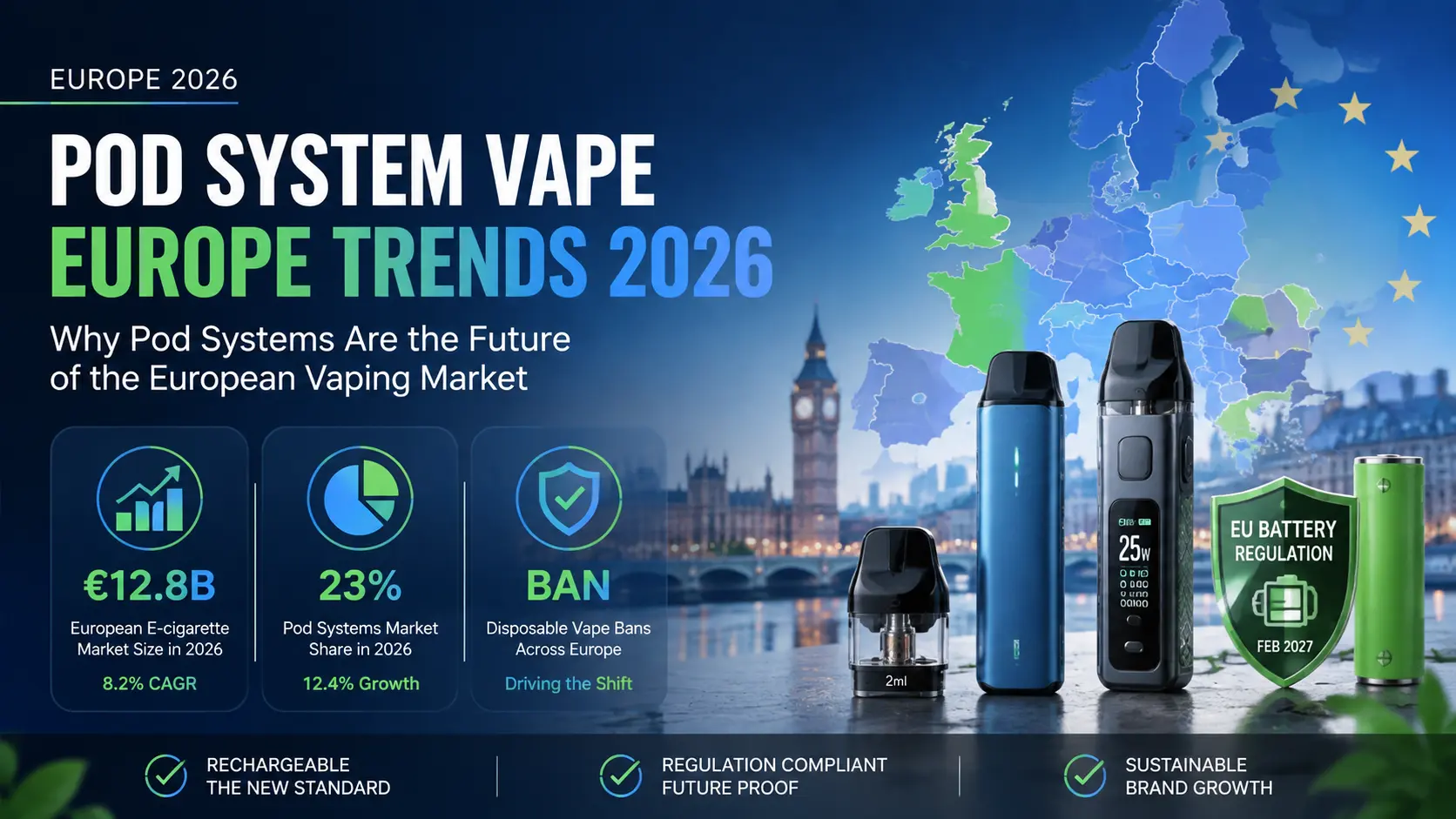
When we look at the market data, the direction is clear. The European e-cigarette market is worth roughly EUR 12.8 billion in 2026, growing at about 8.2% per year, according to the Europe Vape Market Report 2026. Within that total, pod systems account for around 23% of market value and are growing at 12.4% — the fastest of any product segment. Disposables still hold the largest share at about 62%, but their growth has slowed to roughly 5.7%, held back by a wave of national bans. The pod system vape Europe trends therefore tell a simple story: the fast-growing part of the market is moving away from single-use devices and toward rechargeable, refillable pod platforms. We break the wider numbers down in our Global Vape Market 2026 analysis, but the segment-level story is the part that matters for product decisions.
This is not speculation about the future. It is what is already happening in the UK, France, Belgium, Czechia, and beyond. And for a brand owner deciding what to build next, reading these pod system vape Europe trends correctly is the difference between launching a product line with a five-year runway and building inventory that regulators will push off the shelf within eighteen months.
The Disposable Ban Timeline Is the First Driver Behind Pod System Vape Europe Trends
If you want to understand why pod system vape Europe trends point so sharply toward rechargeable devices, start with the regulatory calendar. The single most powerful force moving European brands toward pod systems is the accelerating phase-out of disposable vapes.
The United Kingdom led the way. On June 1, 2025, the UK banned the sale of single-use disposable e-cigarettes — covering both nicotine-containing and nicotine-free devices. Overnight, a category that had dominated UK retail for years became illegal to sell. The shelf space that disposables vacated did not stay empty for long: it was filled by pre-filled pod systems, which have since become the new mainstream in the UK market.
Continental Europe has followed the same pattern, country by country. France banned non-refillable, pre-filled devices effective February 25, 2025, under Law 2025-175, with penalties for first violations reaching EUR 100,000. Belgium passed its own prohibition, and in March 2026 the EU approved Bulgaria’s ban on the sale, promotion, and distribution of disposable e-cigarettes, making it the third EU member state after France and Belgium to fully prohibit these products. Belgium’s health minister has since called for an EU-wide ban on disposables entirely. The full regulatory timeline, including the expected TPD revision, is tracked in the Europe Vaping Industry Update.
Industry forecasters at Euromonitor International have projected that disposable products will gradually phase out of the European market starting in 2025, with sales declining as brands redesign their offerings to stay compliant. For a brand that currently sells disposables into Europe, the message could not be more direct: the pod system vape Europe trends point to a market where single-use devices lose legal shelf access market by market, and the compliant alternative is a rechargeable pod device.
The speed of this transition should not be underestimated. When the UK ban landed in June 2025, retailers had to clear and rework their shelves within months. Manufacturers and brands that had already tooled up for pod platforms captured the replacement demand almost immediately, while those still shipping disposables faced liquidation channels and shrinking margins. That sequencing — a ban, then a scramble, then a new winner — is now repeating across the continent, which is why reading the pod system vape Europe trends early has a direct financial value: it tells you which product architecture will be legal and in demand by the time your production run actually ships. For teams that built their entire range on disposables, the blueprint in our Start a Disposable Vape Brand guide is a useful baseline for understanding the economics you are now transitioning away from.
The EU Battery Regulation Is Rewriting the Hardware Rules Underneath Pod System Vape Europe Trends
Regulation does not stop at disposable bans. The second major driver underneath the pod system vape Europe trends is the EU Battery Regulation, which will prohibit devices with non-replaceable batteries from February 2027. If a product cannot have its battery removed and replaced by the user, it will not be sold legally in the EU after that date.
This is a much bigger deal than most people realize, because nearly all disposable vapes are built around a sealed, non-replaceable battery. In fact, the battery cell is often the single most expensive component in a disposable device. Once the Battery Regulation takes full effect, the entire sealed-battery disposable category becomes unviable in the EU — not because of a flavor rule or a marketing restriction, but because the physical battery design itself no longer complies.
The battery regulation is precisely why the pod system vape Europe trends keep pointing toward rechargeable pod hardware. A well-designed pod system uses a rechargeable device with a battery that can be replaced, paired with refillable or replaceable pods. That architecture satisfies both the February 2027 requirement and the consumer desire for a device that lasts longer than a single tank of liquid.
We have covered the full detail of this regulation in our EU Battery Regulation guide, which we recommend reading if you are designing hardware today. The short version for product decisions: any device you spec for the European market in 2026 should assume a replaceable or user-replaceable battery, or you are designing an expiry date into your own product. The pod system vape Europe trends are, at their core, a compliance-driven shift toward hardware that can be reused and repaired.
There is a practical consequence for the bill of materials as well. Because the battery becomes a replaceable part, the sourcing strategy changes: you want a cell and a battery module with a defined lifecycle, not a sealed unit that is thrown away with the device. That affects cost, spare-part supply, and the warranty model you offer retailers. It also means the design conversation with your manufacturer has to happen earlier — before the mold is cut, not after the first samples. Brands that treat the battery rule as a design input from day one are the ones that will find the pod system vape Europe trends easy to ride; brands that try to retrofit it will pay twice.
TPD Compliance Makes Pod Systems the Easier Product Architecture to Get Right
The third force shaping pod system vape Europe trends is the EU Tobacco Products Directive (TPD), the baseline regulatory framework that governs how vape products can be sold in Europe. And here is the counterintuitive part: for all its complexity, TPD is actually easier to comply with on a pod system than on a high-capacity disposable.
The core TPD constraints are well known. E-liquid containers are limited to a capacity of 10 ml, tanks and refillable devices are capped at 2 ml, and nicotine strength cannot exceed 20 mg/ml. Every product must be notified to the EU-CEG system at least six months before it can be launched, with a full dossier of ingredients and toxicological data. These rules apply across all product types.
But the economics of compliance are very different by category. A high-puff disposable with a large liquid reservoir is, by construction, fighting against the 2 ml tank limit — or relying on interpretations and national carve-outs that keep shifting. A pod system, by contrast, is designed around small consumables from day one. A 2 ml pod is a completely natural product. The pod system vape Europe trends therefore favor the architecture that is already shaped to fit the rules, rather than the one that has to stretch them.
There is a second compliance advantage that matters for brands: modularity. With a pod system, the device and the consumable are separate SKUs. When a rule changes — a flavor restriction, a labeling requirement, a packaging standard — you often only need to rework the consumable, not the entire hardware. That flexibility is exactly why more European brands are choosing pod systems in 2026, and it is a large part of why the pod system vape Europe trends show no sign of reversing.
If you are watching the pod system vape Europe trends from the outside, the TPD story can look like a burden. From the inside, it is a filter that rewards disciplined design. A brand that builds to the 2 ml standard, notifies on time, and keeps its dossier clean faces a market where a meaningful share of competitors are shipping unapproved or under-taxed product — the gray market that a recent EU study put at around EUR 6.6 billion. When enforcement tightens, as it is tightening across the continent, the compliant pod brand inherits the shelf space the gray operators vacate. That is the quiet upside embedded in the pod system vape Europe trends: compliance is not just a cost, it is a competitive moat.
If you are new to European compliance and want the full picture before you commit to a product direction, our TPD compliance guide for Europe walks through the notification process, the documentation requirements, and the practical mistakes that delay launches.
Nicotine Salts Are the Experience Engine Powering the Pod System Vape Europe Trends
The regulatory arguments explain why brands are leaving disposables. But they do not fully explain why consumers are embracing pod systems with such speed. For that, you have to look at the experience itself — and at the role of nicotine salts in the pod system vape Europe trends. Put simply, the pod system vape Europe trends are as much a story about how nicotine is delivered as they are a story about what the device looks like.
Nicotine salts are formulated to deliver a smoother throat hit at higher nicotine strengths than traditional freebase e-liquid. That profile is a near-perfect match for compact, low-wattage pod devices. A 20 mg/ml nicotine salt in a small pod delivers quick satisfaction with less vapor production, in a small package that feels closer to the cigarette experience many former smokers are used to. It is the combination — salt + pod — that makes the category work.
The demand signal from European markets is unambiguous. In Czechia, for example, there is exceptionally high acceptance of 20 mg/ml nicotine salts, and distributors report that the combination of salts with modern low-wattage pod devices is the highest-margin product pairing for wholesalers. French consumers have migrated to pod and closed systems so thoroughly after the disposable ban that refillable pod products now command roughly half the market, and bottled e-liquid demand has surged. In the UK, pre-filled pod systems have become the new default for former disposable users who want low-maintenance, consistent performance without refilling and coil changes.
What all of this means in practical terms: if you are evaluating the pod system vape Europe trends for a new product line, nicotine salt formulation is not a nice-to-have. It is the core of the user experience. The brands winning shelf space in 2026 are the ones that pair solid pod hardware with salts that deliver a consistent, predictable hit — because repeat purchase in this category is driven by how the first pod feels, not by a puff count printed on a box.
The flavor dimension matters almost as much as the nicotine delivery. In market after market, the flavors that dominated disposables — the fruit, ice, and menthol profiles that casual users know by name — are the same profiles winning in pods. Consumers migrating from a disposable do not want to relearn what tastes good; they want the pod version of the flavor they already trust. That is why most pod programs in Europe start with a flavor set that mirrors the top disposable profiles, then expand. When you see a brand grow quickly under the pod system vape Europe trends, the underlying pattern is usually the same: dependable salts, familiar flavors, and hardware that never leaks or burns. Get those three things right and the market does the rest.
The Refill Economy Is Reshaping the Business Model Behind the Pod System Vape Europe Trends
There is a business reason behind the pod system vape Europe trends that has nothing to do with regulation or taste, and everything to do with money: the refill economy. The hardware sale is no longer the profit center. The consumable is.
Look at how the big players structure their economics. British American Tobacco reports that over 75% of its vapor revenue in the UK and mainland Europe comes from refill cartridges rather than initial device sales. Philip Morris International reported roughly US$578 million in recurring refill cartridge sales in a single quarter, growing double-digit. The unit economics are stark: a closed refill cartridge may cost well under a dollar to manufacture and can retail for several times that, while a disposable unit carries a thin per-unit margin and is bought once, then gone.
The same logic applies at brand level, even at much smaller scale. A customer who buys a pod device once, then buys pods every few weeks, is a recurring revenue stream. A customer who buys a disposable is a one-time transaction — and if disposables get banned in their market, that customer is lost entirely. The pod system vape Europe trends reward the business model where you keep selling to the same person, and that is a powerful incentive for any European brand with a retail channel.
This refill logic also changes how inventory should be planned. Instead of carrying many different disposable SKUs, the leaner approach is to carry two or three strong pod platforms and build depth in the consumable range — flavors, nicotine strengths, refill pods. This lowers capital lock-up, increases reorder frequency, and improves cash flow. Wholesale buyers across Europe have already caught on, which is one more reason the pod system vape Europe trends are so consistent across markets. For the brand side, the same principle applies to retail pricing and promo strategy: spend to acquire the device user, then monetize the relationship through the pod. Every successful pod brand in Europe is, underneath the branding, running a subscription business without calling it one — and that is the deepest economic signal in the pod system vape Europe trends.
What Pod System Vape Europe Trends Mean for Your Product Line in 2026
By this point the picture should be complete. The pod system vape Europe trends are driven by four converging forces: disposable bans removing the incumbent category, the EU Battery Regulation forcing rechargeable and replaceable hardware, TPD compliance rewarding small-capacity modular design, and nicotine salts plus the refill economy making pod systems more profitable. If you are a brand owner or startup planning a 2026 or 2027 launch into Europe, here is how to translate all of that into decisions.
One framing helps when you sit down to plan: the pod system vape Europe trends are not telling you to stop selling what works today. They are telling you where the market is heading between now and 2027, and giving you a deadline. Every decision below is essentially a way of moving your product line into the lane that stays legal, keeps demand, and preserves margin. There is no single right answer for every brand, but there is a right set of questions, and the answers depend on how fast you want to move and how much capital you want to commit.
First, decide on your pod architecture early. Open systems — where users refill the pod themselves — maximize compliance flexibility and e-liquid reorder volume, but they ask more of the user. Closed systems — pre-filled replaceable pods — deliver the closest experience to a disposable for migrating users, with the strongest repeat-purchase mechanics. Many brands run both: a closed pod platform for the disposable switchers, and an open pod line for the refill crowd. The pod system vape Europe trends do not pick a single winner between the two; they simply insist that rechargeable, replaceable hardware is the baseline.
Second, spec the hardware for the battery rule now. Assume user-replaceable or easily replaceable batteries. Design for the February 2027 deadline as if it applies to your first production run, because the longer you wait, the shorter the compliant life of the product you ship. This is a decision that has to be made with your ODM partner before tooling, not after.
Third, plan your nicotine salt program. If your target market is Europe, 20 mg/ml salt in a small pod is the experience benchmark. Get the formulation right with your manufacturer and lock in consistency across batches — flavor drift between production runs is one of the fastest ways to kill a pod brand’s repeat rate.
Fourth, choose an ODM partner who has already built pod systems and who can handle the compliance paperwork as part of the service. This is where a factory’s track record matters more than any brochure. A partner who has shipped TPD-compliant pod products before will know the notification timelines, the labeling requirements, the 2 ml design constraints, and the battery sourcing questions that determine whether your product actually launches on schedule. Our guide to evaluating vape ODM factories in China covers the specific checks to run before you commit. And if you are weighing whether to build pods in-house or through a factory partner, the pod system vape Europe trends reinforce the same conclusion: this is a manufacturing and compliance discipline, and a factory that already runs pod lines will always be ahead on cost and speed than one learning the category from zero.
And fifth, price your product for the refill economy, not the one-time sale. If you build your margins around recurring pod sales, you can price the device aggressively to win adoption and make your profit on the consumable — the model that the largest players in Europe already follow. That is the business logic behind the pod system vape Europe trends, and it is available to small brands just as much as to the majors.
The pod system vape Europe trends are not a passing wave. They are the result of regulation and economics pushing in the same direction at the same time — a rare alignment that tends to produce durable market change. European brands are choosing pod systems in 2026 because the alternatives are either disappearing from the shelf or becoming structurally unprofitable.
If you are ready to move your product line toward a pod system, the practical next step is to talk to a manufacturer about what the build actually looks like — device design, pod tooling, salt formulation, and the compliance timeline that ties it all together. When you have the basics of your project defined, you can request a vape ODM quote from our team and get a concrete picture of cost and lead time. The direction of the market is clear; the only question left is how quickly you position your brand inside it.