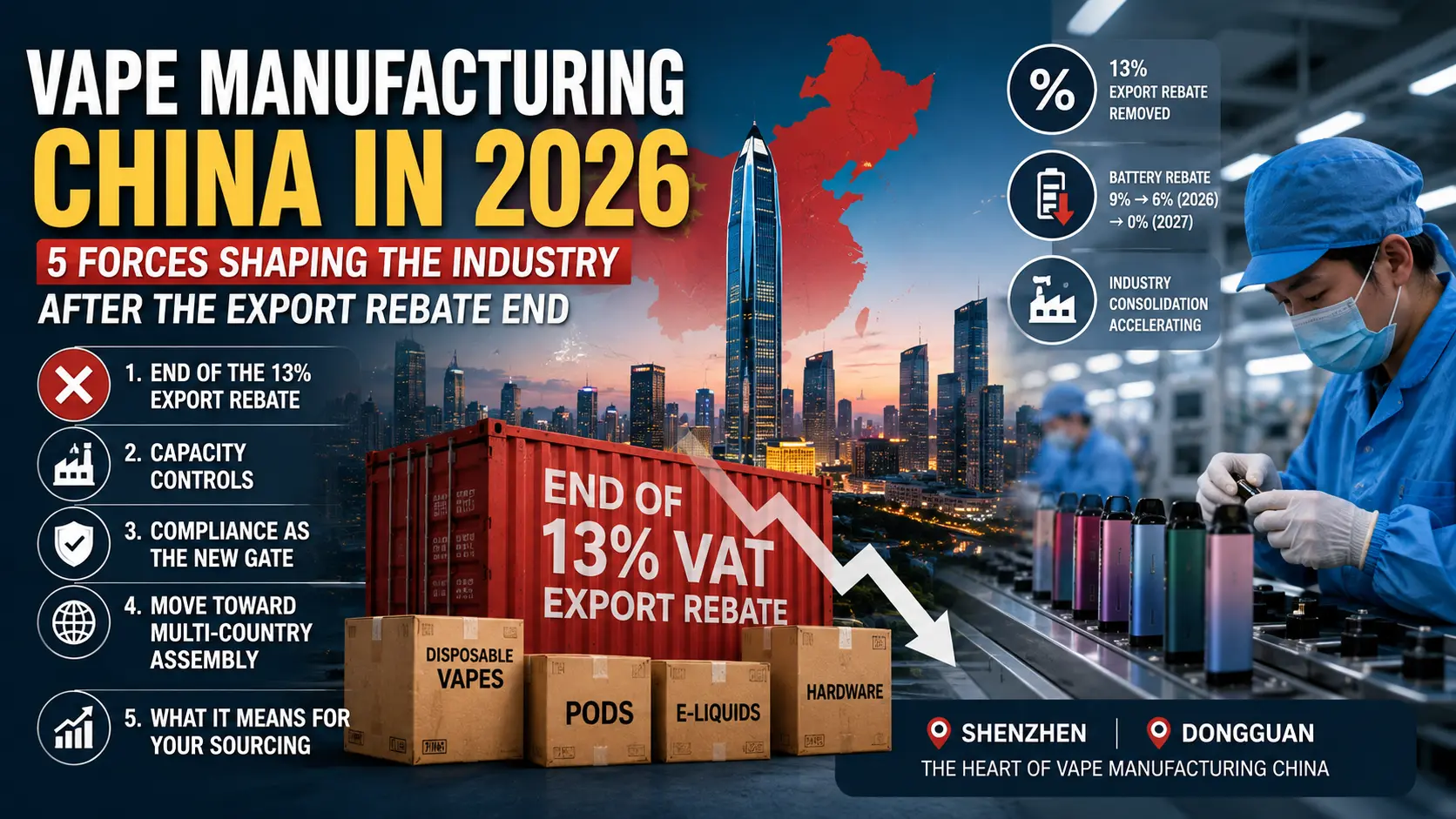
In January 2026, China’s Ministry of Finance and State Taxation Administration issued Announcement No. 2 of 2026, published as the official Ministry of Finance announcement. From April 1, 2026, the 13% VAT export rebate on finished vape products — disposable devices, pods, e-liquids, and related hardware — was eliminated. For a sector that had grown for a decade on that subsidy, the announcement marked the end of an era for vape manufacturing China.
For anyone outside the industry, that reads like a tax footnote. Inside vape manufacturing China, it was the biggest single event in years.
The export rebate was never a small part of the economics. Industry estimates put the annual rebate pool at roughly 60–80 billion RMB (about US$1.4 billion) across the sector. In 2024, China exported about US$10.9 billion worth of vape products. For a typical contract factory running on a 10% gross margin, the 13% rebate was not a bonus on top of profit — it was a large part of the profit itself.
When that buffer disappears, every factory in Shenzhen and Dongguan faces the same three options: raise prices, absorb the cost, or restructure production. None of them is easy.
This is the state of vape manufacturing China in 2026 — and it is changing faster than most brands realize. The rest of this article walks through the five forces reshaping vape manufacturing China this year: the end of the rebate, capacity controls, compliance as the new gate, the move toward multi-country assembly, and what all of this means for your sourcing decisions.
Why the Export Rebate Mattered So Much to Vape Manufacturing China
The VAT export rebate is a standard tool in Chinese trade policy. When a manufacturer exports, the government refunds a portion of the VAT paid along the production chain. For more than a decade, vape manufacturing China’s 13% rate effectively subsidized export pricing — which is one reason Chinese manufacturing costs stayed competitive for so long.
What most overseas buyers did not see: the rebate was built into the price they were quoted. When it is removed, the cost does not disappear. It has to be recovered somewhere along the chain.
According to 2Firsts Research, which interviewed manufacturers across Shenzhen, the impact is uneven by company type:
The same policy also touched batteries: the export rebate on battery products drops from 9% to 6% for the rest of 2026, then to zero from January 1, 2027. Since batteries are a major cost component in vape hardware — for disposable devices the cell is often the single most expensive component — this compounds the pressure on devices that ship with cells.
The repricing is spreading across the whole chain, not just the factory gate. Upstream component suppliers are raising their own prices as battery cells, packaging materials, and flavor ingredients all adjust to the new tax environment. Downstream, distributors and retailers are reassessing margins. That means the full cost impact will land on end consumers gradually over several quarters — but for a brand owner placing an order today, the new pricing is already in the quote. The window for locking in old pricing on new projects has effectively closed.
The Shenzhen and Dongguan Clusters: Where Vape Manufacturing China Lives
To understand the state of vape manufacturing China in 2026, you first need to understand its geography. Production is not spread evenly across the country. It is concentrated in two adjacent cities in Guangdong province: Shenzhen and Dongguan.
Shenzhen is the innovation and trading heart. Most of the world’s disposable vape designs, pod systems, and device architectures originate here. The city hosts the headquarters of the largest listed manufacturers, the component supply chain, the mold shops, and the majority of export trading companies. In the day-to-day reality of vape manufacturing China, Shenzhen is where new products get born.
Dongguan, where Vape ODM Factory operates, is the manufacturing workhorse next door. The city carries a large share of high-volume production, quality-controlled assembly lines, and the engineering teams that turn Shenzhen’s designs into repeatable, manufacturable products. For a buyer, the practical difference matters: Shenzhen is where you find ideas and speed; Dongguan is where you find scale and stability. Between them, the two cities carry most of the capacity of vape manufacturing China.
This two-city structure is part of why vape manufacturing China has been so hard to displace. It is not one factory competing with another. It is an entire industrial ecosystem — component suppliers, tooling shops, testing laboratories, logistics providers — within a few dozen kilometers. That density is the moat. It is also why the current consolidation is so significant: when the ecosystem itself shrinks, the effect is larger than the loss of any single factory. For anyone who studies vape manufacturing China, the density of the Guangdong cluster has always been the core competitive advantage — and it is now being tested under pressure.
If you are evaluating suppliers in this ecosystem, the practical question is how to choose well. Our guide on how to evaluate and choose a vape ODM factory in China walks through the specific checks that matter — from mold exclusivity to production audits — and is a useful starting point when you shortlist factories in Shenzhen or Dongguan.
Capacity Controls: Beijing Is Reining In Vape Manufacturing China’s Expansion
The rebate removal did not happen in isolation. It is part of a broader regulatory trajectory that has been tightening since 2023.
In December 2025, the State Tobacco Monopoly Administration published a draft notice on strengthening capacity management for e-cigarette production — explicitly calling for balance between supply and demand, and for curbing disorderly, “involutionary” competition. Industry reports in early 2026 indicated that new factory construction approvals had effectively been frozen unless tied to confirmed export demand.
This follows a longer arc:
The message is unambiguous: vape products are no longer treated as ordinary light-industrial exports. They are being managed as strictly regulated consumer products. For the first time, the central government is explicitly managing vape manufacturing China’s capacity, and the direction is contraction toward quality.
For buyers, the practical effect is that the pool of factories is shrinking, and the survivors are getting stronger. A 2026 brand sourcing strategy built on “find any factory, get the lowest quote” is no longer viable — because that factory may not be around in twelve months.
This is actually the deeper story of vape manufacturing China in 2026: it is not a crisis of capacity, but a deliberate rebalancing. Beijing is consciously shrinking the sector down to its most capable players, and treating the rest as excess that the market will absorb. For a brand, the implication is clear: your supplier list is about to get shorter, and your due diligence matters more than ever. The direction of travel for vape manufacturing China is toward fewer, stronger, more compliant factories — and that is precisely the type of partner you should be looking for.
Compliance Is Now the New Entry Ticket
The shakeout is not only about cost. It is also about who can meet the compliance requirements of destination markets.
European brands need TPD-compliant products, with EU-CEG notification, 20 mg/ml / 2 ml / 10 ml limits, child-resistant and tamper-evident packaging, and health warnings covering 30% of both main surfaces. UK brands face the single-use ban, MHRA notification, and from October 2026 the new Vaping Products Duty with its duty-stamp requirement. US-bound products face PMTA pathways and state-level excise taxes that in some cases reach 95%.
Maintaining parallel compliance teams for the FDA, the EU Commission, and the UK MHRA is expensive. The cost of global market access has effectively tripled since 2022. Manufacturers in vape manufacturing China that invested early in compliance infrastructure are now pulling away from those that did not.
This is where the industry is bifurcating:
The market is not shrinking. It is being redistributed.
If you need a baseline for what compliant manufacturing looks like, our breakdown of what an ISO certified vape manufacturer actually has to prove is a practical reference — it separates genuine certification from marketing language.
The practical consequence is that compliance documentation now decides whether an order even starts. A brand that previously asked “how low can your price go” now asks “show me your last EU-CEG submission, your current certificates, and your laboratory capability” before discussing price at all. That shift in the buyer’s first question is the clearest evidence that the industry has crossed a threshold: the low-cost era of vape manufacturing China is being replaced by a capability-based one.
Manufacturing Goes Global: The “China + Overseas” Model
One of the clearest trends of 2026 is the acceleration of overseas assembly.
Indonesia, Malaysia, and the US are the most frequently mentioned destinations. Some manufacturers are building full factories; others are doing hybrid models — producing cores and components in China, assembling in a second country.
The economics are shifting. With the 13% rebate gone, the cost gap between Chinese assembly and Indonesian assembly has narrowed significantly. Logistics operators report growing volumes on Indonesia-to-global routes, with plans to move from shared-cargo flights to full charter capacity as scale builds.
It is important to be precise about what this means. This is not vape manufacturing China losing its manufacturing base, nor is it a sign that the Chinese ecosystem is weakening. It is a rebalancing:
Chinese entities filed 4,218 international patent applications related to e-cigarette technology in 2025, compared with 892 from US entities and 614 from UK companies. The innovation pipeline — mesh coil optimization, smart chipsets for age verification and puff-count limits, next-generation nicotine salts that deliver satisfaction at EU-level 20 mg/ml — remains anchored in Shenzhen.
It is worth being honest about the trade-offs of overseas assembly. A factory in Indonesia or Malaysia may lower tariff exposure, but it rarely matches the component depth, tooling speed, or engineering bench of the Guangdong cluster. Prototyping that takes three weeks in Shenzhen can stretch to eight weeks in a new facility. Quality-control infrastructure, laboratory certification, and experienced production managers are not built overnight. This is why most serious manufacturers are not choosing between China and overseas — they are keeping core production where the capability is, and using a second location selectively for markets where the cost math demands it.
A related question that comes up often is whether can a Chinese vape factory handle TPD compliance for your target markets — the answer, in our experience, depends entirely on which factory you choose and what compliance infrastructure they have already built. We have written a dedicated guide on that specific question.
What This Means for Brands Sourcing From China
If you are a brand owner, distributor, or startup planning your next product, here is how the 2026 reality changes your sourcing decisions.
1. Expect price adjustments — and understand why
Prices will rise. Not because factories are being greedy, but because a structural subsidy is gone. A factory that absorbed a 13% cost hit while maintaining 10% margins is not sustainable. When a supplier raises prices, the right response is not to hunt for the cheapest alternative — it is to verify the factory is financially stable enough to survive the next twelve months.
2. Screen factories for survival capacity, not just unit price
The factories that will still be shipping in 2027 are the ones with:
3. Treat compliance capability as a hard requirement
The cost of global market access has tripled. A factory that cannot handle EU-CEG submission, MHRA notification, or US regulatory pathways is a liability no matter how cheap the quote. Ask for evidence: past submissions, compliance staff, certificate validity, laboratory capability.
4. Diversify deliberately, not in panic
A useful framework is to designate one factory as your primary production partner and a second as your qualified backup, rather than treating all suppliers as interchangeable. The primary partner holds your molds, understands your product history, and carries the volume. The backup is pre-qualified — same audits, same compliance documents — so that if the primary hits a capacity or pricing problem, you can switch without starting due diligence from zero. That structure costs little to maintain and removes the most common failure mode of diversification, which is ending up with five suppliers you trust none of.
5. Move toward partners, not transactional vendors
To understand what a full-scope relationship looks like, our guide on how turnkey manufacturing works explains where the handoff points are and what a factory should own end to end — from design through compliance to delivery.
How to Evaluate a Chinese Factory Under the 2026 Rules
Given everything above, here is a practical checklist to apply the next time you evaluate a supplier in vape manufacturing China:
If you want to understand the production process before you commit, two resources help: the VOF 6S system page explains how a single partner can carry a product from idea to shelf, and our guide on request a vape ODM quote tells you exactly what to prepare before your first inquiry so the conversation starts on the right foot.
The 2026 Trends in Summary
The state of vape manufacturing China in 2026 can be summarized in five movements:
Together, these five movements define where vape manufacturing China is heading — and none of them is reversible.
For brands, the takeaway is direct: the era of choosing a vape factory purely on price is over. The 2026 winners are the brands that choose compliant, scaled, financially stable partners — and build the relationship early. The winners among factories are the ones that have already absorbed the cost shock, kept their compliance teams intact, and positioned themselves for a multi-country future. Understanding the trends of vape manufacturing China in 2026 is the first step; acting on them is what separates the brands that will be around in 2027 from the ones that will not.
It is also worth saying what this does not mean. It does not mean abandoning vape manufacturing China as a sourcing base — far from it. The scale, speed, and engineering depth of the Chinese ecosystem remain unmatched, and the consolidation is making the survivors stronger and more reliable. What it does mean is that the buyer-supplier relationship has to change: from price-driven, transactional purchasing toward capability-based, longer-term partnerships. The brands that make that shift now will have a genuine sourcing advantage in the next phase of the industry.
Vape ODM Factory has manufactured for brands across 40+ countries since 2013, from our facilities in Dongguan. We handle design, tooling, production, and TPD/MHRA compliance as a single partner — the kind of factory the 2026 market rewards. If you are planning your next product, we can show you what a stable, compliant sourcing relationship looks like.
This article reflects the state of the industry as of August 2026, based on publicly available announcements and industry research. It does not constitute investment, tax, or legal advice. Regulations change — verify current requirements with official sources before making sourcing decisions.