The EU Battery Regulation 2027 vape question is not a rumor and it is not optional. Regulation (EU) 2023/1542 applies directly across all EU member states, and one of its provisions will force most current vape designs to change.
This guide explains the regulation, the 2027 deadline, and the practical steps brands should take before the design window closes.
This article is informational only and does not constitute legal advice. Confirm all dates and obligations against the official text before making product decisions.
Why the EU Battery Regulation 2027 Vape Rule Matters
Every vape product contains a portable battery, and that is exactly where the EU Battery Regulation 2027 vape rule bites. The regulation was not written for vaping; it was written for all battery-powered products. Vape devices happen to sit squarely inside its scope.
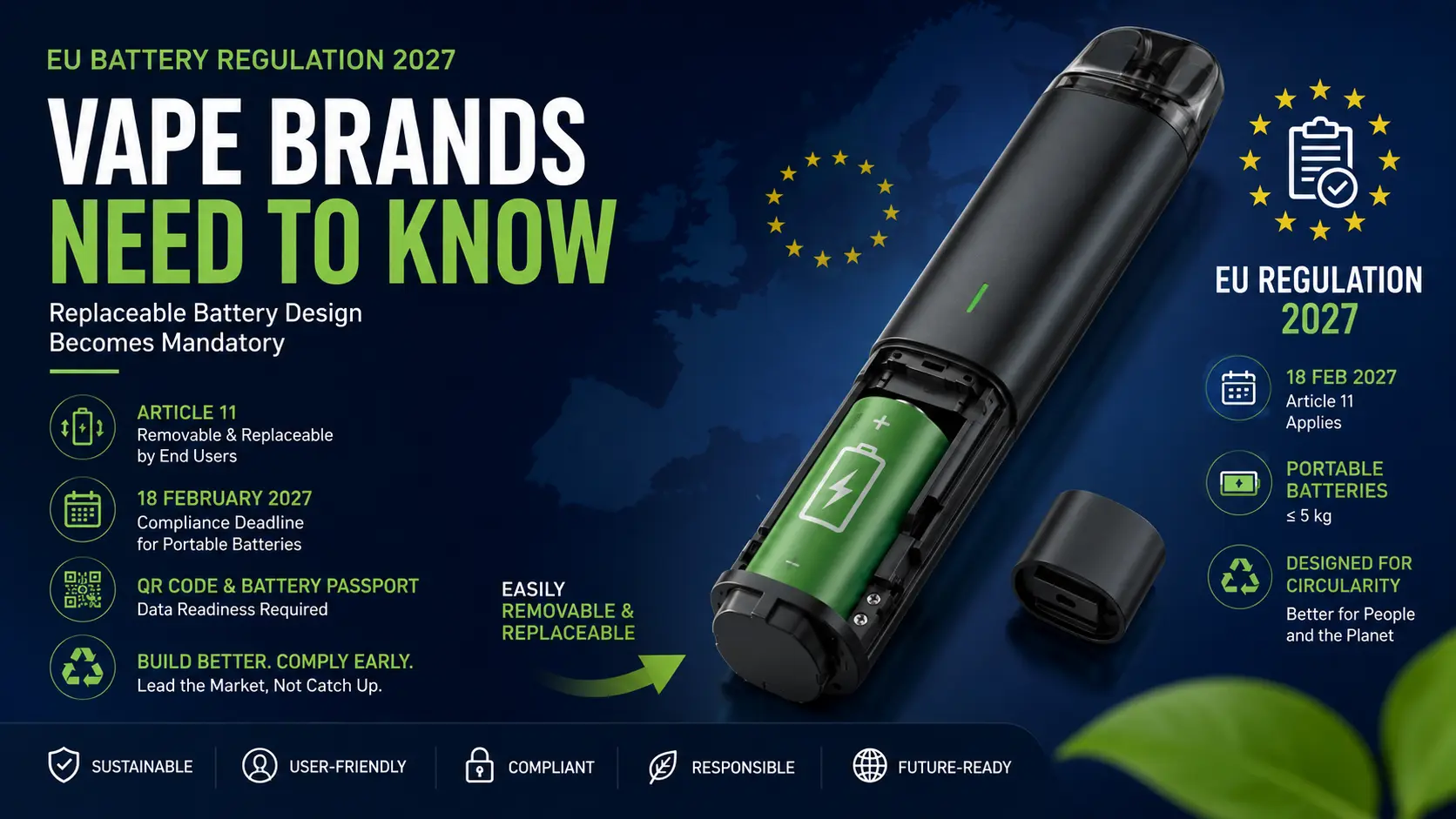
The rule that matters is Article 11. From 18 February 2027, products placed on the EU market that contain portable batteries must allow the end user to remove and replace the battery easily during the product’s lifetime. For an industry built on sealed, glued, single-piece devices, this is a structural change, not a paperwork change.
For context, the vape industry has never faced a design mandate this direct. TPD compliance focuses on liquid content, nicotine limits, and notifications; the EU Battery Regulation 2027 vape rule focuses on the physical product and its end-of-life handling.
It is the first EU-wide regulation that forces vape manufacturers to reconsider how a device is assembled, not just what it contains.
Why should brands care now, not in 2027? Because a redesigned battery structure needs new tooling, new samples, new testing, and new supply chain documents. That cycle takes months. Brands that wait for the deadline will discover that compliant products cannot be built overnight.
There is also a market timing angle. Buyers and distributors are already asking about battery access in product reviews, because the EU Battery Regulation 2027 vape requirement is widely known in the trade.
A brand that shows a replaceable-battery roadmap answers the question before it is asked, which shortens procurement discussions and opens doors that sealed-design suppliers cannot walk through.
What Is the EU Battery Regulation 2027?
Regulation (EU) 2023/1542 was published on 28 July 2023 and entered into force on 17 August 2023, replacing the previous Battery Directive 2006/66/EC. Unlike a directive, a regulation applies directly in every member state without national conversion laws, which means one set of rules for the whole EU market.
The regulation covers the full battery lifecycle: raw material sourcing, production, placing on the market, use, collection, and recycling. It divides batteries into five categories: portable, starting lighting ignition, light means of transport, electric vehicle, and industrial.
Vape batteries fall into the portable category, defined as sealed batteries weighing no more than 5 kg that are not designed for another category.
| Date | Requirement |
|---|---|
| 17 Aug 2023 | Regulation (EU) 2023/1542 enters into force, replacing Directive 2006/66/EC |
| 18 Feb 2024 | Regulation generally applicable, with case-by-case exceptions |
| 18 Aug 2025 | Member states must have producer responsibility and enforcement frameworks operating |
| 2026 | Extended labelling: battery contents, recycled content, separate collection symbol |
| 18 Feb 2027 | Article 11 applies: portable batteries removable and replaceable by end users; QR code and battery passport data readiness |
The official text is published on EUR-Lex, and any reading of this guide should sit next to that primary source. Dates and obligations change; the regulation’s own text is the anchor.
For vape brands, the practical reading of the EU Battery Regulation 2027 vape timeline is simple: 2026 is the preparation year, and February 2027 is the compliance line. The labelling work lands in 2026, the structural work must be designed and sampled before 2026 ends, and the QR and passport data should be ready at the same time as the product.
How the EU Battery Regulation 2027 Vape Rule Affects Products
Article 11 targets the design of the product, not just the battery. The requirement is that the complete battery unit can be removed with commercially available tools, without special tools unless supplied free with the product, without proprietary tools, and without heat or solvents.
Designs that rely on glue, ultrasonic welding, or destructive disassembly will not meet the test.
The impact differs by device category:
| Device type | Typical battery design today | Impact after 18 Feb 2027 |
|---|---|---|
| Disposable vape | Ultrasonic-welded, glued, fully sealed | Highest impact; sealed design must be re-engineered |
| Closed pod system | Built-in sealed battery | Redesign needed for an accessible battery compartment |
| Pen-style device | Built-in sealed battery | Redesign needed |
| Rechargeable box mod | Often removable battery | Easier path to compliance |
The regulation also requires instructions on battery removal, replacement, and recycling, and it requires replacement batteries to remain available for at least five years after the last unit of the product is placed on the market. Software must not prevent users from fitting a compatible replacement battery.
Disposable vapes are the category under the most pressure. A sealed single-piece device is, by definition, hard to open without destruction. The EU Battery Regulation 2027 vape rule does not single out disposables by name, but its effect on them is the strongest because their current structure is the furthest from the requirement.
Closed pod systems sit in the middle. Many already have a structural seam where the pod meets the body, but the battery cavity is still sealed. Re-engineering that cavity into an accessible compartment is a smaller change than rebuilding a disposable from scratch, which means pod brands have a realistic path inside the remaining window.
The EU Battery Regulation 2027 vape impact is therefore not uniform. Disposables need the deepest change, pods need a focused rework, and rechargeable formats are closest to compliance. Each category has a different cost and timeline, and each should be planned separately rather than treated as one redesign project.
What this means for a brand’s product roadmap is clear: if you sell multiple device types, prioritise the ones closest to the February 2027 deadline and start the redesigns in parallel, not sequentially. Running three redesign tracks at once through one factory partner is cheaper than racing a single one alone at the last minute.
Replaceable Battery Vape Design: The Future Direction
The direction for compliant design is an accessible battery compartment: a battery the user can reach with an ordinary tool, remove without damaging the rest of the device, and replace with a compatible unit. Modular construction, screw-fixed battery covers, and separation of the battery cavity from the e-liquid chamber are the building blocks.
Why this is not a step backwards:
- Longer product life. A replaceable battery lets the device outlive the battery, which is the single biggest driver of a lower total cost per user.
- Less electronic waste. Battery separation at end of life makes recycling viable instead of sending the whole device to the shredder.
- European circularity alignment. The regulation is part of the European Green Deal; products designed around removal and recycling fit the policy direction rather than fighting it.
- Buyer confidence. Distributors and retailers increasingly ask about end-of-life design; a removable battery is a concrete answer.
For brands, the design question is not whether to move to replaceable structures, but how quickly and at what cost. Every month of delay pushes the redesign into a tighter window with more expensive alternatives.
A practical design checklist for the new structure: the battery compartment must be reachable without destroying the shell; the cover should use standard screws or a clip system rather than adhesive.
The battery connector should be a standard type so replacement units stay available, and the e-liquid chamber must stay sealed even after the battery is handled.
These four points cover most of what Article 11 will check in practice, and they are the core of any EU Battery Regulation 2027 vape design brief.
What Vape Brands Should Prepare Before 2027
The preparation list below turns the regulation into a project plan. Start now, because each item has its own lead time.
| Area | What to prepare | Why it takes time |
|---|---|---|
| Product structure | Switch from sealed design to accessible battery compartment | New tooling and structural samples |
| Battery sourcing | Supplier data: composition, recycled content, declarations | Data chain for labelling and passport |
| Labelling and QR | Contents label, separate collection symbol, QR/passport readiness | Packaging redesign cycle |
| ODM project timing | Tooling, samples, and testing for the new structure | 3 months end to end |
| Replacement supply | Plan five-year replacement battery availability | Supplier commitment and stock |
The product development cycle deserves special attention. A new battery compartment touches industrial design, structural engineering, tooling, testing, and packaging. Working through that sequence with a factory partner takes most brands 3 months, which is why the vape product development process should be running before 2026 closes.
The supply chain file is the part brands often underestimate. The battery supplier must provide composition data, recycled content declarations, and safety documentation that feed both the 2026 labelling and the later QR and passport layers.
Starting those data requests now means the 2026 label change is an update rather than a scramble, and it keeps the EU Battery Regulation 2027 vape compliance calendar realistic.
How Vape ODM Manufacturers Can Support Compliance
A redesign under a new regulation is exactly the situation where a manufacturing partner adds value beyond production. An ODM can support the transition on four fronts.
- Battery design and integration. Engineering the battery compartment, the removal mechanism, and the separation between battery and e-liquid zones.
- Tooling and mould development. Building the new structural parts without starting from zero, using existing platform experience.
- Testing and certification. Running the mechanical, electrical, and battery-related tests the new structure needs.
- EU market project experience. Applying lessons from products already designed around EU rules, including how to sequence samples and approvals.
When you evaluate factories for this transition, certification and R&D depth matter more than unit price. The factory that can show battery-access prototypes and a clear project timeline is the one that will de-risk your 2027 position. The criteria in how to evaluate a vape ODM factory in China apply directly to this decision.
For brands that want the whole transition handled as one program, a turnkey vape manufacturing solution covering design, tooling, production, and compliance keeps the project on one timeline instead of four separate vendor schedules.
What to ask a factory before signing: show me a battery-access prototype, tell me the tooling timeline for a compartment change, and confirm who compiles the battery documentation.
The answers reveal whether the factory has internalised the EU Battery Regulation 2027 vape requirement or is still treating it as a customer problem. The EU Battery Regulation 2027 vape transition is a design partnership, not a purchase order.
FAQ: EU Battery Regulation 2027 Vape
Q1: Will disposable vapes be banned from 2027?
The regulation does not ban disposable vapes by name. It requires portable batteries to be removable and replaceable by the end user from 18 February 2027. Sealed one-piece disposables as they exist today will not meet that requirement, so their structure has to change rather than the product disappearing by fiat.
National measures may still restrict disposables separately, so check your target markets. The practical effect is that an EU Battery Regulation 2027 vape compliant disposable will look and behave differently from today’s models.
Q2: Does Article 11 mean users must swap batteries every day?
No. The requirement is about the ability to remove and replace the battery during the product’s lifetime, primarily for end-of-life separation and recycling. It is a design and waste-management rule, not a daily-use ritual.
Q3: Does the battery regulation replace the TPD?
No. The TPD and the battery regulation are separate legal instruments that apply alongside each other. A product still needs its TPD notification, and it will additionally need to meet the battery regulation’s design requirements. The EU Battery Regulation 2027 vape rule adds to the compliance stack; it does not replace it.
Q4: Are vape products exempt from Article 11?
No specific exemption covers vape products. In July 2026 six new exemption categories were added, covering wearables, electric toys, food probes, ATEX equipment, subcutaneous delivery systems, and agricultural remote terminals. E-cigarettes are not among them, and water resistance does not automatically qualify as an exemption either.
Q5: What does “readily removable” actually mean?
The official test has four parts: the battery can be removed with commercially available tools; no special tools are required unless supplied free with the product; no proprietary tools are required; and no heat or solvents are needed. If a design depends on glue or ultrasonic welding to stay closed, it fails the test.
Q6: When should we start the redesign?
Now. Tooling, samples, testing, packaging, and supplier documents take 3 months for a structural change. Starting before the end of 2026 leaves room for the two or three sample iterations that a new battery compartment usually needs. Every month of delay in the EU Battery Regulation 2027 vape planning narrows that margin.
Conclusion: Build for the EU Battery Regulation 2027 Vape Future
The EU Battery Regulation 2027 vape requirement turns battery access into a design feature, not an afterthought. Brands that redesign early gain three advantages: compliant products ready before the deadline, a defensible answer for distributors and retailers, and a product story aligned with Europe’s circular economy direction.
The regulation is the clearest signal yet that European product design is moving toward repair and recycling, and vape hardware is being pulled along with it.
The cost of waiting is a compressed timeline, rushed samples, and the risk of holding stock that cannot be sold in the EU after February 2027. The cost of acting now is a normal product development cycle, which your factory should be running anyway. The deadline is fixed; the time to start the redesign is now, while factory capacity is still open.
Look at the calendar honestly: 2026 is the labelling year, and the structural work has to be sampled before it ends. That is roughly twelve months of design, tooling, and iteration, which is exactly the lead time a serious ODM engagement needs.
The EU Battery Regulation 2027 vape transition rewards the brands that start first, because the factories with battery-access experience and proven timelines will book their capacity ahead of the rush.
If you are new to the EU market and need the broader entry picture first, read how to start a vape brand in the UK & Europe. When you are ready to turn the EU Battery Regulation 2027 vape rule into a product plan, talk to a factory that has already built battery-access thinking into its platforms.
Request a vape ODM quote and start the redesign on a timeline you control, not one the regulation dictates.