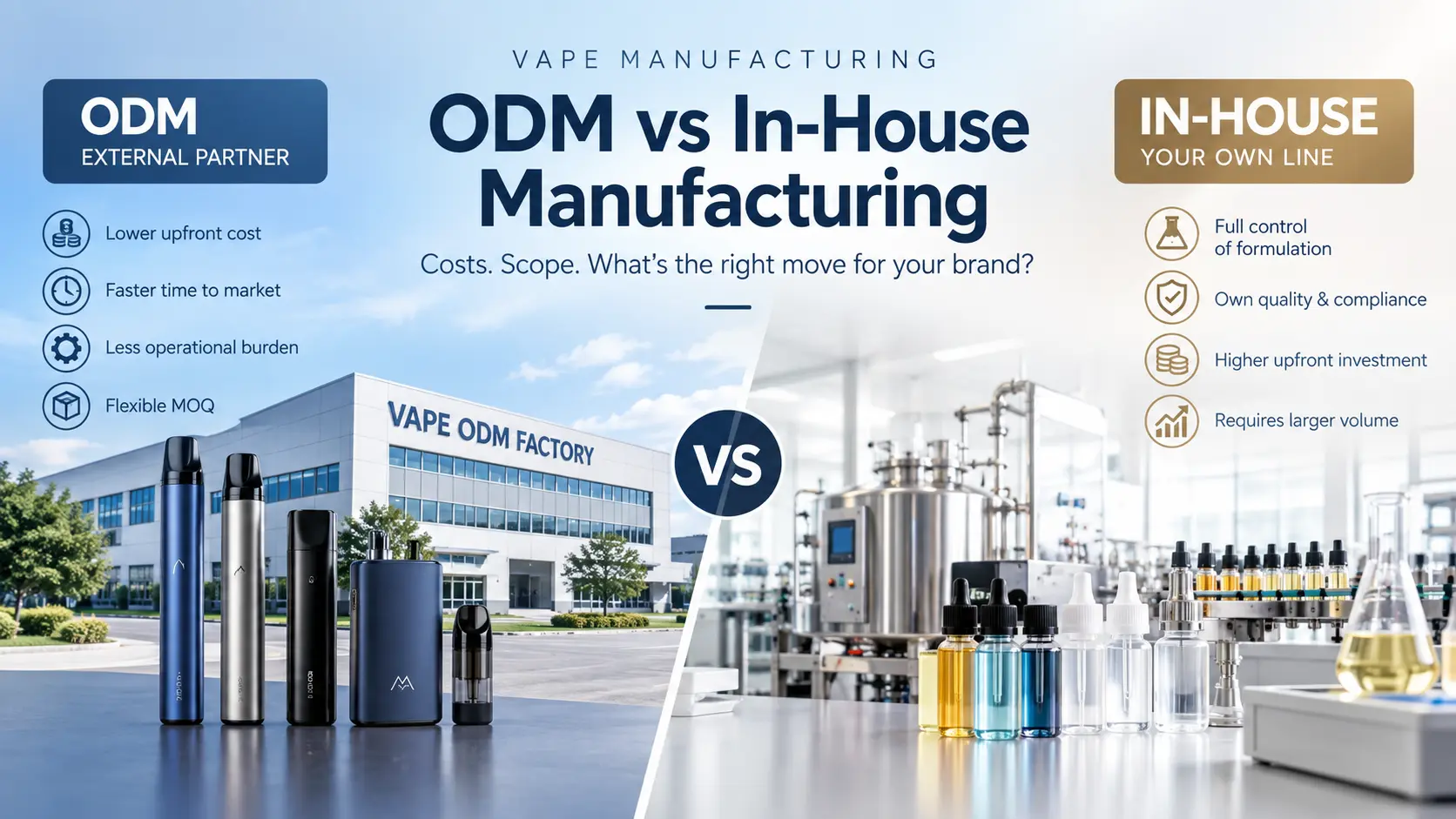
The vape ODM vs in-house manufacturing question looks like an accounting problem and is actually a company-building problem. It gets asked at the point where a brand has proven demand and starts to resent paying someone else for every unit. That resentment is natural. It is also expensive if it leads you to build capacity your real volume cannot feed.
Before we go further, a statement of interest. We operate an ODM factory in China, so we sell exactly the service this article compares against. Read our numbers with that in mind, get a second quote, and use the framework rather than our conclusion. This piece is written for European brand owners and startup teams deciding whether to bring production in-house or keep it with an external partner, and it deliberately separates the two very different products that the word vape covers: the device and the e-liquid.
Those two products change the vape ODM vs in-house manufacturing decision completely. For a hardware device, building your own factory means molds, injection molding machines, battery sourcing, assembly lines and cleanroom capacity. That is a different capital order of magnitude and, for most European brands, simply off the table. For e-liquid, the realistic question is narrower: do you install your own mixing and filling line, or do you pay an external manufacturer to produce your recipes? Frame the vape ODM vs in-house manufacturing comparison around the right product layer and the answer changes from guesswork into arithmetic.
The Vape ODM vs In-House Manufacturing Question Is Really Two Questions
Ask the question at the device layer first, because this is where most naive build-your-own plans die. If your own production line means assembling complete hardware devices in Europe, look at what the factories you would compete with actually contain: injection molds, automated assembly stations, cell sourcing and certified test equipment. Published tooling ranges start around EUR 5,000 and climb steeply from there, and industry guides that quote complete first orders put a fully custom device program at EUR 20,000 to EUR 100,000 or more before a single unit ships. That total excludes the building, the staff and the qualification work. Few European brands survive that math, which is why hardware almost always stays on the ODM side of the ledger.
The e-liquid layer is where the honest debate lives. Mixing tanks, a filling and capping line, a labeling station and a small quality lab are genuinely purchasable at a scale a growing brand can digest. One startup cost analysis for e-liquid equipment we checked puts a small semi-manual setup at roughly EUR 10,000 and a fully automated line above EUR 100,000. That range is real enough that a brand selling meaningful volume of bottled liquid can make a serious argument for owning the line. This is the layer where the vape ODM vs in-house manufacturing decision deserves your full attention.
So split your planning in two. If the product is hardware, the practical question is not build versus buy; it is which kind of external partner you need. If the product is e-liquid, you genuinely face the vape ODM vs in-house manufacturing fork, and the rest of this article is a full cost comparison of those two routes with the numbers we see from both sides of the table.
The Vape ODM vs In-House Manufacturing Comparison Starts With Scope
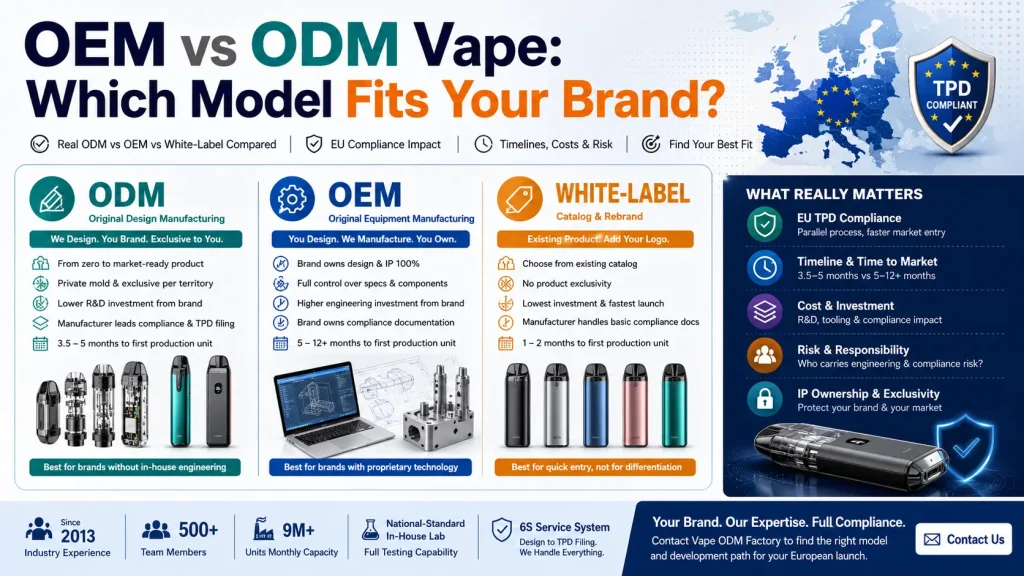
An ODM engagement is a defined scope of work. In the cleanest tier, white label, you take an existing product, put your logo on it and sell it. Private label sits one step higher: the device stays proven but you control packaging, logo execution, flavor lineup and the SKU mix. Full ODM means the factory designs a device around your brief, builds exclusive tooling for it, and usually ties that exclusivity to volume commitments. Each tier adds a supplier with its own minimum viable batch, which is why MOQs are quoted per flavor and rise as customization deepens. Our earlier guide on OEM versus ODM models explains the tier differences in full; the short version is that deeper ODM adds cost and lead time at every step, which is exactly what the vape ODM vs in-house manufacturing comparison must price in.
The in-house route covers a much longer chain. You own the formulation, the mixing, the filling, the labeling, the batch records, the retention samples and the quality results that regulators and retailers will ask to see. Owning the chain sounds liberating until you realize every one of those steps is a fixed cost that needs volume underneath it. In the vape ODM vs in-house manufacturing comparison, scope is not a detail; it decides which cost model applies to you.
A comparison table keeps the two scopes honest.
| Cost and responsibility | Working through an ODM partner | Building your own line |
|---|---|---|
| Upfront capital | Low; setup fees from roughly EUR 100 to a few thousand | Equipment from roughly EUR 10,000 upward; more for automation |
| Unit cost profile | Includes the partner’s development costs, spread over units | Materials plus your overhead; falls only as volume rises |
| Compliance burden | Brand still notifies; partner supplies documents | Brand becomes the registered producer with full documentation duty |
| Team needed | Sourcing, quality and logistics staff | Production, quality, maintenance and compliance staff |
| Speed to first batch | Weeks for white label; months for full ODM | Months of equipment, validation and documentation work |
Upfront Capital: The First Divide in the Vape ODM vs In-House Manufacturing Decision
The capital gap is the first thing founders feel, because it is due in cash before anything sells. On the ODM side, published industry guides put a complete first order in the EUR 1,000 to EUR 10,000 range for a branded existing product, with logo setup from EUR 100 to EUR 500, custom packaging setup from EUR 300 to EUR 2,000 and samples from EUR 50 to EUR 200. Those are the numbers in the VapeVex OEM versus ODM guide, and they match what we quote for white label and light private label work. At this point in the vape ODM vs in-house manufacturing capital comparison, the gap could not be more visible.
On the in-house side, the same money buys one piece of the puzzle. Equipment is the headline, but the room matters as much as the machine. An e-liquid room needs controlled access to nicotine, surfaces that can be cleaned to a defensible standard, ventilation, and enough space that the line can be laid out without cross-contamination between mixing and filling. Add a quality lab with the instruments your documentation requires, and the true setup number lands well above the machine price. Budget for validation runs too: the first batches exist to prove the process, not to sell. When the vape ODM vs in-house manufacturing decision is made on equipment price alone, the room, the lab and the validation work are what break the budget.
Then add the layer nobody prices correctly, which is your own time. One founder running procurement, installation, validation and documentation is a founder not running distribution. When customers ask us to lay out the vape ODM vs in-house manufacturing choice, we always draw a line under time-to-first-batch, because equipment cost is a one-time hit and months of distraction are a recurring one.
Unit Cost in the Vape ODM vs In-House Manufacturing Comparison
Most founders assume the vape ODM vs in-house manufacturing trade-off is decided by unit price, and that assumption is where the mistake starts. An external partner prices units to cover its own development, quality systems and margin, which is why published ODM unit ranges look wide, roughly EUR 1.50 to EUR 7.00 depending on device and volume. Building your own line does not remove those costs; it converts them into overhead that you carry whether or not you produce.
E-liquid unit economics make the point cleanly. An industry cost breakdown of a 10ml e-liquid bottle we reviewed puts the physical factory cost at roughly EUR 0.45 to EUR 1.10 per bottle before tax: base liquid around EUR 0.05 to EUR 0.10, flavor EUR 0.15 to EUR 0.40, nicotine EUR 0.10 to EUR 0.30, and compliant packaging EUR 0.15 to EUR 0.30. Excise and VAT sit on top and are identical whether you mix the liquid or buy it filled. Both routes pay for essentially the same materials, which is precisely why the vape ODM vs in-house manufacturing comparison has to look past unit cost.
The real lever is utilization. An external line only costs you money when you order; your own line costs you money every month it stands still. Run a conservative forecast: fill the line eight hours a day, five days a week, then compare that with the volume your current channel plan actually moves. The moment your forecast volume cannot keep the line busy, the vape ODM vs in-house manufacturing comparison stops being about unit price and becomes a pure overhead question that the external route wins.
There is one honest caveat in the other direction. At genuinely high and stable volume, owning the line removes the partner margin and gives you control over cost structure, scheduling and proprietary recipes. That is a real advantage, and it is why some of the largest European liquid brands do their own filling. The catch is that those brands reached that volume while paying someone else to produce, then brought production in-house once demand was proven. Read that sequence as the natural shape of the vape ODM vs in-house manufacturing journey for the brands that eventually end up owning lines.
Time to Market and the Cash Cycle
Time behaves differently on the two sides, and time is money twice over: once in delayed revenue, once in the cash locked into equipment. On the ODM side, white label and light private label programs move in weeks, and a full ODM program with new tooling runs three and a half to five months with compliance testing in parallel. In both cases your capital converts into sellable stock in a single cycle. On the in-house side, the realistic path to a compliant first batch is measured in months of equipment procurement, installation, validation and documentation before you produce a single bottle you are allowed to sell. That timing gap is why many brands treat the vape ODM vs in-house manufacturing decision as a cash-flow question rather than a pure cost question.
Think about what the delay does to a young brand. The company that reaches market in four weeks collects retail feedback, reorders fast and compounds; the company that spends a year building a line is financing equipment with the same cash the first company used to buy inventory three times. Selling stock and seeing it move teaches you more than installing a filler ever will. For a startup, the cash cycle argument alone usually settles the question for the first two years; revisit the vape ODM vs in-house manufacturing decision only after two years of stable sell-through data.
Compliance, Quality and Risk Ownership in the Vape ODM vs In-House Manufacturing Trade-Off
Here is the part most comparisons get backwards. They treat compliance as an ODM cost you avoid, when the legal duty sits with the manufacturer or importer of the product, which in a brand relationship is the brand. TPD notification to EU-CEG, the six-month clock, the dossier, the child-resistant packaging rules and the market-by-market submissions sit on your side of the table whether you build or buy. Choosing the vape ODM vs in-house manufacturing route does not move that duty; it only changes how much of the underlying evidence you have to generate yourself.
What changes is the burden of proof. A good ODM partner holds emissions data, ingredient declarations and batch records for platforms it has already qualified, and can hand you the documents a notification needs. When you build your own line you become the registered producer, and every batch record, retention sample, quality result and audit trail is yours to create and defend. That is not a one-time cost; it is a standing obligation that scales with every SKU and every market you add. Run the compliance staffing cost through the vape ODM vs in-house manufacturing comparison before you sign anything.
Risk also sits asymmetrically. The ODM route concentrates supply risk: lead times, minimum orders, and for exclusive tooling, the risk that your intellectual property sits in someone else’s factory. The in-house route concentrates operating risk: a line that sits idle, a batch that fails quality control, a staff problem, all absorbed by you with no supplier to push back on. Regulatory change can strand either investment, and this is where hardware decisions look dangerous in 2026: disposable bans across member states and the EU battery rule that effectively ends sealed-battery devices from February 2027 mean a brand building hardware capacity for a category regulators are removing would be building a line for a product with an expiry date. E-liquid capacity is more resilient to those two rules, which tilts the vape ODM vs in-house manufacturing verdict toward the liquid layer for anyone tempted to build.
Quality has a commercial dimension as well. Retailers across Europe will not list an unknown producer without paperwork, and consumers now treat the brand as accountable for what is inside. Owning production means you can stand behind every batch with your own signature; outsourcing means you are only as good as the partner you pick. That is why factory audits and the published red flags when evaluating ODM factories exist, and why we tell customers to treat partner due diligence as a real workstream, not a phone call. The same discipline belongs on the in-house side of the vape ODM vs in-house manufacturing ledger.
A middle path exists and is more common than the pure versions: keep hardware on the ODM side and bring bottled e-liquid filling in-house, or the reverse. Many successful European liquid brands mix their own shortfill and salts while importing devices from an ODM partner. The hybrid route lets you own the layer where you have genuine margin and differentiation while leaving the capital-heavy layer to specialists. Whatever mix you choose, run it through the vape ODM vs in-house manufacturing frame again after two seasons, because the answer moves as your volume moves. Start with what to ask a manufacturer before ODM production, and you will see the due diligence list we give every brand whatever route it eventually takes.
A Decision Sequence for the Vape ODM vs In-House Manufacturing Question
Instead of a gut call, run a sequence. Answer these in order and the vape ODM vs in-house manufacturing choice mostly answers itself.
- Which product layer are we talking about: hardware, liquid, or both?
- What volume can we actually sell in the next twelve months, per SKU and per flavor?
- How much capital can we risk on equipment that produces nothing until it is validated?
- How fast does our cash need to come back, and can we finance inventory and equipment at the same time?
- Who will own the compliance documents, and what evidence do we already hold?
- What would a regulatory change do to the specific product we are building?
Then apply three filters. Filter one is volume: if your forecast does not keep a line busy, outsource. Filter two is capital: if building the line delays your next product launch or your next market, outsource now and revisit in two years. Filter three is control: if your recipe or your hardware design is the actual moat, then owning the line, or owning the tooling with an ODM partner under an exclusivity agreement, may be worth the overhead. Brands that pass all three filters with real numbers, not hopes, are rare, and they are the ones who should build. Everyone else should compare three ODM quotes before they compare anything else. Our guide on the cost to start a vape brand and the minimum investment private label vape guide give the surrounding budget numbers for both situations.
The Short Version
The vape ODM vs in-house manufacturing decision, stated plainly: if you are below the volume that keeps equipment busy every week, if your cash needs to turn quickly, and if your product is not a secret recipe or an exclusive design, outsourcing beats building on almost every line of the comparison. If you have proven demand, protected formulation or design, and capital that can wait, building your own line is a legitimate next step, and the smart operators time it that way. As a factory that sells the ODM side of this comparison, our advice is the same we give our own customers: run the numbers on your real forecast, requesting an ODM quote and a line investment quote in the same week, and let the arithmetic, not the romance of owning a factory, make the call.