Most European vape brand owners learn one lesson the hard way: sourcing disposable vapes from a factory that looks legitimate on Alibaba costs far more than the unit price suggests. Seized shipments, failed TPD notifications, and inconsistent puff counts don’t announce themselves upfront. They surface months later, when your inventory is stuck at customs and your retailers are demanding answers.
The challenge isn’t finding a disposable vape manufacturer. It’s finding one that understands European market realities — a factory that produces a compliant, consistent product and can prove it before you commit to a six-figure order. This guide focuses on the verification steps and risk factors specific to disposable vape sourcing for European brands, skipping the generic factory evaluation basics you can find elsewhere, and drilling into what actually goes wrong.
Why the Wrong Disposable Vape Manufacturer Can Cost You a European Launch
A disposable vape brand entering the EU or UK doesn’t just compete on flavor variety or puff count. The primary gatekeepers are customs authorities, notified bodies, and the EU-CEG portal. If your manufacturing partner can’t provide verifiable documentation, your product never reaches the shelf.
Three specific risks make disposable vape sourcing uniquely dangerous compared to other vape hardware. First, the 2ml tank limit seems simple but is surprisingly easy to violate when e-liquid filling tolerances aren’t tightly controlled — a batch that averages 2.05ml can be seized at the border. Second, battery safety documentation requirements have been intensified across major European ports, and many smaller factories can’t produce the UN38.3 test summaries that customs now routinely request. Third, the disposable format is under active regulatory pressure — countries are banning it, and even where it’s still legal, enforcement thresholds are rising.
To learn more about the fundamentals of evaluating any ODM factory, including ownership verification and communication audits, see our complete factory evaluation guide. This article builds on that foundation with disposable-specific risks you won’t find covered elsewhere.
Disposable-Specific Red Flags That Generic Factory Evaluations Miss
Standard red flags — like unverifiable certificates or reluctance to allow audits — apply to any factory. But disposables carry additional warning signs that experienced buyers watch for specifically.
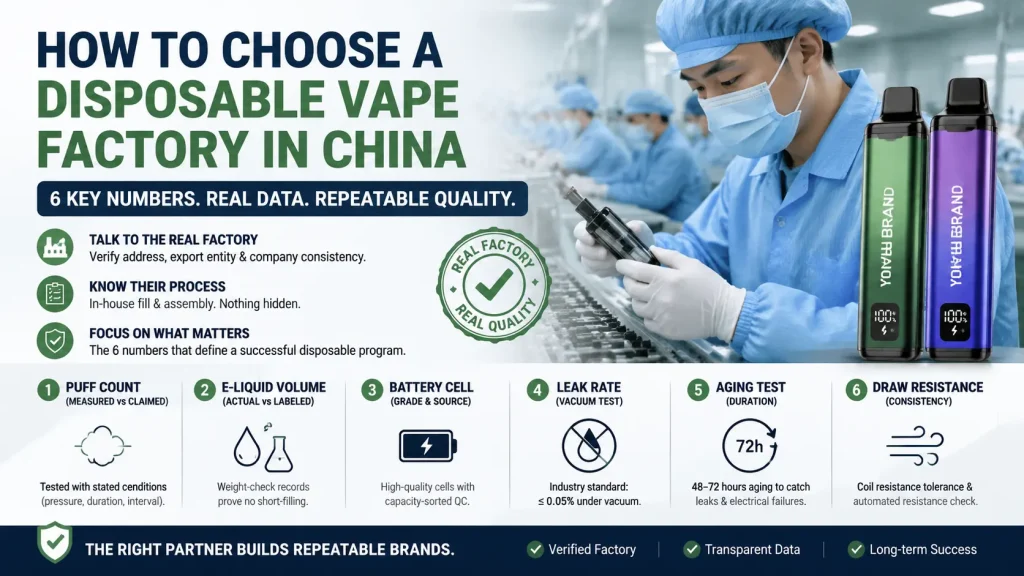
- Inconsistent e-liquid fill levels across units within a sample batch. This usually means the filling equipment isn’t calibrated for the tight tolerances TPD compliance requires.
- Puff count claims that don’t match battery capacity. A disposable claiming 600 puffs with a 400mAh battery and no smart power management is physically impossible. Ask your prospective disposable vape manufacturer to explain the engineering behind their puff count claim.
- Absence of a dedicated 2ml filling line. Factories that produce for multiple markets often run the same line for non-EU products, introducing cross-contamination risk and inaccurate fills.
- Coil degradation visible after 48-hour aging tests. If the factory can’t provide aging test data showing consistent resistance across the claimed puff lifespan, assume consumers will experience burnt tastes before the device is empty.
- Battery cell certificates that don’t list the specific cell model you’re using. Generic battery documentation is a red flag; Grade-A cell suppliers provide traceable lot numbers.
These aren’t theoretical. A European distributor we know ordered 80,000 units before verifying battery documentation. Customs held the shipment for nine weeks pending supplementary testing. By the time the order cleared, the retail launch window had closed.
Six Verification Steps for Disposable Vape Manufacturers (Beyond the Basics)
The foundational checks — business license verification, live video factory tour, ISO certificate validation — are essential but insufficient for disposable products. Here are six additional verification layers specifically for this category.
1. Request batch compliance documentation for a recent European shipment.
Ask the factory for a full document package from a real order they shipped to Europe within the last six months: EU-CEG submission confirmation, toxicology reports, emissions test data, and the packaging artwork file that was actually printed. A factory that can’t produce these either doesn’t understand European requirements or has never genuinely supported a European brand.
2. Verify the filling line’s 2ml precision.
TPD mandates a 2ml maximum for nicotine-containing e-liquid. But the regulation doesn’t specify a tolerance, and many customs authorities interpret any measurable excess as non-compliance. Ask the factory to show internal QC data on fill volume variance across a production run. A reliable disposable vape manufacturer will have a ±0.05ml or tighter specification, documented per batch.
3. Inspect the battery documentation chain.
For every battery cell supplier the factory uses, request UN38.3 test summaries, MSDS documentation, and EU declaration of conformity. Cross-reference the cell model number across all three documents. If the factory sources cells from multiple suppliers, understand which batch uses which cell — and get that in writing. → (正文 P)
4. Evaluate the coil and cotton supply chain.
Inconsistent flavor and dry hits usually trace back to coil and wicking material variability rather than e-liquid problems. Ask whether the disposable vape manufacturer uses the same mesh coil supplier consistently or switches based on cost. Request aging test data for at least three production batches to confirm consistent resistance behavior.
5. Test for packaging compliance across all target markets.
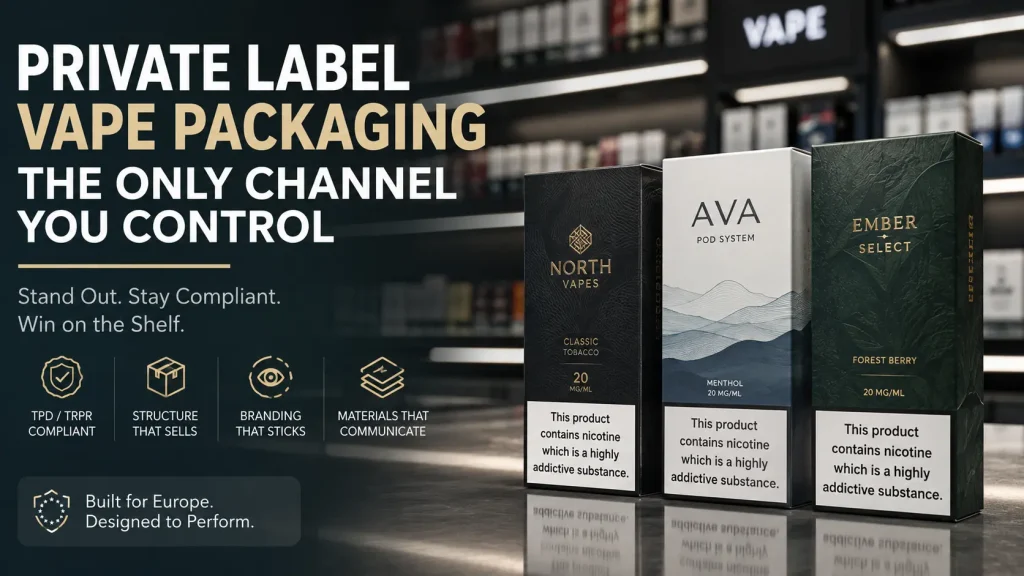
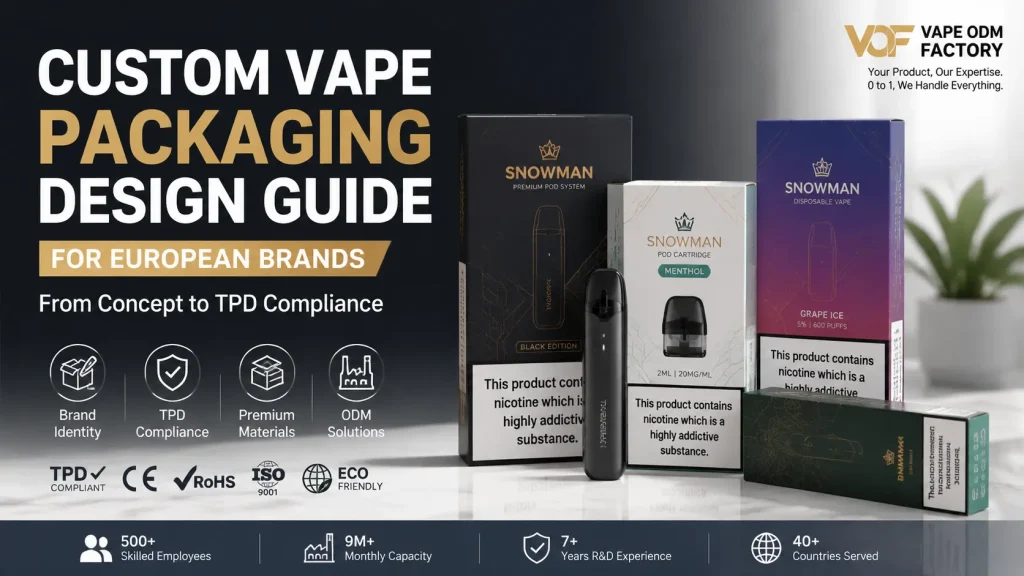
A disposable vape sold in Germany, France, and the Netherlands requires three different health warning formats, often in multiple languages. The packaging must also carry child-resistant certification marks and nicotine warning text that meets the specific formatting requirements of each member state. If your factory can’t show you market-specific packaging samples for each country you’re entering, budget for a packaging redesign before you even launch.
6. Assess format adaptability for markets with impending restrictions.
Several European countries are banning or restricting single-use disposables. A forward-looking disposable vape manufacturer should already be developing rechargeable disposable formats — devices that maintain the convenience form factor but add USB-C rechargeability and replaceable pods, satisfying both consumer demand and regulatory requirements. If your factory only offers one rigid format with no engineering flexibility, you’re building a brand on a product architecture with a shrinking addressable market.
Why Disposable Vape Quotes Vary by 30–40% for the “Same” Specification
Two factories can quote €1.80 and €2.90 respectively for what appears to be an identical 600-puff disposable. The difference rarely reflects profit margin alone. It reflects choices about components, compliance, and quality control costs that directly affect your European market viability.
- Battery cell grade: A-brand cells (from manufacturers like EVE or Lishen) cost 20–30% more than B-grade equivalents. The price difference translates directly into cycle stability, capacity consistency, and documentation traceability — all of which customs authorities and consumers notice.
- E-liquid compound quality: Factories using TPD-registered nicotine and pharma-grade PG/VG with full CAS documentation incur higher ingredient costs. A factory quoting below market average is almost certainly cutting corners on ingredient traceability, which will surface when you try to file EU-CEG notifications.
- Coil wire material: Kanthal, nichrome, and stainless steel behave differently over extended use. Factories that switch coil wire suppliers without updating their testing data produce units that taste different batch-over-batch — a quality consistency problem that retailers notice.
- Filling precision investment: Achieving ±0.05ml fill tolerance requires automated filling equipment with in-line checkweighers. Manual or semi-automated lines produce wider variance, and the lower price reflects lower equipment investment and higher seizure risk.
- Compliance cost inclusion: Some quotes include TPD toxicology testing, emissions analysis, and EU-CEG submission costs. Others exclude them, leaving you to pay €3,000–5,000 separately. A lower unit price that excludes compliance is more expensive than a higher unit price that includes it.
Always ask your disposable vape manufacturer to separate the compliance cost line item. If they can’t, they probably haven’t thought about compliance at all.
EU Warehouse Logistics for Disposable Vapes: What “European Delivery” Actually Means
Many suppliers claim to offer European warehousing and fast delivery. The term is used loosely, and the differences matter.
- China-based factory with DDP shipping: The factory handles door-to-door logistics, including customs clearance and duties. Actual delivery time to your door is typically 7–12 days by air freight. No European storage — you receive the full order and manage inventory yourself.
- Factory with rented EU warehouse space: The factory stores inventory in a European logistics hub and fulfills orders to your retailers or distributors within 2–5 days. But note: the warehouse is a storage facility only. No manufacturing, no assembly, no local compliance work happens there. The product is still entirely made in China.
- European-based assembly or finishing: Almost nonexistent in the disposable vape industry. Some suppliers imply EU presence, but when pressed, they can’t show video of their European operation. This is almost always a China-only manufacturer with rented warehouse space — not a bad thing, but a distinction you need to understand.
A genuine EU warehouse capability is valuable — it reduces your inventory carrying cost and speeds up retailer fulfillment. But it doesn’t reduce your compliance obligations or change the fact that the product is manufactured in China. Ask your disposable vape supplier to clarify exactly where value-add processes happen and where products are stored.
Should You Still Launch a Disposable Vape Brand in Europe in 2026?
The landscape is shifting fast. The UK’s already disposable ban, in mid-2025, removed a major market from the single-use format. France and Belgium are advancing similar legislation. Ireland and the Netherlands have signaled intent. Traditional non-rechargeable disposables are clearly on a downward trajectory in Western Europe.
But that doesn’t mean the market opportunity has evaporated. Two dynamics are emerging. First, Eastern and Southern European markets — where regulatory pressure is currently lower — still maintain active demand for TPD-compliant disposables. Second, the “rechargeable disposable” format is growing rapidly across the EU. These devices look and feel like disposables but incorporate USB-C charging and replaceable pre-filled pods. They satisfy consumer convenience expectations while complying with developing sustainability regulations.
If you’re committed to the disposable segment, your product brief should either target markets where the format remains viable or adopt a rechargeable architecture that future-proofs your brand regardless of which country bans single-use hardware. The disposable vape manufacturer you choose must be able to support both directions — maintaining TPD compliance for current disposable formats and having the engineering flexibility to develop rechargeable variants when needed.
Disposable Vape Supplier Evaluation Checklist for European Importers
Use this checklist when you’re past the initial factory verification and ready to make a purchasing decision.
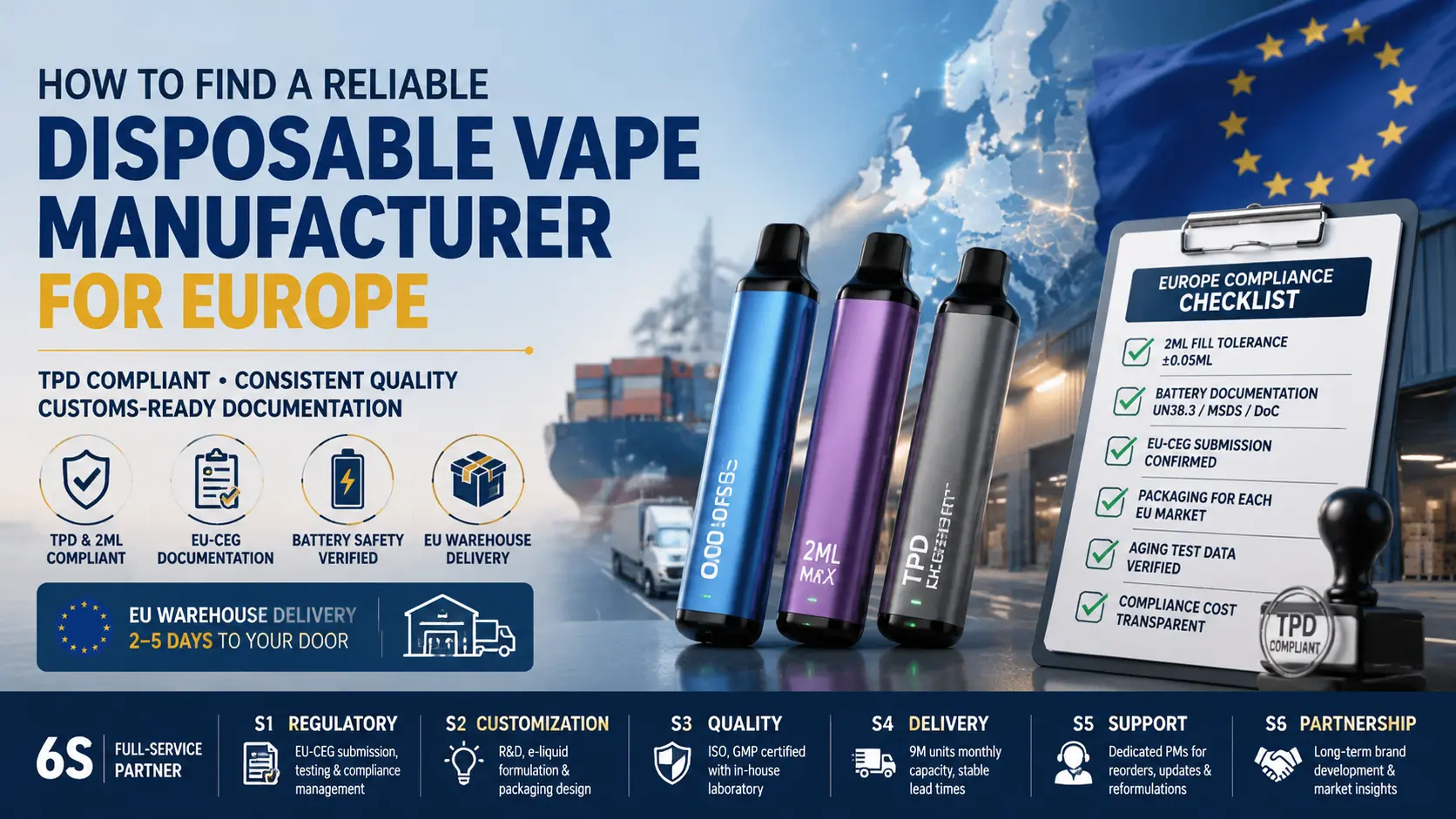
- 2ml fill tolerance documented at ±0.05ml or better
- Battery cell documentation (UN38.3, MSDS, DoC) verified for the specific model used
- Batch compliance packet from a recent European shipment reviewed and validated
- Coil aging test data provided for at least three production batches
- Packaging artwork confirmed for each target EU member state
- EU-CEG submission responsibility clarified in writing
- Ingredient documentation with CAS numbers obtained for TPD registration
- Quality control defect rate and return policy documented in supplier agreement
- Factory’s format adaptability assessed (disposable → rechargeable capacity)
- Compliance costs separated from unit price in the quotation
If the factory passes this checklist, you’ve significantly reduced your sourcing risk. No checklist eliminates all uncertainty — but a factory that can’t answer these questions isn’t ready for your European brand.
How the 6S System Supports European Disposable Vape Sourcing
The evaluation criteria in this guide reflect what European importers actually need, not generic factory capabilities. Vape ODM Factory built the 6S service system to address these needs directly.
- Regulatory (S1) : Direct EU-CEG submission on your behalf — not just compliance advice, but execution. This includes toxicology testing coordination, emissions analysis, and packaging compliance validation.
- Customization (S2) : In-house R&D covering industrial design, e-liquid formulation, and packaging — all developed with TPD constraints built in from day one.
- Quality (S3) : ISO 9001, ISO 14001, ISO 45001, and GMP certifications with a national-standard laboratory performing internal batch testing.
- Delivery (S4) : 9 million units monthly capacity from a 500+ staff facility in Dongguan, with documented lead time consistency.
- Support (S5) : Dedicated project managers who handle reorders, reformulations, and regulatory updates.
- Partnership (S6) : Long-term brand development support including product roadmap planning and regulatory monitoring.
Your brand handles sales — the factory handles everything else. If that aligns with how you’re building your European vape business, explore the 6S system or start a conversation with our team to discuss your project brief.
Choose a Disposable Vape Manufacturer That Protects Your European Brand
Every disposable vape launched in Europe carries the importer’s legal responsibility, not the factory’s. Customs authorities, notified bodies, and consumers hold you accountable — not the manufacturing partner in Shenzhen. The verification steps, red flags, and checklist in this guide are designed to surface risks before they become liabilities.
Priority one is compliance documentation that stands up to customs scrutiny. Priority two is production consistency that protects your retailer relationships. Priority three is engineering flexibility that future-proofs your brand as European regulations evolve. A factory that addresses all three priorities is worth its unit price.
Vape ODM Factory has supported European vape brands since 2013 from a Dongguan facility with 500+ staff and 9 million units of monthly capacity. The team handles design, compliance, production, and delivery. If you’re ready to discuss your disposable vape project, contact us with your brief or explore our full product development range to understand what’s possible within today’s European regulatory framework.