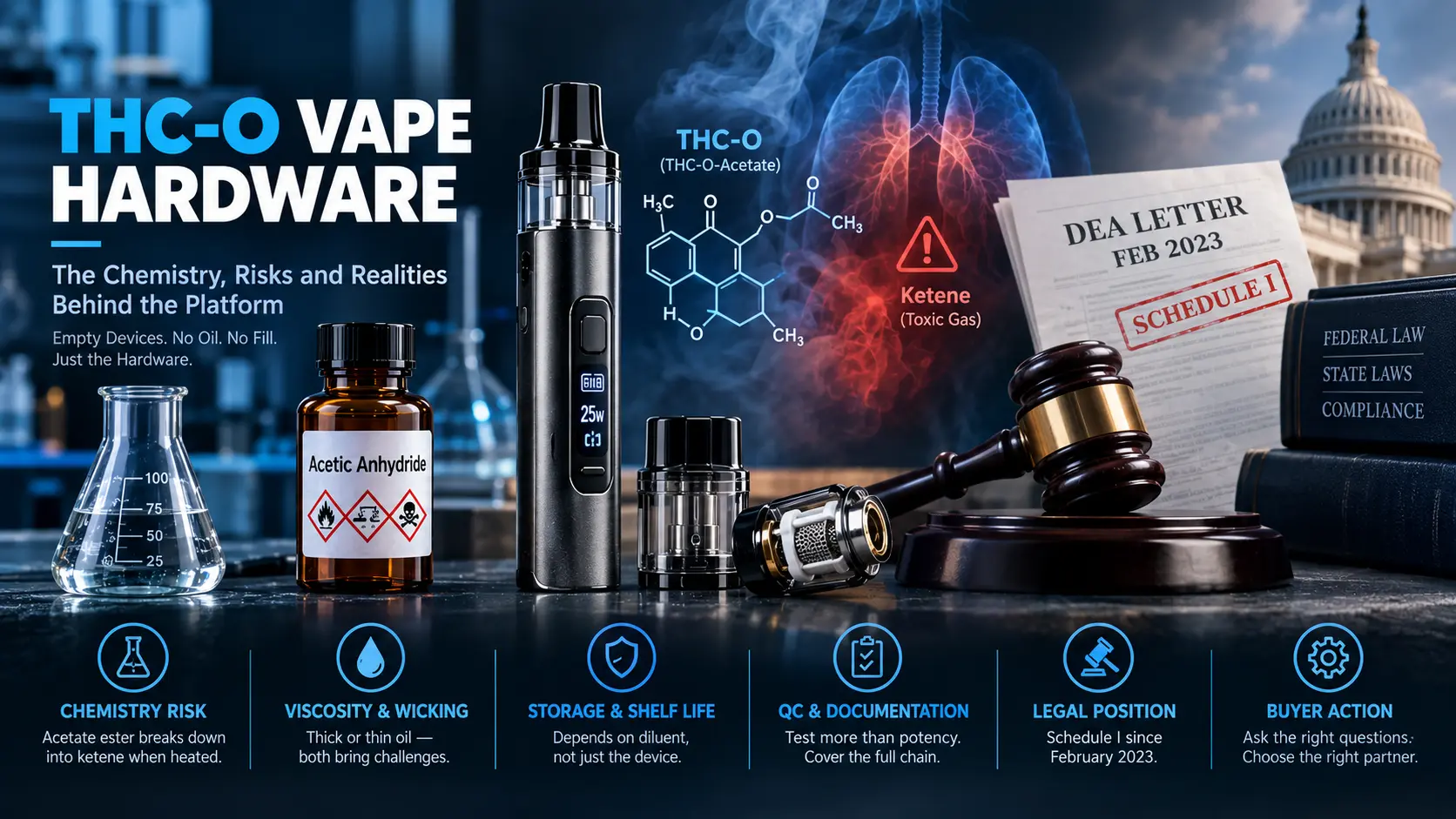
Start with scope. We build hardware and we do not build oil. Everything on our side ships as an empty all-in-one device with no fill, so what follows describes what a THC-O vape hardware platform must survive once a formulator fills it. Where this article touches finished, filled products, that is the other side of the market, included for comparison and not sold by us.
Second, the boundary that matters more here than on any other page we publish. This article does not constitute legal advice. The federal position of THC-O vape hardware was set by a DEA letter in February 2023 and state law has moved since, so anyone weighing a purchase, a label or a shipment should get an answer from qualified counsel before money moves.
Now the tension. For delta-8 our advice was a countdown and for HHC it was a listing date. A THC-O vape hardware program faces a harder question: not when regulation arrives, because it arrived in 2023, but whether a device can be engineered at all for a molecule that breaks down into a pulmonary toxicant at the temperature the device exists to reach. That is the part product pages leave out.
1: What THC-O Is, and Why It Is Not a Normal Cannabinoid
THC-O is short for THC-O-acetate, and the name carries the chemistry. Hemp-derived CBD is isomerized into delta-8 THC, which is then acetylated with acetic anhydride. Acetylation attaches an acetate group to the molecule, so the result is an ester rather than a plant cannabinoid. THC-O does not occur naturally in cannabis in any meaningful amount, and no cultivar was ever bred to contain it.
That point is not trivia. It is the legal story, and it also explains the physical behavior. Acetic anhydride is a corrosive, flammable and volatile reagent that belongs in controlled laboratory conditions. Acetylation itself is routine pharmaceutical work, since aspirin is acetylated salicylic acid, but the reagent list and the reaction control are not things a small brand improvises.
The molecule also has a longer history than the market realizes. DEA laboratories encountered an acetylated cannabis extract made with acetic anhydride in Florida in 1978, and a United Kingdom case in 1995 treated THC-O-acetate as a Class A drug. Each new generation of sellers rediscovers it.
What did not exist until recently is human evidence. Claims that THC-O is three times stronger than delta-9, or reliably psychedelic, have no published human study behind them; a 2024 survey found 79 percent of users describing the experience as not at all or only a little psychedelic. Any THC-O vape hardware specification therefore starts from an artificial ester with thin clinical history, made with a hazardous reagent, sold on potency claims nobody has verified.
2: Why THC-O Vape Hardware Is a Chemistry Problem, Not an Engineering One
An acetate ester is thermally unstable. Heat one past a certain point and the ester bond breaks, releasing ketene, a highly reactive gas that industrial operators handle with ventilation because it damages lung tissue. This is textbook organic chemistry, and the supply chain confirms it: acetic anhydride, the reagent used to make THC-O, is produced industrially from ketene. For a THC-O vape hardware platform, the molecule arrives with its failure mode built in.
The experimental record on THC-O vape hardware starts in 2022. Researchers vaporized CBD-acetate, CBN-acetate and THC-O-acetate with an e-nail and screened the emissions for ketene. All three produced it. The team also bought a commercial delta-8 THC-O product online and tested it, and ketene appeared there too, in a product people were already using.
Then comes the number that should stop a purchase order. A toxicology paper calculated the activation energy for ketene release from THC-O-acetate at 63.7 kcal/mol for the delta-8 form and 62.7 for the delta-9 form. Vitamin E acetate, the compound the CDC identified in the 2019 EVALI outbreak, sits at 65.9. THC-O’s barrier is lower, and the authors framed their paper as a warning about another EVALI epidemic.
The most rigorous measurement arrived in 2026 in the journal Analyst. Researchers vaped a panel of acetylated cannabinoids on a commercial cannabis e-cigarette and trapped the emissions; the acetate group decomposed into ketene with nearly quantitative efficiency, above 99 percent, with ketene yields running 1 to 4 percent by cannabinoid mass. A THC-O vape hardware platform heats a compound whose acetate group converts almost completely, on every draw.
Two control results close the escape routes. No ketene was detected in the unvaped distillates, and none came from the non-acetylated cannabinoids. This is not contamination or storage, because the oil is clean until it is heated. It is also not a device-tuning story, since opening the airflow vent lowered ketene yields but raised carbonyl yields. There is no THC-O vape hardware setting that removes the problem, only a choice of which mix gets generated.
Context matters. Between 2019 and 2020, 2,807 people were hospitalized and 68 died in the EVALI outbreak, which the CDC tied to vitamin E acetate used as a cutting agent in gray-market THC carts, and the PNAS paper the following year established the mechanism: an acetate ester plus heat produces ketene. THC-O is not a cutting agent. Here the acetate ester is the active ingredient itself, and the chemistry does not care about that distinction.
Which returns the conversation to hardware, where a buyer still holds real decisions. Coil resistance, voltage band, preheat curve and airflow geometry are all dials a factory sells, and every one of them is a temperature and residence-time dial. Temperature and residence time are exactly what drive the decomposition. A THC-O vape hardware platform can be built well, tested hard and sealed properly, and still cannot fix this.
3: Viscosity and Wicking in THC-O Vape Hardware
Viscosity is where most buyer conversations start, and for this molecule it is genuinely murky. Poison control literature describes THC-O-acetate as a thick, dark oil with no flavor or odor, while formulation writing in the trade describes it as running thinner than most cannabinoids and often needing a blend partner to hold together. A filling line sees the finished blend, not the raw ester, so a THC-O vape hardware spec has to be written against the blend.
Whichever way the blend lands, the burden on a THC-O vape hardware platform is familiar from delta-8 and HHC. Thin oil works past seals and finds its way out of a tank in transit. Thick oil starves a wick tuned for something else, which surfaces as dry hits and a burnt note a customer never forgets. The device absorbs that range in the tank, the airway and the wick, or the brand absorbs it in returns.
The discipline that follows is what we recommend for every high-viscosity extract line. Get the working viscosity at filling temperature in writing, name the diluent class, and validate a THC-O vape hardware platform against that specific blend rather than against the phrase viscous oil. Seal architecture follows the same logic: multi-layer silicone gaskets, a press-lock assembly, packaging that keeps the device upright, and pressure-decay leak testing on the line.
Be clear about what viscosity work buys. It buys a device that fills, seals and draws without failing on the bench. It does not touch the decomposition described above, because that reaction happens at the coil, after the oil leaves the tank, on every draw. Treating a wicking fix as a resolution is the most common reasoning error here.
4: Seals, Storage and Shelf Life: The Ester Problem
A second chemical issue shows up before the device is ever used, and it lives in storage. A stability study published in Japan tested delta-9 THC-O-acetate alongside glycerol, propylene glycol and PEG400. Pure acetate did not convert into delta-9 THC under heat, but in the diluted liquid products the acetate concentration fell or disappeared entirely, which means the shelf life of a THC-O vape hardware line is set by the diluent rather than the device.
That is an ester exchange problem, and it has direct consequences for anyone stocking a THC-O vape hardware line. Shelf life depends on what the oil was cut with, so the diluent profile belongs in the written specification and the storage data belongs in the document pack. Ask for it and expect a short answer, because the industry has produced little data on ester-based liquids in long-term contact with silicone, PCTG or tank adhesives.
The sealing and logistics discipline matches what we recommend for delta-8. Multi-layer silicone gaskets rated for the oil chemistry, a press-lock assembly, upright packaging, and leak verification by pressure decay. Shipments travel through private carriers, so transit tolerance deserves to be counted twice.
One honest note. Cold warehousing will slow degradation and reduce complaints, but it will not alter what happens at the coil. Storage engineering protects the oil before the sale, not the reaction a customer triggers when they inhale.
5: Quality Control Points If a Line Is Still Being Built
THC-O vape hardware buyers still ask for this list, which is why it exists. That is not a recommendation to proceed. Read it as the minimum documentary standard for a category with an unresolved chemistry question, and pair it with legal advice before a purchase order rather than after one.
Start on the reagent side. Acetic anhydride is classified by DEA as a List I chemical because of its role in heroin synthesis, and the FDA warning letters sent to THC-O sellers in February 2023 raised the reaction process itself as a concern. Residual reagent, residual solvent and reaction by-products belong on the testing panel, not just cannabinoid potency, and a COA reporting only potency is a marketing document.
Then double the paperwork, because both halves of the product carry risk. On the oil side: potency, residual solvents, residual acetic anhydride where measurable, heavy metals, and a named testing laboratory with batch numbers. On the hardware side: materials documentation for tank and airway, a battery safety file, and batch-level device COAs covering the same heavy metals. For THC-O vape hardware, a clean oil certificate does not survive contact with a dirty platform.
Finally, hold the batch discipline this category struggles with. Freeze the variant list before quoting and spec it per flavor, because a different diluent or blend is a different product and therefore a different specification. Re-verify whenever the oil source changes, and test the leak path after filling rather than assuming the design holds. A THC-O vape hardware supplier who cannot produce these documents has already answered the question.
6: The Legal Position: Schedule I Since February 2023
If a buyer takes one date from this article, take this one. In February 2023 the DEA stated in a letter that THC-O-acetate does not occur naturally in the cannabis plant and therefore does not meet the hemp definition under the 2018 Farm Bill, which places it under federal controlled substance rules. The Congressional Research Service summarizes that position as the agency’s interpretation, and the letter’s precise legal footing has been described differently in different trade write-ups, which is why a lawyer belongs in the decision.
Federal agencies were not alone in moving. The FDA sent warning letters to six companies marketing THC-O in February 2023, stating that the compound is not a naturally occurring hemp derivative and flagging acetic anhydride’s status as a DEA List I chemical. On the state side, Tennessee banned THC-O and other synthetic cannabinoids in consumable hemp products effective January 1, 2026, and Texas removed inhalable hemp products from the shelf entirely.
The federal clock still runs for the rest of the category. The Continuing Appropriations and Extensions Act takes effect on November 12, 2026 and changes the hemp definition three ways: a 0.3 percent cap on total THC including isomers, a 0.4 milligram per-container limit, and a natural-source rule excluding cannabinoids synthesized outside the plant. Congress also directed the FDA to publish lists of synthetic and natural THC-class cannabinoids by February 10, 2026, and that deadline passed with nothing published.
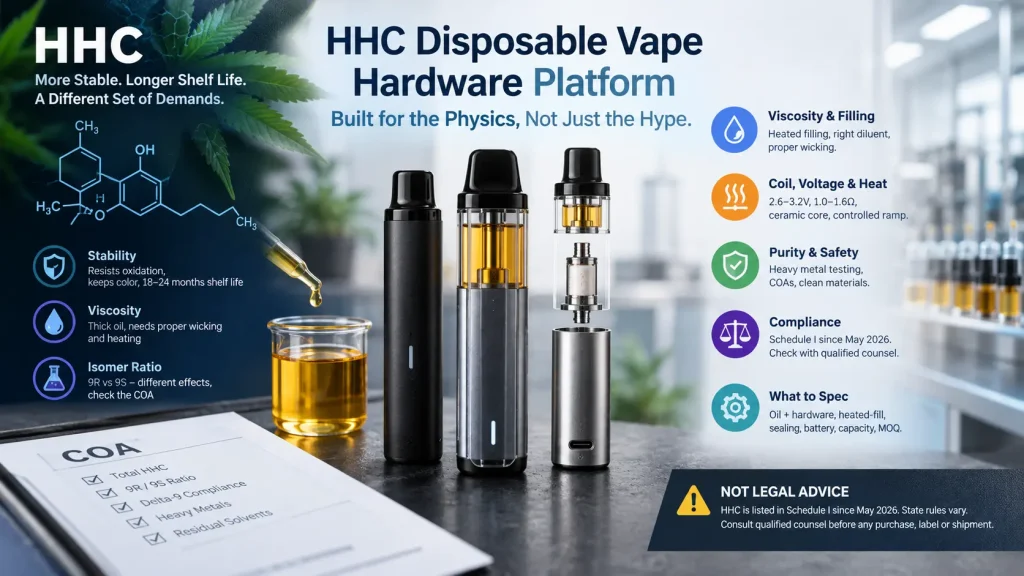
Compare the timing with the neighboring categories to see why this one is different. HHC received its specific Schedule I listing in May 2026 and industry litigation is pending, so a brand can at least litigate while it sells. Delta-8 faces the November 2026 change with courts still split. THC-O vape hardware was addressed in 2023, which leaves less room to argue that the legal question is unsettled, and no comparable argument that the chemistry is.
7: What a Hardware Buyer Should Do Now
Put the questions in the right order, because the usual order wastes months. First, what is the legal identity of this product in each destination state, answered by counsel rather than a supplier. Second, given the ketene evidence, does the product concept survive that answer. Third, and only then, what documentation does a factory owe a THC-O vape hardware buyer.
If a line proceeds, the hedge is the platform. Coil engineering for thick extracts, sealing systems, battery matching and heated-fill compatibility transfer unchanged to any oil that shares the physics: hemp CBD, other extracts, state-licensed lines. That is the same argument we made for HHC, and a THC-O vape hardware program needs it more, because the compound is harder to defend. The customization ladder from logo programs to full ODM builds is set out in our private label guide.
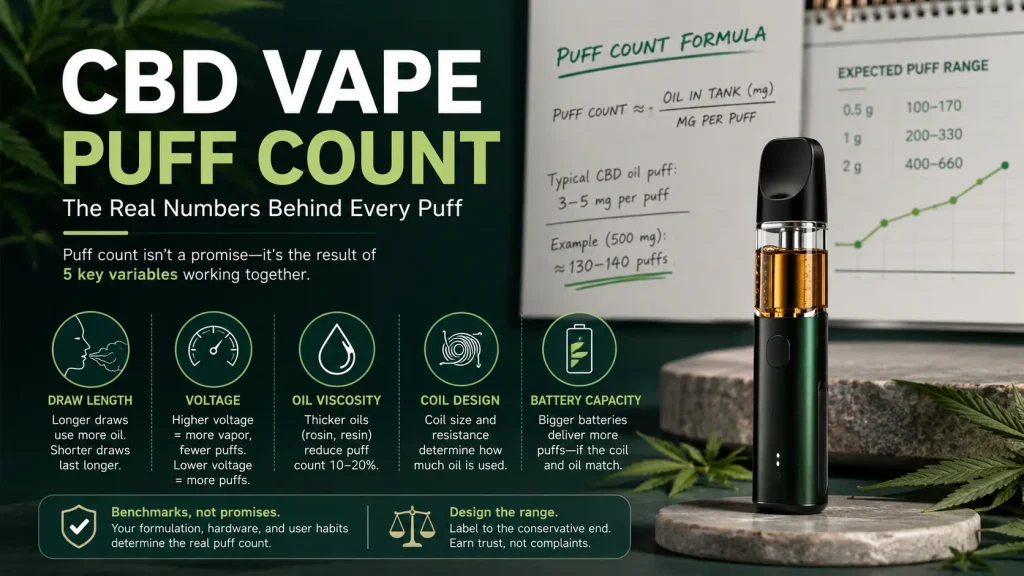
For buyers comparing THC-O vape hardware with neighboring compounds, our delta-8 hardware requirements and our HHC buyer’s guide cover the chemistry and compliance clocks of the two neighboring categories, and the CBD versus THC hardware comparison explains where the underlying platform splits. If capacity planning is on the table, the puff count math connecting fill size to real usage is in our CBD capacity guide, and the framework for vetting a supplier on those documents is in our manufacturer checklist.
Five questions, asked of every supplier and compared by answers rather than adjectives. Which diluent classes was this platform validated on? What coil and voltage pairing is standard, and what temperature does it reach? Where is the wicking proof under chain draws? What does the batch-level device COA cover? And what is the per flavor MOQ and requote policy when the oil supplier changes? A THC-O vape hardware supplier who cannot answer is selling a device with a battery and a story.
8: THC-O Vape Hardware After the Acetate Warning
Strip away the category name and what remains is a platform. THC-O vape hardware, at the parts level, is high-viscosity extract hardware: a ceramic core, a sealed tank, a battery matched to the oil’s life, and filling compatibility for warm oil. Isomerization and acetylation change which legal lane the oil sits in. They do not change the physics the platform was built for, and they do not change the chemistry the device triggers when it fires.
Our position here is simple, and it is not a sales position. We sell empty all-in-one devices, shipped with no fill. We do not sell THC-O oil, we do not blend it, and we are not going to dress coil and airflow engineering up as a way to make an acetate ester behave inside a lung. Where the evidence says the problem is the molecule rather than the device, a factory claiming otherwise is not doing engineering, it is selling against the data.
If you are weighing a product line now, send us the oil class, the destination markets and the timeline. We will come back with platform options, validation data and the document chain behind each number, and we will say plainly when the better answer is a different oil. Our request-a-quote page starts that conversation. Buy THC-O vape hardware for the physics if you buy it at all, and take the chemistry and the statute to someone qualified to advise on them.
This article provides general information about vaping hardware specifications and does not constitute legal advice. THC-O-acetate has been treated by the DEA as a controlled substance since its February 2023 letter, state rules vary and continue to change, and nothing here should be read as encouraging the manufacture, distribution or sale of any controlled substance. Consult qualified counsel before any compliance decision, and treat nothing here as a health claim.