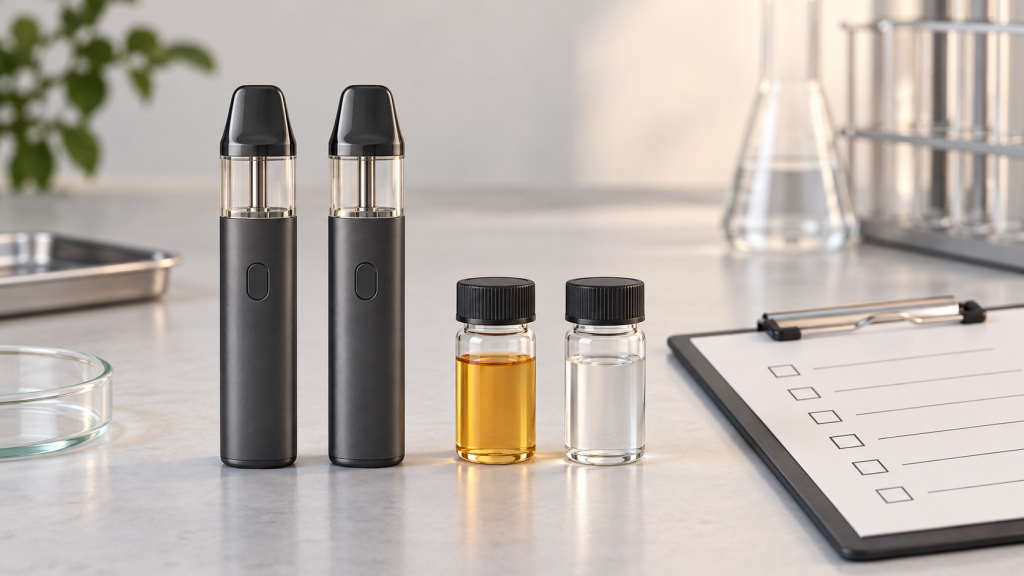
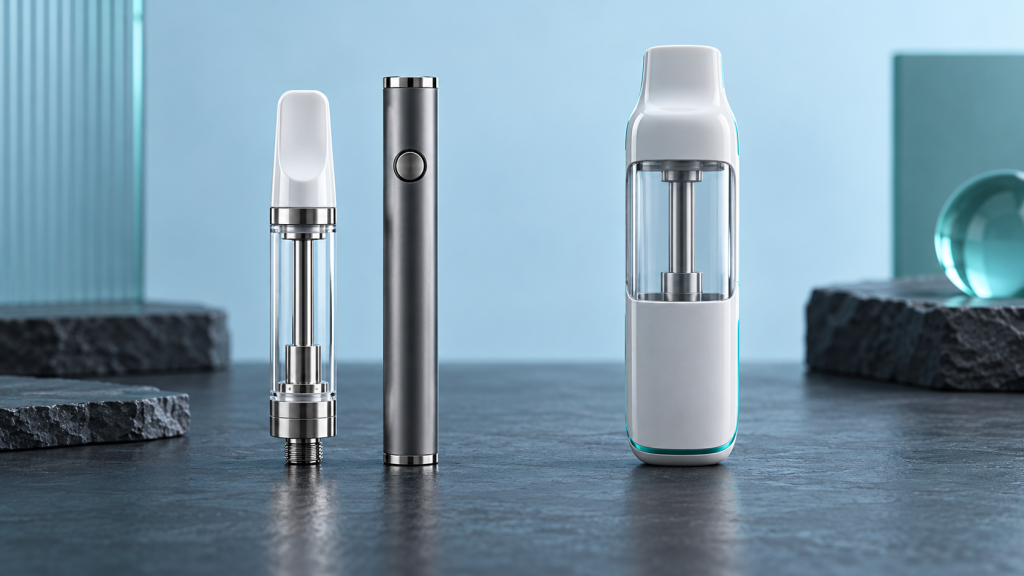
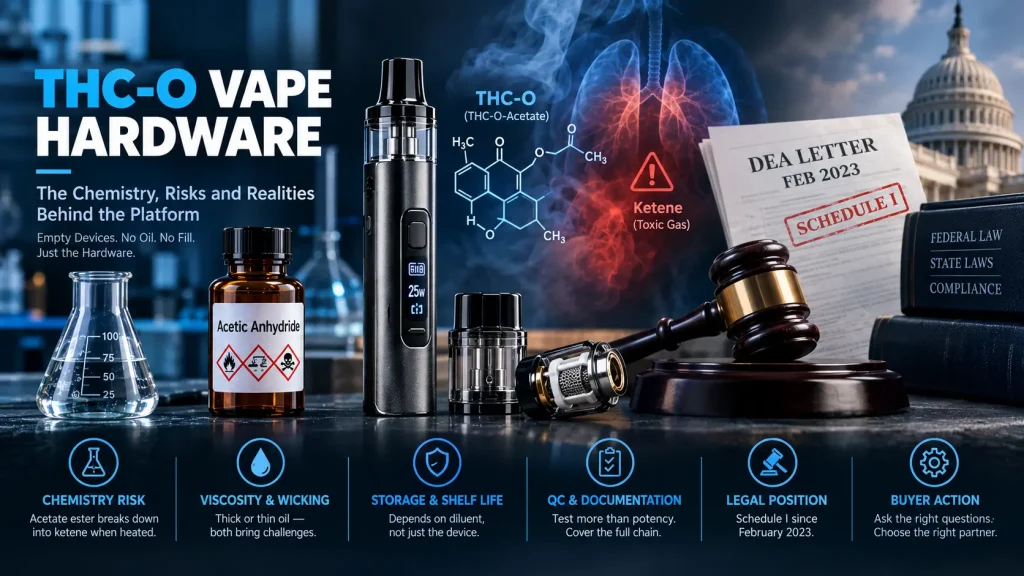
A CBD vape battery disposable specification needs more than a capacity number and a charging connector. A rechargeable cell can sit inside a device whose reservoir is used only once, and that combination raises separate questions about usable energy, charging behavior, transport and disposal. For brands buying hardware, the useful starting point is a documented device configuration, followed by evidence that the complete configuration works as intended.
We supply empty hardware. An empty all-in-one device is shipped with no fill; the buyer or its filling partner remains responsible for the formulation and its market requirements. References to filled products below concern the other side of the market, for comparison only. An empty reservoir does not remove the need to evaluate the battery, charging system or restrictions that can apply to a component.
This guide does not constitute legal advice, an electrical design instruction or permission to ship a particular product. Nothing here constitutes legal advice for a specific transaction. Numerical examples are calculations with stated assumptions, rather than promises about our products. The cell manufacturer’s approved limits and the tested finished-device specification take priority over a generic voltage, charge rate or headline battery capacity.
The CBD vape battery disposable buying decision becomes clearer when four records agree: the component list, the validation report, the product description and the shipping declaration. A change in one can make the others obsolete. The following sections explain what to ask for, how to read the numbers and which conclusions those numbers cannot support before a brand approves production or a distributor accepts inventory.
What a CBD Vape Battery Disposable Specification Describes
Define the assembly before comparing suppliers. A CBD vape battery disposable quotation should distinguish a sealed reservoir from a replaceable cartridge, a rechargeable cell from a nonrechargeable one, and an installed battery from a loose battery supplied separately. A USB-C opening describes a connector, not every feature behind it. Ask for the exact device revision and a description of which parts the end user can replace. This avoids approving a sample with one architecture and receiving production with another, even when the two housings look identical.
For a concrete example, UK government guidance says reusable vapes need a rechargeable battery, refillable container and a removable, replaceable coil where a coil is present. Separately available replacement pods can satisfy the refill approach described there. A charging port alone does not turn a sealed product into a reusable one. Treat that as a market-specific check for a CBD vape battery disposable proposal, rather than claiming that every country uses the same definition or that a battery feature establishes permission to sell.
Keep the commercial terminology equally specific. A white-label arrangement changes branding on an existing design; private label can add control over packaging and SKU choices; full ODM requires a separately defined design project. None of those labels proves an electrical test result. Our CBD and THC hardware comparison provides context for separating the formulation question from the hardware question. For a CBD vape battery disposable program, put the actual configuration and responsibility split in the quotation instead of asking a marketing label to do that work.
Capacity Calculations for a CBD Vape Battery Disposable Build
Milliamp-hours describe charge capacity, while watt-hours describe energy using a stated voltage. For an illustrative CBD vape battery disposable calculation, 280 mAh is 0.280 Ah; multiplying by an assumed nominal 3.7 V gives 1.036 Wh. At the same assumed voltage, 400 mAh gives 1.480 Wh. These are arithmetic examples, not an approved cell range or a measured runtime. Use the actual cell’s rated nominal voltage and manufacturer documentation when checking the declared energy of a purchase. A rounded catalog number should not replace the identified component.
Usable runtime requires another layer of evidence. A CBD vape battery disposable device consumes energy through the heater and control electronics, and its cutoff behavior can leave some rated capacity unused. Reservoir volume does not supply the missing information about power, draw duration or the chosen formulation. Ask the supplier to state the validation conditions and provide results for the assembled device. Our puff-count discussion explains why a printed draw total needs a test context. Avoid accepting a universal conversion from milliliters to milliamp-hours.
Specify an acceptance method before arguing about a larger cell. For a CBD vape battery disposable sample, a buyer can request recorded operating conditions, the reason the device stopped and the remaining usable contents where relevant. Compare samples under the same agreed procedure. A larger cell may support a different usage pattern, but size alone does not establish better performance or a longer product life. Likewise, do not attach a generic claim about hundreds of cycles or retained capacity to a cell without its own supporting data and the relevant test conditions.
Charging Limits Must Come from the Selected Cell
A CBD vape battery disposable charging specification should name the cell, charging controller, allowed input and approved operating limits together. Do not copy a voltage limit from another product because both advertise the same capacity. Request the manufacturer’s cell document and the supplier’s finished-device validation record, then check that the controller settings agree with them. A connector change, substitute cell or revised circuit board is a reason to review that agreement. Procurement approval should cover the combination actually delivered, including the cable or charging accessories when they form part of the supplied configuration.
C-rate is useful for discussing current, provided its reference capacity is stated. If a hypothetical 280 mAh cell is approved for a 0.5C charging setting, the corresponding current is 140 mA. Dividing capacity by that current gives an idealized two-hour calculation; it is not a complete charging-time claim. The actual profile and termination conditions still matter. For a CBD vape battery disposable listing, use observed charging time under declared conditions instead of converting that arithmetic directly into a promise printed on the box. The example does not recommend a charging rate for an unidentified cell.
Make temperature behavior and charging during use explicit purchasing questions. A CBD vape battery disposable supplier should explain what its design permits, which conditions disable charging and what instructions accompany the product. Do not advertise simultaneous charging and use unless that mode belongs to the validated configuration. Ask how incorrect adapters, damaged ports and substituted accessories are addressed in the evaluation and user information. This is a request for qualified test evidence, not an invitation for a buyer to conduct improvised overcharge or short-circuit experiments on a workbench or to override a protective shutdown.
What the Arizer Recall Establishes and What It Does Not
The CPSC recall dated June 18, 2026 concerns about 5,000 Arizer Solo III portable electronic vaporizers in the Intergalactic/Black version. The notice identifies a battery ignition or explosion hazard and four reported incidents. It is a recall of a named product and specified serial-number prefixes, not evidence of a 47,000-unit event covering several brands. A CBD vape battery disposable buyer can use that distinction to check whether a supplier is citing an actual notice or repeating an unsupported summary.
The notice does not identify the charging threshold or component-level cause asserted in some summaries. Do not turn its hazard description into a universal failure voltage for a CBD vape battery disposable cell. It also does not say that every device in this article’s category shares the recalled design. The procurement lesson is traceability: know the production revision, cell source and affected batch so a complaint can be investigated against records. When citing a recall, preserve the product identity, reported scope and stated hazard rather than supplying missing engineering details yourself.
Ask for evidence at the appropriate level. UL 8139 addresses battery-operated electrical systems of electronic cigarettes and vaping devices, including charging systems and components; its scope does not establish the contents or emissions of consumables. A CBD vape battery disposable certificate review should match the model and scope to the supplied assembly. A cell report, transport report and complete-device evaluation answer different questions. Our manufacturer selection framework can support that document review without treating a logo as proof of everything.
Shipping a CBD Vape Battery Disposable Device Requires More Than Wh
Start with the product description, not the smallest battery exception. USPS Publication 52 defines ENDS broadly, including devices delivering nicotine, flavor or another substance through an aerosolized solution. Its component and accessory coverage is not limited to products containing nicotine. An empty CBD vape battery disposable assembly therefore cannot be assumed outside the rules merely because no liquid is included. Get the classification and proposed route assessed against the actual shipment. A battery calculation is useful supporting information, not a decision that a postal service must accept the parcel.
USPS also states that covered products are generally nonmailable, subject to defined exceptions and their conditions. Even a qualifying shipment remains subject to other applicable restrictions, including lithium-battery rules. For a CBD vape battery disposable order, confirm any required eligibility and approval before promising a postal service to a customer. Passing a battery packaging test does not establish an ENDS exception. Conversely, an exception under the product rules does not remove the battery requirements. Keep those two reviews separate in the shipping file.
For a private carrier or freight forwarder, request written acceptance of the described CBD vape battery disposable shipment, including whether it contains installed cells, separate cells or filled components. Confirm the documents, packaging and service level before booking. Do not change the description to a generic electronic accessory to obtain acceptance. Returns need their own assessment because their condition may differ from new stock. Assign one owner to maintain the shipping file and another to verify that the warehouse actually packs the configuration that was reviewed; a valid document for a different shipment does not solve the problem.
Separate Product Rules from Battery Recycling Obligations
Do not assign every California battery obligation to AB 2440. CalRecycle distinguishes its loose-battery stewardship program from the battery-embedded product expansion under SB 1215. The agency’s SB 1215 overview lists ENDS among excluded products and places the covered-product consumer recycling fee at January 1, 2026. That does not establish how every CBD vape battery disposable configuration is classified. Check the actual statutory definitions and product facts before assigning a fee, registration duty or exemption to the brand or factory.
A CBD vape battery disposable contract should record who obtains the market-specific classification, who supplies product information and who handles applicable collection or disposal instructions. Separate a removable battery sold independently from a battery permanently incorporated in equipment; the same cell can appear in different commercial arrangements. Obtain advice for the actual product instead of importing a conclusion from a nicotine device or another consumer electronic item. The useful purchasing question is which documented obligation applies to this configuration, not which familiar bill number can be placed on a presentation slide.
For EU planning, Regulation (EU) 2023/1542 establishes portable-battery removability and replaceability requirements, with Article 11 applying from February 18, 2027. Scope and derogations need review against the current text and the particular product. A CBD vape battery disposable tooling decision should therefore include an assessed battery-access approach rather than an assumption that a sealed enclosure has permanent permission. Our EU battery regulation article gives related context; the current legal text and a documented product assessment remain the basis for a market decision.
Lock the CBD Vape Battery Disposable Configuration Before Production
A purchase specification is useful only when it identifies what can change. For a CBD vape battery disposable program, list the approved cell model, board revision, charging arrangement, reservoir configuration and supplied accessories. Attach the relevant documents and sample identification rather than relying on an email saying that the next batch is the same. Ask which substitutions require renewed approval. A purchasing team can then compare production records with the approved sample and identify a component change before it becomes a dispute about runtime, charging behavior or the meaning of an earlier certificate.
Connect the electrical validation to the filling plan without claiming to validate the formulation itself. If a CBD vape battery disposable project changes formulation characteristics, the supplier and filling partner should review whether the existing device evaluation still represents use. Record the agreed variant list and approval evidence per flavor when that is how the project is specified and quoted. A production order per flavor is a commercial definition, not a substitute for technical evaluation. Ask which evidence can be shared across variants and which tests must be repeated; do not assume either answer from the packaging artwork alone.
Set a practical complaint and return process before the first shipment. A CBD vape battery disposable buyer should be able to identify the affected lot, isolate the related records and obtain instructions from the responsible supplier. Agree who preserves samples, who contacts a qualified laboratory and who communicates with distribution partners if further investigation is needed. Do not ask an untrained warehouse team to dismantle a suspect battery device. The commercial objective is a traceable decision with documented responsibility, including an appropriate route for handling suspect stock, rather than an unsupported promise that a specified capacity eliminates failures.
Five Questions to Settle Before Approving the Order
Use a short review meeting to connect the files rather than collecting more disconnected documents. Ask five questions: Which exact cell and device revision are being supplied? Which charging limits and modes were validated? Which report covers the assembled electrical system? Which product and battery rules govern the proposed shipping route? Who owns the applicable market and end-of-life assessment? For a CBD vape battery disposable order, an answer should point to a named record, responsible person or clearly defined action before release. A claim that the factory has always done it this way is not the missing evidence. Keep a dated approval checklist with the sample identifier and the reviewer responsible for each open item. If the cell or board changes after that meeting, reopen the affected checks before releasing stock. That record makes a later comparison possible without reconstructing the decision from scattered messages.
Our interest is straightforward: we supply empty hardware, and we want the buyer’s specification to match the delivered product. We do not supply the filled formulation or decide its legality. A CBD vape battery disposable procurement process works best when capacity calculations, test scope and shipment classification agree with the same identified assembly. Request the remaining project-specific documents through the contact page, then close the approval record against those documents. More capacity is an option to evaluate; an accurately described, documented configuration is the foundation for the decision.
This CBD vape battery disposable guide does not constitute legal advice, a certification statement or a carrier acceptance. Review current rules for the destination, product and shipment, and use qualified technical assessment for electrical limits. Do not treat an illustrative calculation, a report on a different model or an exception for another shipment as approval of your own. Before release, reconcile the final specification, evidence, labeling and shipping arrangement so the order being approved is the order actually produced.