Every few weeks, a brand that already sells one of the two categories asks us the same question: can we just run the other one on the same device? It is the most natural question in the industry and the most expensive one to get wrong. The CBD vs THC disposable vape comparison looks trivial on a spec sheet — both are draw-activated, pre-filled, sealed units — until you look at the oil, the coil, the label and the shelf it sits on. Change any one of those and the “same device” stops being the same device.
We manufacture both lines, so this is not a theoretical exercise for us. Our C-series disposables and pod units run CBD and non-intoxicating hemp formulas, and our 510 cartridge line (the S16-2) is the format most THC brands ask about first. Building both sides of the CBD vs THC disposable vape market has taught us where the two categories genuinely overlap and where they diverge hard. This article is the comparison we wish someone had given us before we tooled our first batch: four differences, the data behind them, and the questions a brand should answer before placing an order. None of this is legal advice — cannabis and hemp rules vary by state and are changing fast in 2026 — but the hardware reasoning behind the CBD vs THC disposable vape choice holds regardless of jurisdiction.
One more thing before the details. The two categories are converging on the retail side: disposables overtook 510 cartridges as the majority format in U.S. vape sales in spring 2026, and capacity is climbing on both sides of the aisle. But convergence at retail does not mean convergence in engineering, and the CBD vs THC disposable vape category is the clearest place to see that. If anything, the tighter the market gets, the more the oil-coil match determines which brands survive and which ones drown in returns. Start with the oil, because the oil dictates everything downstream.
Oil Viscosity Drives the Biggest CBD vs THC Disposable Vape Difference
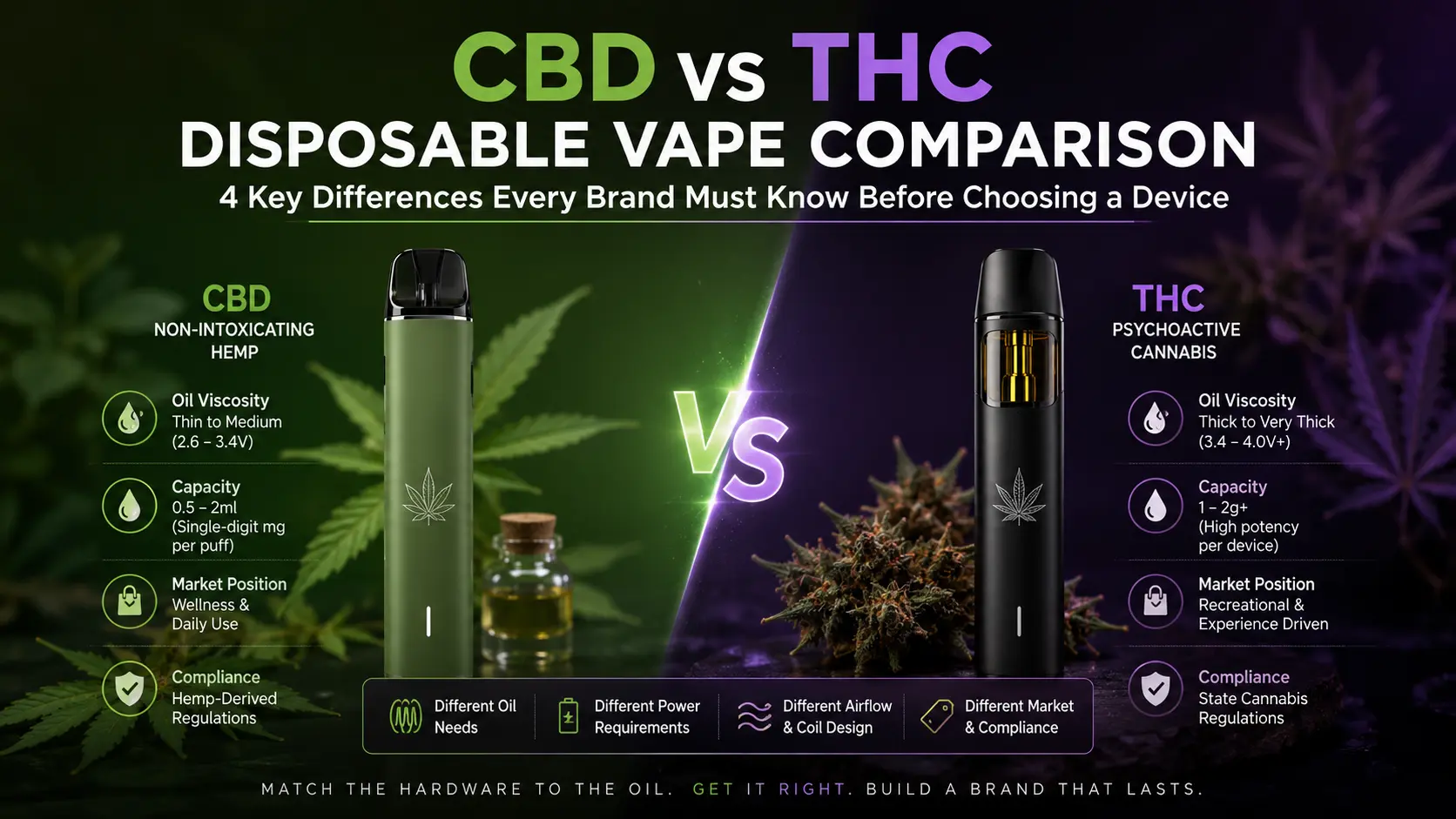
The single largest engineering gap in the CBD vs THC disposable vape comparison is oil viscosity, because viscosity decides which coil, which intake and which voltage actually work. A device built for thin CBD isolate oil will struggle with thick THC distillate, and a device tuned for distillate will scorch a low-viscosity CBD formula. The published matching guidance for oil vape pens is consistent across manufacturers: CBD isolate runs best on a fine ceramic coil with a small intake at 2.6 to 3.0 volts; full-spectrum CBD sits in the middle at 3.0 to 3.4 volts; THC distillate needs a high-porosity ceramic coil with a wider intake at 3.4 to 4.0 volts. Live resin and live rosin sit at the extreme end, requiring dedicated coils and a strong preheat function to avoid clogging.
What does that mean in practice? If a brand takes a platform designed for one side of the CBD vs THC disposable vape market and fills it with the other side’s oil, the customer gets one of two failures: weak vapor and burnt flavor when the oil is too thick for the coil, or flooding and leakage when the oil is too thin for the intake. Both failures land in the same place — returns, chargebacks and a dead product line. That is why the first question we ask every brand is not “what capacity do you want” but “what oil are you filling, and at what viscosity.” Get that answer right and the rest of the CBD vs THC disposable vape spec follows; get it wrong and no marketing spend can save the unit economics.
The viscosity gap also explains why “one device, two categories” fails more often than it succeeds. A middle-ground platform that handles both exists in some catalogs, but the compromise usually means the device is excellent at nothing. For a brand deciding between lines, the honest recommendation is to match the hardware to the oil profile from day one, and to use the viscosity reading as the anchor of the whole CBD vs THC disposable vape engineering decision. Our guide to disposable CBD vape hardware covers the CBD side of this matching in detail; the THC side follows the same logic with higher viscosity and higher voltage.
CBD vs THC Disposable Vape Capacity: Milligrams vs Grams
The second divergence in the CBD vs THC disposable vape comparison is capacity, and it is not a cosmetic difference. CBD brands typically sell single-digit milligram-per-puff experiences in 0.5 to 2 ml fills, sized for occasional use and a lighter price point. THC brands sell grams of distillate or extract per device, because the psychoactive product is consumed at a fraction of the volume per session and the consumer expects the device to last. A 1-gram cartridge has been the THC industry’s baseline for years, and the 2-gram format is now the fastest-growing segment on that side of the CBD vs THC disposable vape market, roughly doubling its share in two years.
The market data makes the split visible. On the THC side, 1-gram cartridges still capture about three quarters of vapor pen sales, but 2-gram units grew roughly 96 percent year over year, and 2 ml live resin disposables more than doubled in a single year. Meanwhile, on the dispensary side of the ledger, disposable vapes overtook cartridges in dollar share during spring 2026, climbing to just over half of U.S. vape sales, with cartridge revenue declining in parallel. CBD disposables follow a slower, steadier curve, with fill volumes holding in the 0.5 to 2 ml range because the category is built on repeat purchase at accessible price points rather than potency per unit.
Capacity has a direct battery consequence. A 1-gram THC device can get away with a 280 to 400 mAh cell sized to match the oil. A 2-gram THC disposable, and the multi-gram devices now appearing on the market, need either a larger cell or a rechargeable port, because a battery that dies at 60 percent of a 2-gram fill is a device that generates refunds. The same rule applies to CBD: a 1 ml fill with a 280 mAh battery is a balanced unit; scale the fill and the battery has to scale with it, or the user throws away usable oil. Matching battery life to fill volume is a design decision, not an accident, and it is one of the first specs we lock in any vape product development process — regardless of which side of the CBD vs THC disposable vape spectrum the product sits on.
Format Choice in the CBD vs THC Disposable Vape Market
The third difference is format strategy, and here the two categories are moving in opposite directions. The THC side is going all-in on all-in-one disposables: devices crossed the 50 percent mark in U.S. vape dollar share for the first time in 2026, growing 41 percent over twelve months while cartridge sales fell 14 percent. Yet the 510 cartridge remains the backbone of the licensed market by unit volume — roughly 60 percent of hardware units — because consumers who already own a battery keep buying the cheaper refill. The result is a two-lane market on the THC side: cartridges for the installed base, disposables for new and convenience-driven buyers.
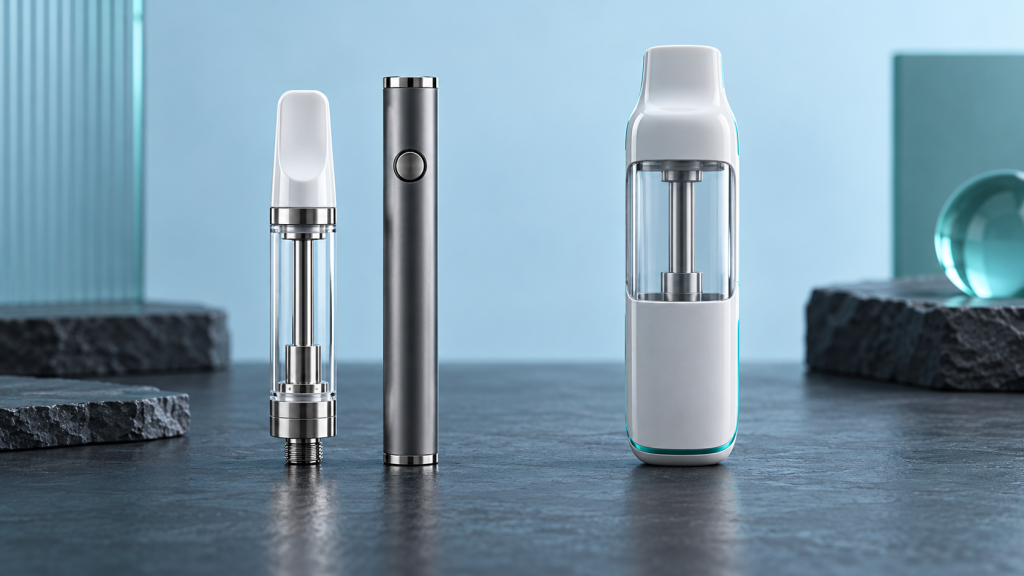
The CBD side is simpler in structure. Most CBD hardware is sold as an all-in-one disposable or a pod unit, because the CBD consumer skews toward simplicity and the smoke-shop channel rewards products that need no explanation at the counter. 510 cartridges exist in CBD, but they are a minority format, and their sales are concentrated in states with strong dispensary ecosystems rather than in general retail. The practical reading for a brand: if you want to sit on the dispensary shelf next to THC brands, a 510 or a premium disposable matters; if you want the smoke-shop and online shelves, an all-in-one disposable is the safer first SKU. In both cases the format decision belongs inside the CBD vs THC disposable vape plan, not after it.
There is a supply-chain angle here that brands rarely consider. A 510 cartridge and an all-in-one disposable use completely different assembly lines, different filling equipment and different QC checkpoints. Running both formats means managing two factories’ worth of process — or one factory with two disciplines. The formats also fail differently in the field: cartridges fail on connection and wicking, disposables fail on battery life and sealing. When you evaluate a factory, ask which format its line is actually built for, because a factory that builds both will still have a default that shows up in your defect rate. Our sample request guide explains how to test a first batch so format-specific failures surface before you commit to volume, and it applies equally to both halves of the CBD vs THC disposable vape market.
Labeling and Compliance: Two Rulebooks Behind One CBD vs THC Disposable Vape Decision
The fourth difference — labeling and compliance — is where the CBD vs THC disposable vape comparison stops being engineering and becomes law, and it is the difference most likely to kill a product line. The two categories sit under different federal and state frameworks, and the gap is widening in 2026.
On the CBD side, the baseline is the 2018 Farm Bill’s definition of hemp, which allows hemp-derived products with delta-9 THC at 0.3 percent or less on a dry-weight basis. That framework is changing. Section 781 of the 2025 federal funding law, effective November 12, 2026, redefines hemp under a total-THC standard: 0.3 percent total THC on dry weight — now counting THCA and other intoxicating cannabinoids, not just delta-9 — and no more than 0.4 milligrams of total THC per finished container. The practical effect is that full-spectrum CBD vape formulas, which carry trace THC, will need to move to broad-spectrum or isolate profiles to stay legal, which changes oil viscosity and therefore the coil match inside the CBD vs THC disposable vape equation. Meanwhile the FDA has not approved CBD as a food ingredient and continues to police health claims; any label language that implies therapeutic benefits or disease prevention is an enforcement risk, not a marketing choice.
On the THC side, the rulebook is state-by-state. In the licensed adult-use and medical markets, products carry universal symbols, potency declarations, batch numbers and lab results that are mandated and audited by the state. Hemp-derived THC products — delta-8, delta-10, HHC, THC-O and THCA flower — have been living in a federal gray zone, and Section 781 closes most of that zone: synthesized cannabinoids are removed from the hemp definition, and finished products that exceed the 0.4 mg total-THC container cap move out of the hemp category entirely. States are diverging in how they apply the change, with some banning intoxicating hemp products outright and others folding them into their licensed cannabis frameworks, which is why a single CBD vs THC disposable vape SKU cannot assume one national rulebook.
The hardware takeaway is that the label is not a sticker you add at the end; it is a specification that flows back into the device. A label that must carry a state-mandated universal symbol or a batch-scannable QR code affects packaging dimensions and print placement. A formula change forced by Section 781 affects the oil’s viscosity, which affects the coil — which means the compliance calendar and the hardware spec have to be designed together. For the full CBD rulebook context, our vape ODM manufacturer guide covers what a factory should be able to document for you before you sign anything.
Channels: Smoke-Shop Shelf vs Dispensary Counter
The last practical difference in the CBD vs THC disposable vape market is where the product physically sells, and the channel shapes the SKU. A licensed dispensary buyer expects lab-tested, state-compliant product with packaging that survives a regulatory audit; a smoke-shop buyer expects margin, display appeal and no compliance homework. The same hardware line cannot serve both without different packaging, different documentation and often different formulations.
THC products sell through licensed dispensaries and delivery services in states with legal markets, and the sales data shows the consumer there is chasing value per gram — which is driving the shift to larger-format disposables. CBD products sell through smoke shops, vending machines, online stores and, in some states, mainstream retail, but the channel carries its own friction: the PACT Act’s restrictions on shipping vape products mean many carriers will not move CBD vapes, so logistics is a channel decision too. Several states have already restricted or banned specific hemp products ahead of the November 2026 federal date, which means a single national SKU plan can turn non-compliant overnight in one state while staying fine in the next. That asymmetry is part of why the CBD vs THC disposable vape channel map is more complex than any single product guide admits.
For a brand that wants both channels — a common ambition, because the two customer bases rarely overlap — the honest structure is two SKU families with shared supply but separate compliance files. The device platform can be the same family; the oil profiles and labels cannot. That split mirrors the CBD vs THC disposable vape reality: shared hardware is possible, shared compliance is not. We have watched brands try to run one SKU across both channels and watched the same brands rebuild after a state audit or a carrier refusal. The cost of the second compliance file is real, but it is an order of magnitude cheaper than a recall. Handled properly, both lanes of the CBD vs THC disposable vape business can live under one roof; the discipline is in keeping the paperwork separate.
How to Decide Which Line to Build — and What to Verify First
So which side of the CBD vs THC disposable vape market should your brand build? The answer depends on three questions. First, what is your regulatory runway? If you can navigate licensed-market state compliance, the THC side rewards larger formats and faster growth. If you want a federal-compliant product that can move through general retail, the CBD side — with broad-spectrum or isolate oil under the 2026 total-THC standard — is the lower-risk lane. Second, what does your existing channel look like? Dispensary relationships point toward 510 or premium disposables; smoke-shop and online relationships point toward all-in-one CBD disposables. Third, what oil capability do you have? Hardware follows oil viscosity, not the other way around, and that rule is the same on both sides of the CBD vs THC disposable vape line.
The verification checklist is short but non-negotiable. Confirm the oil’s viscosity and the coil-intake-voltage match on paper before sampling. Confirm the fill volume and battery are balanced so the device dies last, not first. Confirm the labeling plan against both the federal calendar and the states you ship to — the Section 781 effective date of November 12, 2026 is a hard deadline, not a suggestion. Confirm the factory can show you certificates of analysis per batch and documentation for every market it claims to serve. And confirm the logistics path: if your carrier will not move the product, the spec sheet does not matter.
If this is your first time choosing between the two lines, start narrow and validate — the CBD vs THC disposable vape learning curve is steeper than it looks from a spec sheet. Pick one format — a 1 ml CBD disposable with a ceramic coil, or a 1-gram THC cartridge if your market is licensed — build a small compliant batch, test it through the channel, and expand on evidence. The category punishes wide, cheap, unvalidated launches on both sides of the CBD vs THC disposable vape divide. The brands that survive pick one lane, match the hardware to the oil, and only then look at the second lane. When you are ready to translate this comparison into a spec, send us your oil type, target channel and volume, and we will come back with a device recommendation and samples you can actually test — a conversation that starts with a vape ODM quote request.
One closing note on expectations. This article compares hardware categories for informational purposes; it does not constitute legal advice, and cannabis and hemp rules vary by state and are changing through 2026. Verify current federal and state requirements for every market where you plan to sell before committing to a formulation, a label or a device.
This article compares hardware categories for informational purposes only and does not constitute legal advice. Verify current federal and state requirements for any market where you plan to sell.