A CBD cartridge vs disposable decision starts with the product the customer buys a second time. A cartridge program can keep the battery in use while the customer replaces the filled cartridge; an all-in-one program supplies the reservoir and power system together. That difference changes the quotation, compatibility checks, support process and inventory plan. A brand needs to compare those responsibilities before treating one format as cheaper or easier to sell.
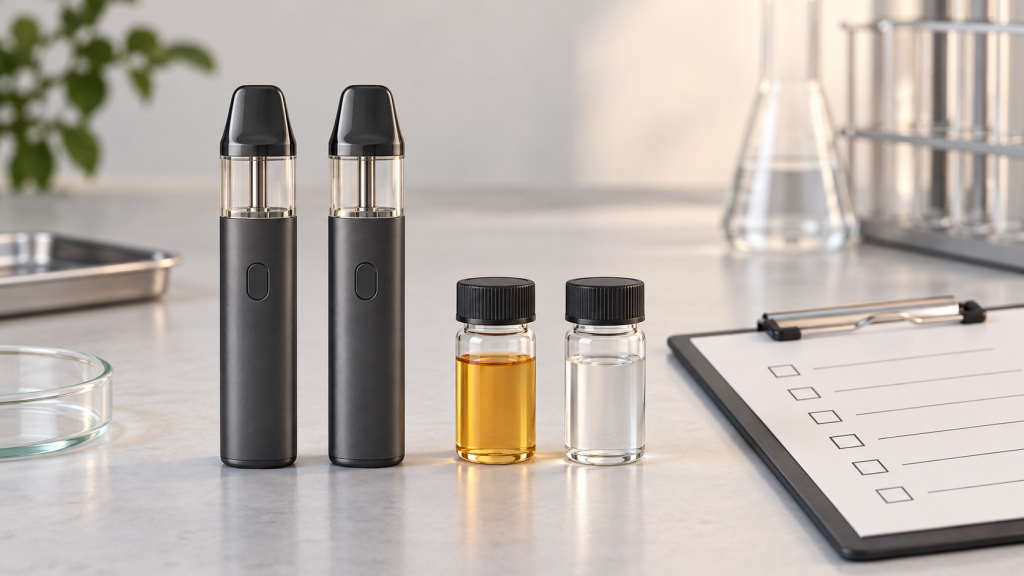
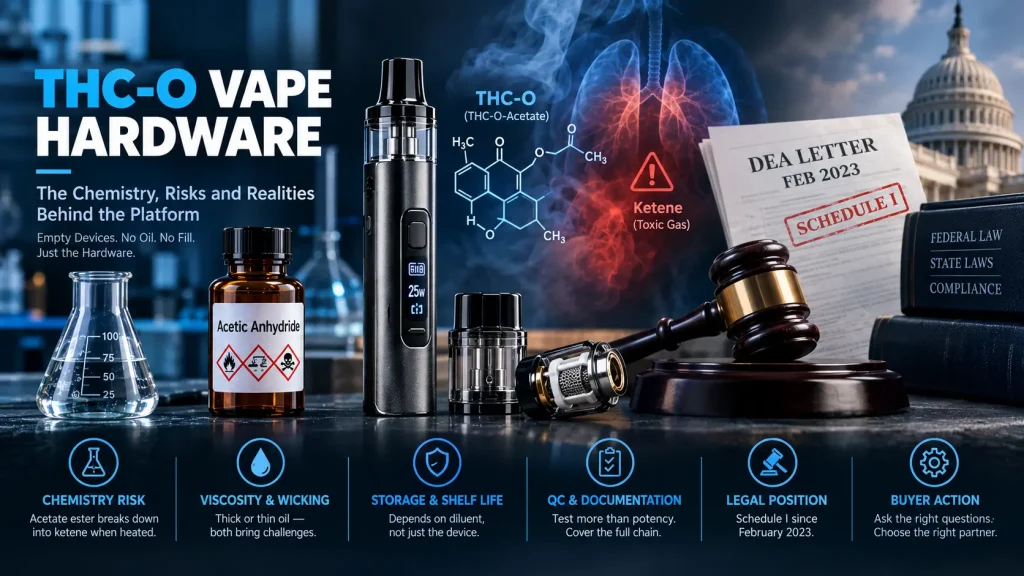
We supply empty hardware for both formats. An empty all-in-one device is shipped with no fill, and an empty cartridge also requires a separately controlled filling process. References to filled retail products concern the other side of the market, for comparison only. The buyer or filling partner remains responsible for the formulation and its market requirements. Our role in the CBD cartridge vs disposable discussion is to explain the hardware decisions and the evidence a purchasing team should request.
This is general information about hardware and format planning. It does not constitute legal advice for any market; nothing here constitutes legal advice for a particular transaction. Product eligibility, formulation limits and shipment acceptance require separate checks against the actual configuration and destination. A sample that works electrically does not establish permission to sell it, and a carrier accepting one shipment does not approve every later revision of the same product.
Most comparisons of these two formats are written for a consumer at a counter. A brand deciding what to launch answers different questions: what the unit costs to build and reorder, who buys the second unit and how often, how much of the brand can live on the product, which shelf it can reach, and what a certificate of analysis can legally contain per container. That is the comparison this CBD cartridge vs disposable guide makes, and most of it settles before a sample is built.
What the CBD Cartridge vs Disposable Choice Actually Changes
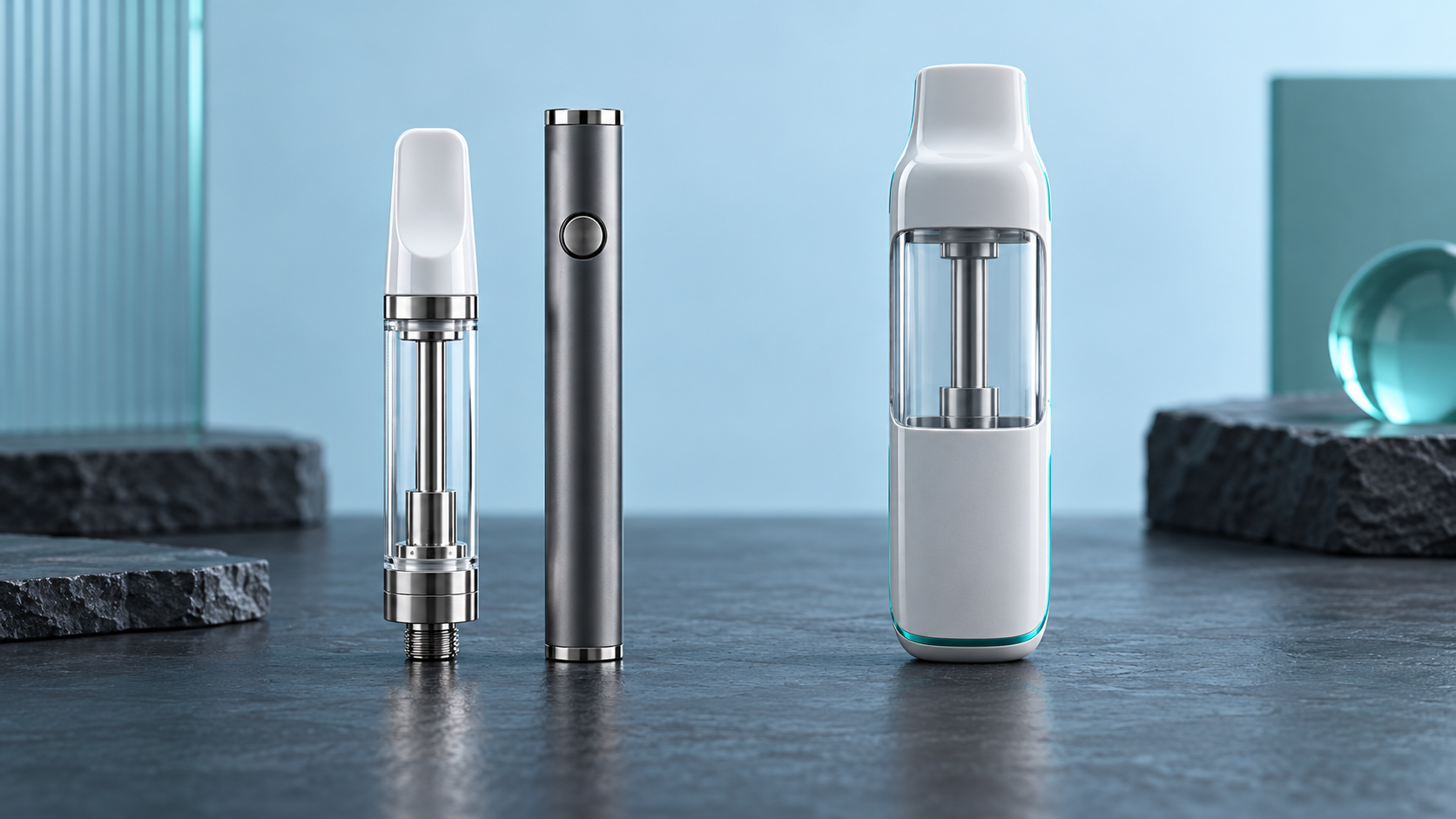
Start with the mechanical difference. A cartridge program sells a consumable: the cart head is filled, sold, consumed and replaced, while the battery is a separate durable the customer buys once and keeps. A disposable program sells one sealed object containing the reservoir, the coil, the air path, the charge board and the cell, and every purchase is the whole device. Same oil, same ceramic core options, same vapor-path physics, and a different answer to who owns the battery.
The naming confuses more than it helps. Cartridge and disposable both describe oil handling: neither format is refillable by the user in practice, and a sealed cart is exactly as sealed as a sealed all-in-one. Disposable does not mean the electronics are single use; cartridge does not mean the system is permanent. What splits is the purchase unit and the failure unit, and a brand that reads the names as one cheap and one premium will misprice both ends of a CBD cartridge vs disposable line.
Three operational checks follow from that split. A cartridge route needs an identified battery pairing, including contact geometry, activation behavior and the permitted electrical range. A disposable route needs the installed cell and control system validated with the intended reservoir and formulation. Running both formats means two acceptance plans rather than one catalog comparison. For the oil-side questions both formats share, our CBD and THC hardware comparison explains why a formulation description and a hardware description belong in separate records. The CBD cartridge vs disposable decision should name both records.
Cost Structure: Where CBD Cartridge vs Disposable Programs Diverge
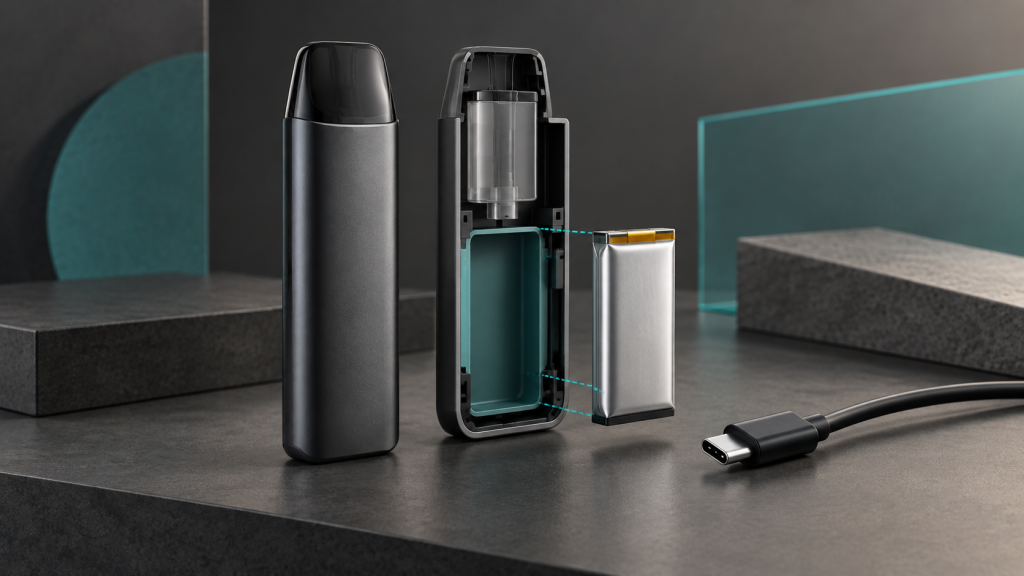
A rechargeable all-in-one carries its cell, charging electronics, housing, coil and seals in the unit sold. A cartridge carries the reservoir and atomizer, while the battery can remain in use across purchases. That creates different bill-of-material structures, without proving a universal retail-price advantage. For a CBD cartridge vs disposable budget, compare the same delivery scope, inspection method and order size. Include replacement batteries where relevant rather than assuming the customer buys one battery and keeps it forever. First-purchase cost and repeat-purchase cost answer different commercial questions.
The quoting structure differs too. A cartridge program can involve separate cartridge and battery specifications, even when one supplier coordinates both. An all-in-one combines those assemblies within a complete-device specification. State whether the quote covers empty hardware, filling, packaging or finished goods, because those scopes cannot be compared directly. For a CBD cartridge vs disposable plan, list variants per flavor when a filled-product program requires them, and separate color or packaging quantities from formulation quantities. Do not assume one universal minimum order or two supplier relationships simply from the format name.
A finished-product price ladder includes a different scope from an empty-hardware quotation. It may include formulation, filling, packaging, distribution or taxes that the hardware supplier does not provide. Request the factory’s written tier table for the identified empty assembly, with the included tests and packaging stated. No shelf price answers that CBD cartridge vs disposable question. Compare delivered scope and documented exclusions before comparing the headline unit number; otherwise the apparently cheaper option may simply leave more work for the buyer or its filling partner.
Two cost lines are format-specific and belong in the model. Cartridge programs pay a compatibility tax: batteries that fail to fire carts, carts that seep on batteries with deeper threads, and support time spent diagnosing a two-part system. Disposable programs pay a quality tax: one bad unit takes the cell, the oil and the brand’s review score down together, which is why leak testing and aging before shipping belong in the disposable quote rather than the after-sales budget. Both taxes are real line items on a CBD cartridge vs disposable budget, and both shrink when the factory builds the format its line is set up for.
Fill-Size Calculations in a CBD Cartridge vs Disposable Plan
The enacted text of Public Law 119-37, Section 781 uses a 0.4 mg combined amount per container for specified cannabinoids in final hemp-derived products. Its definition includes total THC with THCA and certain other cannabinoids, rather than a simple delta-9-only number. The statutory container is the innermost retail enclosure in direct contact with the final product. Treat the enacted text as a source to review with current amendments and guidance, not a complete approval rule for a CBD cartridge vs disposable launch. Later, Public Law 119-103, Section 2019 limited Section 781’s application until December 11, 2026 to the specified non-naturally-producible cannabinoid provisions. The original timeline is not a complete description of the amended law. Check subsequent changes before applying a threshold.
For an illustrative CBD cartridge vs disposable calculation, assume a combined analyte budget of 0.4 mg and a fill measured by mass. Dividing by 500 mg gives 0.08 percent; dividing by 1,000 mg gives 0.04 percent; dividing by 2,000 mg gives 0.02 percent. These ratios describe arithmetic, not whether a particular oil or product qualifies for sale. A concentration result must use the same analytes, units and measurement basis as the applicable rule. Keep the laboratory reporting limit and uncertainty visible rather than treating a printed zero as proof of absence.
Volume requires another input. A 4 ml reservoir does not automatically contain 4 g of formulation; the mass depends on the measured density and actual fill. If, purely for illustration, density were 1 g/ml and fill were 4 ml, the assumed mass would be 4,000 mg and the same arithmetic would give 0.01 percent. Change density or fill and the result changes. On a CBD cartridge vs disposable specification, record the mass calculation, batch result and assumptions together. Never turn the device’s nominal reservoir volume into an unconditional laboratory acceptance threshold.
The purchasing takeaway is to freeze a proposed fill specification before approving the device. Ask the filling partner to state the actual mass range, measurement method, batch identity and acceptance criteria, and ask the appropriate adviser to assess the finished product and destination. Hardware capacity alone cannot settle those questions. A CBD cartridge vs disposable plan should keep a place for the formulation review without presenting the empty device as a way around it. If the product cannot qualify under its applicable requirements, switching the housing does not resolve the underlying problem.
Repurchase: Which Format Sells the Second Unit
The two sides of a CBD cartridge vs disposable decision support different repeat-order models. A cartridge program can sell replacement consumables to a customer who retains a compatible battery. An all-in-one program replaces the complete device with each new filled unit. Those are possible operating models, not a claim that every customer behaves the same way. Before projecting revenue, separate first-time buyers, returning buyers and battery replacements. Use the brand’s own sales or pilot data to estimate the share in each group, and show how the forecast changes if repeat purchasing is slower than expected.
Market-share claims need a defined market. Revenue share, units sold and hardware shipments measure different things; licensed cannabis data do not automatically describe the CBD-only segment or an individual retailer. For a CBD cartridge vs disposable proposal, request the geography, product definition, observation period and source before repeating a percentage. When those details are unavailable, use a scenario rather than a market fact. A small pilot can test whether customers understand the format, whether they own a compatible battery and whether the second purchase actually occurs within the assumed interval.
Consumption assumptions also need evidence. A gram of formulation does not imply a universal draw count, because the device, formulation and test procedure affect consumption. Our puff-count discussion provides context, but a CBD cartridge vs disposable plan should use a declared procedure and the actual proposed pairing. Record the conditions and the reason a sample stops operating. For repeat purchasing, track customer behavior separately from laboratory draw counts. A measured device result and a predicted reorder date are related inputs, not interchangeable promises for a quotation or retail listing.
Customization and Channel: Where the Brand Lives, and Where It Sells
On the cartridge side of a CBD cartridge vs disposable program, the branding surface is a small cylinder: a wrap label, a ring, or glass printing, plus whatever the brand does with the battery, the one long-lived object in the relationship. Most cartridge programs leave the battery generic and lose value with it: a durable that sits on a nightstand for a year is a stronger brand medium than a cart that empties in a week. On a disposable, the whole body is the medium: finishes, colorways, windows that show the oil, and one packaging master file.
The CBD cartridge vs disposable decision also changes how customization is managed. Use clear commercial definitions: white label is an existing platform with branding changes; private label adds agreed control over packaging or SKU choices; full ODM is a separately specified design and tooling project. None guarantees a particular coil, delivery schedule or exclusivity without written terms. A cartridge program maintains a cartridge specification and, where supplied, a battery specification. An all-in-one program maintains a complete-device specification. Decide which drawings, approval samples and change records belong to the buyer before paying for development.
Each flavor and viscosity class still gets its own line on the quotation, quoted per flavor and frozen before tooling, because the coil and the fill are validated together on both sides of the CBD cartridge vs disposable question. Our private label options guide details how that ladder is priced, and the manufacturer checklist covers what to verify before committing volume to either format.
Channel fit is a question to investigate, not a fixed rule about store types. A retailer serving existing battery owners may value compatible cartridges; a retailer serving first-time buyers may prefer a complete kit. Both propositions need confirmation from the buyer, its merchandising plan and pilot results. In a CBD cartridge vs disposable channel map, record the product the retailer accepts, the instructions it expects and the support responsibility it will carry. Our wholesale supplier guide can support the commercial review, while shipment acceptance remains a separate documented decision.
What Each Format Does Wrong: Failure Modes and Shipping Classes
The formats fail in different places, and on a CBD cartridge vs disposable balance sheet the difference shows up in warranty language and batch testing. Cartridges fail on connection and wicking: thread and contact tolerance, dry hits when cold oil meets an undersized intake, clogging from condensed oil in the center post, and seeping at the post seals after temperature swings. Disposables fail on power and sealing: a cell that gives out before the reservoir empties, leaks at the window seams, corroded charge ports, and draw sensors that stop sensing. The cartridge program’s warranty conversation happens between two products the brand does not fully control; the disposable program’s happens inside one.
Shipping requires two reviews. USPS defines ENDS to include devices delivering nicotine, flavor or another substance through an aerosolized solution, with separately sold components and accessories also covered. Covered products are generally nonmailable unless an applicable exception and its conditions are met. Empty hardware is not automatically outside that scope. A CBD cartridge vs disposable comparison therefore cannot promise mail or air service from the format name, absence of liquid or small battery size alone.
Battery classification is an additional layer. PHMSA transport guidance distinguishes batteries shipped alone from batteries packed with or contained in equipment and directs shippers to the applicable requirements. USPS Packaging Instruction 9D also addresses battery configurations; its very-small-battery conditions do not establish an ENDS mailing exception. For a CBD cartridge vs disposable order, obtain written acceptance for the accurately described shipment, its battery configuration, documents and service. Assess returns separately, and do not relabel vape hardware as an unrelated accessory to obtain acceptance.
The Five Questions That Settle CBD Cartridge vs Disposable
Five questions, asked in order, settle a CBD cartridge vs disposable decision faster than any comparison chart.
- Which channel will accept the first SKU, and what does its customer already own? For a CBD cartridge vs disposable pilot, verify battery ownership, retailer instructions and expected support before assuming one format fits a particular store type. Record the evidence beside the proposed launch quantity.
- What does the formulation review establish? Record the batch, measured fill mass, analyte basis and applicable acceptance criteria. A CBD cartridge vs disposable specification needs these inputs before capacity is approved. A certificate alone does not settle all legal requirements or turn a nominal milliliter figure into a mass result.
- Who owns the battery? If the brand wants a durable object carrying its logo and wants refill revenue, the cartridge format hands it both; if it prefers one sealed object and no compatibility surface, the disposable does.
- What is the repurchase assumption? Refills per customer require oil supply discipline and a filler partner; replacements per customer require shelf turnover and repeat marketing. Model one honestly before choosing the format that assumes it.
- Which carrier will accept the actual shipment, under which conditions? Confirm product eligibility and battery requirements separately. For a CBD cartridge vs disposable plan, retain written acceptance and the packing configuration before promising a service level. An installed small cell does not, by itself, preserve an air option.
The One-Line Answer
Choose a cartridge when the documented customer and channel plan supports retaining a compatible battery and buying replacement cartridges. Choose an all-in-one when the plan supports supplying a complete device and carrying its replacement and support obligations. Validate either choice with samples, written quotations and shipment acceptance. If the formulation or finished product cannot satisfy its applicable requirements, neither housing resolves that problem. The CBD cartridge vs disposable decision is about battery ownership, repeat purchasing and responsibility for the complete offering; it should follow evidence from the proposed program rather than a headline market percentage.
We build the hardware on both formats, so read our interest honestly: we benefit when either side of a CBD cartridge vs disposable program is specified properly and ships clean, we sell no oil or finished product, and we have no argument to win about a formulation. Use the five questions as a framework, then pressure-test it against a second quote, because a format decision made from a price list alone costs more to reverse than to research.
Nothing in this CBD cartridge vs disposable guide is legal, tax or regulatory advice, and it does not constitute legal advice for any market. The enacted statutory text, illustrative calculations and shipping sources answer different questions. Confirm current requirements for the actual product and destination with a qualified adviser, and confirm the carrier’s acceptance separately. Keep the approval record dated and reopen it when the formulation, device revision, packaging or route changes, because an earlier review cannot establish that a changed shipment still meets its conditions.