A DTC vs wholesale vape brand decision starts with a permitted route to the buyer. A larger retail selling price means little when a destination prohibits online sales, a payment provider declines the category, or customer service consumes the apparent margin. Compare channels using contribution after delivery and support, the timing of cash, and evidence that stock reaches adult consumers through a lawful route.
We work on the manufacturing side, so our interest is in orders that can be produced, documented, and replenished. This comparison concerns European vape brand distribution; it is not an endorsement of any restricted product or market. Our CBD AIO HARDWARE offering is a separate scope: empty all-in-one hardware, shipped with no fill. Finished cannabinoid products sit on the other side of that boundary and appear here only as a comparison.
The regulatory examples below were checked on 14 October 2026. They illustrate why a DTC vs wholesale vape brand plan needs country and product checks, rather than a single Europe setting. This discussion does not constitute legal advice; nothing here constitutes legal advice for a particular shipment, shop, or contractual arrangement. Obtain current advice for the actual parties and destination before committing stock.
The useful question is which work your team can reliably perform. Direct selling makes the brand responsible for the consumer transaction; wholesale introduces another business that must earn its own margin. Neither arrangement guarantees demand or removes product responsibility. A DTC vs wholesale vape brand comparison becomes practical when both proposals name who pays, who holds inventory, who handles exceptions, and what happens after the first order.
Define the DTC vs Wholesale Vape Brand Transaction
Direct-to-consumer means the brand sells to the final consumer through a channel it operates. That could be a physical shop where permitted, so DTC is not automatically synonymous with ecommerce. Wholesale means the buyer purchases for resale. A distributor may add another resale layer, while an agent may introduce orders without taking ownership. Write the actual chain before comparing prices: brand, importer, distributor, retailer, consumer. A DTC vs wholesale vape brand label cannot replace that map.
Record three identities separately: seller on the invoice, owner of the goods, and party responsible for a regulated activity. They may be different businesses. A warehouse location does not by itself identify the importer, and a factory invoice does not explain who makes a consumer sale. For a DTC vs wholesale vape brand plan, draw one representative order from purchase commitment through delivery, recording every ownership transfer and every document that supports it.
Compare equivalent scopes. A distributor buying a cleared, tax-paid carton provides a different service from one asking the brand to import, warehouse, finance, and accept unlimited returns. Likewise, a consumer price including tax cannot be compared directly with a trade quotation excluding tax. The DTC vs wholesale vape brand worksheet should state product configuration, destination, tax treatment, delivery responsibility, order size, and payment timing before a margin percentage is calculated. Otherwise the comparison rewards whichever proposal omits more work.
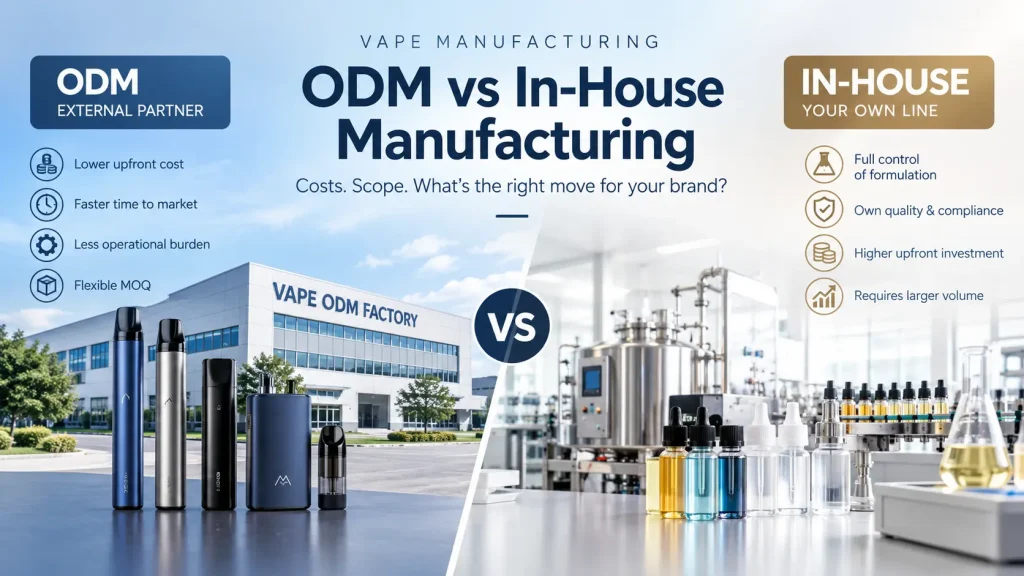
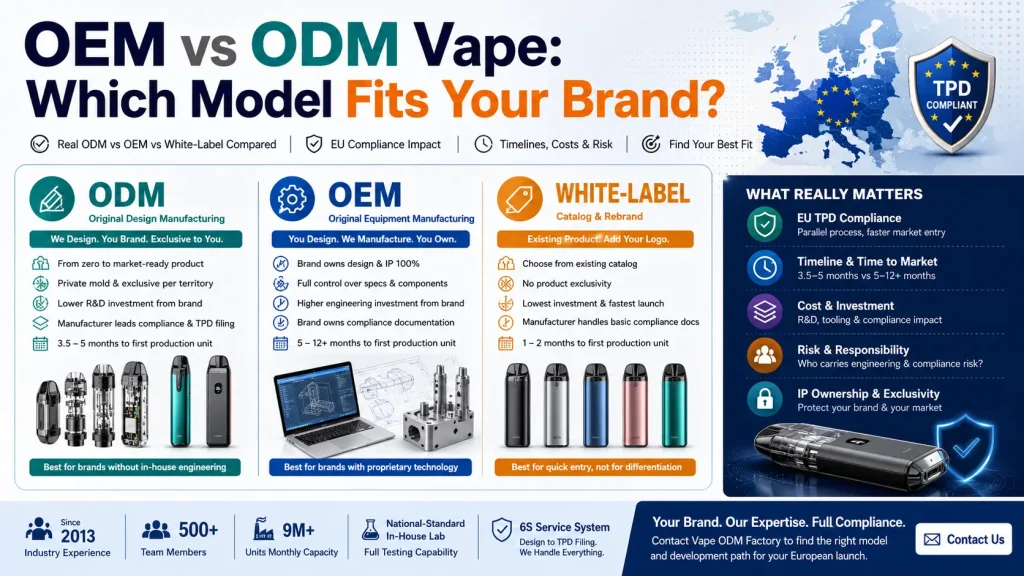
Keep channel selection separate from manufacturing depth. White label means an existing device with a logo change; private label adds control over packaging, logo, flavor, or SKU choices on an existing platform; full ODM entails a new design, private tooling, and agreed exclusivity. None of those choices proves that DTC will outperform wholesale. The related manufacturing cost comparison addresses a different decision. Here, a DTC vs wholesale vape brand analysis starts after the sellable configuration is defined.
Treat Channel Permission as a Product Requirement
A Netherlands launch cannot assume that a translated checkout creates a permitted DTC route. The NVWA distance-sales guidance prohibits remote consumer sales of tobacco and related products, including vapes and components. It also states that remote offering is prohibited from 1 July 2026. Moving payment or collection into a physical shop does not make an online reservation acceptable. For the DTC vs wholesale vape brand decision, screen the proposed transaction against current national guidance first.
Do not turn that consumer restriction into a blanket conclusion about every B2B transaction. Identify the customer category and obtain advice for the proposed wholesale structure. Separately, the UK cross-border registration guide distinguishes Northern Ireland from Great Britain and says its registration is not required for retailers trading exclusively with other retailers. An older country table is not a substitute for current destination rules. A DTC vs wholesale vape brand route needs its own documented permission check.
Product legality remains a separate gate. The UK single-use vape guidance covers online and physical sellers and wholesalers; changing channel does not make a prohibited single-use device marketable. Check the complete reusable-product criteria, including refillability, rechargeability, and coil replacement arrangements, rather than treating a charging socket as sufficient. A DTC vs wholesale vape brand strategy should begin with the permitted product architecture, then select a route able to support its replacement parts and required customer information.
Create a dated market file containing the proposed SKU, seller and buyer locations, retail or trade status, product notification evidence, labeling review, and current tax treatment. Add written acceptance from the intended payment and delivery providers for the actual category. These are proposed diligence items, not a claim that every country uses the same filing system. The DTC vs wholesale vape brand decision should remain open until material questions have named owners; an attractive forecast is not evidence of permission.
Calculate DTC vs Wholesale Vape Brand Contribution
Gross margin leaves out much of the work that distinguishes these routes. Start with revenue excluding recoverable sales tax, subtract the product cost on a consistent landed basis, then allocate the costs caused by the order. For direct orders, examine payment fees, age-check costs where applicable, picking, packing, delivery subsidy, support, refunds, and acquisition. For wholesale, examine account servicing, trade freight, credit losses, rebates, and agreed returns. A DTC vs wholesale vape brand model should explain every deduction.
Use a deliberately fictional example, not a market benchmark. Suppose a permitted reusable product produces EUR 20 net DTC revenue per unit, EUR 7 product cost, EUR 4 fulfillment and transaction cost, EUR 2 support and return provision, and EUR 5 allocated acquisition cost. Contribution is EUR 2 before fixed overhead. A wholesale proposal with EUR 12 revenue, the same EUR 7 product cost, and EUR 2 allocated trade costs contributes EUR 3. The DTC vs wholesale vape brand result follows the assumptions, not a universal margin rule.
Change one input and the ranking can change. If allocated DTC acquisition cost falls from EUR 5 to EUR 3 with the other fictional inputs unchanged, direct contribution becomes EUR 4. That sensitivity is useful; it does not establish that repeat customers will actually deliver the saving. Build separate new-customer and returning-customer cohorts, including failed payments and refunds. A DTC vs wholesale vape brand forecast should show which measured behavior would justify the preferred route and which untested assumption currently carries the conclusion.
Keep fixed launch spending visible outside those unit figures. Site operation, specialist advice, packaging setup, testing, staff, software, and warehouse commitments still require funding even if a per-order contribution looks positive. The private-label investment framework provides context for separating launch costs from reorder costs. For a DTC vs wholesale vape brand comparison, calculate contribution at a realistic order mix and then test whether the expected volume can cover the fixed commitments without assuming every manufactured unit sells.
Compare DTC vs Wholesale Vape Brand Cash Exposure
Profit and cash answer different questions. A consumer may pay at checkout, yet the brand has already financed production, inbound movement, and stored stock. A wholesale purchase order may promise volume while paying only after delivery or later. Those are possible contract structures, not standard terms. Plot the dates of supplier deposit, balance payment, freight, tax, customer receipt, and expected refunds. A DTC vs wholesale vape brand decision should include the largest cash deficit before collections catch up.
A useful stress case delays the largest customer’s payment while slowing consumer demand in the same month. Can the brand fund the next production balance without using cash reserved for tax or refunds? A second case tests a batch held for a documentation question. Neither scenario predicts a failure; both reveal dependence on timing. The DTC vs wholesale vape brand model should retain an explicit cash reserve assumption and name the action taken when a receivable passes its agreed date.
Inventory fragmentation can outweigh a theoretical unit saving. Every destination label, strength, flavor, device color, or pack configuration can create another stock position that needs replenishment and eventual disposition. Confirm which variations genuinely require a separate manufacturing commitment. Quote MOQ per flavor whenever flavor is the relevant minimum, and do not present a combined launch quantity as if each variant independently satisfies it. A DTC vs wholesale vape brand plan should connect the sales forecast to the exact variants the factory will make.
Keep product and regulatory age separate from accounting stock value. An unsold carton may still appear at cost while its practical sales window is narrowing. Record batch identity, destination eligibility, packaging revision, and the event that would trigger a stop-sale review. Wholesale does not remove that exposure if the contract permits returns or leaves ownership with the brand. A DTC vs wholesale vape brand comparison should identify who owns aging stock at each stage and what evidence supports its continued sale.
Assign Tax and Operational Responsibilities
For a current UK example, HMRC guidance updated on 7 October 2026 describes vaping-liquid duty and stamping across wholesale and retail. It says liable products released onto the UK market from 1 October 2026 require stamps. Qualifying stock produced or imported before that date can use the stated transition through 31 March 2027. This is a liquid-product example, not a claim that empty hardware automatically attracts the same treatment. The DTC vs wholesale vape brand allocation must identify the actual taxable product.
That same guidance distinguishes businesses only selling or distributing duty-paid goods from businesses also manufacturing, importing, stamping, or holding goods under duty suspension. Do not assume a distributor performs those additional activities simply because its quotation says delivered. Ask for a written responsibility schedule tied to the actual transaction. For the DTC vs wholesale vape brand decision, unresolved duty and stock-documentation questions belong in the launch gate, rather than being hidden inside a freight allowance.
Build an exception procedure that works for individual orders and cartons. Name the person receiving a complaint, the evidence required to identify a batch, the decision maker for replacement or credit, and the route for escalating a potential product issue. Commercial return terms do not replace statutory duties. A DTC vs wholesale vape brand plan should let the brand trace a complaint through its partners without depending on an informal message chain or a salesperson who happens to remember the order.
Packaging is part of operations rather than decoration. A carton must support identification, storage, and the intended sales route; the retail pack must match the reviewed market configuration. Compare sample handling, barcode use, and batch records with the chosen partner before production. The private-label packaging discussion covers design choices; this DTC vs wholesale vape brand assessment asks whether the approved version survives ordering, fulfillment, returns, and replenishment without staff improvising labels or substituting a different market pack.
Measure Customer Learning and Partner Performance
Direct transactions can expose order-level behavior, but a database is useful only when it supports a lawful, defined purpose. Decide which events answer the commercial question: first purchase, second purchase, refund, failed delivery, and time to resolution. Use appropriate privacy controls and permissions for the actual processing. A DTC vs wholesale vape brand plan should avoid equating access to customer records with unlimited marketing rights, especially where category advertising and national channel restrictions require a separate review.
Wholesale measurement needs an agreed distinction between goods sold to the partner and goods sold onward. Ask whether the partner can report active outlets, stock by variant, returns, and reorder dates, and agree a practical reporting cadence. These are negotiation proposals, not an entitlement to a retailer’s customer information. The DTC vs wholesale vape brand analysis should identify what can actually be measured. A large opening order without credible replenishment evidence may represent inventory placement rather than durable consumer demand.
Run a small, lawful pilot with explicit questions rather than a promise of scale. Choose the product range and exposure that the team can service; set the observation period before reading results. Compare contribution, cash received, support burden, stock age, and repeat demand using the same definitions. A DTC vs wholesale vape brand pilot can test whether a shop needs staff training or whether direct orders fail at delivery. It cannot justify selling into a prohibited market while collecting evidence.
Document the decision rule before a disappointing or exciting week changes the story. For example, expansion might require positive measured contribution, acceptable unresolved-complaint levels, and cash sufficient for the next committed batch. The actual thresholds should come from the brand’s capacity and obligations, not a borrowed industry average. A DTC vs wholesale vape brand review should state the sample size and uncertainty alongside results. Sparse data support a cautious next test; they do not establish a universal channel winner.
Use a Hybrid Model Only With Clear Boundaries
A hybrid structure may fit different permitted markets or customer needs, but it adds decisions instead of removing them. State which products and services belong in each channel, who supports an existing customer, and how inventory is allocated during shortages. General DTC and wholesale comparisons describe control and operational tradeoffs; their examples from other categories do not prove vape profitability. A DTC vs wholesale vape brand hybrid needs evidence for both sides and a realistic staffing plan for their interaction.
Prevent channel disputes by explaining service differences before partners commit. A retailer may provide local availability and product support while the brand performs another role. Discuss promotions, communication, stock visibility, and the handling of consumer questions in writing. Do not solve disagreements by assuming the brand can dictate independent resale prices; proposed pricing restrictions require competition-law review. The DTC vs wholesale vape brand objective is a workable division of service and risk, supported by terms the parties can actually follow.
Limit exclusivity to a proposal that can be evaluated. Specify territory, products, duration, reporting, performance review, and a lawful exit mechanism, then have the actual agreement reviewed. A partner’s claim to a whole region should not automatically block a permitted market it cannot serve. Conversely, a brand should not promise overlapping rights casually. A DTC vs wholesale vape brand plan should show how a missed reorder, ownership change, or regulatory restriction changes the relationship without leaving stock and customer support ownerless.
Keep production planning anchored to confirmed demand and conservative replenishment assumptions. A consumer forecast and a distributor forecast must not both count the same units. Maintain one variant-level stock record, show reserved quantities, and distinguish orders from expressions of interest. MOQ per flavor remains a manufacturing constraint even when sales are split across channels. A DTC vs wholesale vape brand hybrid should reduce unexplained inventory exposure, with a named decision maker able to pause purchasing when the combined forecast no longer supports the batch.
Choose the Route Your Team Can Prove
Choose the route that is permitted for the product and destination, produces positive contribution under measured costs, and leaves enough cash to honor the next commitment. Prefer direct sales when the team can document lawful access, service individual orders, and fund acquisition without relying on an untested repeat-purchase forecast. Prefer wholesale when a credible partner provides a defined service, transparent ownership and payment terms, and evidence of onward demand. Use both only when their boundaries and combined inventory plan are clear. For the DTC vs wholesale vape brand decision, the first purchase order is a test of those assumptions, not the end of the assessment. Keep the evidence dated, review exceptions, and stop expansion when permission, cash, or product support is unresolved. Nothing in this comparison constitutes legal advice for a specific business.