We manufacture disposable CBD vape hardware ourselves, and most brands come to us after a sourcing failure, not before one. They have already paid the expensive tuition: samples can lie, a cheap price hides a defect rate, a catalog is not a production line. This article is not about us. It is the evaluation framework we would hand any brand that asked, in the order you should run it: documents first, oil match second, the spec in writing third, verification before scale, factory depth, and finally the red flags that should end the conversation. None of this is legal advice — cannabis and hemp rules vary by state and are changing through 2026, so confirm anything compliance-related with counsel. The selection process itself is stable, and it starts before anyone talks about price, because the right disposable CBD vape manufacturer is rarely the cheapest one.
Start With the Documents a Disposable CBD Vape Manufacturer Must Produce
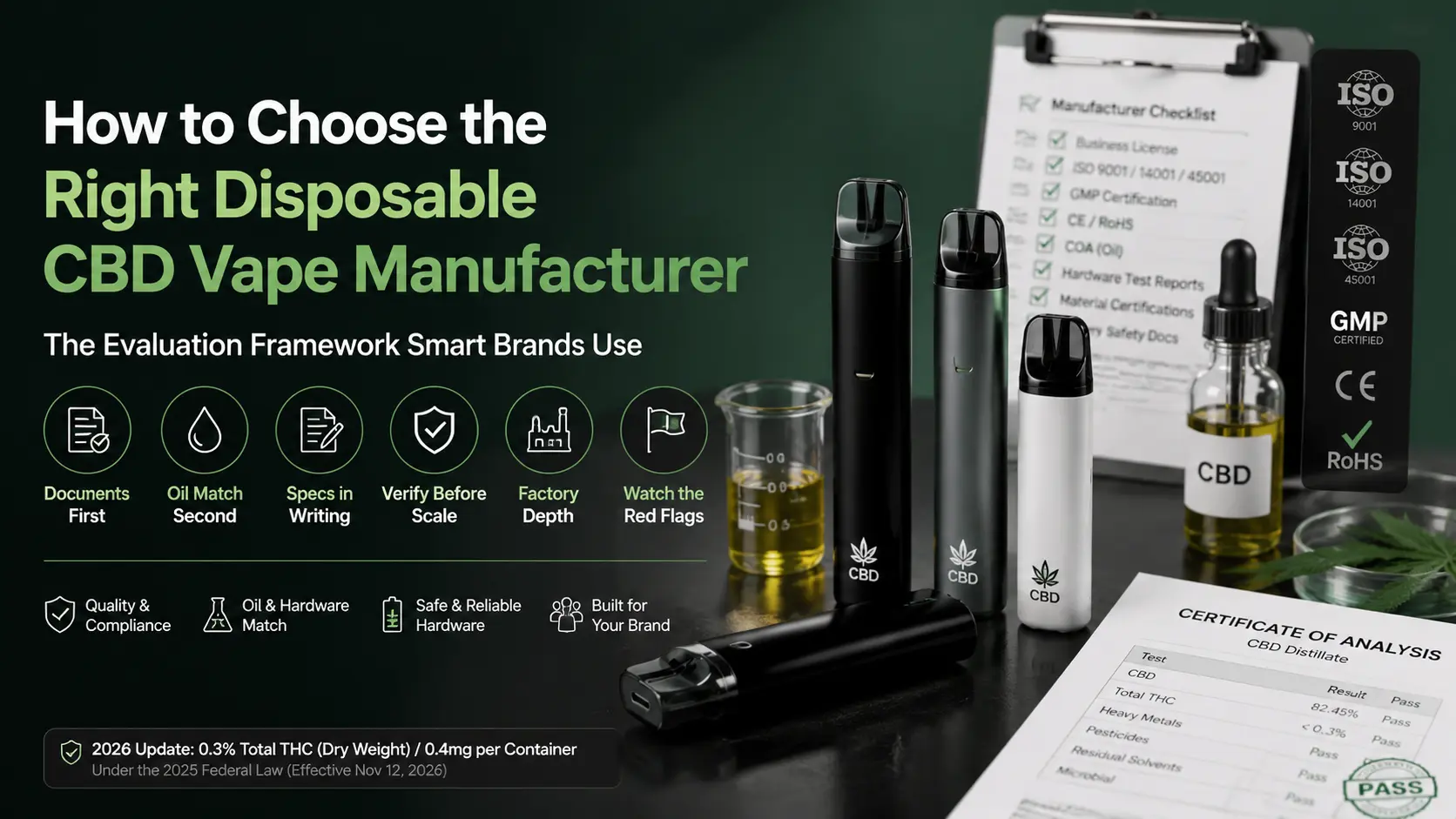
The first filter has nothing to do with product samples. Every serious disposable CBD vape manufacturer keeps these files ready before it is asked. Before you evaluate anything else, request: business license, export qualifications, ISO 9001 quality management, ISO 14001 environmental, ISO 45001 occupational safety, GMP certification where applicable, and CE or RoHS for the hardware itself. A factory that hesitates on paperwork before you send money will not get faster at it after you do. Certificates matter less as marketing badges than as proof that the facility runs documented processes — and documented processes are what keep defect rates low when your order runs through the same line as ten other brands’.
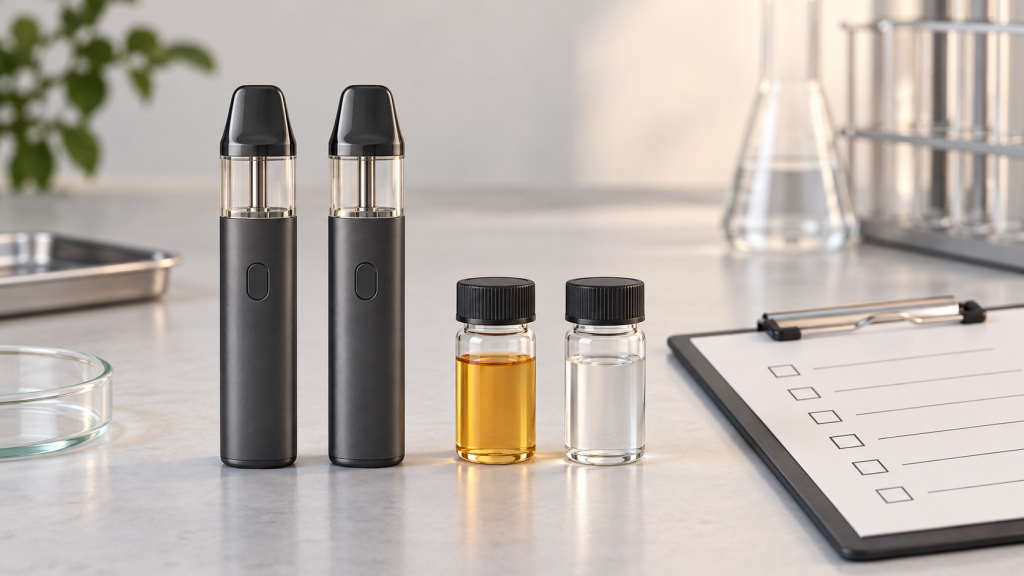
The second document is where most buyers go wrong. A certificate of analysis proves what is in the oil — potency, contaminants, total THC — and it is non-negotiable for any CBD product. But a COA is issued for the fill, not the device, and that distinction confuses a lot of sourcing conversations. When you evaluate a disposable CBD vape manufacturer, ask separately what it will give you for the hardware: coil resistance consistency data across a batch, leak test results, material certifications, battery safety documentation. The oil-side COA belongs to your extract supplier; the hardware-side evidence belongs to the factory, and you want both on file before the first production run. A disposable CBD vape manufacturer that cannot produce both kinds of evidence is a hardware risk in disguise. Reading a certificate of analysis properly is a skill worth building before you start asking for them.
Regulation is now a hardware conversation, which is new. Section 781 of the 2025 federal funding law takes effect November 12, 2026 and tightens the definition of legal hemp to a total-THC standard: 0.3 percent on dry weight and 0.4 milligrams per finished container, counting THCA and other intoxicating cannabinoids. For full-spectrum CBD formulas that means reformulation to broad-spectrum or isolate, which lowers oil viscosity, which changes the coil match inside your device. The FDA’s April 2026 enforcement memo covers oral CBD products only; inhalable products remain the sensitive lane, and health claims remain the fastest way to draw a warning letter. When you choose a disposable CBD vape manufacturer, you need one that handles your formula’s THC profile as a hardware question instead of waving it off, and whose engineering team can retune coil and intake when your oil changes. The current FDA compliance picture for CBD is worth reading before the sourcing conversation starts.
Match the Hardware to Your Oil, Not the Other Way Around
The most common sourcing mistake is picking a device first and hoping the oil will work in it — a mistake that has nothing to do with which disposable CBD vape manufacturer you chose. Oil viscosity decides everything downstream, and the wrong match produces the two failures every vape brand fears: weak vapor and burnt flavor when the oil is too thick for the coil, or flooding and leakage when the oil is too thin for the intake. Published matching guidance is consistent across the industry: thin isolate formulations run best on a fine ceramic coil at low voltage; thicker distillate-type formulas need a high-porosity ceramic coil, a wider intake and more power; live resin and live rosin sit at the extreme end and need dedicated coil tuning with a preheat function.
Tell your candidate the exact viscosity and carrier of your fill, and let the disposable CBD vape manufacturer propose the coil, intake and voltage. If it asks for a sample of your oil before quoting, that is a good sign. If it quotes without asking, that single question separates a serious disposable CBD vape manufacturer from a reseller.
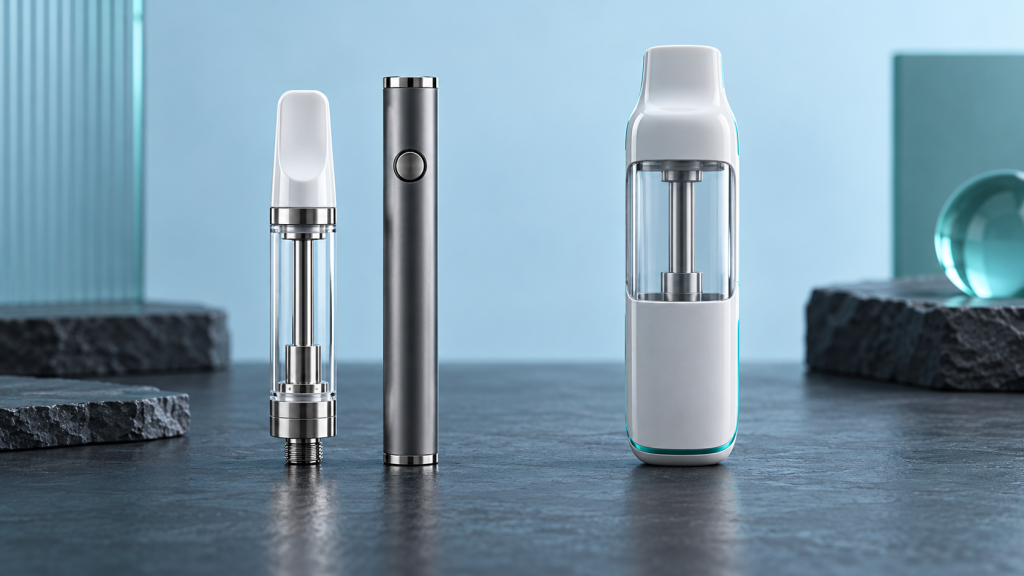
Capacity and battery follow the same logic. A 0.5 to 1 ml fill with a 280 to 400 mAh cell is a balanced, lightweight unit — the standard envelope for CBD disposables. Scale the fill to 2 or 4 ml and the battery has to scale with it, or the user throws away usable oil when the cell dies first. Our own CBD platform runs this range: top-fill devices from 0.5 to 4 ml, 280 to 400 mAh, Type-C charging, all in-house, and every model is specced to a viscosity class rather than a fixed oil. That is the design discipline you want from any disposable CBD vape manufacturer: the spec sheet should name the oil range the device is built for, not just the capacity — the mark of a disposable CBD vape manufacturer that engineers around oil, not around a catalog. Our guide to disposable CBD vape hardware explains the capacity-to-battery relationship in detail.
Get the Specification Written Into the Order
Verbal agreements and catalog screenshots are how defect disputes start. When you settle on a disposable CBD vape manufacturer, every technical detail belongs in the order document: fill volume, coil resistance, battery capacity, charging port, airflow, leak-rate target, materials, packaging, and the QC checkpoints at which the factory inspects. Two items deserve special attention. First, the approved sample: the factory keeps a signed reference unit, and both sides agree that production must match it within a defined tolerance. Second, batch consistency: ask what the factory measures between batches and what variance it allows — coil resistance drift, fill-weight spread, leak test failure rate. If the supplier cannot articulate its own tolerances, it does not have them, and you will discover that in the field, not at the factory, the same way the brand in our opening story discovered its disposable CBD vape manufacturer’s defect rate.
A written spec with revision control also protects you on the change side. Oil reformulation, packaging redesign, a new flavor lineup — every one of these can silently alter device performance, and a documented spec means changes get re-tested and signed off instead of shipped on trust. This is standard practice in any vape product development process, and it is the cheapest insurance in the whole selection. If a supplier resists documenting the spec, take that as a warning rather than a negotiation win — documentation is the cheapest feature a disposable CBD vape manufacturer can offer.
Run a Three-Stage Verification Protocol Before You Scale
The 40 percent defect story above did not happen because the samples were bad. The samples were fine. The disaster happened because the brand skipped the stages between sample approval and volume production. A reliable disposable CBD vape manufacturer will support — and in our view should insist on — a three-stage protocol. Stage one is samples: order a small set, typically 20 to 50 units, and test them as a consumer would: draw quality, leak behavior after a week of sitting, battery life, flavor consistency from first puff to last.
Stage two is a pilot batch: 500 to 1,000 units through the actual production line, not a hand-built sample line, with full QC records and a defect-rate target agreed in advance. Stage three is scale, with the pilot’s defect rate written into the contract as the acceptance baseline. Industry benchmarks for MOQ tiers and lead times — 100 to 500 units for startups, 1,000 to 5,000 for growing brands, 10,000 and up for established lines, standard hardware production around 15 to 25 days — give you a sense of where your negotiation should land, though you confirm the real numbers in writing.
Each stage has an exit condition. Samples tell you whether the product works; the pilot tells you whether the factory can build it repeatedly; scale tells you whether the economics hold. Most brands rush stage two because the sample looked good and the price was right, and that is exactly the pattern that produces 40 percent defect lines. Any disposable CBD vape manufacturer that cannot hold tolerances across a pilot run will not hold them across ten thousand units. The pilot also gives you something samples never can: real inspection data from the factory’s own line — QC reports, failure modes, actual yield — the strongest evidence a disposable CBD vape manufacturer can show you. Our sample request guide lays out what to test at each stage and how to read the results.
Audit the Factory’s Line, Not Just Its Catalog
A catalog tells you what a disposable CBD vape manufacturer wants to sell you. The production line tells you what it can actually build. Before you commit, find out who owns the factory: a manufacturer with its own facility controls quality and cost very differently from a trading company that forwards orders to whoever has capacity. Ask about the line itself — what format the factory is set up to build in volume, whether disposable and cartridge lines are separate, what QC checks run at incoming, in-process and finished stages, and whether inspection records are kept per batch. A factory that builds five formats indifferently is riskier than one that builds one format deeply, and format depth is a fair question for any disposable CBD vape manufacturer you are evaluating.
Customization depth is the second factory question. CBD branding lives or dies on the shelf: Pantone-matched colors, logo placement, finish options like rubber paint, anodized sandblasting or baked enamel, packaging that matches your brand’s visual language. Ask which of these a supplier can do in-house — a factory that can only change a label is a reseller with a printer. Ask about capacity honestly: monthly output, how many other brands share the line, and what happens to your lead time during peak season; a candid disposable CBD vape manufacturer answers this without a spreadsheet. Standard hardware production runs roughly 15 to 25 days before shipping, and you want the factory’s real calendar, not its brochure. What a vape ODM manufacturer actually provides covers the difference between a supplier and a development partner.
Cannot visit the factory in person? Video audits and customer references close most of the gap. A serious disposable CBD vape manufacturer can walk the line on a live call, show you the QC bench and the inspection records, and put you in touch with two or three normal customers in your category — not its best reference, ordinary ones. Then ask what happens when something fails: the return policy, the replacement flow, who carries the freight on a defective batch. A factory with a written process for failure is a factory that has seen failure before, and that experience is worth more than any floor tour.
Red Flags That Should End the Conversation With a Disposable CBD Vape Manufacturer
Some signals are disqualifying on their own, no matter how good the price looks. A disposable CBD vape manufacturer that cannot produce certifications, license and export records on request — end the conversation. One that refuses small pilot batches or sets the minimum order far above the stage-two volume you proposed — end it; the factory is either protecting a bad line or locking you into volume before the product is proven. A price far below every other quote, especially for a device with a battery and a ceramic coil — take it as a defect-rate signal, not a bargain. A supplier that will not put the spec in writing, or whose communication goes quiet after the deposit — both are previews of production-time behavior. And one that promises compliance for your target state without asking which state or which formula you sell — walk away; compliance depends on the oil and the label, not on the hardware alone.
None of these red flags is exotic. They are the ordinary failure modes of a crowded market, and every one of them is visible before you sign if you look for it. The brands that get burned are not the ones that ignored exotic risks; they are the ones that skipped the boring checks. Run the list, and you will eliminate most of the market — including some disposable CBD vape manufacturer that looked good on paper but could not survive contact with a checklist.
The Checklist: Questions to Ask Every Disposable CBD Vape Manufacturer
- What documents can you produce today: license, ISO and GMP certificates, export records, material and battery safety documentation?
- Where does the COA responsibility sit? Show me how oil-side testing and hardware-side testing are separated.
- What oil viscosity range is each device built for? Can you retune coil, intake and voltage if my formula changes?
- What is your leak-rate target, and what leak test runs before shipping?
- What is the standard lead time, and what is your on-time delivery record?
- What are the MOQ tiers by model and by colorway — and are they in writing?
- Can I order a 20-to-50-unit sample set, then a 500-to-1,000-unit pilot through the actual production line?
- What QC records do you keep per batch, and will I receive them?
- Which customization do you do in-house: color, finish, logo, packaging?
- Can you help me think through Section 781’s THC limits as a hardware and formula question before I commit?
Then the last test, and it is the cheapest one: ask the hard questions and watch how the supplier answers. A disposable CBD vape manufacturer that responds with documentation and a concrete plan is a partner. One that responds with vague reassurances or a price discount is telling you what the relationship will feel like after the deposit. The answers to these ten questions will tell you more about your future defect rate than any sample round — and they cost nothing but the nerve to ask a disposable CBD vape manufacturer directly.
We are VAPEODMFACTORY, and we build disposable CBD vape hardware in our own factory in Dongguan: ISO 9001, ISO 14001, ISO 45001 and GMP certified, with fourteen device platforms from 0.5 to 4 ml, custom colors, custom finish and full ODM support from concept to certification. We wrote this guide because the checklists above are the right way to buy hardware, and we are happy to be measured against them, the way any disposable CBD vape manufacturer should be. Request a quote and we will send the documents, the spec sheet and the pilot-batch protocol before we talk about price.
One closing note on expectations. This article is provided for general information and does not constitute legal advice. Cannabis and hemp regulations vary by state and change frequently; consult qualified counsel for your specific products and markets before committing to a formulation, a label or a device.
This article is provided for general information and does not constitute legal advice. Cannabis and hemp regulations vary by state and change frequently; consult qualified counsel for your specific products and markets.