Sourcing vape regulatory support from a China supplier has become essential for EU brands navigating TPD compliance.
If you’re sourcing from China and selling into the EU, you’ve probably asked this question — or at least thought it. Can a Chinese vape factory actually handle TPD compliance, or is that something you have to figure out yourself?
The short answer: it depends entirely on the factory. Some have built real regulatory infrastructure. Most haven’t. Knowing the difference before you sign a contract is what this guide is about. We’ll cover what vape regulatory support from a China supplier actually looks like, what factories can and can’t do, and how to run the full compliance process without getting burned.
Why TPD Compliance Is Non-Negotiable for EU Market Entry
The EU Tobacco Products Directive (TPD) — specifically Article 20 — sets the legal framework for all e-cigarettes sold across EU member states. It’s not optional, and it’s not something you can fix after the fact.
Key requirements include:
- Maximum nicotine concentration: 20 mg/ml
- Maximum e-liquid tank capacity: 2 ml
- Maximum refill container volume: 10 ml
- Mandatory notification to national authorities before market entry
- Full ingredient disclosure and toxicological assessment
- Child-resistant and tamper-evident packaging
- Health warnings covering 30% of packaging surface
Failure to comply doesn’t just mean a product recall. It can mean import bans, fines, and permanent damage to your brand’s standing in the market. In Germany, France, and the Netherlands, enforcement has become significantly stricter since 2022.
The notification process alone — submitting product data to the EU Common Entry Gate (EU-CEG) — requires detailed technical documentation that most brands can’t produce without factory-level data.
What Chinese Vape Factories Can and Cannot Do
This is where most buyers get confused. There’s a real gap between what factories claim and what they actually deliver.
What a Capable Factory Can Do
A well-equipped Chinese vape factory with genuine vape regulatory support capabilities can:
- Formulate e-liquids within TPD nicotine and ingredient limits
- Conduct in-house or third-party lab testing (emissions, heavy metals, coil materials)
- Prepare technical documentation packages (ingredient lists, toxicological data, device specs)
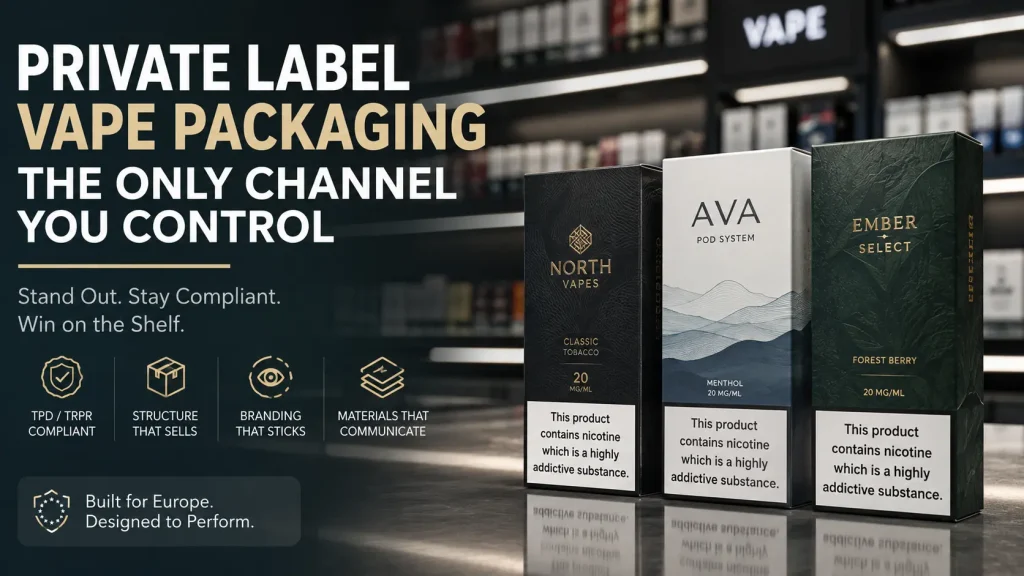
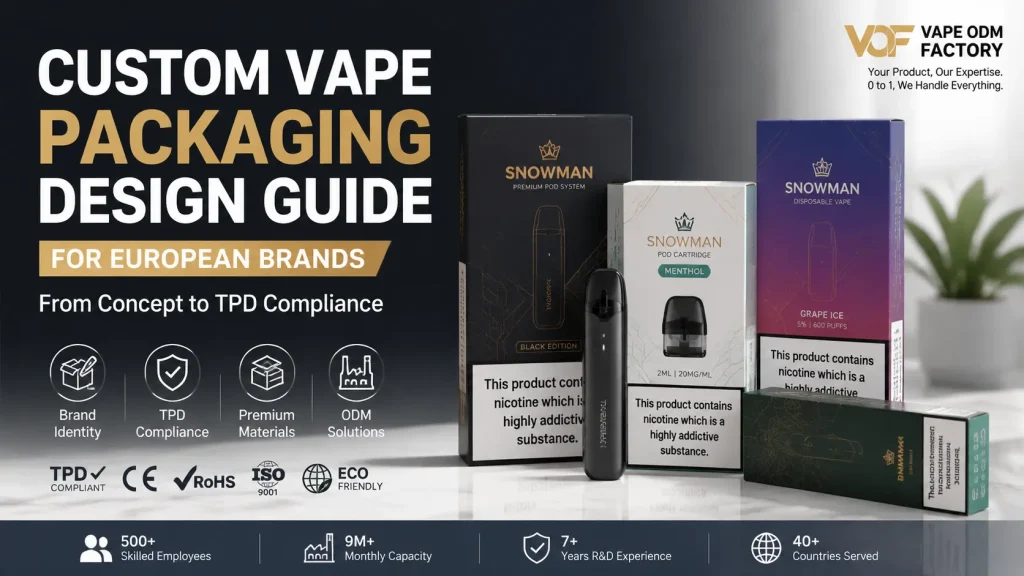
- Produce TPD-compliant packaging with correct health warnings and label language
- Prepare and submit EU-CEG notifications under your company’s name
- Adjust product specs to meet specific member state requirements
What Most Factories Cannot Do — But Some Can
Here’s where Vape ODM Factory is different from most Chinese suppliers. The majority of factories can prepare your documentation, but they stop there. You’d still need to appoint an EU Responsible Person and manage the EU-CEG submission yourself — adding cost, time, and coordination overhead.
Vape ODM Factory holds its own EU-CEG account. Once you provide your company registration information, they submit the TPD notification directly under your company’s name. You don’t need to hire a third-party EU RP or navigate the EU-CEG portal yourself.
What the factory still cannot do — and no factory should claim otherwise:
- Guarantee regulatory approval (that’s a government decision, not a production outcome)
- Act as the legal product owner in the EU market (that remains your responsibility as the brand)
- Replace legal counsel if your product faces a compliance dispute
How a China Vape Supplier Provides Vape Regulatory Support
When a factory says “we support TPD compliance,” that phrase can mean very different things. Here’s what it should mean in practice.
Formulation and Ingredient Control
TPD restricts certain ingredients outright — vitamins, caffeine, colorants that color the aerosol, and any ingredient with CMR (carcinogenic, mutagenic, reprotoxic) properties. A compliant factory maintains a controlled ingredient list and can provide full CAS number documentation for every component.
If a factory can’t give you a complete ingredient disclosure with CAS numbers, that’s a red flag.
Lab Testing and Emissions Data
TPD notification requires emissions testing data — specifically for carbonyls (formaldehyde, acetaldehyde, acrolein) and other toxicants. This testing must be done at a certified laboratory.
Factories with national-standard certified labs can run this in-house. Others outsource to third-party labs like SGS, Intertek, or TÜV. Either is acceptable — what matters is that the test reports are traceable and formatted for EU-CEG submission.
Technical Documentation Package
A complete TPD documentation package typically includes:
- Product description and device specifications
- Full ingredient list with quantities and CAS numbers
- Toxicological assessment summary
- Nicotine dose and uptake data
- Emissions test reports
- Production process description
- Declaration of conformity
A factory that has done this before will have templates and processes. A factory doing it for the first time will slow you down significantly.
Packaging and Labeling Compliance
TPD packaging requirements are specific. Health warnings must appear in the official language(s) of the member state where the product is sold. Child-resistant closures are mandatory. Nicotine addiction warnings must be present.
A factory with EU market experience will have artwork templates for major markets (DE, FR, IT, ES, NL, PL) and can adapt them for your brand. This saves weeks of back-and-forth with your design team.
The Full Compliance Process: Step by Step
Here’s how a complete TPD compliance workflow looks when factory and brand are properly aligned.
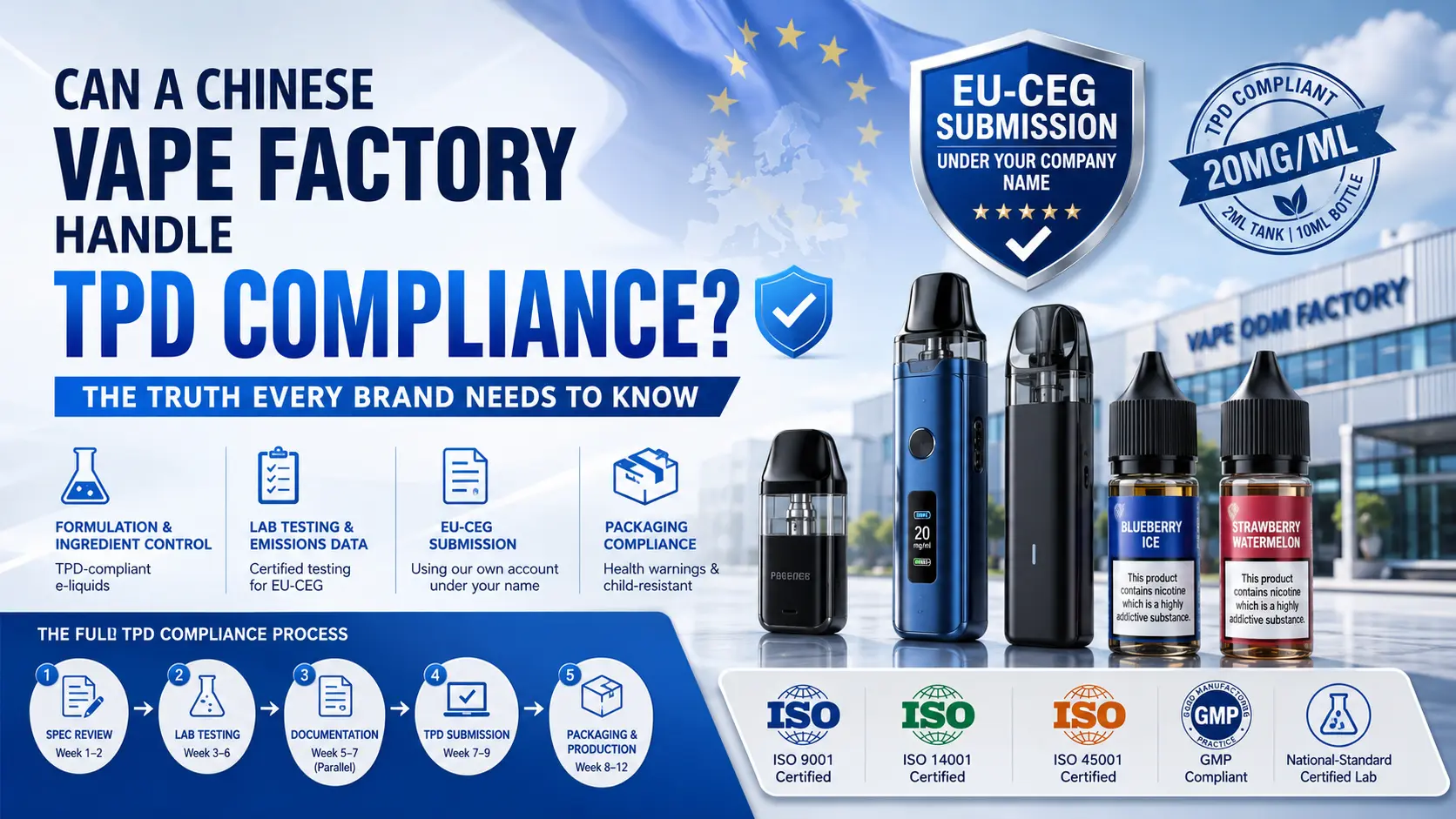
Step 1: Product Specification and Formulation Review (Week 1–2)
You share your target market, nicotine strength, flavor profile, and device type. The factory reviews against TPD limits and flags any issues — nicotine concentration, restricted ingredients, device capacity.
Step 2: Sample Development and Lab Testing (Week 3–6)
Samples are produced and submitted for emissions testing. This is often the longest step. Certified lab turnaround is typically 2–4 weeks. Results are reviewed against TPD thresholds.
Step 3: Documentation Package Preparation (Week 5–7, parallel)
While testing is underway, the factory prepares the full technical documentation package. This runs in parallel to save time. The package is reviewed internally before submission.
Step 4: TPD Notification Submission (Week 7–9)
This is where most brands hit a bottleneck — finding an EU Responsible Person, granting portal access, and coordinating submission. Vape ODM Factory removes this step entirely. Using their own EU-CEG account, they submit the notification directly under your company’s name. You provide your company registration details; they handle the rest.
Most EU member states require a 6-month waiting period after submission before the product can be placed on the market. Germany and a few others have additional national requirements on top of the standard EU-CEG process — these are flagged and handled during documentation preparation.
Step 5: Packaging Artwork Approval and Production (Week 8–12)
Packaging artwork is finalized with correct warnings, language, and legal text. Production begins once artwork is approved and notification is submitted (not necessarily approved — submission is the trigger in most markets).
Total timeline: 10–14 weeks from brief to production-ready. Brands that skip steps or rush documentation typically add 4–8 weeks of rework.
Common Pitfalls When Working with China Vape Suppliers on Compliance
Most compliance failures aren’t about bad intentions. They’re about process gaps.
The Factory Doesn’t Understand EU Member State Differences
TPD is an EU directive, but implementation varies by country. Germany requires products to be registered with the BfR. France has specific packaging language requirements. Some markets have additional nicotine strength restrictions beyond the EU baseline.
A factory that treats “EU compliance” as a single checkbox will miss these nuances.
Documentation Is Prepared After Production
This is the most common and costly mistake. Some factories treat compliance documentation as an afterthought — something to prepare when the buyer asks for it. By then, the product may already be non-compliant in ways that require reformulation or retesting.
Documentation should be built into the development process, not bolted on at the end.
No Clear Responsibility Split
Who is responsible for what? If this isn’t defined in writing before the project starts, you’ll find out the hard way. The factory should provide documentation and compliant product. The brand handles final market responsibility. Blurring this line creates gaps.
Inconsistency Between Sample and Mass Production
Lab testing is done on samples. If the mass production batch uses different materials — different coil wire, different cotton, different e-liquid batch — the test data may no longer be valid. A factory with proper quality management (ISO 9001/45001/14001, GMP) will have change control processes to prevent this.
TPD Compliance Checklist for Evaluating Your Factory Partner
Use this checklist when assessing whether a Chinese factory can genuinely support your EU compliance needs.
Factory Capabilities
- ISO 9001 certified quality management system
- GMP-compliant production environment
- In-house or contracted certified lab for emissions testing
- Documented ingredient control list with CAS numbers
- Experience with EU-CEG documentation format
- Holds own EU-CEG account for direct submission
- Packaging templates for major EU markets
Documentation Readiness
- Can provide full ingredient disclosure within 5 business days
- Has existing emissions test reports for similar products
- Can prepare toxicological assessment summary
- Can submit EU-CEG notification under your company name
Process and Communication
- Has a dedicated compliance or regulatory contact
- Can provide references from EU market clients
- Has a defined change control process for production
- Clear responsibility split documented before project starts
How to Choose a China Vape Regulatory Partner
Not every factory that claims vape regulatory support has actually built the infrastructure to deliver it. Here’s how to tell the difference.
Ask for existing documentation samples. A factory with real experience will have redacted examples of TPD documentation packages they’ve prepared. If they can’t show you anything, they’re learning on your project.
Check their certifications — and verify them. ISO 9001, ISO 14001, GMP, and CE certifications should be current and verifiable. Ask for certificate numbers and check expiry dates.
Ask about their EU client base. How many EU brands do they currently supply? Which markets? A factory supplying 20+ EU brands has navigated the compliance process repeatedly. A factory with one or two EU clients is still building that experience.
One capability separates the top-tier factories from the rest: EU-CEG submission.
Most Chinese factories will prepare your TPD documentation and hand it back to you. At that point, you still need to find an EU Responsible Person, pay their fees, grant them portal access, and coordinate the submission timeline. That process typically adds 2–4 weeks and €500–2,000 in additional cost per product notification.
A factory that holds its own EU-CEG account and submits under your company name eliminates that entire layer. When evaluating vape regulatory support from a China supplier, ask directly: “Do you have an EU-CEG account, and can you submit on our behalf?” Most will say no. The ones that say yes have built a genuinely end-to-end compliance capability.
Vape ODM Factory, based in Dongguan, operates with ISO 9001, ISO 14001, ISO 45001, and GMP certifications, a national-standard certified lab, and a dedicated regulatory support function. Their 6S service system includes direct TPD compliance handling — documentation preparation, EU-CEG submission under your company name, and full packaging compliance. For brands entering the EU market, that end-to-end capability is the difference between a smooth launch and a delayed one. You can explore their full product range to see what’s already been developed with EU compliance built in.
Case Study: What a Successful TPD Compliance Process Looks Like
A European brand entering the German and Dutch markets approached Vape ODM Factory with a disposable vape concept — 2 ml, 20 mg/ml nicotine, three flavor SKUs.
Week 1–2: Product brief reviewed. One flavor contained a restricted colorant — flagged and reformulated before sampling began.
Week 3–6: Samples produced and submitted to a certified third-party lab for emissions testing. Results came back clean across all three SKUs.
Week 5–7: Full TPD documentation package prepared in parallel with testing. Ingredient lists, device specs, toxicological summaries, and emissions data compiled in EU-CEG format.
Week 7: Vape ODM Factory submitted the TPD notification via their EU-CEG account, under the brand’s company name. The brand provided their company registration details — nothing else was required on their end.
Week 8–10: Packaging artwork finalized with German and Dutch health warnings, child-resistant closures confirmed, and nicotine addiction warnings placed correctly.
Week 12: Production commenced. Products reached market within the 6-month notification window.
The brand avoided three common failure points: the restricted ingredient catch in week one, the parallel documentation process that prevented a 3–4 week delay, and the EU RP coordination overhead that typically costs €500–2,000 and adds weeks to the timeline.
The Bottom Line: Vape Regulatory Support From a China Supplier Is Real — If You Choose the Right Partner
Chinese vape factories can absolutely support TPD compliance. The capability exists. What varies is whether a specific factory has built the systems, certifications, and experience to deliver it reliably — and whether they can take the process all the way through to EU-CEG submission, or just hand you a folder of documents and leave the rest to you.
The factories that do it well share a few traits: certified quality management, in-house or contracted lab testing, dedicated regulatory staff, an active EU-CEG account, and a track record with EU market clients. The ones that don’t will tell you what you want to hear and leave you holding incomplete documentation six weeks before your launch window.
Before you commit to a factory, run through the checklist in this guide. Ask for documentation samples. Verify certifications. Ask specifically whether they hold an EU-CEG account and can submit on your behalf. The right vape regulatory support from a China supplier isn’t just a service add-on — it’s a core capability that determines whether your EU launch happens on schedule or gets delayed by months.
If you’re evaluating options, the about page at Vape ODM Factory covers their regulatory infrastructure in detail. Or if you’re ready to discuss a specific project, reach out directly — the compliance conversation is worth having early.