Packaging is where most EU market entries fail — not at customs, not at testing, but at the print stage. A brand spends months developing a product, gets the device engineering right, and then sends artwork to the printer without running it through a proper compliance review. The result is TPD compliant vape packaging that isn’t actually compliant — and by the time anyone notices, the run is already printed.
This guide is not a restatement of legal text. It’s a practical walkthrough of what your packaging needs to include, what it cannot say, how structure affects compliance, and where brands consistently make avoidable mistakes before going to print.
Why Vape Packaging Compliance Gets Brands into Trouble
The EU Tobacco Products Directive — Directive 2014/40/EU — sets out the packaging framework for all nicotine-containing products sold across EU member states. For e-cigarettes and refill containers, the packaging requirements are specific, non-negotiable, and enforced at the national level by regulators who do pull products from shelves.
What makes this difficult for brands is that compliance failures are rarely obvious at the design stage. A health warning that’s 1mm too small after the dieline folds. A nicotine statement placed on the back panel when it should be on the primary surface. A finish treatment that technically obscures the warning text at certain viewing angles. These are the kinds of issues that don’t look like problems on screen.
The consequence isn’t just a product recall. It’s a delayed market entry, reprinting costs, a restarted TPD notification clock, and retailer relationships damaged at the worst possible time. Getting TPD compliant vape packaging right before the print run is significantly cheaper than fixing it after.
What TPD Requires on Vape Packaging
The directive addresses packaging in Articles 20 and 23, with implementing regulations providing further technical detail. The core requirements cover what must appear, how it must appear, and what cannot appear. Here’s the framework.
Health warnings
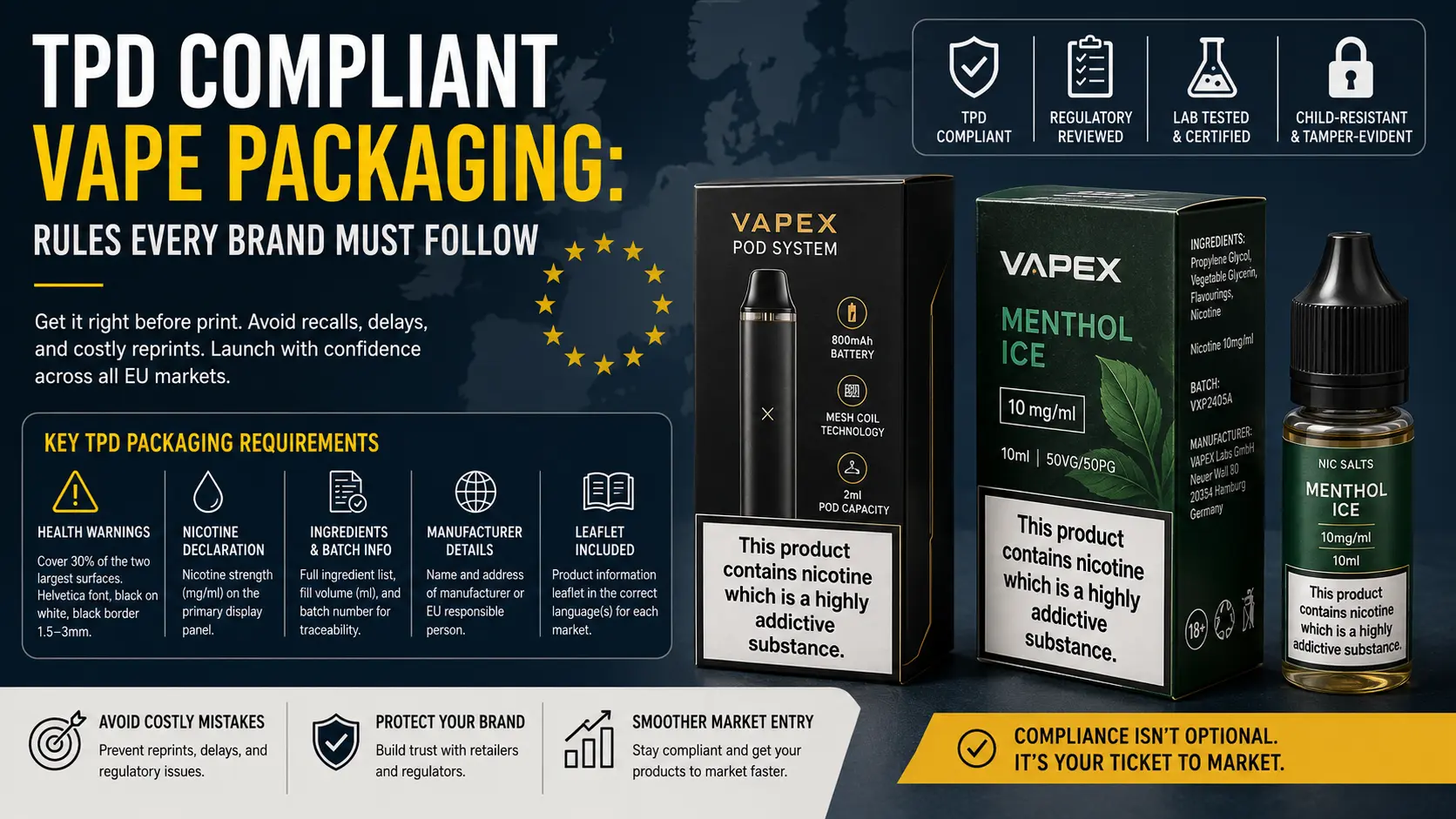
Health warnings must cover 30% of the external surface of the two largest sides of the packaging unit. For a standard rectangular box, that typically means the front and back panels — with one panel each carrying the warning text.
The warning must use Helvetica font, black text on white background, with a black border no wider than 3mm and no narrower than 1.5mm. Font size must be as large as possible within the allocated space. The warning text cannot be covered, obscured, or interrupted by other design elements — including gloss spot UV, foil stamping that bleeds into the warning area, or packaging folds that cut across the text.
One practical issue that trips up designers: when a flip-top or magnetic closure box is in its open position, the warning area can appear split across the lid and base. This counts as an obstruction. The warning must remain fully readable on the closed unit.
Nicotine declaration
Every unit must display the nicotine concentration in mg/ml for e-liquids, or mg per unit for other formats. This declaration must appear on the primary panel — not just the side or back. It cannot be presented in a way that implies the concentration is low, minimal, or otherwise understated.
For multi-strength product ranges, each SKU requires its own packaging with the correct concentration declared. A shared outer with a sticker is not acceptable for retail units sold to consumers.
Ingredient and batch information
The packaging must list all ingredients in descending order of weight. Nicotine must be listed separately and identified explicitly. Each unit requires a batch number for traceability — this is a production-side requirement that your packaging artwork needs to accommodate structurally, either as a printed field or a stamped area.
The volume of e-liquid in the container must be stated in ml. For devices with a non-refillable format, the fill volume and puff count information should both appear, though puff count is not strictly mandated — the fill volume is.
Manufacturer and importer details
The legal manufacturer or EU-authorised importer must be identified on the packaging. For brands manufactured in China entering the EU market, this typically means the name and registered address of your EU-based responsible person or import entity. This is not optional and is verified during customs clearance.
Leaflet inclusion
A product information leaflet must accompany every unit. It must include instructions for use, contraindications, dependency warnings, information for vulnerable groups (pregnant women, people with cardiovascular conditions), and the nicotine content statement. The leaflet must be in the official language(s) of the country where the product is sold.
The packaging structure must physically accommodate the leaflet — it cannot be attached externally with a sticker or tucked under shrink wrap. This has structural implications for box design that need to be resolved before artwork, not after.
Child-resistant and tamper-evident requirements
All e-liquid containers and refill units must have child-resistant closures compliant with EN ISO 8317. Tamper-evident features are required on retail packaging. These are physical construction requirements that must be verified during sampling — they cannot be confirmed from artwork alone.
Packaging Design Restrictions Brands Regularly Overlook
The TPD doesn’t only specify what must appear on packaging — it specifies what cannot. This is the area where brand-side designers, working without compliance oversight, most often introduce problems.
Prohibited claims and descriptors
Packaging cannot include any element that suggests a product is less harmful, reduced risk, or presents a modified health profile. This includes visual metaphors as well as text — imagery that implies freshness, nature, or vitality in a way that carries a health-adjacent connotation has been challenged by regulators in multiple markets.
The following are explicitly prohibited:
- Any claim that a product is “lighter,” “smoother,” “cleaner,” or similar
- References to flavors in ways that could appeal to minors (this is interpreted differently across member states, but the safest approach is to avoid cartoon imagery, toy-like design elements, or language clearly directed at under-18 consumers)
- Promotional materials or information leaflets embedded in packaging that function as advertising
- References to taste or smell that imply a positive health or lifestyle claim
Misleading visual design
This is more nuanced and also more frequently overlooked. A packaging design that uses a distinctive color — say, a deep forest green — across a product range that includes a menthol variant is not inherently non-compliant. But if that green is applied in a way that a regulatory body could reasonably argue implies a cooling, refreshing, or respiratory benefit, it becomes a risk.
Germany and France have both seen enforcement actions on packaging design that doesn’t contain any explicit claims but uses visual coding that regulators interpreted as implying health properties. Design intent is not a defense — perceived consumer interpretation is what regulators evaluate.
How Packaging Structure Affects TPD Compliance
This is a topic almost entirely absent from compliance guides — and it’s one of the more technically interesting aspects of designing TPD compliant vape packaging for EU markets.
Flip-top boxes
The most common retail format. The compliance risk here is at the hinge: depending on how the lid opens, the health warning can be split across the lid and base panels when the box is open. The TPD requires the warning to be readable on the closed unit — but if your photography shows the box open (for e-commerce listings, for example), ensure the warning is still prominently visible.
Gloss laminate on the exterior is a common finishing choice. Ensure the spot UV treatment maps avoid the warning block entirely — any finish that alters the reflective properties of the warning area has been cited as a potential obstruction in several member state interpretations.
Drawer boxes (sliding sleeve)
Drawer boxes present a specific challenge: the sleeve and the inner tray are two separate surfaces. The health warning must appear on the sleeve (the outer packaging the consumer sees), not on the inner tray. Brands that design beautiful inner trays and treat the sleeve as secondary often create a situation where the primary panel warning is technically correct but surrounded by conflicting design hierarchy.
Leaflet insertion is also more constrained with drawer boxes — the internal dimensions need to accommodate a folded leaflet without it becoming wedged or preventing the tray from sliding cleanly.
Magnetic closure boxes
Premium format. The closure mechanism is not a compliance issue in itself — but the interior facing panels (lid interior, base interior) often become brand expression surfaces. These are fine for branding. The risk is when brands try to extend warning-adjacent copy onto interior surfaces in a way that fragments the regulatory information.
Tamper evidence on magnetic boxes also requires design consideration. A standard perforated band works; a removable ribbon seal can also function if it’s clearly tamper-evident on first opening.
Sleeve-over-tray (book-style)
This format is less common in vape retail but appears in premium ODM product lines. The outer sleeve carries the health warning. The inner tray can carry batch information and ingredient listings if the sleeve is retained during retail display — but if the sleeve is typically removed at point of sale, all required information must also appear on the inner tray.
The practical advice: design as if the sleeve will be removed. Every piece of mandatory information should exist on the base unit.
Common TPD Packaging Mistakes — and What They Cost
These are real categories of errors, not hypothetical ones. They appear repeatedly in factory packaging reviews.
Warning area too small after dieline fold
A packaging designer calculates 30% of the declared panel area and places the warning accordingly. The dieline folds. The finished box is 2mm narrower than the flat specification because of board thickness. The warning now covers 28.3% of the panel. This fails.
The fix is to calculate warning dimensions from the finished box specification, not the flat dieline. Always prototype the physical box and measure the warning area on the folded unit before approving artwork.
Nicotine statement on a non-primary panel
A brand places the nicotine concentration on the side gusset — logical from a design layout perspective, keeps the front and back visually clean. Multiple EU market regulators require nicotine content to appear on the principal display area. A side panel doesn’t qualify.
The fix: define the primary display panel at the structural design stage, not during artwork layout. The nicotine declaration location gets locked in with the dieline, not at the artwork stage.
Gloss UV bleeding into the warning block
Spot UV is a standard premium finish choice. When the UV coating edge runs across the health warning text — even partially — it alters the surface texture and light reflection properties of the warning area. Some printers argue this is cosmetic. Regulatory auditors have not consistently agreed.
The fix: define a hard exclusion zone around the entire warning block in the dieline artwork file. Mark it as a “no print treatment” zone and communicate this explicitly to the printer.
Leaflet language doesn’t match retail market
A brand manufactures a single packaging run for four EU markets. The leaflet is in English and German only. Units shipped to France, Spain, and Italy are non-compliant — the leaflet must be in the official language of each country of sale.
This is a supply chain issue as much as a design issue. The solution is either market-specific packaging runs or a multi-language leaflet designed to meet the language requirements of every target country simultaneously. The second approach requires careful leaflet formatting to remain legible — but it’s significantly more cost-efficient at production scale.
Designing TPD Compliant Vape Packaging That Still Works as a Brand Asset
The most common concern from brand-side designers: “If 30% of my primary panels are taken up by warning text, what’s left for the brand?”
For a full playbook on turning the remaining 70 percent into shelf impact — structure, finish, color discipline and traceability — see our private label vape packaging guide to standing out on shelves.
More than you’d think — if the compliance constraints are treated as design parameters from the start rather than imposed restrictions at the end.
Start with the constraint, not the canvas
Set the warning block dimensions and position before any other design element is placed. Build your visual hierarchy around the warning — not despite it. Brands that do this successfully use strong color blocking, typography, and structural packaging choices (embossing, soft-touch laminate, matte-gloss contrast) to create premium shelf presence within the constraint.
The warning block itself can be treated as a design element. High-contrast brands with dark packaging use the mandated white background of the warning as a deliberate visual counterpoint. It’s not invisible — but it can be intentional.
Use the restriction to differentiate
Every compliant brand in your target market carries the same warning format. Your differentiation comes from everything else: the quality of the structural packaging, the precision of the print registration, the choice of secondary finishes, the unboxing experience, the leaflet design. These are all brand-expression surfaces that exist entirely outside the mandatory warning framework.
The brands that look premium in EU retail are not the ones that found ways to minimize the warning — they’re the ones that designed everything else with enough craft that the warning becomes context rather than the dominant visual.
TPD Packaging Requirements That Vary Across EU Markets
The directive is harmonized, but member state implementation creates real differences. These are the markets where localization matters most for vape packaging.
| Market | Key Localization Note |
|---|---|
| Germany | Health warning must be in German. The German FCTC implementing authority (BZgA) has specific enforcement history on visual design claims. |
| France | French-language warning and leaflet mandatory. ANSES has been active on flavor marketing restrictions. |
| Italy | Italian-language requirements. ISS (Istituto Superiore di Sanità) notification required before market entry, beyond standard EU-CEG. |
| Spain | Spanish and, depending on region, Catalan/Basque. AEMPS notification process has stricter documentation requirements for novel products. |
| Netherlands | Dutch-language leaflet. NVWA actively monitors packaging compliance at retail level. |
The practical implication: if you’re entering three or more EU markets simultaneously, packaging strategy needs to address language requirements at the structural design stage. Either market-specific runs, or a multilingual packaging architecture planned from the beginning. Retrofitting language requirements onto an existing design is expensive and almost always results in layout compromises.
For brands planning multi-market EU entry, the EU TPD compliance guide has a detailed breakdown of notification requirements by country and how to sequence submissions for parallel market launches.
Pre-Print Compliance Checklist for TPD Compliant Vape Packaging
Run through this before approving any artwork for production. Every item here corresponds to a real enforcement point.
Mandatory content
- Health warning covers ≥30% of the two largest external surfaces (measured on finished, folded box — not flat dieline)
- Warning text: Helvetica, black on white, black border 1.5–3mm, maximum possible font size within the block
- Warning text not covered, split, obscured, or overlaid by any finish treatment
- Nicotine concentration stated on primary display panel in mg/ml
- All ingredients listed in descending order by weight, nicotine identified separately
- Fill volume stated in ml
- Batch number field present (printed or stamped area allocated)
- Legal manufacturer name and address (or EU responsible person)
- Leaflet included and in correct language(s) for each target market
- Child-resistant closure certified to EN ISO 8317 (physical verification required)
- Tamper-evident feature present and functional
Design compliance
- No claims or visual elements implying reduced harm, modified health profile, or lifestyle benefits
- No flavor descriptors that function as health-adjacent claims
- No imagery that could be interpreted as directed at minors
- Spot UV, foil, and other finish treatments mapped away from warning block
- Dieline accounts for board thickness and fold tolerances in warning area calculation
Production readiness
- Physical box prototype produced and warning area measured (not calculated from flat artwork)
- Leaflet fits inside closed packaging without force
- CRC tested on physical unit, not assumed from component specification
- Print proof reviewed against digital artwork for color accuracy, text legibility, and warning block dimensions
How Vape ODM Factory Reviews Packaging Before Production
Most factories review packaging artwork for print quality — color profiles, bleed margins, resolution. That’s necessary, but it’s not compliance review.
At Vape ODM Factory, packaging compliance review is a distinct step in the pre-production workflow, run by the regulatory team in parallel with print preparation. It’s part of the 6S service system — which means it’s not a recommendation to seek external review, it’s a step the factory executes directly.
The review process covers:
- Structural compliance check — warning dimensions verified against finished box specification, not artwork flat
- Regulatory copy validation — all mandatory text elements confirmed present, correctly formatted, and in the correct language for each target market
- Design restriction review — artwork checked for prohibited claims, restricted descriptors, and visual elements with compliance risk
- Print proof verification — physical proof checked against regulatory requirements before full production run approval
For brands entering the EU for the first time, this process typically surfaces 3–6 issues that need resolution before print. These are standard findings — not indications of a poorly designed brief. They’re exactly what the review is designed to catch before they become production problems.
Vape ODM Factory has been operating from Dongguan since 2013, with a national-standard certified laboratory and a regulatory team that handles TPD notification submissions directly. For packaging, that means the compliance documentation that supports your EU-CEG filing is produced by the same team that reviewed your artwork — not assembled from separate sources after the fact.
You can review our product range to understand what packaging formats are supported, or contact the team to discuss your specific market entry requirements.
Before You Send the Artwork File
Packaging compliance is the last thing most brands think about — and the first thing that stops a product reaching shelves. The rules for TPD compliant vape packaging are specific enough that guessing doesn’t work, and the cost of getting it wrong at print scale is significant.
The correct approach is not to design the packaging, then check compliance. It’s to build compliance into the design brief from day one: fixed warning block dimensions, confirmed language requirements, defined structural format, mapped finish exclusion zones. Everything else follows from those constraints.
If your factory isn’t reviewing packaging artwork against TPD requirements as a standard step before production approval, that’s a gap worth addressing before your next product launch. A pre-print compliance review is not optional at this stage of the EU regulatory environment — it’s the kind of thing that determines whether your product makes it onto European shelves or gets held at the border.
Submit your packaging brief through our contact page and the regulatory team will review it against the requirements of your specific target markets.