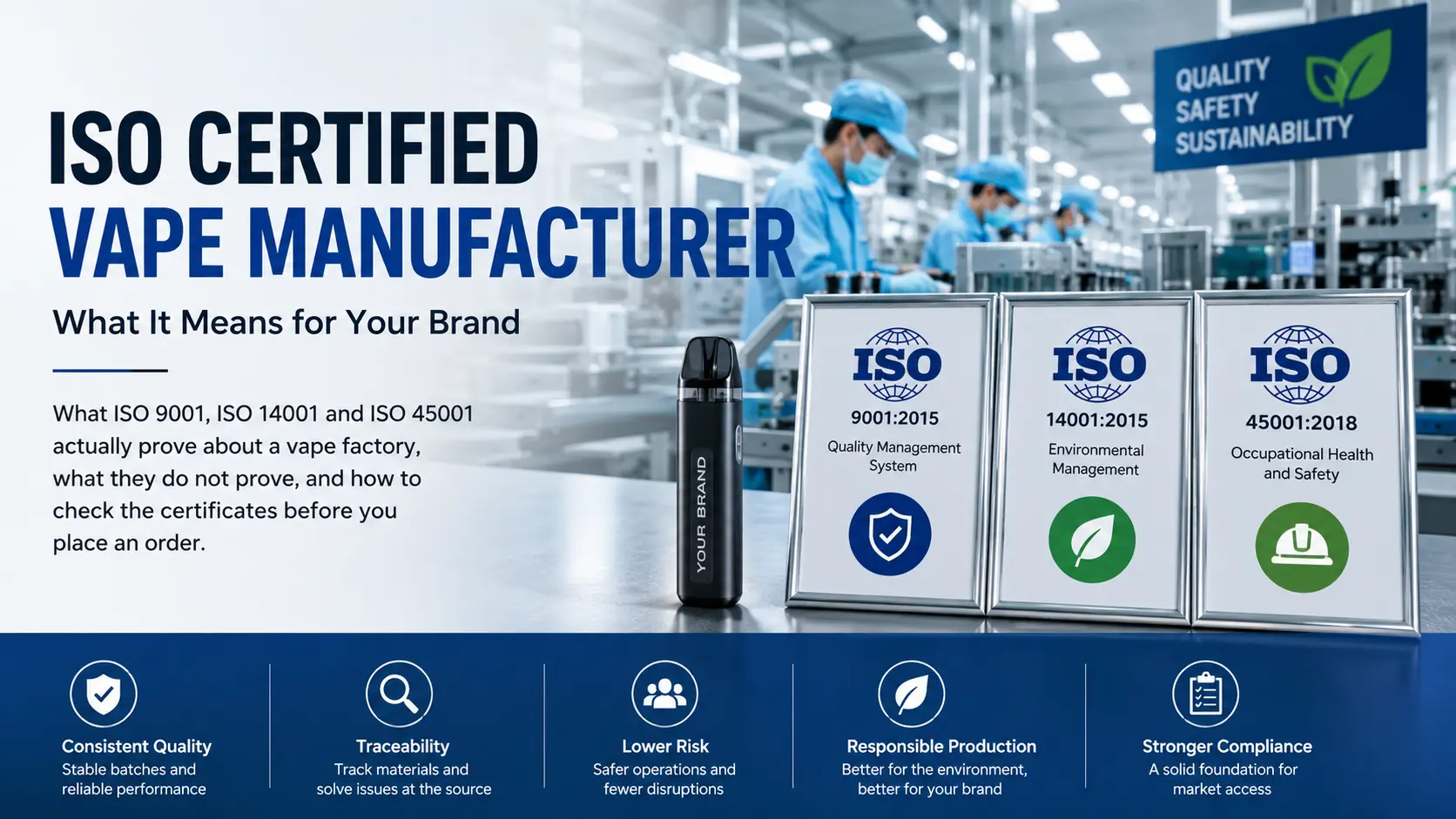
What ISO 9001, ISO 14001 and ISO 45001 actually prove about a vape factory, what they do not prove, and how to check the certificates before you place an order.
“ISO certified vape manufacturer” is a phrase you see on every second factory website, and it tells you less than you think. Most buyers nod at the logo and move on.
This guide explains what the three common ISO standards really certify, why an ISO certified vape manufacturer can still ship you a product that fails TPD notification, and how to verify the certificates before you commit an order.
What Is an ISO Certified Vape Manufacturer?
An ISO certified vape manufacturer is a factory whose management systems have been audited and certified against international standards published by the International Organization for Standardization (ISO). The certification covers how the factory is run, not what the product is made of.
ISO itself does not issue certificates. Independent certification bodies, accredited by national accreditation bodies, perform the on-site audits and issue the certificates. That structure is worth remembering when you check a factory’s claims, because the certificate’s value depends on the body behind it.
That distinction is the whole story. ISO certification describes the process: how quality is managed, how the environment is handled, how worker safety is controlled.
It does not say that a specific device is approved for sale in Europe. Many brands treat an ISO certified vape manufacturer as a guarantee of product compliance, and that assumption is where the trouble starts.
The three standards you will most often see on vape factory certificates are ISO 9001, ISO 14001, and ISO 45001. Each covers a different layer of the factory’s operations.
Holding all three is a meaningful statement about how seriously the factory takes management discipline, which is why the strongest candidates for your shortlist will usually hold more than one.
The standards behind an ISO certified vape manufacturer overlap in practice, but each one adds a distinct control that protects a different part of your supply chain.
ISO 9001 – The Quality Management System
ISO 9001 is the most common and the most relevant for buyers. It certifies a quality management system covering design, production, inspection, and delivery. The standard requires documented processes, defined responsibilities, and continuous improvement.
What ISO 9001 means for you as a brand owner:
- Consistent output across batches, because processes are documented and repeated
- Traceability of materials, so a defect can be traced back to its source
- A quality loop that captures customer complaints and feeds them into production
- Structured supplier control for components like coils, batteries, and cartridges
Inside the factory, ISO 9001 shows up in concrete habits: written work instructions on every line, incoming material inspection records, calibration schedules for test equipment, and internal audits that catch drift before a customer does.
These are unglamorous, but they are exactly what protects your reorders from surprise variation. When you visit or audit a factory, these habits are what separate a real ISO certified vape manufacturer from a factory that bought a certificate and kept the old chaos.
When you evaluate a factory, ask what its internal audit cycle looks like and whether customers can review a recent audit summary. A factory that treats ISO 9001 as a living system will answer without hesitation; a factory that treats it as a wall decoration will not.
The ISO 9001:2015 quality management standard is published on the ISO website, and certification is issued by accredited third-party bodies after an on-site audit of the factory’s processes.
ISO 14001 and ISO 45001 – Environment and Worker Safety
ISO 14001 certifies an environmental management system. For a vape factory this covers waste handling, chemical storage, emissions control, and compliance with environmental regulations in the factory’s country.
ISO 45001 certifies an occupational health and safety management system. It covers worker protection: safe handling of batteries and chemicals, ventilation, fire safety, and incident reporting.
| Standard | What it certifies | Why it matters for your brand |
|---|---|---|
| ISO 9001 | Quality management system | Consistent batches, traceability, complaint loop |
| ISO 14001 | Environmental management | Responsible waste and chemical handling |
| ISO 45001 | Occupational health and safety | Safe factory conditions, lower liability risk |
For a brand, these two standards are quieter than ISO 9001 but not irrelevant. A factory with ISO 45001 is less likely to have a serious incident that halts production mid-order. A factory with ISO 14001 is easier to defend in ESG reviews that some European distributors now run on suppliers.
Concrete examples: ISO 14001 drives how e-liquid waste and used cartridges are disposed, how solvents are stored, and how the factory documents its environmental permits.
ISO 45001 drives how battery handling is supervised, how ventilation is maintained in mixing rooms, and how incidents are reported and investigated. A factory that holds all three, as Vape ODM Factory does, gives a buyer a management baseline that goes beyond a single quality stamp.
What ISO Certification Does NOT Mean
This is the section most factory blogs skip, and it is the reason this article exists. ISO certification does not mean any of the following:
- The product is TPD compliant or notified in the EU. Product notification is a separate regulatory process per market.
- The product has CE, RoHS, or FCC certification. Those are product-level certificates tied to the device, not the factory.
- Every batch is tested to a published specification. ISO 9001 governs the system, not the specific test report.
- The factory’s claims about capacity or capability are true. Certification is about management systems, not marketing statements.
A factory can hold valid ISO certificates and still ship a device that has no EU notification, because the two systems run on different tracks. The factory handles process quality; the brand or the factory acting on its behalf handles product compliance.
If you are new to the market, the market entry rules in how to start a vape brand in the UK & Europe explain where product compliance sits in the overall process.
A real scenario makes this concrete. A brand in Spain sourced a pod kit from a factory that advertised itself as an ISO certified vape manufacturer. The factory’s management systems were genuinely certified.
The product, however, had not been notified for the Spanish market. The shipment sat in customs while the notification was filed, and the launch lost three weeks. Certification had not failed; the brand had simply assumed one document covered both systems.
The lesson: read the certificate for what it is, and run product compliance as a separate track with its own deadline. Certification is process assurance, not market access.
Why an ISO Certified Vape Manufacturer Matters for Your Brand
None of the above means ISO certification is worthless. For a brand choosing a production partner, an ISO certified vape manufacturer removes a specific class of risk: the risk of chaotic, undocumented production.
The practical benefits show up in four places:
- Batch consistency. When your German distributor reorders, the third batch should taste and perform like the first. Documented processes make that repeatable.
- Customer due diligence. Some European retailers and distributors now ask suppliers for management system certificates during onboarding. ISO 9001 answers that question before it is asked.
- Dispute evidence. If a quality dispute arises, documented processes give both sides a factual baseline instead of a blame game.
- Audit readiness. A factory that already passes ISO audits is far easier to walk through a client’s own factory audit later.
This is why the sourcing criteria in your plan should include certification, alongside sample quality and compliance support. If you are drafting your brand plan, the private label vape brand launch checklist covers certification in the factory evaluation step.
The commercial logic is simple to state: choosing an ISO certified vape manufacturer does not guarantee your product sells, but it removes the production-side variables that make reorders unpredictable.
Consistency is a quiet competitive advantage. When your competitor’s third batch tastes different from the first, your distributor notices which brand they can rely on.
How ISO Certification Is Audited
ISO certification is not a one-time sticker. It follows a repeating cycle that keeps the system honest.
| Phase | What happens | Typical frequency |
|---|---|---|
| Initial audit | On-site review of processes and records | One-time, before certification |
| Certificate issue | Valid for three years | Every 3 years |
| Surveillance audits | Spot checks that the system still holds | Annual |
| Re-certification | Full re-audit before renewal | Every 3 years |
The audits are performed by accredited certification bodies, not by ISO itself. The certificate carries a number that can be checked with the issuing body, which is the foundation of the verification step below.
As a buyer you will rarely see the audit itself, but you can see its fingerprints: the certificate number, the issue and expiry dates, and the scope line that defines what was certified. These three pieces of data are your verification toolkit, and they should be recorded in your supplier file the day you shortlist an ISO certified vape manufacturer.
What happens during a surveillance audit matters as much as the audit itself. The auditor samples recent production records, checks that corrective actions from the previous audit were closed, and interviews line staff to confirm the documented process is the process actually used.
Factories that keep their certification current have a rhythm of continuous small fixes; factories that let it lapse usually show gaps in the same places: calibration, training records, and complaint handling.
How to Verify an ISO Certified Vape Manufacturer
A certificate in an email attachment proves nothing by itself. Verification takes five minutes and follows four checks.
| Check | What to do | Red flag |
|---|---|---|
| Certificate scope | Read what the certificate actually covers | Scope does not include manufacturing |
| Issuing body | Confirm it is an accredited certification body | Unknown or expired accreditation |
| Certificate number | Ask the body to confirm the number is live | Number does not resolve |
| Validity date | Check the expiry and surveillance status | Expired or no surveillance records |
If the factory resists these checks, treat that as an answer. A genuinely certified factory treats its certificates as reference documents, not as state secrets. This is also the place to record the certificate details in your supplier file, so you can re-check them before each reorder.
A documented verification trail also protects you later: if a quality dispute ever reaches a distributor’s procurement team, you can show that the factory presented valid certificates at the time of the order, which is the diligence an ISO certified vape manufacturer relationship is expected to carry.
One more practical habit: ask for the certificate of the actual site you will use. A group with several factories may hold certification for one site and not another. The scope line and the address on the certificate should match the factory that will build your product, not the group’s headquarters.
Common Mistakes When Choosing an ISO Certified Vape Manufacturer
- Treating ISO as product compliance. The most expensive mistake. Verify the TPD notification and product certificates separately.
- Accepting a photocopied certificate. Ask for the certificate number and the issuing body, then check.
- Ignoring the scope line. A certificate that covers “sales and administration” does not cover production.
- Assuming all three standards are held. ISO 9001 is common; 14001 and 45001 are not automatic. Read the actual list.
- Never re-checking. Certificates expire and surveillance audits lapse. Re-verify before each new project.
Most of these mistakes share one root cause: treating the certificate as a checkbox instead of a living document. The factory that handed you the certificate last year may have changed scope, lost a certification, or moved production to a different site.
Verification is not a one-time task; it is a habit that belongs in your reorder routine. Building that habit early is the difference between a brand that gets burned by a photocopied logo and a brand that works with a genuinely certified ISO certified vape manufacturer for years.
FAQ: ISO Certified Vape Manufacturer
Q1: Is ISO certification the same as TPD compliance?
No. ISO certification covers the factory’s management systems. TPD compliance covers the product’s regulatory status in the EU, including the notification filing. You need both, and they are verified separately. Confusing the two is the most common reason brands discover compliance gaps late, even when they chose an ISO certified vape manufacturer carefully.
Q2: Which ISO standard should I require from a vape factory?
Start with ISO 9001 for quality management. If the factory also holds ISO 14001 and ISO 45001, treat that as a plus that strengthens its due diligence profile.
The three together form a solid management system baseline. A factory that holds all three and can prove them under the verification checks is what most brands mean when they say “ISO certified vape manufacturer”.
Q3: How do I know the certificate is real?
Take the certificate number and the issuing body name, then confirm the number with the issuing body and check the expiry date. Cross-check that the scope line covers manufacturing. Real certificates survive this process; fake ones do not. This four-step check is the same one procurement teams use when they audit an ISO certified vape manufacturer.
Q4: Does ISO certification guarantee product quality?
It guarantees that quality is managed as a documented system. It does not guarantee a specific product passes a specific test. Sample testing and product-level certificates still matter, and no ISO certified vape manufacturer should argue otherwise.
Your own incoming inspection and the factory’s batch test reports remain the quality evidence that matters at the product level.
Q5: How often do certificates need renewal?
Certificates are typically valid for three years with annual surveillance audits, then a full re-audit before renewal. Check the expiry date and the surveillance status before you rely on a certificate.
Q6: What if the factory shows me only part of the certificate?
Ask for the full document including the scope line and the certificate number. Partial documents are usually a sign that something is being hidden. If the response is slow or vague, move the factory down the shortlist.
Final Verdict: Use ISO as a Filter, Not a Finish Line
An ISO certified vape manufacturer is a better starting point than an uncertified one, and the reason is simple: documented systems make consistent output more likely. Use certification as one filter in your sourcing process, then apply the filters that matter more: samples, compliance support, communication, and audit readiness.
Keep the verification habit: check the certificate scope, the issuing body, and the expiry date, and re-check before every reorder. The five-minute check protects a relationship that will run for years. Done consistently, it turns the phrase “ISO certified vape manufacturer” from marketing copy into a verified fact in your supplier file.
When you are ready to evaluate factories, start with how to evaluate a vape ODM factory in China, which turns this guide into a practical checklist.
For a factory that holds ISO 9001, ISO 14001, and ISO 45001 alongside a national accredited laboratory and GMP production, Vape ODM Factory is the direct answer to your search for an ISO certified vape manufacturer.
Request a vape ODM quote and bring your brand to a partner whose systems are certified, not just claimed.