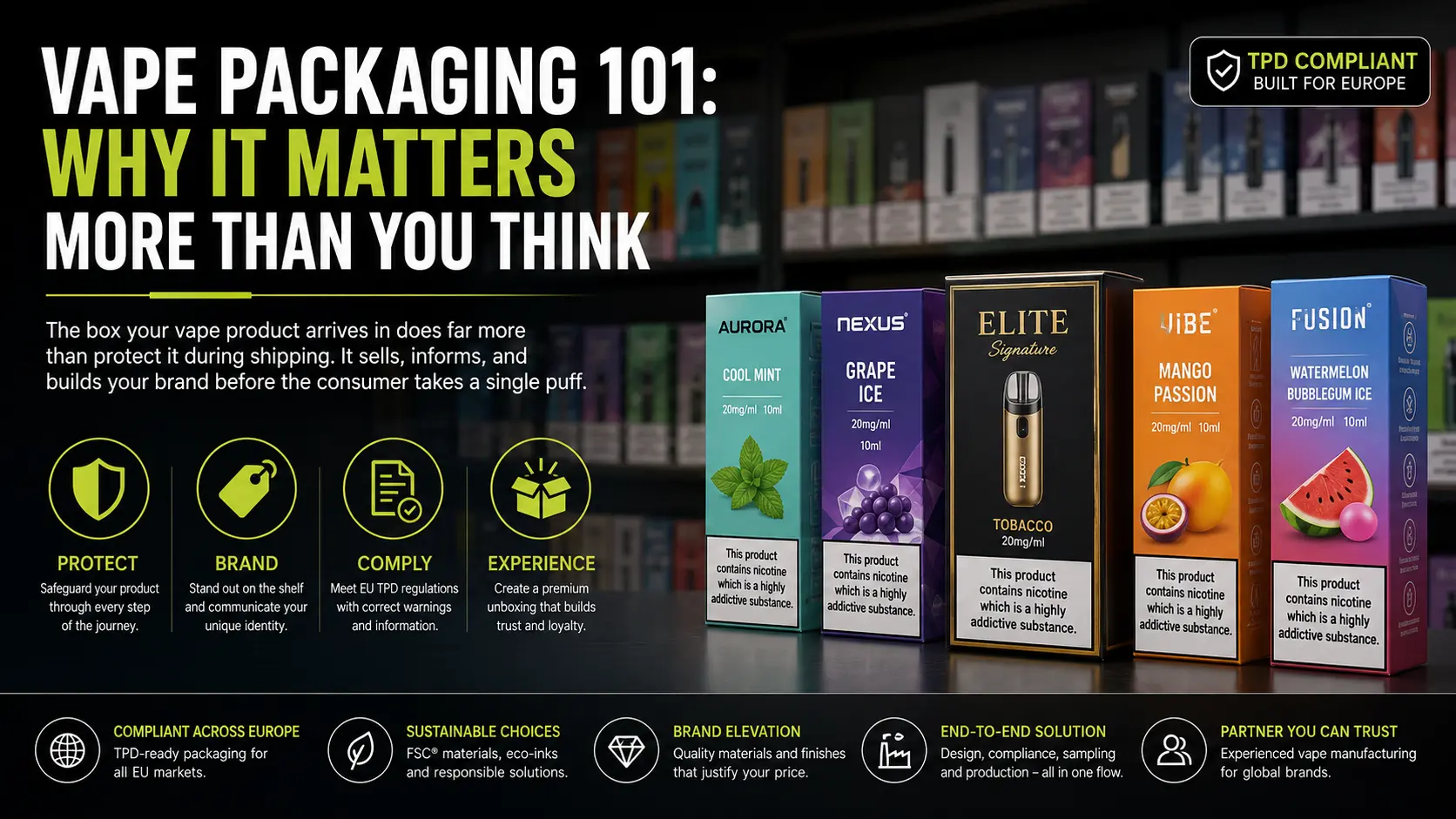
Most new vape brands treat packaging as a final checkbox: design a box, print a logo, add a warning, ship. That sequence misses the point entirely. Vape packaging is not a cost to be minimized; it is a sales tool, a compliance document, and the first physical interaction a customer has with your brand. The most successful European vape products don’t just perform well — they look like they belong on a premium shelf.
This guide breaks down the four functions of vape packaging, how it shapes buying decisions, the design elements that matter most for European markets, common mistakes that kill retail credibility, and why packaging should be part of your product development conversation from day one.
What Is Vape Packaging?
Vape packaging is the complete physical presentation system for a vape product. It includes the outer retail box, any internal trays or sleeves, the product label or device printing, the user manual or leaflet, and the protective materials used during shipping.
For a typical European vape brand, vape packaging must satisfy three demands simultaneously: it must be structurally strong enough to protect a device containing e-liquid and a lithium battery, it must meet strict regulatory requirements for nicotine-containing products, and it must communicate a clear brand identity on a shelf crowded with competitors.
Packaging is not just a container. It is the first tangible part of your product a consumer sees, the surface where legal compliance is demonstrated, and the last thing that influences a repeat purchase after the device is used.
The 4 Main Functions of Vape Packaging
Great vape packaging performs four jobs at once. None of them is optional in the European market.
1. Protect the Product
A vape device must survive transport from a Dongguan production line to a retail shelf in Berlin or Manchester. It faces vibration, compression, temperature swings, and moisture. E-liquid can leak. Batteries can be damaged by impact. A well-designed box distributes force, seals against humidity, and uses internal padding to immobilize the device. Packaging that fails here generates returns, retailer complaints, and lost credibility.
2. Communicate the Brand
On a shelf with thirty other vape products, your packaging has approximately three seconds to register. The color, typography, logo placement, and material finish decide whether a consumer picks up the device or reaches past it. Consistency across SKUs builds brand recognition over multiple purchases. Packaging is not decorative — it is the silent salesperson on every retail shelf.
3. Support Regulatory Compliance
For nicotine-containing products sold in the EU, packaging must carry specific health warnings, nicotine declarations, ingredient information, batch codes, and importer details. TPD Article 20 requires health warnings to cover 30% of both main surfaces, in the official language of each market. Child-resistant and tamper-evident features are mandatory. A packaging design that ignores these requirements fails before it ever reaches a consumer. For a complete breakdown of what EU-compliant vape packaging must include, our TPD compliant vape packaging guide covers warning area dimensions, language rules, and print-proof verification steps.
4. Improve Customer Experience
The unboxing moment shapes a consumer’s perception of product quality. A device that slides out of a precision-fit tray, with clear labeling and a thoughtfully designed leaflet, feels more valuable than one in a generic plastic blister. This perceived quality translates directly into brand trust, word-of-mouth recommendation, and the likelihood of a repeat purchase. Packaging that makes a user feel like a premium buyer builds the kind of loyalty no discount can replace.
How Vape Packaging Influences Purchasing Decisions
The decision to buy happens at the shelf, not online. For most vape brands, a new customer encounters the product physically in a vape shop, convenience store, or tobacconist. They have no prior exposure to your website, your reviews, or your advertising. The packaging must do all the heavy lifting.
First Impressions and Shelf Visibility
Subconscious judgments happen in milliseconds. A matte, heavyweight box with minimalist typography signals premium positioning. Saturated colors and bold fonts signal value. Neither is wrong, but mismatched packaging confuses buyers. A premium e-liquid in a flimsy, glossy box erodes trust. A budget disposable wrapped in expensive rigid packaging looks like it’s hiding something.
Flavor Communication
Vape products live and die by flavor. If a consumer cannot identify the flavor within the first glance, they move on. Successful packaging uses color systems, iconography, and clear typographic hierarchy to make flavor recognition instant — even from across the room. A green device labeled “Cool Mint” with no mint icon is ambiguous. A green device with a stylized mint leaf, a clear color code, and a descriptive sub-label is confident and trustworthy.
Perceived Quality and Price Justification
Consumers judge the product by the packaging before they ever use it. A box with sharp printing, consistent color, and a soft-touch finish signals attention to detail. A box with crooked warning labels, pixelated artwork, or flimsy cardboard signals that the brand cut corners. That signal transfers to the device itself — fairly or not. A custom vape packaging investment that adds €0.10–€0.30 per unit can support a €2–€5 retail price increase because the perceived value is
Key Elements of Effective Vape Packaging Design
Professional vape packaging design works on several levels: visual identity, communication clarity, and structural integrity.
Color as a Brand Signal
Consistent, distinctive colors build shelf presence faster than any other element. Solid blocks of color register faster than gradients or complex illustrations. The best-known vape brands don’t use multicolor explosions — they own one color per SKU and make it instantly recognizable.
Typography as a Quality Cue
Font choice reflects brand personality: a sans-serif with tight spacing feels modern and technical; a serif font on a tobacco-flavor product suggests tradition. Legibility matters more than aesthetic novelty. A flavor name that cannot be read from arm’s length fails its purpose.
Information Hierarchy
What does a consumer need to know first? The brand name, then the flavor, then the nicotine strength, then the puff count or e-liquid volume. That order should lead the eye down the packaging face. Regulatory warnings belong in their designated area — not dominating the primary brand space. Smart design integrates compliance rather than fighting it.
Finishing Techniques and Material Choices
Matte laminates feel premium and resist fingerprints. Spot UV accents draw attention to the logo or flavor name. Embossing adds a tactile dimension that generic printing cannot replicate. However, finishing must never encroach on the health warning block. A UV spot that bleeds into a TPD warning is a compliance fail waiting to happen.
Structural Design and the Unboxing Experience
A box that opens smoothly, with a device presented in a die-cut tray and a leaflet that slips out without tearing, creates a premium unboxing moment. A box that requires force to open, where the leaflet is crumpled at the bottom, signals careless manufacturing. These design choices cost fractions of a cent at production scale but generate vastly different customer experiences.
Common Vape Packaging Mistakes to Avoid
Even experienced brands make avoidable errors in the rush to launch. These five mistakes appear repeatedly across European retail.
- Treating compliance as an afterthought. Designing the box first and adding warnings later nearly always results in warnings that are too small, placed incorrectly, or printed without the proper border. A compliance review must happen before artwork is signed off, not after it’s printed. Our 6S service system integrates compliance validation into the packaging development stage, so your launch isn’t delayed by a reprint.
- Overcomplicating the front panel. Cramming too much information — five flavor sub-notes, a feature list, a QR code, a slogan — defeats recognition. The first job of the front panel is to identify the product in one second. Simplicity and a clear visual focal point outperform information density every time.
- Weak brand identity. A logo placed inconsistently across SKUs, two different fonts on the same box, or a color palette that changes between flavors destroys brand recognition. Every SKU should feel like part of a single brand family.
- Poor material selection. Folding carton stock that crumples in a pocket or tears when the box is opened creates a poor quality signal. For vape products carried daily by consumers, packaging durability matters.
- Confusing flavor presentation. A flavor called “Blue Razz Ice” with a mostly-red label is a cognitive mismatch that causes hesitation. Flavor colors should align with consumer expectations: cool colors for mint, rich tones for tobacco, bright for fruit. Surprise is for flavor experience, not flavor recognition.
Compliance Considerations for Vape Packaging
European vape packaging is regulated packaging. The Tobacco Products Directive sets specific rules that cannot be negotiated.
TPD Health Warnings
The warning “This product contains nicotine which is a highly addictive substance” must cover at least 30% of the two largest surfaces of the box. It must appear in Helvetica, black on white, with a defined border. Translations must match each target market’s official language. A box for Germany uses German text; a box for France uses French. Mixing them up at the print stage costs the entire batch.
Child-Resistant and Tamper-Evident Features
EU law requires child-resistant closures on e-liquid containers and tamper-evident seals on retail packaging. These are physical, structural requirements — not just artwork decisions. They must be tested and confirmed at the sample stage.
Traceability and Batch Information
Every unit must carry a batch number, manufacture date, importer address, and manufacturer details for traceability. These are not optional and are checked by customs authorities and market surveillance bodies.
What Changed in 2025–2026: New Rules That Reshape the Box
The packaging fundamentals above have not changed, but the regulatory frame around them has moved faster in the past two years than in the previous decade. Three shifts matter for anyone planning artwork right now.
First, the United Kingdom. Since June 2025, single-use disposable vapes are banned outright in the UK, and the new plain-packaging-style rules prohibit colorful, cartoon-themed and toy-like presentation. If your packaging look was designed for the pre-ban UK market, it needs more than a warning-block update — the palette itself is now regulated territory, and brands are being pushed toward restrained, adult-oriented design across the whole range.
Second, the EU Battery Regulation. From February 2027, most non-rechargeable disposable vapes cannot be placed on the EU market. Packaging will have to communicate rechargeability, battery removal and recycling information, and environmental claims must be backed by documentation rather than adjectives. Our EU Battery Regulation guide covers what the 2027 deadline means for device and packaging planning.
Third, national layers keep multiplying. The Netherlands has banned non-tobacco flavors and online sales, Denmark restricts flavors to tobacco and menthol, and Germany adds an excise tax of around €0.26 per ml to e-liquids. Each of these changes what your packaging can legitimately say and code: a flavor color system built for one market may reference flavors that do not legally exist in another. A single artwork master no longer fits Europe — plan market-specific panels the way you plan market-specific translations.
Sustainable Vape Packaging Trends
European retailers and consumers increasingly demand packaging sustainability. Single-use vape devices are under regulatory scrutiny partly because of their physical waste; the boxes they come in are also part of that conversation.
Recyclable Materials
Cardboard and paper-based packaging using FSC-certified stock are now the baseline expectation in markets like Germany and the Netherlands. Plastic clamshells persist in budget segments but generate negative perception among environmentally-conscious retailers and consumers.
Reduced Plastic and Eco-Friendly Inks
Soy-based inks, water-based coatings, and minimal internal plastic trays signal that a brand takes its environmental responsibilities seriously. A box that says “recyclable” but contains a glued-in plastic window and a laminated inner tray sends conflicting signals.
QR Codes and Traceability
The QR code has quietly become standard equipment on European vape packaging. A code that resolves to lab results, batch information and an authenticity check serves three masters at once: the consumer who wants proof, the retailer who wants to avoid counterfeits, and the brand that gains a legitimate, compliant surface for information that cannot appear on the box as marketing. Unlike decoration, it reads as responsibility rather than promotion — and it is one of the few “trend” features that also strengthens your compliance story.
Sustainability is not just a feature to list on the box. It is a brand-positioning decision that affects material choices, supplier selection, and the entire perception of your vape product packaging strategy. You can explore our facility’s environmental management credentials — ISO 14001 certified — on the about page to see how manufacturing infrastructure supports sustainable packaging commitments.
How to Choose Packaging for Your Vape Brand
The optimal packaging system depends on your retail channel, price point, and competitive environment.
Budget Brands in High-Volume Channels
If your disposable vape sells at €5–€8 in convenience stores, a complex rigid box is neither affordable nor expected. A well-printed folding carton with a clean design, clear flavor communication, and all required compliance marks is appropriate. Investing in print quality and color consistency matters more than structural complexity.
Mid-Market Brands in Specialty Retail
At the €10–€15 retail price, buyers expect a discernible difference. A thicker board stock, a soft-touch matte laminate, and a foil-stamped logo on a slide box communicate quality. The unboxing becomes part of the purchase experience.
Premium Brands and Flagship Products
For products positioned above €15, packaging is an experience. A rigid magnetic-close box, a precision-cut foam insert, a multi-page booklet, and textured finishes all contribute to a sense of luxury. At this tier, packaging is not an added cost — it is a core part of the product’s value proposition.
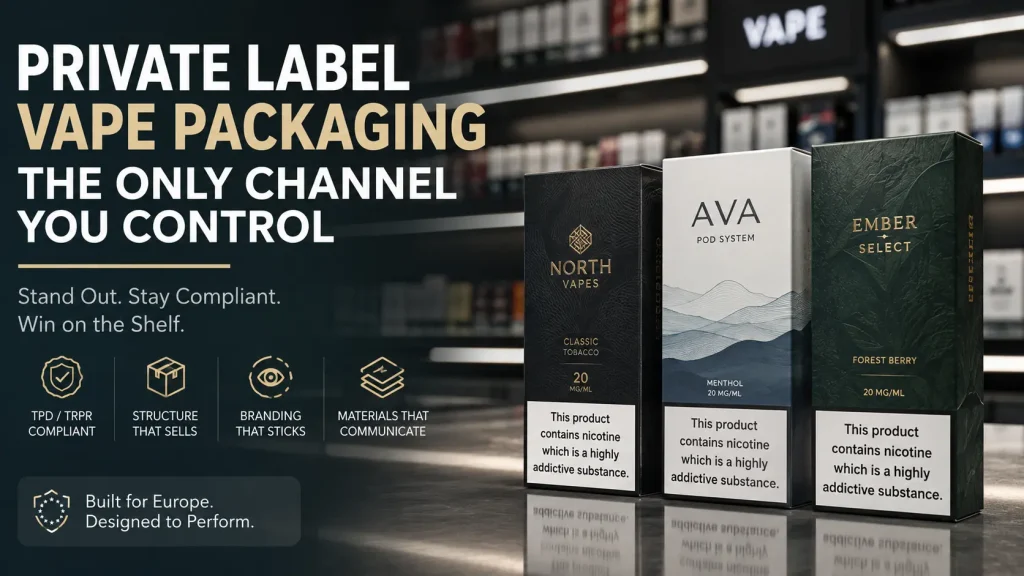
Whichever tier you target, remember what the box now represents commercially. Europe has banned television, radio, print and most online promotion for vape products, which leaves the shelf as the last advertising channel a brand legally controls — and packaging is that channel. Our private label vape packaging guide breaks down how to turn that constraint into shelf impact: structure, finish, color discipline and traceability, dimension by dimension.
Why Packaging Should Be Considered Early in Product Development
Most brands approach packaging as the last step before a production order. They finalize the device, choose the e-liquid, and then ask the factory to “design a box.” That sequence creates built-in problems.
Packaging design should begin in parallel with product development, not after. Device dimensions determine the box structure. Compliance requirements determine warning block sizes and label placements. Brand positioning determines the material and finish level. Flavor portfolio decisions determine the communication system.
When all these elements are designed together, the result is a cohesive product. When packaging is an afterthought, the result is a box that cramps the device, fights the warnings, and underserves the brand. Integrated product development that treats packaging as a strategic asset, not a shipping requirement, is what separates disciplined brands from reactive ones. Our product development process guide shows exactly where packaging proofing slots into the wider ODM program.
The Box Is Part of the Product
Vape packaging is not wrapping. It is not a container you buy because you have to ship something. It is the first interaction a customer has with your brand, the surface where legal compliance is demonstrated, and the vehicle that carries your flavor story through every retail shelf in Europe.
The brands that win at the shelf treat packaging as a strategic asset. They involve regulatory review before print. They design for visual clarity, not just visual flair. They pick materials that feel like the price they charge. And they do it early in development, not in a rush before the container ships.
Consumers never tour your factory, read your regulatory dossier, or inspect your quality control reports. They see the box. They open the box. They judge the product — and the brand — by that experience. Make those seconds count.
If you’re planning a product launch in Europe and want a manufacturing partner who integrates packaging design, compliance review, and production in one flow, contact Vape ODM Factory with your product brief. Define your target markets, brand positioning, and format — the packaging conversations should start from day one.