China builds most of the world’s disposable vapes, and that is both the opportunity and the problem. The supply chain around Shenzhen and Dongguan is deep enough that you can go from a logo sketch to a container in under two months. It is also crowded enough that a trading company with a website can look identical to a real disposable vape factory China — right up until your first quality claim.
This article is written for brand owners and wholesale buyers choosing between suppliers for a disposable program, not a pod system or an open device. The disposable category has its own failure modes: overstated puff counts, short-filled e-liquid, downgraded batteries and leak rates that only show up after transport. A factory can be excellent at rechargeable devices and mediocre at disposables, so the evaluation has to target this category specifically. Whether you are sourcing a white label run (existing device plus your logo) or stepping up to private label (with your packaging, flavors and SKU control), the partner you pick is what decides if the program repeats. We covered the broader selection logic in our guide to choosing a vape ODM factory; here we go deeper into the checks that matter for disposables.
Start With Who You Are Actually Talking To
The first thing to establish is whether the person quoting you works at the factory or in front of it. An estimated share of “manufacturers” on B2B platforms are trading companies, and some are honest about it; many are not. Nothing about a trading company is automatically bad, but you should know which one you are dealing with because it changes who controls quality, pricing and lead time at your disposable vape factory China.
Three verification actions settle the question. First, ask for the business license and compare the registered address against the actual production address — then confirm the production address itself exists, via maps, photos with timestamps or a live video call. Second, ask who the export entity is on customs declarations; a factory exports in its own name, a middleman does not. Third, check that the company signing the contract, the account receiving payment and the entity on the quotation are the same legal name. If quotation, contract and bank account carry three different names, stop and investigate before paying anything. Every disposable vape factory China worth working with passes this test without negotiation.
One more structural point matters for disposables: fill and assembly. Some factories assemble devices but subcontract e-liquid filling, coil winding or battery preparation. Every outsourced step is a quality variable the factory cannot fully see, so if any part of the process is subcontracted, you want that disclosed up front — not discovered after a leakage claim. Our overview of what a vape ODM manufacturer is explains these roles in more depth, and applies equally to a disposable vape factory China of any scale.
Where your project sits on the customization ladder also changes what you need from a disposable vape factory China. A white label order takes an existing device and applies your logo — the lightest engagement and the lowest MOQ. Private label adds your packaging, flavors and SKU control. ODM means the factory designs a new product around your brief with its own tooling; OEM means you bring the design and the factory manufactures it. Most first-time disposable buyers start at white label or private label, and the evaluation criteria below are written for that level.
The Six Numbers That Define a Disposable Program
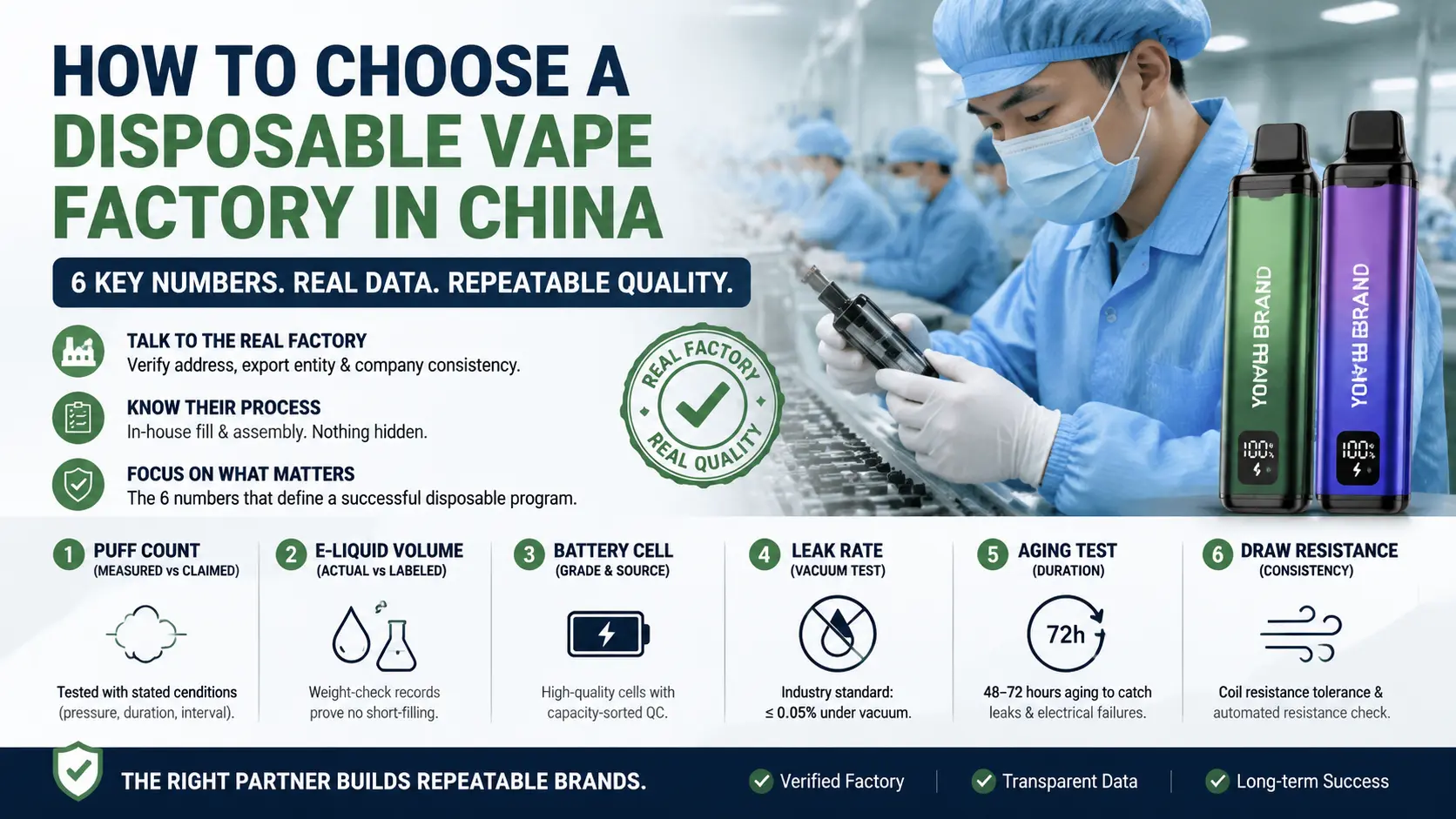
Generic advice says “check quality control.” For disposables, quality control comes down to six specific numbers, and every serious disposable vape factory China will have data for all six. A factory with no data is not a partner — it is a sales deck.
First, measured puff count versus claimed puff count. The number printed on the box means nothing unless the test conditions are stated — machine draw pressure, puff duration and interval all change the result. A disposable vape factory China with real confidence states its test method unprompted. Second, actual e-liquid volume against the labeled volume. Short-filling is the quietest way to cut cost by five percent; weight-check records from the filling line prove whether it happens. Third, battery cell grade. Capacity claims depend entirely on the cell, so ask which manufacturer supplies the cells and whether incoming cells are capacity-sorted rather than spot-checked.
Fourth, leak rate. Industry audit standards put an acceptable hardware leak rate below roughly 0.05 percent under vacuum pressure — published quality-threshold data for 2026 sets exactly those checkpoints. Ask what your prospective disposable vape factory China measures as its own threshold and how. Fifth, aging test duration. Filled devices should sit through a 48 to 72 hour aging window before final inspection, catching leaks and electrical failures that appear hours after filling. Sixth, draw resistance consistency — the parameter behind “the samples were great but production draws differently.” Coil resistance tolerance and automated resistance measurement during assembly keep draw consistent across tens of thousands of units.
A factory that answers all six with documented numbers is run by engineers. One that answers with “our quality is very good” is run by sales. Neither answer proves anything on its own, but the pattern across all six tells you what kind of operation you are about to wire money to.
How to Verify Certificates Instead of Collecting PDFs
Every factory website displays ISO 9001, CE marks and test reports. Half of what gets sent around in first conversations cannot survive thirty seconds of verification, so make verification part of your process instead of trusting document collections — every disposable vape factory China deals with certificate requests, and the serious ones answer them with numbers.
The working method has three steps. Request the certificate number and the issuing body, not just the certificate file. Then verify directly with the issuing organization — accredited certification bodies maintain online databases where a registration number either matches a valid certificate or does not. Finally, cross-check four details on the verified certificate: that the company name matches the legal entity you are contracting with, that the scope covers the product category you are buying (a food-grade certificate does not cover vaping hardware), and that the validity dates are current. Our breakdown of the seven certifications a vape manufacturer must have explains what each covers. A disposable vape factory China with current certificates is a baseline, not a finish line — most factories can produce a PDF; far fewer pass the cross-check.
For Europe specifically, add a fourth test. Ask the factory to walk you through one redacted EU-CEG notification they have filed — the product data, emissions figures and dossier structure, with sensitive parts blacked out. A disposable vape factory China that genuinely notifies products for European brands can produce this within days. One that goes quiet has never opened the submission portal. Battery documents belong in the same conversation: UN38.3 test summaries and material safety data sheets are non-negotiable for shipping lithium batteries, and the full compliance sequence is covered in our TPD compliance guide.
One more document question separates factories that support OEM programs from those that only print logos. Ask who owns the tooling if a custom mold is involved, and whether the factory has transferred tooling between clients. A disposable vape factory China running OEM work for established brands will have clear answers on tooling ownership, design transfer and the IP boundary between your project and their standard platform.
Video Audit, Done Properly
An on-site visit remains the gold standard, and third-party audits running roughly $800 to $2,500 depending on depth are worth it for large programs. Most first orders do not justify flying anyone anywhere — and a structured live video call catches more than buyers expect.
Set the call up so improvisation is impossible. Schedule it during local production hours, insist it is live and unedited, and follow a fixed camera route: injection molding or shell storage first (so you see raw shells), then assembly lines with workers present, then the filling area where you look for enclosed cleanroom-style enclosures and calibrated equipment, then the aging racks. Pause at the aging rack and count units — the stock sitting there reflects throughput that actually runs. Finish at the packing line and warehouse. A disposable vape factory China that resists this route has something to hide; one that agrees without pushback has nothing to.
Three details reveal more than the tour itself. Whether the guide walks freely or keeps steering back to prepared corners. Whether workers handle product bare-handed or with gloves and uniform in the filling zone. Whether the factory answers an unplanned question on camera — ask someone to pull yesterday’s filling weight log while you watch. A real disposable vape factory China performs these requests casually; a staged one starts negotiating alternatives.
MOQ Logic and Why Quotes Differ So Much
Buyers comparing factories often find quoted minimums ranging from a few hundred pieces to tens of thousands, and conclude someone is lying. In reality the numbers measure different things, and understanding why makes quotes comparable again. A disposable vape factory China will not give the same minimum to a stock-product buyer as to a fully custom ODM program, because the setup work is not the same.
A published industry survey current to 2026 puts typical ranges at 5,000 to 10,000 units for stock products, 10,000 to 30,000 for logo customization, and far higher for fully custom ODM programs — those sourcing-guide benchmarks reflect single-order thinking at high-volume factories. Platform-based manufacturers quote differently: per flavor. A mature device platform with stocked shells and proven oil formulations removes most setup cost, which is why a logo-level order on such a platform can start around 1,000 pieces per flavor rather than 10,000 per order. When you compare quotes, normalize the basis first — units per flavor, per color, per box design — or you will compare a platform quote against a tooling quote and pick the wrong supplier.
The same normalization applies to unit price, and it is where cheap quotes earn their hidden costs. Four downgrades fund below-market pricing: lower-grade battery cells (quieter puff count, earlier failure), short-filled volumes, basic coils swapped for inferior ones, and packaging simplified after sample approval. None show up in the proforma invoice; all show up in returns and reviews — a disposable vape factory China decision runs on total cost, not unit price.
The same logic explains why comparing a private label quote against an OEM quote is meaningless. OEM pricing assumes tooling cost amortized across large volumes and a multi-month engineering engagement; private label pricing assumes platform shells, proven formulations and minimal setup. A quote that looks 40 percent cheaper may simply reflect a lower customization tier, not a better factory. Before you negotiate price, confirm the tier — white label, private label, ODM or OEM — so the comparison runs on the same basis. The same applies to MOQ: an OEM disposable vape factory China will quote one number per order, a platform-based private label supplier will quote per flavor, and only the normalized comparison tells you which is actually cheaper at your volume.
Specification Discipline Before You Wire Money
Everything negotiated verbally evaporates at the factory door. Two documents turn promises into obligations, and both belong in your process before any deposit leaves your account — every disposable vape factory China deals with these terms, and the ones worth working with handle them without complaint.
First, a written specification sheet, confirmed by both parties: device model, e-liquid volume, battery capacity, coil type and resistance, nicotine strength, charging specification, puff count with the test condition stated, packaging configuration and carton quantity. Vague specs leave every dispute unresolved — “you said 600 puffs” collapses immediately once the sheet states the measurement method. Second, a testing and acceptance annex defining what happens if reality diverges: the leak rate threshold you accept, the aging duration required before shipment, and the defect remedy — replacement ratio, timeframe, freight responsibility. A disposable vape factory China that pushes back on a written spec sheet is telling you something before you pay, not after.
If your project involves custom industrial design rather than branding on a platform, intellectual property discipline shifts from optional to critical. Contract enforceability inside China depends on using NNN agreements — covering non-use, non-disclosure and non-circumvention — rather than generic NDAs drafted elsewhere. Production-line segregation between clients also deserves a direct question, since your exclusive shell design next to a competitor’s order is exclusivity on paper only. A disposable vape factory China running multiple brand clients on shared lines should explain how it separates molds, formulations and artwork.
The boundary between tiers also changes what IP protection applies. White label and private label orders draw on the factory’s existing device library, so IP focuses on artwork, flavor formulations and packaging designs. ODM and OEM orders involve custom tooling and bespoke engineering, where tooling ownership, design transfer terms and non-circumvention clauses carry real financial weight. Asking a white label supplier for an elaborate OEM IP package wastes everyone’s time; asking an ODM disposable vape factory China for nothing more than a logo NDA leaves your mold exposed.
Red Flags and Green Flags at a Glance
Six months of sourcing distills into pattern recognition faster than any checklist. These are the signals experienced buyers weigh most heavily when they assess a disposable vape factory China.
Red flags: prices 30 percent below the field with no explanation; certificates that verify to a different company name than the contract; refusal of live video audits; production slots always available tomorrow but never today; specification sheets that never arrive; defect rates discussed as feelings rather than numbers; and a sales team that cannot answer one compliance question about your target market. Any single flag merits questions; three deserve silence. A disposable vape factory China flashing multiple red flags is rarely the bargain it appears to be.
Green flags look quieter. The factory publishes its test methods unprompted. Sample specifications match production specifications because both come from the same documented standard. Compliance questions get forwarded to an in-house regulatory person who answers with specifics. Quotations itemize what is included — samples, printing plates, packaging proofs — rather than quoting a single number. References offered include brands from your own region. None of these require diligence beyond asking; they simply require you to notice.
For context on how Chinese manufacturing is evolving — consolidation, licensing pressure and technology investment — our report on the state of vape manufacturing in China covers the industry backdrop. The bar a disposable vape factory China must clear in 2026 is higher than it was three years ago, which makes the verification work simpler.
The Decision Sequence
Pulling this together, the practical sequence looks like this. Verify identity: license, addresses, export entity, one legal name end to end. Verify capability: the six disposable-specific numbers, documented. Verify credentials: certificate numbers checked against issuing-body databases plus one redacted EU-CEG example if Europe is the destination. Verify operations: a scripted live video audit with pauses where truth lives. Normalize the commercial terms: MOQ per flavor, price per spec, warranty in writing. Only then place the deposit, with the specification sheet and acceptance annex signed alongside it. A disposable vape factory China that has passed all five gates is one you can wire money to with a clear process for handling surprises.
Brands that follow this sequence rarely relitigate their choice; brands that skip steps tend to repeat the search within a year. A disposable vape factory China vetted this way is not a guarantee of perfection — production surprises happen on every line — but the documented standards, the verified certificates and the written acceptance terms give you the bargaining power to fix problems instead of absorbing them. Send us your target market, quantity and flavor direction and we will respond with a concrete proposal including the documentation described above. Request a vape ODM quote and see the difference paperwork makes.
Closing note: this article describes manufacturing evaluation practices; regulatory requirements such as TPD notifications, import registrations and market-specific rules are legal obligations that vary by country and change over time. Nothing here constitutes legal advice — confirm current requirements with the relevant authorities or qualified advisers before committing to a market entry plan. A disposable vape factory China can support your program, but the legal responsibility for market entry sits with the brand.