Most articles on vape product development stop at four words: idea, design, prototype, production. That summary is technically correct and practically useless. It tells a brand owner nothing about how long the work takes, what it costs, when compliance must start, or where projects actually fail.
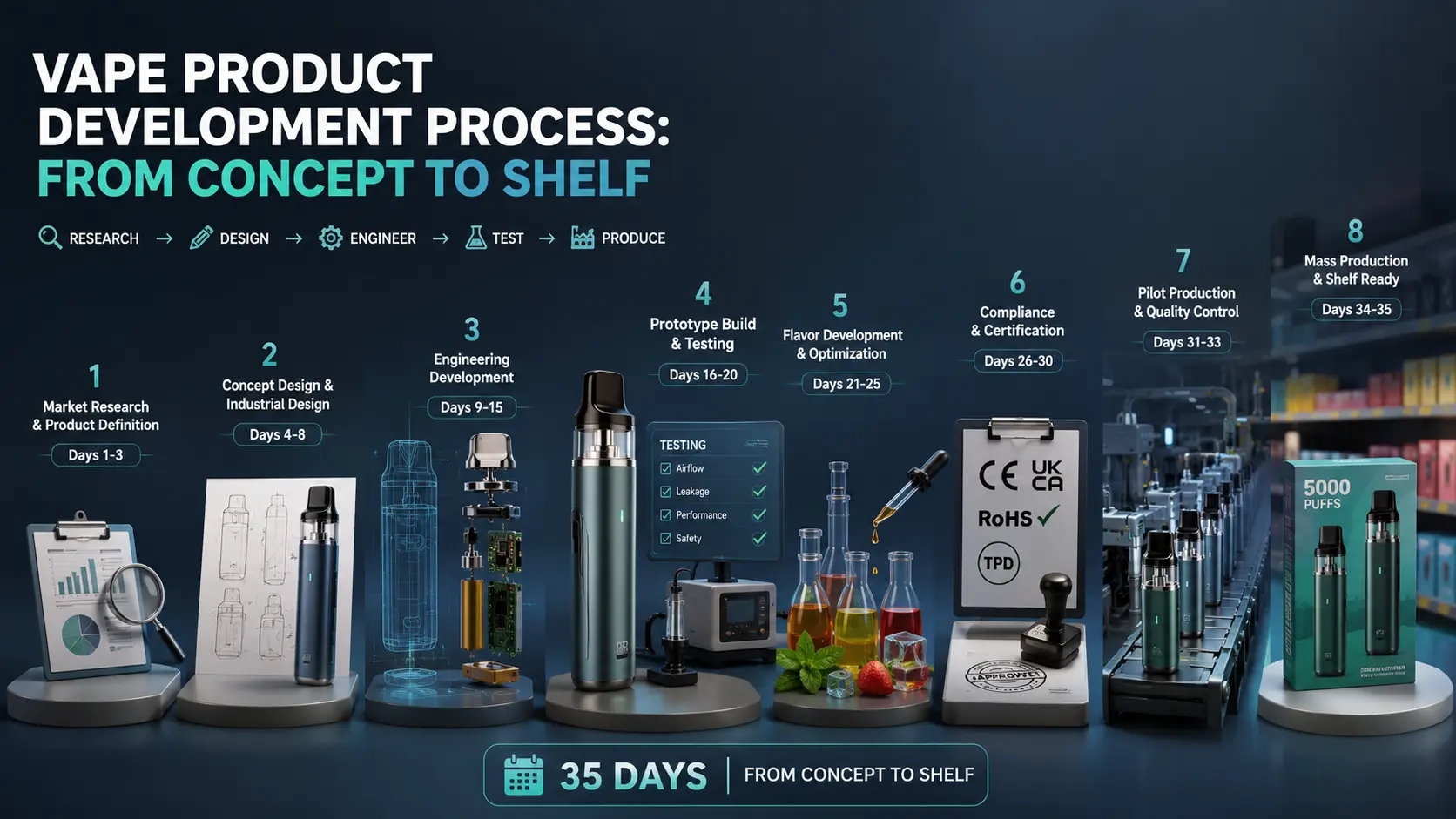
This guide goes deeper. It breaks down the full vape product development process into eight stages, with a realistic 35-day timeline, cost ranges, and the vape-specific engineering work that generic electronics guides ignore.
The goal is simple: give a European brand a clear picture of what really happens between a product concept and a shelf-ready device. With the right partner, design, tooling, prototyping, and flavor tuning can be completed in as little as 35 days.
What Is Vape Product Development?
Vape product development is the structured process of turning a product concept into a manufacturable, compliant, shelf-ready device.
It combines several disciplines that must work in parallel, not in sequence. Industrial design shapes the look and feel. Engineering builds the internal systems. Flavor development creates the experience. Compliance ensures legal market access. Manufacturing makes it repeatable at scale.
What makes vape R&D development different from ordinary electronics is the combination of hardware, e-liquid chemistry, airflow physics, and strict regulation. A power bank does not need emissions testing. A vape device does.
A device must perform consistently across thousands of units, survive transport and daily handling, deliver a stable flavor experience, and pass regulatory testing in every target market. Missing any one of these turns a promising concept into an expensive failure.
The stages below show how a serious vape product design process manages all of this at once.
Stage 1: Market Research and Product Definition
Every successful project starts with definition, not design. A vague brief produces a vague product.
Identifying Consumer Trends
Research begins with the target market. What formats sell there? What puff ranges, flavors, and price points dominate? Which features are gaining traction — rechargeable disposables, pod compatibility, larger e-liquid capacity within legal limits?
For European markets, trend research must account for regulation. A trend that thrives in one market may be banned in another. Market data without regulatory context leads to wasted development.
Analyzing Competitors
Competitor analysis is not about copying. It identifies the performance baseline your product must meet or beat — draw resistance, flavor accuracy, battery life, and build quality that the market already expects.
Defining Product Specifications
The output of Stage 1 is a written product specification. This document defines target market, device format, e-liquid capacity, nicotine strength, puff target, flavor list, price position, and compliance markets.
A precise specification is the single most important document in vape product development. Everything downstream is measured against it. Skipping this stage is the most common cause of expensive mid-project changes.
Stage 2: Concept Design and Industrial Design
With a specification in place, industrial design (ID) turns requirements into a physical concept.
Sketches and Concept Rendering
Designers produce sketches, then 3D renderings of the device. These show proportions, surface finish, color options, and the overall product identity before any engineering begins.
Multiple concepts are usually presented. The brand selects a direction, and the design is refined into a detailed CAD model that engineering can build on.
Ergonomics and User Experience
A vape device is held, carried, and used many times a day. Ergonomics matter: how it sits in the hand, the mouthpiece comfort, the weight balance, and how intuitive the airflow feels.
These decisions are made at the ID stage because they directly affect internal engineering. A mouthpiece shape, for example, influences airflow and condensation management downstream.
Brand Identity Integration
The device must express the brand. Color, finish, logo placement, and texture all carry brand meaning. This is where an exclusive ODM design separates a brand from generic catalogue products.
Stage 3: Engineering Development
Engineering is where a beautiful concept becomes a functioning device. This stage carries the most vape-specific complexity, and it is where generic development guides fall short.
Structural Design
Structural engineers convert the ID model into a buildable assembly. They define every internal part, wall thickness, snap fit, seal, and tolerance. The device must be strong, manufacturable, and serviceable on an assembly line.
Airflow System Development
Airflow is one of the most important and least discussed parts of vape product development. Airflow geometry determines draw resistance, vapor volume, flavor delivery, and how the device feels.
Engineers model airflow channels, intake positions, and the path from coil to mouthpiece. Small geometry changes produce large differences in user experience. This is precision work, not guesswork.
Battery and PCB Design
The PCB controls power delivery, safety features, and any smart functions like displays or charging management. Battery selection balances capacity, size, charge cycles, and safety protections.
For rechargeable formats, charging circuits, over-discharge protection, and thermal management add further engineering layers that single-use devices do not require.
Leak Prevention Engineering
Leak prevention is where many products fail in the real world. E-liquid is a thin fluid under temperature and pressure changes during transport and use.
Engineers design sealing structures, condensation channels, and pressure-balancing features to keep liquid where it belongs. A device that leaks in a customer’s pocket generates returns, complaints, and dead distributor relationships. This single area separates serious manufacturers from weak ones.
A related discipline is flavor development. In most ODM projects, the hardware and e-liquid are developed in parallel. The coil, wicking material, and airflow must be tuned together with the flavor formulation to deliver a consistent taste. Hardware and flavor are not separate projects — they are one system.
Stage 4: Prototype Development and Testing
Prototypes turn engineering files into physical objects that can be evaluated and tested.
3D Printed Samples
Early prototypes are usually 3D printed or CNC machined. These appearance and fit samples confirm proportions, ergonomics, and assembly logic before expensive tooling is committed.
Functional Prototypes
Functional prototypes include working internals — battery, PCB, coil, and airflow. These are the first units that actually perform like the final product, allowing real evaluation of draw, flavor, and reliability.
Performance Validation
Prototypes undergo structured testing before the project advances. Typical tests include:
- Draw resistance and airflow consistency
- Battery performance and charge cycle behavior
- Leak testing under temperature and pressure changes
- Drop and durability testing
- Flavor consistency across units
- Lifecycle testing to simulate full product use
Prototype testing is iterative. Most projects run two or three prototype rounds. Each round refines the design until performance meets the specification. Rushing this stage is a leading cause of mass-production failures.
Stage 5: Compliance Planning and Certification
Most articles put compliance at the end. That is exactly the mistake that costs brands months of delay.
Compliance planning should begin in Stage 1 and run in parallel through the entire vape product design process. Design decisions, material choices, and e-liquid formulations all affect certification outcomes.
CE Marking
CE marking confirms the device meets applicable EU directives, including electrical safety and electromagnetic compatibility. It requires testing, a technical file, and a Declaration of Conformity for the specific product.
RoHS Compliance
RoHS restricts hazardous substances in the device’s electronic and material components. Testing must reflect the actual materials used in production, not a generic reference.
TPD Requirements
For nicotine-containing products in the EU, the Tobacco Products Directive governs e-liquid capacity, nicotine strength, ingredient disclosure, emissions testing, and EU-CEG notification. The official framework is published through EUR-Lex Directive 2014/40/EU.
Why Compliance Should Start Early
If compliance starts after the design is frozen, a failed test can force a redesign. That means new tooling, new prototypes, and weeks of lost time.
When compliance runs in parallel, the design is built to pass from the start. This is why an experienced partner matters. Vape ODM Factory’s 6S service system handles TPD notification and compliance operations directly for European clients, integrating regulatory work into development rather than bolting it on at the end.
Stage 6: Tooling and Pilot Production
Once the design is validated and compliance is on track, the project moves to tooling — the most expensive commitment in vape product development.
Mold Development
Production molds are precision steel tools that shape every plastic part. Mold development is costly and time-consuming, which is why design changes after tooling are so expensive.
A single device may require several molds for different components. Mold quality directly affects part consistency, fit, and finish across millions of units.
DFM Optimization
Design for Manufacturing (DFM) is a critical stage most articles skip entirely. Before tooling is cut, engineers optimize the design for mass production.
DFM addresses real production constraints:
- Draft angles so parts release cleanly from molds
- Wall thickness for consistent injection molding
- Tolerance control for reliable assembly
- Ultrasonic welding compatibility for sealed joints
- Compatibility with automated assembly lines
A design that works as a prototype may fail in mass production without DFM. This stage is where factory engineering experience pays off directly.
Pilot Production Runs
Between prototypes and full production sit validation builds that most guides ignore entirely:
- EVT (Engineering Validation Test): confirms the engineering design works
- DVT (Design Validation Test): confirms the design is ready for manufacturing
- PVT (Production Validation Test): confirms the production line builds units correctly at volume
A pilot run produces a small batch on the actual production line. It exposes assembly issues, tolerance problems, and quality risks before committing to full volume. Skipping pilot production is one of the most expensive shortcuts in new vape product development.
Stage 7: Mass Production and Quality Control
Mass production turns a validated design into reliable volume. Quality control is what keeps that volume consistent.
Incoming Material Inspection
Quality starts before assembly. Incoming Quality Control (IQC) inspects batteries, PCBs, e-liquid, plastic parts, and coils against specification. Bad components caught here never reach the customer.
Assembly Process
Assembly combines automated and manual stations. Each station has defined procedures and checks. Cleanroom-grade environments matter for e-liquid filling, where GMP standards control hygiene and contamination.
Final Product Testing
Finished units undergo in-line and end-of-line testing — airflow, activation, leak checks, charge function, and visual inspection. Statistical sampling and full-batch traceability allow any issue to be traced back to its source.
Manufacturers operating under ISO 9001 and GMP, with accredited laboratory capability, can test and document this consistency credibly. To understand which credentials matter here, see the certifications for vape manufacturer guide.
Stage 8: Product Launch and Market Entry
A finished product is not a finished project. Launch turns inventory into sales.
Packaging
Packaging carries brand identity and compliance information. For Europe, it must include health warnings, nicotine declarations, importer details, batch codes, and correct local language. Packaging design should be finalized in parallel with production, not after.
Distribution
The product moves to distributors, wholesalers, or retail channels. Each channel needs a buyer pack: pricing, compliance documents, product images, and barcode data.
Retail Readiness
Retail readiness means the product is easy to stock, explain, and reorder. Display units, staff product sheets, and reliable supply continuity decide whether a launch becomes a repeat business.
One stage almost every competitor ignores: the post-launch feedback loop. Strong brands collect user and retailer feedback after launch, then feed it into a V2 product upgrade. Vape product development is not a straight line that ends at the shelf — it is a cycle that improves with each generation.
The 35-Day Vape Product Development Timeline
Brands always ask the same question: how long does it take? With an integrated ODM partner, the core development cycle — design model, R&D tooling, prototype testing, and flavor tuning — can be completed in 35 days. Here is how those five weeks break down.
| Phase | Timeline | Main Work |
|---|---|---|
| Discovery & Design Model | Days 1–7 | Brief, specification, industrial design, CAD model |
| R&D & Tooling | Days 8–18 | Structure, airflow, PCB, leak prevention, mold development |
| Prototype Testing | Days 19–28 | Functional prototypes, performance and leak validation |
| Flavor Tuning | Days 22–32 | E-liquid development tuned with coil and airflow (overlaps) |
| Pilot & Production Prep | Days 29–35 | Pilot run, DFM checks, production readiness |
The reason this fits into 35 days is parallel execution. Flavor tuning runs alongside prototype testing. Tooling begins while engineering finalizes the airflow system. A single organization controlling every stage removes the handoff delays that stretch fragmented projects into months.
Compliance and certification testing run in parallel with this cycle and continue afterward, since TPD notification and lab testing have their own timelines outside the factory’s control. The 35 days covers design, tooling, prototyping, and flavor — the work that turns a concept into a tested, production-ready device.
Private label projects using an existing validated platform are even faster, since tooling and engineering already exist. The 35-day cycle applies to custom ODM development with new tooling.
Typical Vape Product Development Costs
Cost is the other question competitors avoid. Exact figures vary by complexity, but realistic ranges help brands plan.
| Cost Area | Practical Range | Notes |
|---|---|---|
| Industrial design | €0–€10,000 | Depends on concept rounds(Generally included in Tooling / Molds) |
| Engineering development | €0–€20,000+ | Higher for rechargeable/smart features(Generally included in Tooling / Molds) |
| Prototyping | €0–€10,000 | Multiple rounds typical(Generally included in Tooling / Molds) |
| Tooling / molds | €15,000–€60,000+ | Largest single investment |
| Compliance & testing | €0–€15,000+ | Scales with SKUs and markets(Generally included in Tooling / Molds) |
| Pilot production | €0–€10,000 | Validates the line(Generally included in Tooling / Molds) |
Tooling is usually the largest cost, which is why design changes after mold cutting are so painful. It is also why many brands validate demand with private label first, then invest in custom tooling once the market is proven.
Common Mistakes That Delay Vape Product Development
Most delays are predictable and avoidable. These are the mistakes that derail projects most often.
- Focusing only on appearance. A beautiful device that leaks or fails testing is worthless. Engineering matters more than rendering.
- Treating compliance as a final step. Late compliance forces redesigns. Plan it from Stage 1.
- Cutting tooling before validation. Mold changes after cutting are slow and expensive. Validate the design first.
- Insufficient prototype testing. Skipping test rounds pushes failures into mass production, where they cost far more.
- Skipping pilot production. Going straight from prototype to full volume hides assembly and tolerance problems until it is too late.
- Over-scoping the first product. Too many SKUs or features at launch increases cost, risk, and delay.
Each mistake shares a root cause: rushing a stage to save time, which ends up costing far more time later. Discipline in early stages is the fastest path to the shelf.
How an ODM Partner Accelerates Vape Product Development
Running every stage in-house requires industrial designers, engineers, a tooling shop, a testing laboratory, and regulatory specialists. For most brands, building that is neither realistic nor necessary.
An experienced ODM partner provides the entire capability as a system. Stages run in parallel because the same organization controls design, engineering, tooling, flavor development, and production. This is how the core development cycle compresses into 35 days instead of several months.
Vape ODM Factory operates from Dongguan since 2013, with 500+ employees, 9 million units monthly capacity, 7+ years of R&D experience, and a national-standard laboratory. The team holds ISO 9001, ISO 14001, ISO 45001, and GMP systems, with CE, RoHS, FCC, and TPD compliance support.
The practical advantage is integration. Instead of coordinating a designer, an engineering firm, a testing lab, and a separate factory, a brand works with one partner that manages the full vape product development cycle. You can review the company background on the about page, or browse current platforms in the product catalogue.
Final Thoughts: Treat Vape Product Development as a System
The brands that bring strong products to shelf treat vape product development as an integrated system, not a linear checklist. Design, engineering, flavor, compliance, and manufacturing succeed or fail together.
The biggest lessons are consistent. Define the product precisely before designing it. Run compliance in parallel from the start. Respect the engineering work that competitors ignore — airflow, leak prevention, and DFM. Never skip prototype rounds or pilot production. Plan the next generation before the first one ships.
Handled well, the core vape product development cycle moves from concept to a tested, production-ready device in just 35 days. Handled poorly, the same project stalls in redesigns, failed tests, and tooling rework that stretches into months.
If you are planning a new vape product development project for Europe and want a partner that manages design, engineering, compliance, and production as one process, contact Vape ODM Factory with your product brief. Define your target market, format, budget, and launch date first — a clear brief is where every strong product begins.