A practical note on scope before the chemistry. We build hardware, not oil: everything on our side is empty all-in-one hardware, shipped with no fill, so what follows describes what an HHC disposable vape hardware platform must survive once a filler loads it. Where the article touches finished, filled products, that is the other side of the market, included for honest comparison.
HHC earned its shelf reputation for a real engineering reason: hydrogenation makes the molecule more stable than delta-8 or delta-9, and stability changes what buyers should demand from devices. Viscosity, heat behavior, purity paperwork and the isomer problem all flow from that single chemical fact. The regulation is newer and harsher, but the physics is the physics.
One ground rule before any of it. Nothing here is legal advice: HHC’s status changed at the federal level in May 2026 and keeps moving at the state level, so confirm every compliance question with qualified counsel before a purchase order, a label or a shipment.
1: What HHC Is and Why the Hardware Cares
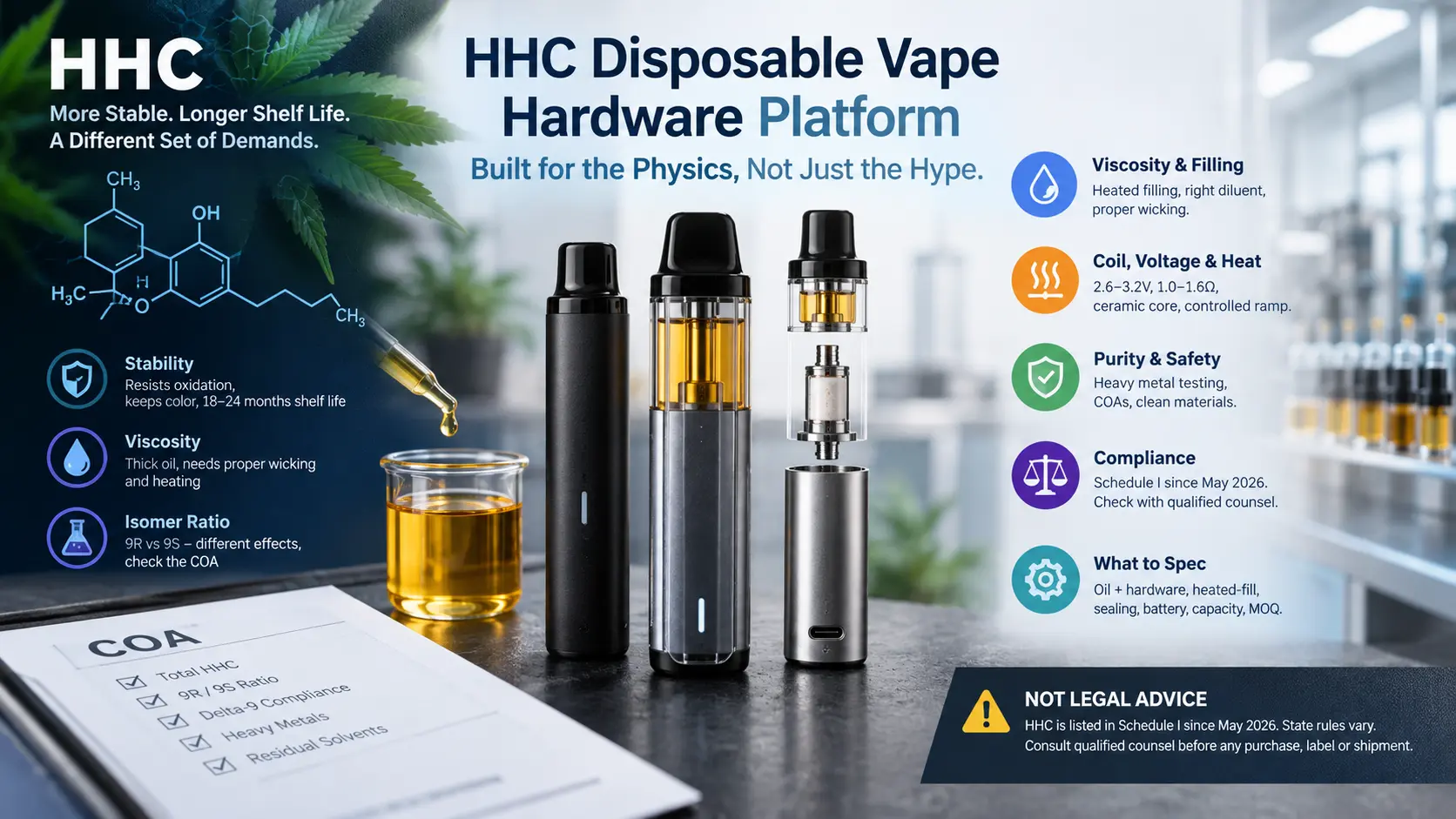
Hexahydrocannabinol is THC with two extra hydrogen atoms, produced by catalytic hydrogenation: hemp-derived CBD is isomerized to delta-8, then hydrogen is added across the double bonds over a metal catalyst. The process is the whole story. Saturation removes the double bonds that make THC prone to oxidation, which is why HHC resists degrading into CBN, holds its color on a shelf, and carries a typical sealed shelf life of 18 to 24 months. For a formulator that is a feature; for HHC disposable vape hardware it is a set of requirements.
Hydrogenation also produces a mixture. Two mirror-image isomers come out of the reaction, 9R and 9S, and they behave differently: the 9R form binds the main cannabinoid receptor with potency users describe as approaching delta-9, while the 9S form is far weaker. Commercial distillate is a blend of both, and the ratio varies with production conditions. A buyer reading a COA should read the isomer profile, not just the total percentage, because two liters of HHC distillate with different ratios are not the same product.
Stability is the reason suppliers market this oil for vape lines at all. An HHC disposable vape hardware platform paired with hydrogenated oil ages slower in the tank: less oxidation, better color retention, fewer degradation complaints from stock that sat through a slow season. That advantage is real, and it is also why the category’s hardware problems concentrate somewhere else, in a single physical property that hydrogenation does not fix.
That property is viscosity, and it is where most HHC hardware disappointments start. Everything else in this guide, coil choice, voltage, sealing, filling, traces back to how thick this oil is at working temperature. A brand that specs HHC disposable vape hardware without owning the viscosity question is renting its launch outcomes from luck.
2: Viscosity: The Core Engineering Problem in HHC Disposable Vape Hardware
Raw HHC distillate is a thick, oil-based concentrate that will not flow into a wick at room temperature. Suppliers tell formulators to warm it to roughly 140 degrees Fahrenheit before measuring or filling, which tells you where the oil sits on the viscosity scale relative to thinner distillates. Terpene dilution brings it to working viscosity, but the base oil sets the engineering problem: HHC disposable vape hardware is high-viscosity hardware wearing a trendy name.
Viscosity touches every downstream decision. Thick oil wicks slowly, so a device that works on thin distillate will starve its coil on HHC, producing dry hits, scorching, and the burnt note that ends a customer relationship. Cold weather thickens it further, which is why winter logistics and unheated retail storage both show up months later as clog complaints. Diluting harder fixes flow but changes the formula declaration and the experience; HHC disposable vape hardware has to absorb the range, not the formulator.
Crystallization behaves differently here than in delta-8, and the difference matters for spec. Hydrogenated blends resist crystal formation better than high-purity delta-8 distillate, so the classic “sugar in the tank” failure is less common on HHC. But resistance is not immunity: the wrong diluent profile, or a cold warehouse, still thickens oil until it blocks an airway. HHC disposable vape hardware validated on one diluent class can fail on another, so a buyer should ask what diluent profile the platform was proven on, not just whether it “handles viscous oil.”
The filling line adds a constraint buyers rarely see. Automated filling of HHC requires heated reservoirs and heated lines, and a device that tolerates warm filling without gasket distortion or tank clouding is worth more than its catalog price suggests. When brands ask us to quote HHC disposable vape hardware, filler temperature tolerance is one of the first questions we ask back, because the answer decides whether the line runs or the line scraps.
3: Coil, Voltage and Heat Management in HHC Disposable Vape Hardware
Hydrogenated oil vaporizes inside a narrower window than thin distillates: hot enough to aerosolize, cool enough not to scorch terpenes or degrade the oil. Field testing and industry guides converge on a modest band for HHC-type oils: roughly 2.6 to 3.2 volts on ceramic cores in the 1.0 to 1.6 ohm range, with lower settings for high-terpene formulations. HHC disposable vape hardware should be specified inside that band deliberately, because a coil-battery pairing inherited from a catalog was tuned for a different oil.
Power curves matter as much as the numbers. The failure mode is flash heating, a hot first second that scorches the oil near the wick and leaves a persistent burnt note buyers describe as “burnt sugar.” Better platforms ramp quickly then settle: a controlled curve that sustains vapor without cooking the terpene profile. On our platforms, fixed output is tuned to the oil class and button models expose preheat, two clicks, for stiffened oil after storage or cold transit.
Ceramic core construction is the second half of heat management. Sintered ceramic wicks evenly, cannot burn, and tolerates heat stress, and the current generation differs from the last in microstructure: pore size, channel geometry and capillary depth determine whether thick oil reaches the heating surface after a burst session. Five quick draws should not produce a dry sixth on a half-full tank; that is a wicking spec for HHC disposable vape hardware, not luck, and it is testable before a purchase order.
Buyers evaluating HHC disposable vape hardware should ask suppliers for three concrete proofs: the voltage band and coil resistance the platform was validated on, the wicking performance on a viscosity class matching their formulation, and heavy-metal documentation for the heating element, which matters for reasons the next section covers. A supplier with answers has done the engineering; one with adjectives has not.
4: Purity Paperwork: Catalysts, Heavy Metals and COAs
The hydrogenation route leaves a paper trail, and buyers should follow it. Catalytic hydrogenation uses metal catalysts, and the industry standard is explicit about what follows: residual catalyst removal is a critical purification step, verified through residual heavy-metal testing. For HHC disposable vape hardware specifically, heavy-metal screening is not a formality on either side; it is the signature risk of the production pathway, and any COA that does not show it is incomplete.
The hardware side has a matching obligation. The device’s heating element and airflow path contact the oil and the vapor, so a clean COA can be undone by a dirty platform: lead in a center post, heavy metals in a cheap ceramic core, contamination from unknown materials. Our ceramic components are heavy-metal-free by sintering process and documented by batch-level hardware COAs, because the oil’s purity claim and the device’s purity claim have to match on the same certificate chain.
What a buyer should assemble before ordering HHC disposable vape hardware is a two-sided documentation set. Oil side: per-batch COA with total HHC, the 9R to 9S isomer ratio where measured, delta-9 compliance, and the heavy-metal and residual-solvent panels. Hardware side: materials documentation for the tank and airway, battery safety files, and batch-level device COAs covering the same heavy metals. The framework for vetting a factory on those documents is in our manufacturer checklist.
Batch discipline closes the loop. Because the isomer ratio varies with production conditions, two batches of the same “HHC” formula can differ in working viscosity and in experience, and an HHC disposable vape hardware platform tuned on one batch can underperform on the next. Spec and test per flavor, freeze the variant list before quotes, and re-verify whenever the oil supplier changes, because the hardware is the fixed point in a supply chain where the oil keeps moving.
5: The Legal Reality: Schedule I Since May 2026
The compliance picture for HHC is not a countdown like delta-8’s; for HHC disposable vape hardware buyers it already happened. In May 2026 the DEA finalized a specific listing that named hexahydrocannabinol in Schedule I of the Controlled Substances Act with its own drug code, effective on publication. The agency’s reasoning ran through the hydrogenation process: synthetically converted tetrahydrocannabinols, even from hemp-derived starting material, do not qualify for the hemp exemption, so HHC was already controlled, and the rule made the control explicit.
The international layer moved first: in March 2025 the UN Commission on Narcotic Drugs voted to schedule HHC under the 1971 Psychotropic Convention, and the US listing followed that signal. Industry groups have sued, and the litigation is pending, but a federal appeals court upheld the DEA’s authority over semi-synthetic cannabinoids in August 2026, which is not a promising backdrop for the challenge. State agencies have begun conforming their own schedules, and most states that never named HHC still capture it under synthetic-cannabinoid or total-THC definitions.
The practical map, stated plainly: HHC remains openly sold in some states under hemp-theory arguments, but the federal position is that selling it is controlled-substance distribution, and enforcement exposure sits with the seller. None of this is legal advice and none of it predicts the litigation; a buyer’s counsel should own the go or no-go decision for any market. What a hardware supplier owes the conversation is honesty about what the device is for and where the oil in it comes from.
For buyers already holding stock, packaging, or HHC disposable vape hardware in the pipeline, the honest framing is risk management, not business as usual: know each destination state’s rule, watch the litigation, and keep the documentation chain that shows what the platform is and is not. The device itself carries no scheduled substance; what carries risk is the oil, the label and the market. That distinction is exactly why hardware decisions and legal decisions need to be made in the same week, not in sequence.
6: What a Buyer Should Actually Spec
The specification sequence that survives contact with this category starts with the oil, not the catalog. Characterize the actual formulation: working viscosity at fill temperature, isomer ratio, diluent class, and the heavy-metal panel behind it. Then choose HHC disposable vape hardware against that characterization: a ceramic core validated on the viscosity class, a voltage band inside 2.6 to 3.2 volts, and a filler process that tolerates heated filling.
Sealing and logistics come next, and they are the same discipline as delta-8 with one extra caution. Multi-layer silicone gaskets, press-and-lock assemblies, and packaging that keeps units upright are the baseline for a thick oil that thins with heat; HHC’s added thermal stability helps in storage but does nothing for a gasket in a summer truck. HHC disposable vape hardware ships through private carriers, not the Postal Service, so transit tolerance matters twice.
Capacity and battery follow the same rule that governs every high-viscosity line: the battery must outlast the fill, and anything above 1 mL should be rechargeable as a requirement. The 0.4 milligram per-container cap that reshapes delta-8 capacity planning in November binds hemp-derived finished products, and an HHC line needs counsel’s answer on whether it is even in the hemp lane at all; if it is not, container math is moot and market math is everything. Either way, freeze the variant list before quoting HHC disposable vape hardware, per flavor.
Ask every supplier the same five questions and compare answers, not adjectives: What viscosity class was the platform validated on? What voltage and resistance pairing ships by default? What wicking proof exists after burst sessions? What heavy-metal documentation covers the core and center post? And what is the per-flavor MOQ and re-quote policy when the oil supplier changes? HHC disposable vape hardware sold without those five answers is a story with a battery attached.
7: HHC Disposable Vape Hardware After the Listing
The part of this conversation that outlasts the category is the platform. Coil engineering, sealing systems, battery matching and heated-fill compatibility were built for thick extracts, and they transfer intact to any oil that shares the physics. HHC disposable vape hardware is, at the component level, high-viscosity-extract hardware, and hydrogenation did not change that; it only changed which legal lane the oil rides in.
That is the buyer’s hedge, stated without spin. HHC disposable vape hardware speced for this oil carries hemp-CBD lines without modification, and moves into state-licensed channels with a compliance layer adapted around it. The customization ladder, from logo-and-color programs to full ODM builds, is laid out in our private label guide, and the platform options across 0.5 to 4 mL, coils from 1.2 to 2.7 ohms, and preheat functions are described in our CBD disposable guide. The puff-count math that connects fill size to real usage is in our capacity guide.
If you are speccing a line now, send us the oil class, the destination markets and the timeline. We will come back with HHC disposable vape hardware options across 0.5 to 4 mL, validation data, and the documentation chain behind every number; our request-a-quote page starts that conversation. For how the two THC-adjacent lines diverge at the platform level, our CBD versus THC hardware comparison covers the split. Buy the hardware for the physics, and let counsel own the rest.
Whatever the courts decide, the engineering facts in this guide hold: hydrogenated oil is thick, stable and heat-sensitive in specific ways, and HHC disposable vape hardware that respects those facts outperforms hardware that was merely available. Spec against the oil, document the platform, and let the lawyers argue about the name on the bottle.
This article is provided for general information about vape hardware specification and does not constitute legal advice. Hexahydrocannabinol is listed in Schedule I of the Controlled Substances Act effective May 4, 2026, state rules vary and continue to change, and no statement here should be read as encouragement to manufacture, distribute or sell any controlled substance; consult qualified counsel before any compliance or purchasing decision. No statement in this article is a health claim or a statement about the effects of any substance.