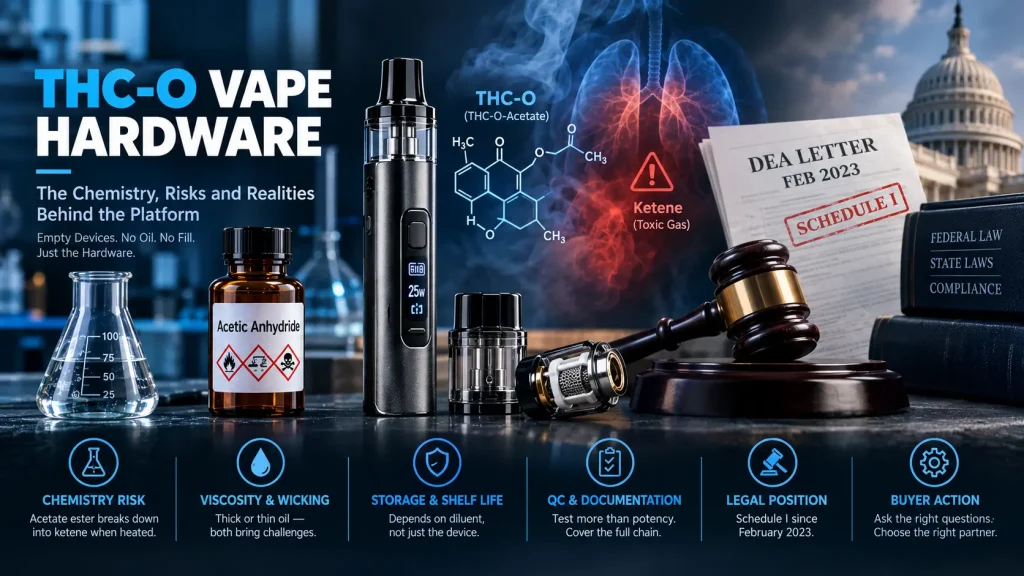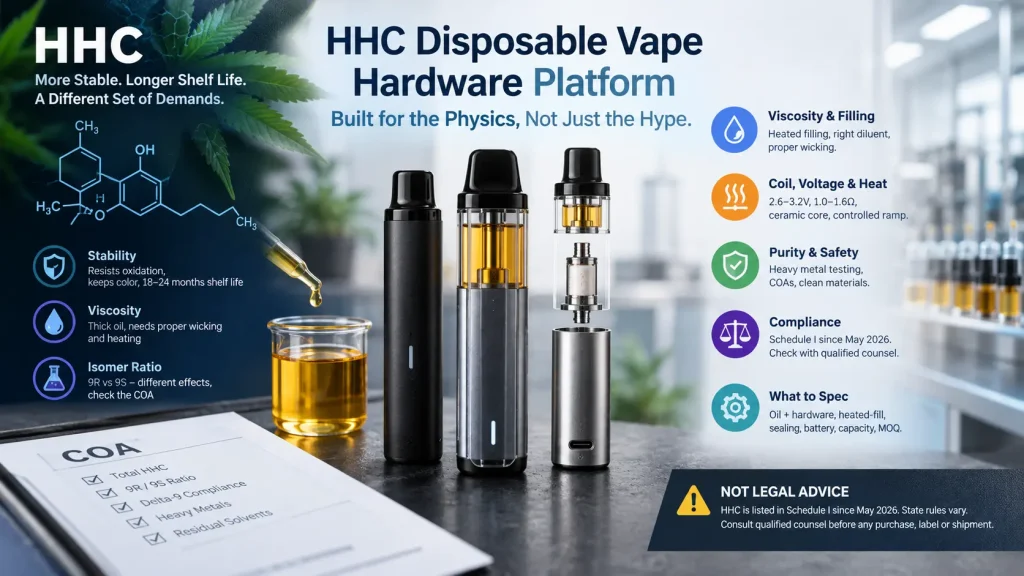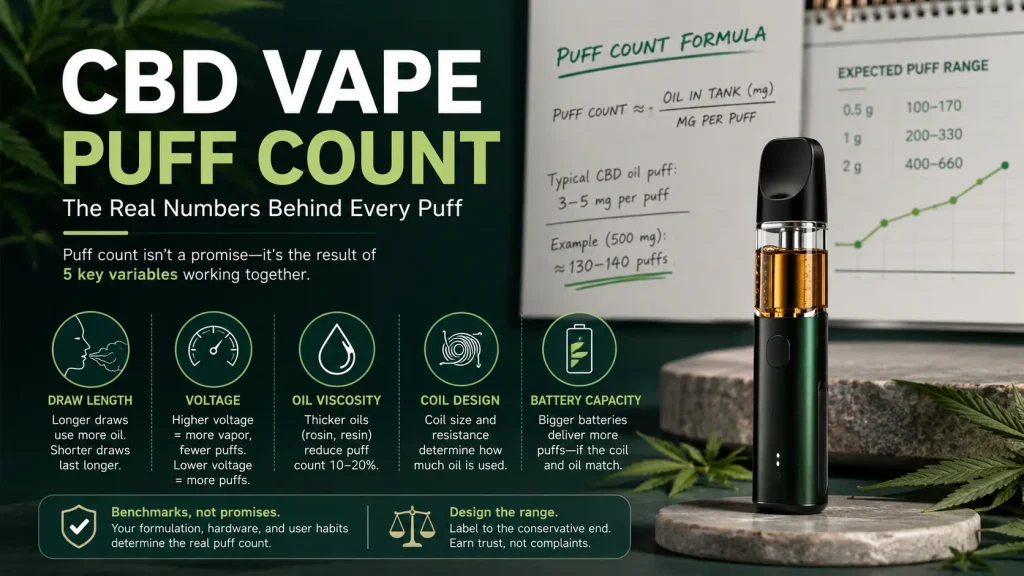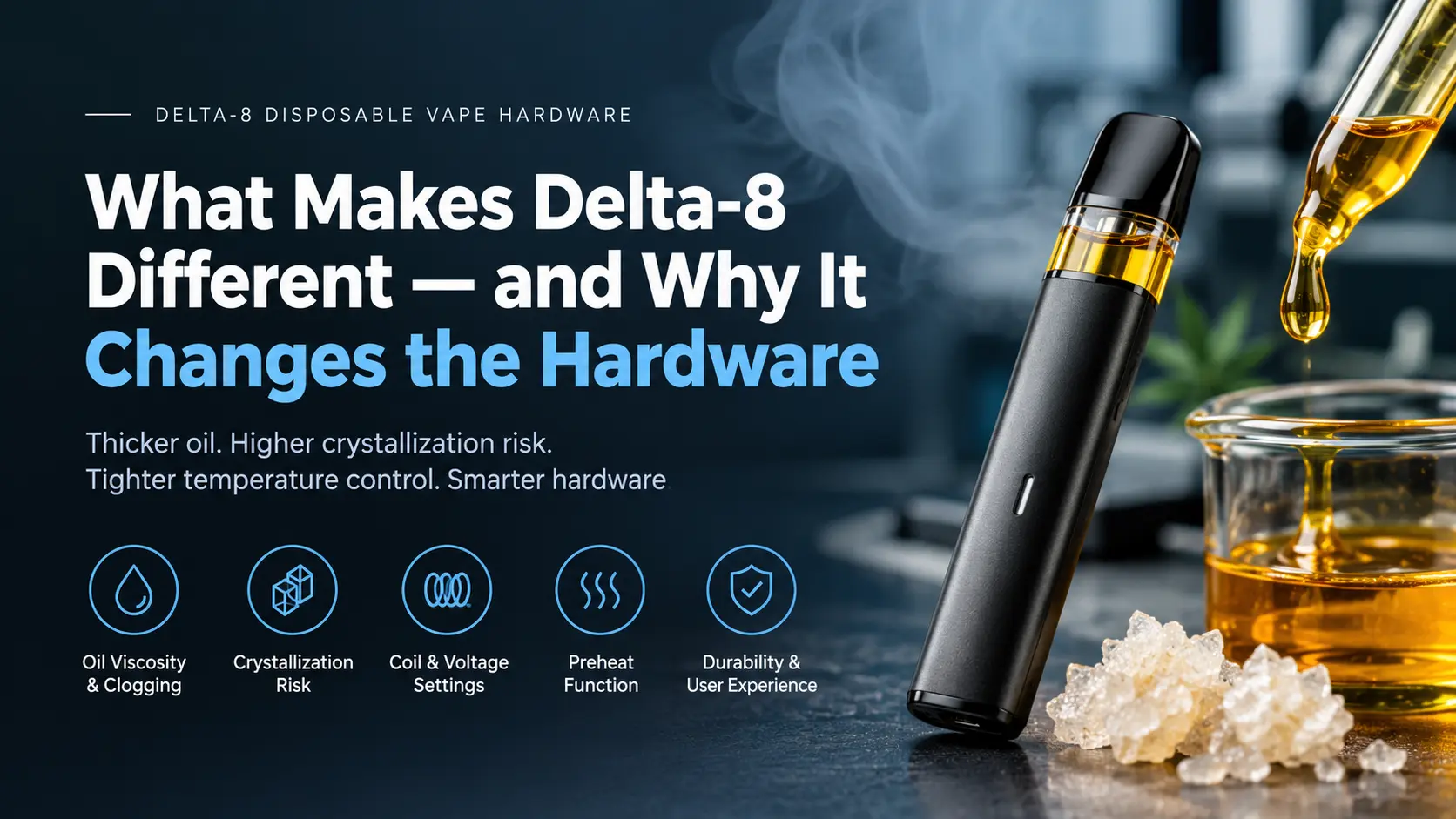
Choosing delta-8 disposable vape hardware is an engineering decision, not a catalog pick. Delta-8 distillate is thicker than nicotine e-liquid, solidifies as it cools, and crystallizes under conditions CBD oil never sees. On top of the physics sits a regulatory clock: the federal framework that made delta-8 a category ends on November 12, 2026, and more than twenty states have already restricted it.
A scope note first, because it changes how this guide reads. We build hardware, not oil: everything on our side is empty all-in-one hardware, shipped with no fill, so the requirements below describe what delta-8 disposable vape hardware must survive once a filler loads it. Where this article discusses filled, finished delta-8 products, that is the other side of the market, included so the two paths can be compared honestly.
One more ground rule. None of this is legal advice: cannabinoid rules vary by state and are changing at the federal level right now, so confirm anything compliance-related with qualified counsel before it reaches a label, a listing, or a purchase order.
1: What Delta-8 Distillate Does to Hardware That CBD Does Not
Start with the oil, because every requirement downstream traces back to it. Delta-8 distillate is a thick, sticky concentrate that behaves like candle wax at room temperature: heated, it flows and wicks; cooled, it stiffens into a solid that blocks airflow channels and starves the wick. Consumer troubleshooting guides for delta-8 devices read like a single repeating complaint: clogging, because delta-8 disposable vape hardware designed around thin oil meets a different material entirely. That mismatch, not the cannabinoid itself, is where most delta-8 disposable vape hardware complaints start.
The second property is crystallization, and it is less widely understood. Delta-8 distillate can nucleate and form crystals over time, a process tied to the hydroxyl groups in the molecule and accelerated at cooler temperatures. Crystallized oil stops flowing toward the wick, so a tank that looks full can stop producing vapor, which is why delta-8 disposable vape hardware for this oil class is judged on how it handles solids, not just liquids. Industry testing notes point out an uncomfortable detail: the purer the distillate, the more prone it is to crystallize, so a brand’s quality claim and its clog rate are connected. When dilution agents fell out of favor, cartridges became more prone to crystallization, not less.
That leaves the formulator with a genuine trade-off, and the hardware has to absorb both sides of it. Cutting distillate with terpenes lowers viscosity and reduces clogging, but changes the formula declaration; running high-purity distillate with minimal dilution keeps the label clean and raises the crystallization risk. One large delta-8 brand runs around 95 percent distillate and accepts the clog complaints that come with it; another targets a lower purity precisely to keep oil flowing. Neither choice is wrong, but both define what delta-8 disposable vape hardware must do: tolerate a wide viscosity range and survive crystals forming in the tank without a burned coil.
For a hardware buyer, the practical translation is simple. Ask what viscosity range the platform was validated on, not just whether it supports delta-8 at all. A device tuned on thin CBD distillate will underperform on a high-purity delta-8 formula, and the gap shows up as field complaints, not as a spec-sheet difference. That question, asked before the purchase order, is the cheapest quality control a delta-8 disposable vape hardware program ever gets.
2: Coil, Voltage and Preheat in Delta-8 Disposable Vape Hardware
Delta-8 hardware lives or dies on temperature management, because the oil is only usable inside a window. Too cool, and the distillate stays solid: no wicking, no vapor, a blocked airway. Too hot, and the wick scorches, which produces a burnt taste no cleaning reverses and destroys the coil for the rest of the tank. Delta-8 disposable vape hardware therefore needs a coil system built for low-and-slow operation rather than the high-output curve a nicotine device follows.
Published guidance converges on a modest voltage band: settings between roughly 2.5 and 3.0 volts are generally sufficient for delta-8 distillate, and running lower protects both flavor and coil life. Higher voltage burns through oil faster, raises the clog risk in the airway, and shortens the life of the heating element. On a fixed-voltage device this becomes a factory-set pairing decision, the coil resistance and the battery output chosen together for the oil class, which is exactly why that pairing should be specified deliberately instead of inherited from a catalog listing.
Preheat is the second half of the answer. A preheat cycle warms the oil briefly at low power before the draw, softening distillate stiffened overnight or in a cold truck. Industry hardware guides treat preheat as standard equipment for thick extracts, and consumer guides treat it as the first fix for every clog. On our platforms, preheat is a two-click function on button models, and we treat it as a requirement rather than a feature on anything specced for high-viscosity oil. A delta-8 disposable vape hardware quote that leaves preheat out is quoting for returns.
Coil construction matters as much as the electronics around it. Ceramic cores dominate this category because ceramic wicks evenly, cannot burn, and holds up to heat stress, and pore structure determines how readily thick oil reaches the heating surface. When a brand evaluates delta-8 disposable vape hardware, the questions that separate real platforms from resold catalogs are about the ceramic: pore size, sintering process, heavy-metal testing, and which viscosity classes the coil was validated on. A supplier who cannot answer those questions has not done the engineering.
3: Sealing, Filling and the Shipping Problem
Leak control is a bigger deal in this category than in nicotine vaping, for two reasons that compound each other. First, delta-8 distillate thins dramatically with heat, and a device sealed for room-temperature oil will weep in a summer truck or a hot warehouse. Second, the category ships long distances across state lines, which multiplies the hours the device spends in conditions nobody controlled. Multi-layer silicone gaskets at the tank interfaces are the industry’s answer, and on sound delta-8 disposable vape hardware they are the difference between a clean carton and an oil-stained return.
On the manufacturing side, sealing and filling interact. Automated filling runs at volume and speed, and a device that fills cleanly at the filler saves the brand money on every unit; poor sealing shows up first as filling-line waste, then as transit leaks, then as reviews. This is why our platforms use press-and-lock mouthpiece assemblies and layered gasket systems, and why we ask brands about their filler’s process before quoting delta-8 disposable vape hardware, not after the first leak claim.
Storage orientation belongs in the same conversation. Side-stored devices let oil settle away from the intake ports, which produces dry hits and, over time, airway clogs, and retail displays rarely keep units upright. Delta-8 disposable vape hardware should therefore be judged against real shelf behavior for real shelf behavior: an airway geometry that tolerates some horizontal time, and packaging that keeps units standing when it can.
One more shipping fact worth knowing: United States Postal Service rules bar shipping vape devices through the mail, which pushes the category onto private carriers with their own restrictions. For a brand, that is one more reason the device has to survive rough handling, because the logistics chain for delta-8 disposable vape hardware is narrower and rougher than the nicotine supply chain it resembles.
4: Capacity in Delta-8 Disposable Vape Hardware When the Container Is the Unit of Law
Delta-8 built its retail pitch on size. Because delta-8 is less potent per milligram than delta-9, the category drifted toward big tanks: two-gram and three-gram disposables, high oil loads, aggressive value pricing. That playbook worked in a market where nobody counted containers. It stops working on November 12, 2026, because the container is now the unit the law counts in, and this single fact should drive every delta-8 disposable vape hardware capacity decision made this year.
The 2026 federal rewrite caps finished hemp products at 0.4 milligrams of total THC per container, counting THCA and other intoxicating cannabinoids. A typical delta-8 gummy contains 25 milligrams or more; a large disposable carries far more. Against that cap, the big-tank value strategy inverts: every additional milliliter of THC-adjacent oil concentrates more regulatory exposure into the same container rather than spreading it out, which turns the tank size printed on delta-8 disposable vape hardware into a compliance input, not just a commercial one.
Capacity has follow-on effects a brand should model before choosing a platform. Larger fills need rechargeable batteries, because a non-rechargeable cell on a big tank dies with oil stranded inside, which is the most reliable one-star review generator in this category. Every platform in our family charges through Type-C, and on anything above 1 mL we treat rechargeability as a spec requirement, not a feature, and we carry it through every capacity tier of our delta-8 disposable vape hardware. Puff-count expectations scale with fill size too: a gram of oil yields roughly 200 to 400 puffs under standard assumptions, and any printed number beyond that range is a marketing claim, not an engineering output.
The planning rule for 2026 is therefore different from the one that built the category. Do not ask how big the tank can be. Ask what the line is legally allowed to contain per container, which oil classes the brand intends to run, and which platform carries that volume with a battery that outlasts the fill. That question set is how delta-8 disposable vape hardware should be sized from here on. On hemp-CBD-only lines, the container cap barely binds; on delta-8 and similar lines, it binds everything, right down to the capacity options worth quoting.
5: The November 2026 Deadline, Stated Plainly
The legal foundation of the delta-8 category is scheduled to disappear, and any honest manufacturing guide has to say so. The 2018 Farm Bill defined hemp by its delta-9 THC content alone, which is the gap delta-8 grew through: a product could carry high levels of delta-8 and still qualify as legal hemp. Congress closed that gap in November 2025, and the new framework takes effect on November 12, 2026.
The new law makes three changes that read the category its last rites. Hemp is redefined around total THC, so all intoxicating isomers count against the 0.3 percent limit. Cannabinoids synthesized or converted outside the plant are excluded from the hemp definition, which captures the isomerization process used to make virtually all commercial delta-8. And the per-container cap discussed above applies to finished products. Every one of the three reaches past the oil and into the device itself, which is why the deadline belongs in a delta-8 disposable vape hardware conversation and not just a legal one. Separately, the Drug Enforcement Administration classified synthetically converted delta-8 as a Schedule I controlled substance in 2024, and a federal appeals court upheld that authority in August 2026.
The state layer was already hostile and is getting more so. More than twenty states have banned or restricted delta-8 products, and courts have confirmed states may regulate hemp more strictly. Enforcement is not theoretical: state agencies report delta-8 products making up a rising share of cannabinoid seizures, and market analysts estimate the federal changes will reach the overwhelming majority of current retail hemp products, which includes most of the devices sold as delta-8 disposable vape hardware over the past three years.
The regulatory machinery is still moving as this article is written: rulemaking to exclude synthetically derived THC from the hemp definition opened for public comment in August 2026, with the comment period closing in October. Nothing in this guide predicts how any of it resolves, and nothing here is legal advice. What a brand should take from it is simpler: the window for delta-8 as a federal-hemp category closes on a known date, and delta-8 disposable vape hardware investments made now should be planned with that date on the calendar.
6: What Survives: Delta-8 Disposable Vape Hardware After the Deadline
Here is the part of the delta-8 conversation most content skips, and the part that matters most to a manufacturer: the platform does not expire. Coil engineering, sealing systems, battery matching and filling compatibility were built for thick cannabis extracts, and they transfer intact to any oil that shares the physics. Delta-8 disposable vape hardware is, at the component level, high-viscosity-extract hardware, and high-viscosity extracts exist in plenty of product lines whose legal footing is not in question.
That reframes what a brand is actually buying in 2026. A hemp-CBD line keeps the platform and changes nothing. A brand moving into state-licensed channels keeps the platform and adapts the compliance layer around it. A brand with a delta-8 SKU planned for the remaining window can run it on the same family of devices, then migrate the line without requalifying a new form factor. The engineering requirements in this guide, viscosity tolerance, temperature window, sealing, battery-before-oil, apply across all of those paths, which is why delta-8 disposable vape hardware bought with them in mind keeps earning its place after the category it was named for is gone.
The specification sequence we use with brands holds regardless of cannabinoid. Define the user and the usage cadence. Characterize the actual oil, its viscosity at storage temperature, not just its name. Choose the coil and voltage pairing for that viscosity class. Size the tank against the container rules that apply to the line, and the battery against the tank. Verify the whole stack with the real formulation before anything ships, and freeze the variant list before quoting, because each flavor and viscosity class in delta-8 disposable vape hardware programs is specced, tested and quoted per flavor.
The customization ladder runs the same way on every path, from logo-and-color programs to full ODM builds with custom tooling. The private label options for CBD hardware are laid out in our custom CBD vape guide, and the factory vetting framework that should precede any of it is in our manufacturer checklist. Either way, the platform that a delta-8 disposable vape hardware program leaves behind is an asset the next product line inherits. A platform chosen for physics outlives a platform chosen for a product name, and the delta-8 era has made that distinction expensive to ignore.
7: Where to Start with Delta-8 Disposable Vape Hardware
The short version fits in five lines. Treat the oil as the first spec: viscosity range, crystallization behavior, storage temperature. Match coil, voltage and preheat to that oil, and demand the validation data behind the match. Seal and pack for a logistics chain nobody controls. Size capacity to the container rules that actually apply to your line, not to the category’s old value playbook. And put November 12, 2026 on the project calendar, because it determines which product lines delta-8 disposable vape hardware will carry and for how long.
If you are speccing a line now, send us the oil class and the target market. We will come back with platform options across 0.5 to 4 mL, coil choices in the 1.2 to 2.7 ohm range, preheat options, and the assumptions behind every recommendation; our request-a-quote page starts that conversation. Every delta-8 disposable vape hardware recommendation we make is written that way: oil first, platform second, assumptions attached. For the surrounding decisions, our CBD versus THC hardware comparison covers how the two product lines diverge at the platform level, our puff count guide shows how fill size translates into real usage, and our wholesale supplier guide covers the buying side of the relationship.
Whatever happens to delta-8 as a category, delta-8 disposable vape hardware will still be in service for years, carrying other oils on the same platforms. The hardware is the part of the line that outlasts its own category. Spec it that way.
This article is provided for general information about vape hardware specification and does not constitute legal advice. Cannabinoid product regulations vary by state and continue to change, including the federal changes effective November 2026; consult qualified counsel before making compliance decisions for any product line. No statement in this article is a health claim or a statement about the effects of any substance.