If you run a CBD brand or you are planning to enter the category, you have probably watched the disposable CBD vape segment grow from a niche curiosity into a repeat-purchase product line. The numbers back it up: disposable formats accounted for roughly 50% of global CBD atomization revenue in 2025, ahead of refillable devices and cartridges combined. But most coverage of this category talks about oils and effects, not about the device itself. That is a gap, because the disposable CBD vape is, at its core, a piece of hardware — and hardware decisions decide your cost, your compliance risk, and whether customers come back for a second one.
We build vape hardware for a living, so this guide looks at the disposable CBD vape the way an engineer and a compliance officer would: what the device contains, how it works, where it differs from a nicotine disposable, and what a brand must verify before placing an order. None of this is legal advice — CBD rules in the United States are still fragmented across federal and state lines, and the rules changed again in 2026 — but the hardware side of the equation is something you can check today, before you spend a dollar on inventory. If you are earlier in the journey, our guide to custom disposable vape design explains the customization options you will be choosing between.
What Is a Disposable CBD Vape? The Hardware Behind the Category
Strictly speaking, a disposable CBD vape is a self-contained vaporizer that ships filled with CBD oil, is activated by inhaling, and is discarded when the oil runs out or the battery dies. No refills, no charging (in the classic format), no maintenance. For a brand, that simplicity is the whole point: one sealed unit, one box, one price point, and a customer who has nothing to learn.
The phrase “disposable CBD vape” describes a hardware format, not a type of oil. The same device architecture can carry full-spectrum extract, broad-spectrum distillate, or isolate diluted in a carrier — and in practice the market also sells Delta-8, HHC, and THC-O in this exact form factor. What makes each unit legal or not is the oil inside it and the label on the box, which is why hardware sourcing and compliance planning have to happen together rather than in sequence.
There are three related formats brands often confuse when they first look at the disposable CBD vape category. A pure disposable CBD vape has a non-removable battery and cannot be refilled. A rechargeable disposable CBD vape adds a USB-C or magnetic charging port so the user can finish the oil instead of tossing a dead battery. A cartridge or pod system separates the tank from the battery, which is a different inventory model entirely. This article stays on the first two, because they are the formats that dominate the CBD shelf today.
How a Disposable CBD Vape Works: Six Parts, One System
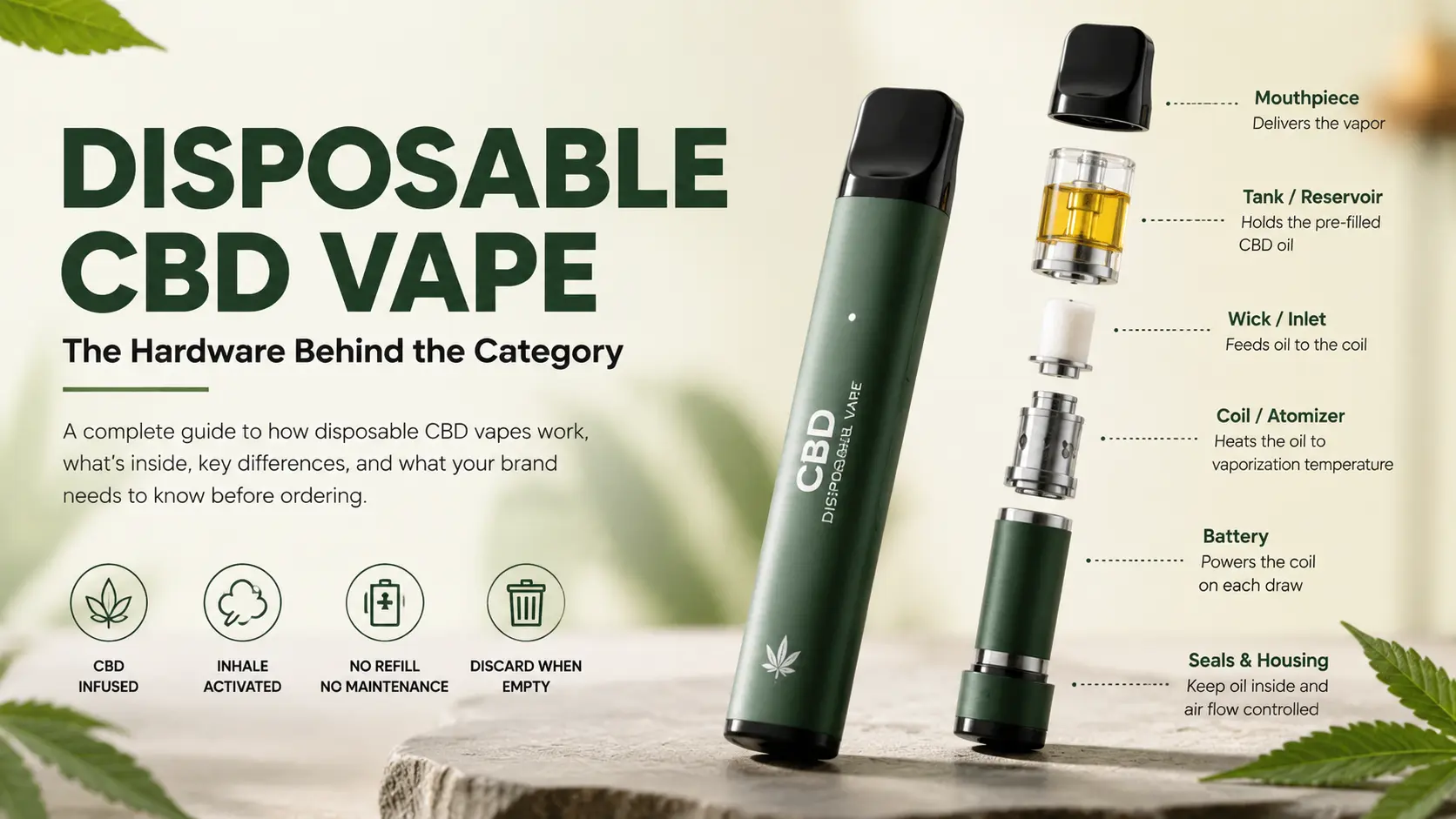
Inside every disposable CBD vape you will find the same six components, working together every time the user inhales. There is no button and no settings screen in the classic design — an airflow sensor detects the draw, closes the circuit, and the coil starts heating almost instantly.
| Component | What it does | What a brand should care about |
|---|---|---|
| — | — | — |
| Battery | Powers the coil on each draw | Capacity, charging (if rechargeable), UN38.3 transport certification |
| Coil / atomizer | Heats the oil to vaporization temperature | Material, resistance, and how it matches oil viscosity |
| Tank / reservoir | Holds the pre-filled CBD oil | Fill volume, material, and leak resistance over shelf life |
| Wick / inlet | Feeds oil to the coil | Clogging behavior with thick distillate |
| Mouthpiece | Delivers the vapor | Shape, material, and child-resistant closure options |
| Seals & housing | Keep oil inside and air flow controlled | Gasket quality, assembly tolerance, drop resistance |
The coil is the part that separates a good disposable CBD vape from a frustrating one. Modern devices use ceramic coils, which hold heat evenly and handle thick CBD distillate far better than the older fiber wicks that clog and burn. The coil’s resistance and power setting must match the oil: high-viscosity extract needs a lower-wattage profile and a larger inlet, or the user gets weak vapor, burnt taste, or both. This is a manufacturing detail, but it is the single biggest driver of returns and one-star reviews in the category.
The other part that matters is the seal system. A disposable CBD vape sits in a warehouse, on a truck, and on a retail shelf for months before it is used. If the gaskets are wrong or the tank is not fully welded, oil migrates, the packaging arrives stained, and the whole batch has to be written off. Serious suppliers pressure-test units for leaks and weigh-check every batch before shipping — those two checks catch most of the failures that actually reach customers.
One historical note explains a lot of today’s quality requirements. The 2019 EVALI outbreak in the United States was traced to vitamin E acetate used as a thickening agent in unregulated oil. The hardware itself was not the cause, but the event pushed every responsible buyer in the category toward third-party testing of the oil and cleaner device materials. If a supplier cannot show you a certificate of analysis for the oil that goes into your disposable CBD vape, count that as a hard stop, not a negotiation point.
Battery engineering deserves its own line, because the battery is the most expensive component in a disposable CBD vape’s bill of materials. A typical disposable CBD vape carries a 280–500 mAh cell, sized to outlast the oil rather than to maximize cloud volume. If the battery dies before the tank is empty, the customer throws away usable product and remembers the brand negatively — so the two specs have to be matched at the design stage. Rechargeable units solve this by adding a charging circuit and a port, which pushes the unit cost up slightly but extends the usable life of every device. Whichever route you choose, the battery needs UN38.3 transport testing and a documented charge profile, because lithium cells are the first thing customs and freight forwarders ask about.
Disposable CBD Vape vs Nicotine Disposable: What Actually Differs
If you already sell nicotine disposables, a disposable CBD vape looks familiar — same cylindrical body, same draw activation, same wholesale math. The differences are hidden in the engineering and in the label, and they matter more than the similarities.
| Dimension | Disposable CBD vape | Nicotine disposable |
|---|---|---|
| — | — | — |
| Oil viscosity | High (distillate-based) | Low (freebase or salt nicotine liquid) |
| Coil design | Ceramic, low wattage, larger inlet | Mesh or ceramic, tuned for thin liquid |
| Fill volume | Commonly 0.5–2 ml per unit | Commonly 2–10 ml per unit |
| Battery draw | Lower, shorter session profile | Higher power, longer session |
| Labeling | Cannabinoid content, THC level, COA reference | Nicotine strength, TPD-style warnings |
| Sales channel | Dispensaries, specialty CBD retail, online | Convenience, vape shops, online |
The practical consequence: you cannot take a nicotine disposable mold, fill it with CBD distillate, and call it a day. The oil is roughly ten to a hundred times more viscous depending on the extract, which changes the inlet size, the coil wattage, and the wicking behavior. Brands that try to shortcut this end up with clogged units and burnt coils, and they usually blame the supplier when the real problem was an architecture mismatch.
The label side differs just as much. A disposable CBD vape sold in the United States needs to state cannabinoid content, reference a certificate of analysis, and — since November 2026 — respect a federal cap on total THC per container under Section 781 of the Hemp Act. Nicotine products have their own regulatory stack, but it is a different one, with different enforcement priorities and different age-gating rules. If you are launching a disposable CBD vape, plan the labeling and the testing regime before you design the box, not after.
The channel logic differs too, and it changes your pricing math. Nicotine disposables move through convenience stores and vape shops on high unit velocity and thin margins. A disposable CBD vape more often sells through dispensaries, specialty CBD retailers, and e-commerce, where the basket size is larger, the buyer is more deliberate, and shelf rotation is slower. That means your wholesale price can carry a better margin, but you need packaging and compliance documentation that the retail buyer can verify in under a minute — most buyers now scan a QR code on the box to pull up the certificate of analysis before they commit shelf space. Build that into the design from day one.
Why the Disposable CBD Vape Format Is Growing
Market data explains why brands keep asking about this format. Across the global CBD atomization market, disposable devices were the largest product type in 2025 with roughly half of revenue, and North America accounted for about 51% of the total market. On the broader hemp-derived CBD side, industry analysts expected the US market to pass $6 billion in 2026, with vapor formats taking a meaningful slice of that spend. The direction of travel is clear: buyers want a zero-learning-curve device, and retailers want a single-SKU product that does not need displays or cleaning stations.
Retail logic pushes in the same direction. A disposable CBD vape moves through checkout like any sealed consumer good, needs no staff training to explain, and turns over quickly. For a brand, the format is the fastest way to test a flavor lineup or a dose range without committing to refillable hardware and its spare parts inventory. If the first batch sells, you scale; if it does not, you have burned a small, contained amount of money. That optionality is the real reason the format keeps growing.
Regulation is quietly helping too. After years of warning letters against unregulated CBD vapes, enforcement attention has shifted toward products that skip premarket authorization and toward labels that overpromise. That pushes the category toward the same kind of compliance infrastructure that nicotine hardware already has: tested materials, documented oil, audited factories. For an ODM-style hardware supplier, this is an advantage — a disposable CBD vape built with the same quality systems as a European-market device starts ahead of the field.
Two more data points frame the demand for the disposable CBD vape format. On the consumer side, the largest age cohort buying CBD vapor products in the US is 21–35, which is the same demographic that already understands disposable formats from the nicotine side — so the learning curve is effectively zero. On the supply side, online channels now carry a large share of CBD vape sales, and online buyers rate products by consistency and lab transparency. A disposable CBD vape with documented batch testing converts better in that environment than a cheaper unit with no paperwork, because the paperwork is what the customer actually searches for.
What to Check Before Sourcing a Disposable CBD Vape
Sourcing a disposable CBD vape is a five-part checklist, and skipping any of the five parts shows up later as a chargeback, a failed audit, or a returned batch. Run through them in order, with your supplier on the call.
1. The device itself. Ask for the battery spec (capacity, certification, charging behavior), the coil spec (material, resistance, wattage window), and the leak-test procedure. A serious factory has a documented QC flow and will share it. If you are new to launching hardware, our guide to starting a disposable vape brand walks through the full readiness checklist.
2. The oil that goes inside. This is the part most hardware-only suppliers cannot cover, and it is the part that decides your legal exposure. You need a certificate of analysis for every batch: cannabinoid potency, total THC, heavy metals, pesticides, residual solvents, and microbial counts. Vitamin E acetate should be explicitly absent. If your supplier fills the device, demand the COA as part of the delivery.
3. The label and the box. The United States has no single federal label for a disposable CBD vape, so your packaging needs to satisfy the states where the product will actually sell: cannabinoid declaration, THC disclosure, batch traceability, and in many states an age-gate statement. Child-resistant packaging is expected in most retail channels. Plan for a compliance review of the label before you print 10,000 of them.
4. The factory behind it. Do not buy a disposable CBD vape from a supplier who cannot answer basic questions about capacity, lead time, and defect rates. The same evaluation criteria that apply to nicotine hardware apply here: factory audit, sample testing, production records. If you already know how to pick a disposable vape manufacturer for nicotine, apply that framework — then add the oil-compliance checks on top.
5. The unit economics. Fill volume, battery grade, coil quality, and packaging depth drive 80% of the cost difference between a $4 wholesale unit and a $9 one. Decide what price point your channel supports first, then let the bill of materials follow. This is where a small sample batch is worth more than any spreadsheet: test the real device, the real label, and the real shelf life before committing to volume.
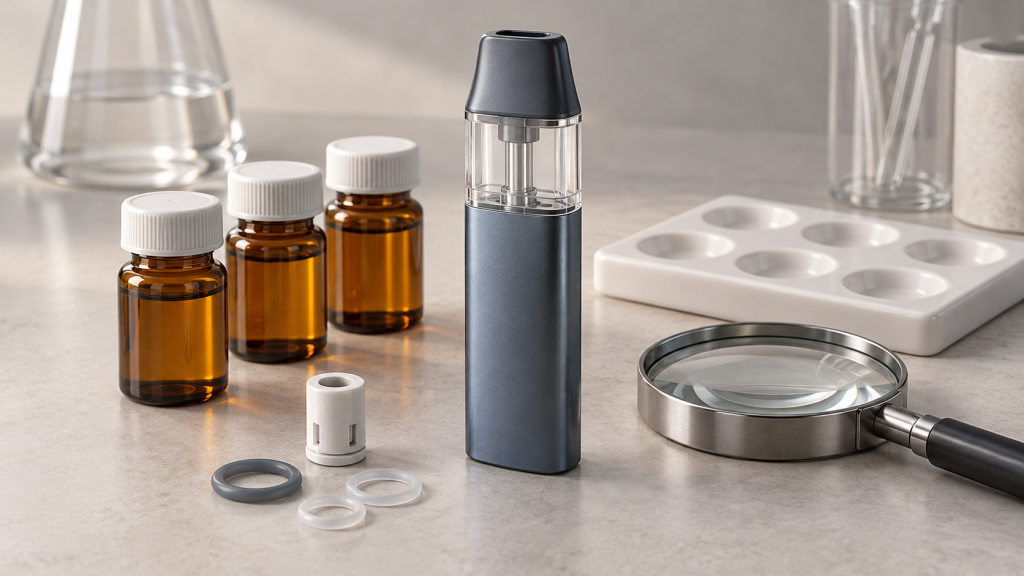
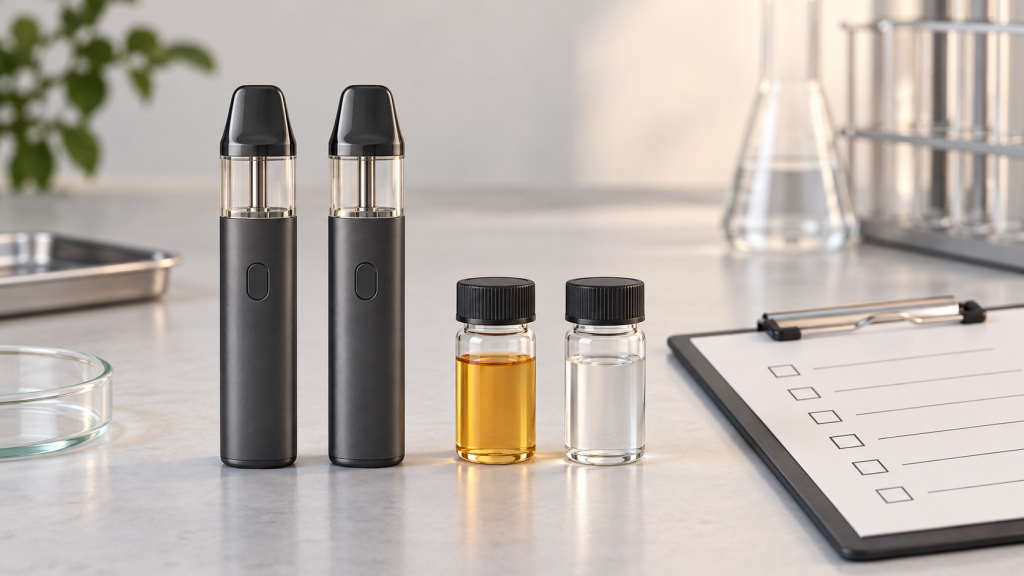
When the samples arrive, run them through a short test protocol instead of just unboxing one. The checks that catch real problems are simple and take an afternoon:
- Weight check. Weigh every unit in the sample batch. Wildly inconsistent weights mean inconsistent fill volumes, which is the fastest way to lose a compliance audit.
- Draw test. Vape three units start to finish. Log the first draw, the halfway point, and the last ten draws. Burnt taste before the oil is gone is a coil mismatch.
- Leak test. Leave units upright and upside down for 48 hours. Oil at the bottom of the bag is a seal failure.
- Battery test. Run the device until the battery cuts out. If it dies with oil still visible, the battery was undersized.
- Label audit. Pull the COA against the label. The numbers on the box must match the lab results for the same batch.
That protocol takes half a day and has caught problems in supposedly vetted products in every market we have worked in. The supplier who welcomes this testing is the supplier you want in production.
Where the Disposable CBD Vape Category Is Headed
Three shifts are visible from where we sit on the manufacturing side. First, rechargeable disposables are eating into the pure single-use format, because the battery is the most expensive component and letting customers finish the oil is better for both cost-per-use and waste. Second, the Section 781 THC cap that takes effect in November 2026 is forcing full-spectrum formulations toward isolate or broad-spectrum alternatives, which changes the oil profile your hardware needs to handle — usually toward lower viscosity and cleaner coil performance. Third, brands are consolidating their hardware across nicotine and cannabinoid lines with the same factory, which rewards suppliers who can build both and keep the compliance paperwork separate.
None of this changes the fundamentals. A disposable CBD vape is a sealed, tested, honestly labeled product, or it is a liability. The brands that win in this category approach the hardware as a real engineering decision — they check the coil, the seal, the battery, the oil COA, and the label before they check the price. That is the entire difference between a product line that grows and a product line that generates chargebacks.
For a brand deciding whether to enter now, the practical answer is to start narrow. Pick one format — a 1 ml or 2 ml disposable CBD vape with a ceramic coil and a rechargeable battery — choose three to five flavors, and validate the whole chain: oil source, COA, label, packaging, and one retail channel. The category rewards brands that launch a small compliant line and expand on evidence, and it punishes brands that launch a wide cheap line and hope. Hardware is where that discipline either pays off or falls apart. If you need to understand the full journey before you commit, our vape product development guide walks through the stages a custom device goes through.
If you are evaluating suppliers for a disposable CBD vape line, we would rather you ask us the hard questions than find the answers on a bad batch. Our team handles ODM and private-label hardware for nicotine and cannabinoid brands, and we will walk you through coil options, fill volumes, battery grades, and the compliance documentation that should ship with every unit. Send us your target price point and channel, and we will come back with a spec sheet and samples you can actually test.
This article explains hardware for informational purposes only and does not constitute legal advice. Verify current federal and state requirements for any market where you plan to sell.