Two formulations can share a flavor name while behaving differently in the same device. A sample that initially functions may later leak, change appearance, or deliver inconsistent aerosol. For a CBD vape flavors disposable project, the purchasing question is which formulation and hardware combination has actually been evaluated. A familiar name, a ceramic label, or a clear reservoir cannot answer that question on its own.
Our CBD AIO HARDWARE scope means an empty all-in-one platform. Each device is shipped with no fill; liquid responsibility belongs to the brand working with its qualified formulation partner. Filled retail products belong to the other side of this market and are mentioned only for comparison. CBD vape flavors disposable planning here concerns equipment compatibility, without offering a formulation recipe, a filled product, or an endorsement of any ingredient.
This guide does not constitute legal advice or a toxicological assessment. Nothing here constitutes legal advice for a specific product or destination. Mechanical compatibility, aerosol chemistry, and permission to market require separate decisions. Treat the proposed CBD vape flavors disposable checks as questions for qualified engineers and laboratories. A successful functional test cannot establish inhalation acceptability, and a pleasant aroma cannot substitute for evidence about the assembled product.
The useful distinction is between choosing a flavor range and validating its physical consequences. Our focus is the second task: how a changed liquid may affect contact materials, liquid delivery, and the interpretation of test results. CBD vape flavors disposable buyers should leave with a way to investigate a mismatch and define the next evidence request. The outcome is a documented compatibility decision, rather than a universal list of flavors that every platform can support.
Define CBD Vape Flavors Disposable Variants by Composition
Begin with the formulation identity behind each proposed variant. Request a controlled ingredient declaration, relevant analytical documentation, batch identifier, and revision number through an appropriate confidential exchange. A public name such as citrus or mint is a marketing description; it does not identify every component or its concentration. In a CBD vape flavors disposable comparison, two samples with the same label should remain separate until the responsible partner confirms their relationship. Record what is known and mark missing information explicitly, rather than filling the gaps from another supplier’s catalog.
Keep extract classification separate from the flavor description. Full spectrum, broad spectrum, and isolate describe different aspects of the cannabinoid material, while the finished liquid may include additional constituents. Our oil-type selection guide addresses that first distinction. The narrower CBD vape flavors disposable task is to identify what changed between two finished formulations and which contact or delivery behavior needs reassessment. A supplier’s claim that both liquids are CBD-based is insufficient evidence that the same test result applies to both.
Give the laboratory the exact formulation version and the engineer the corresponding hardware bill of materials. Ask how proprietary details will be protected while still allowing the necessary assessment. A confidentiality agreement can facilitate disclosure, but it cannot make missing composition data technically adequate. For CBD vape flavors disposable procurement, define which party can review the complete record and who will communicate the resulting limitations. If access remains restricted, the release decision must retain that uncertainty instead of presenting a partial file as complete evidence for the intended combination.
Separate Flavor Descriptions From Inhalation Evidence
Food-use documentation does not answer an inhalation question. FEMA’s statement on vaping explains that its expert panel assesses flavor ingredients for intended food uses, rather than vaping or other inhalation uses. A CBD vape flavors disposable file should therefore identify the exposure route covered by each document. Do not turn a food-related ingredient listing into an assertion that the proposed aerosol has been evaluated. Ask the qualified assessor what additional information is needed for the actual intended application.
Natural origin is also an identity claim, rather than a completed evaluation. Botanical or cannabis-derived descriptions may help explain sourcing, but they do not establish the composition of every batch or the behavior of a heated mixture. Keep that distinction visible in a CBD vape flavors disposable request. Obtain the relevant supplier records, ask how identity and consistency are checked, and leave the interpretation to qualified specialists. Avoid replacing the evidence question with a contest between natural and synthetic labels, because those labels alone cannot resolve the product-specific assessment.
Separate sensory observations from analytical findings in the report. A change in aroma can be recorded as an observation without claiming that a particular chemical reaction caused it. CBD vape flavors disposable development may involve sensory evaluation under lawful, professionally managed arrangements, but this article supplies no participant protocol or consumer test instructions. Ask which questions the proposed work can answer and which remain open. A report should distinguish a measured constituent, a physical fault, and a subjective impression, so a purchasing decision does not inherit a conclusion that the method never tested.
Match CBD Vape Flavors Disposable Liquids to Contact Materials
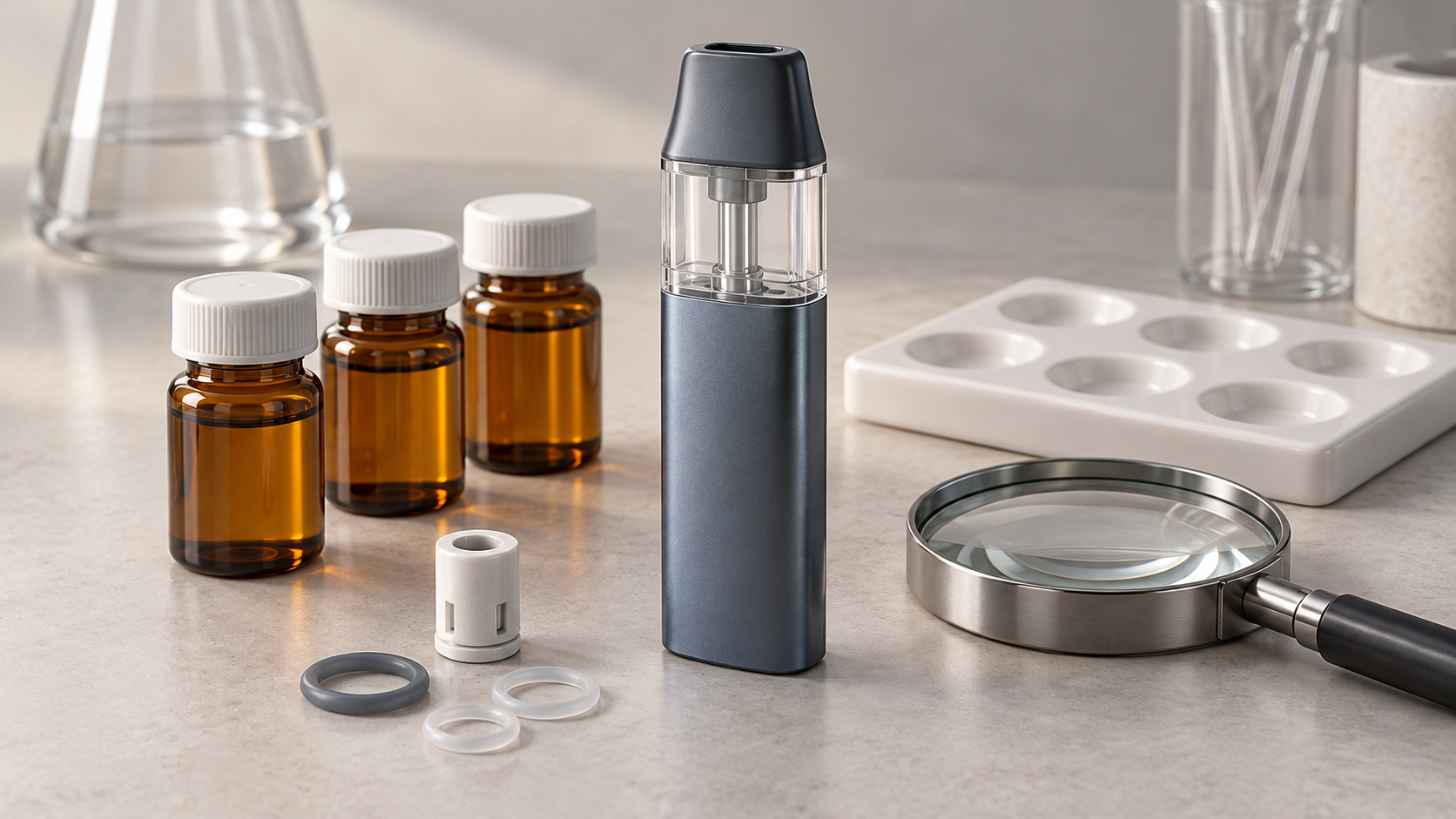
Identify every relevant surface before choosing a seal material. The tank, closure, gasket, adhesive, core, and aerosol path may require different evidence. Request material identifiers and compound grades, rather than accepting a broad label such as silicone or ceramic as the entire specification. In a CBD vape flavors disposable review, ask which parts contact the liquid during storage and which encounter aerosol during operation. That contact map helps the specialist select an assessment scope. It does not establish that every listed component needs the same test or that a generic certificate covers the assembled device.
A compatibility chart is a starting point for selection. The Parker O-Ring Handbook treats the fluid and operating conditions as central inputs and calls for appropriate testing of a proposed compound. Its general engineering guidance is not certification of a vape seal. CBD vape flavors disposable buyers should ask for evidence concerning the actual compound, mixture, contact duration, and expected conditions. Avoid blanket claims that one polymer family always swells or that another has zero interaction with every terpene-containing liquid.
Ask the engineer to define observable changes and their acceptance basis before exposure work begins. Relevant questions may include dimensional change, visible damage, hardness change, loss of sealing function, or findings from a separately specified chemical assessment. These are proposed investigation categories, not universal pass limits. A CBD vape flavors disposable sample that looks unchanged can still leave other questions unanswered. Likewise, a visible alteration identifies a finding to investigate; it does not, by itself, establish the migration profile or the cause of a later field complaint.
Retain the relationship between a material result and the assembled seal. A coupon or loose ring does not reproduce every feature of an installed component, including compression, geometry, and neighboring parts. For CBD vape flavors disposable qualification, ask how the team will bridge material screening to the final assembly. The supplier should identify which component revision was assessed and whether production uses that revision. An unannounced change of compound grade should trigger a documented review, even when the purchase description and external appearance remain the same.
Investigate Liquid Delivery Before Blaming the Flavor
Describe the fault before naming its cause. Leakage, delayed activation, intermittent aerosol output, and a changed liquid appearance are different observations. A CBD vape flavors disposable investigation should record where and when the finding appeared, the sample identity, and the relevant handling history. Preserve photographs and laboratory records where appropriate. Do not classify every liquid found near a mouthpiece as the same failure mechanism. Ask the engineer to distinguish reservoir leakage, assembly contamination, and condensation before proposing corrective work or changing the formulation.
Request physical-property data at stated conditions. A viscosity value without a temperature, method, or sample identity has limited comparison value. For CBD vape flavors disposable variants, ask whether the reported measurements describe the actual finished mixture and the relevant state of that mixture. Qualified personnel should decide which properties matter for the proposed platform. A cold-storage observation should not be compared casually with a room-condition measurement and then described as proof of batch inconsistency. The conditions are part of the evidence, rather than administrative detail to remove from a summary.
Change one investigation factor deliberately and preserve a control. If both the liquid revision and the hardware revision change together, a better result does not identify which change mattered. A CBD vape flavors disposable comparison should state the question, the unchanged features, and the criteria used to interpret the result. This is a proposed experimental planning principle, not a complete laboratory method. Ask the responsible team to choose an appropriate design and sample size; procurement should retain the rationale instead of inventing a universal number of devices or test days.
Build a fault matrix that keeps competing explanations visible. Against each observation, list the evidence already available, the next discriminating check, and the person responsible for interpreting it. For example, a leak after storage should retain both component and handling questions until the investigation narrows them. This proposed record avoids repeated trial substitutions without a stated hypothesis. Preserve unsuccessful comparisons too, so an apparently attractive replacement does not send the team back through a previously rejected combination.
Evaluate Heating Evidence Without Universal Settings
Published research supports evaluating the formulation and device together. A 2021 study of THC and beta-myrcene mixtures found that aerosol composition depended on terpene content, power, and consumption method. Those experiments involved particular THC-based systems, rather than every CBD formulation. For a CBD vape flavors disposable assessment, the lesson is a question about evidence coverage, not a transferable recipe or recommended terpene percentage. Ask the laboratory how the actual product differs from the research model before applying a finding to a commercial decision.
A labeled voltage is not a measured heating history. A 2022 thermography study compared three cannabis vaporization systems and found voltage alone to be a poor indicator of coil temperature. The work used modified cartridges and a defined laboratory arrangement, and the authors disclosed industry affiliation. CBD vape flavors disposable buyers should request the method and limitations behind a temperature claim. The study does not identify a universal setting for a different device, and it should not be used to promise a particular emission outcome.
Require a report to identify what was actually measured. Electrical output, coil temperature, aerosol mass, and chemical constituents answer different questions. In CBD vape flavors disposable work, a laboratory should explain the chosen endpoints, collection conditions, analytical scope, and uncertainty relevant to its conclusions. Procurement should not convert a low reading on one endpoint into a broad product claim. Nor should a report on the unheated liquid be represented as an analysis of the aerosol generated by the assembled device. Identify that missing coverage before approving language for the product file.
Check the report’s comparison basis before comparing suppliers. One laboratory may report a constituent per collection, another per device, and another relative to collected aerosol mass. Those quantities cannot be treated as identical without understanding the methods and units. Ask the assessor to explain whether the results can support the intended comparison. Retain the original reports alongside any purchasing summary, including results below a reporting limit and any qualification attached to them, rather than reducing the file to a pass badge.
Keep Storage Results Separate From Shelf Life Claims
A successful initial check supports only the conditions and interval actually assessed. Ask how the compatibility plan addresses the proposed storage and distribution conditions and the relevant device orientations. CBD vape flavors disposable purchasing should retain the observed results, sample identifiers, and deviations, including samples that did not meet the agreed criteria. Avoid treating accelerated exposure as automatic proof of a calendar shelf life. A qualified specialist must explain any relationship between the test and the proposed claim, including limitations and further evidence needed for that interpretation.
Investigate changes without assuming their meaning. Discoloration, crystallization, clouding, or an altered aroma may justify further assessment, but none should receive an automatic diagnosis from a photograph. For CBD vape flavors disposable validation, ask the laboratory and engineer to compare the affected sample with appropriate retained controls and records. Document any recommended restriction on using the result. The next action may be a targeted analysis, a component review, or a reformulation decision by the responsible partner; the purchasing team should not select a cause simply because it offers the fastest commercial resolution.
Carry the approved configuration into the pilot batch. Record the actual formulation batch, hardware component revisions, assembly process, and relevant packing conditions used for the verification work. A CBD vape flavors disposable laboratory sample and a later production run are related only through the evidence connecting them. Ask how discrepancies will be detected and who can hold release when those records disagree. Our manufacturer assessment guide covers broader supplier diligence; this stage asks whether the delivered combination still matches the one the specialists evaluated.
What a Brand Buyer Should Ask Before Ordering
Ask five specific questions in the compatibility handoff. Which formulation revision is being supplied? Which hardware and material revisions were evaluated? What observations and analytical endpoints were covered? What limitations remain on the conclusions? Who must approve a proposed change before production continues? Keep the answers linked to reports rather than scattering them across chat messages. For a CBD vape flavors disposable order, this compact record helps a replacement buyer reconstruct the decision without assuming that an old sample approval applies to every later variant.
Request the MOQ per flavor and distinguish liquid, empty hardware, decoration, and packaging commitments in the written proposal. A shared device platform does not automatically allow every flavor or component to be pooled into one minimum. CBD vape flavors disposable quotes should identify development, laboratory, and production scopes separately where applicable. No standard price or minimum is established here. Ask the supplier to state the actual offer, exclusions, validity, and change process in writing, and have the responsible commercial team resolve those terms before treating a technical sample as a production order.
Define a stop condition for unresolved evidence. If the formulation partner cannot supply needed information, the component revision is uncertain, or a report covers a different combination, hold the affected release decision. That is narrower and more useful than inventing a blanket verdict on every flavor. CBD vape flavors disposable procurement should assign the missing item to a named owner and specify the evidence required to resume. The battery design discussion addresses another distinct device layer; its electrical evidence cannot close an unresolved liquid-contact assessment.
CBD Vape Flavors Disposable Decisions After Testing
Approve only the combination whose evidence matches the intended order. CBD vape flavors disposable development does not end with selecting attractive names or choosing a material from a chart. It ends with a traceable formulation, device, assessment scope, and decision that the next shipment can reference. VOF’s empty hardware role does not transfer responsibility for the liquid or authorize a finished product. Keep remaining limitations visible, require review of relevant substitutions, and retain the basis for accepting or rejecting each variant. This discussion does not constitute legal advice, and neither its proposed workflow nor a functional result constitutes legal advice or an inhalation assessment.