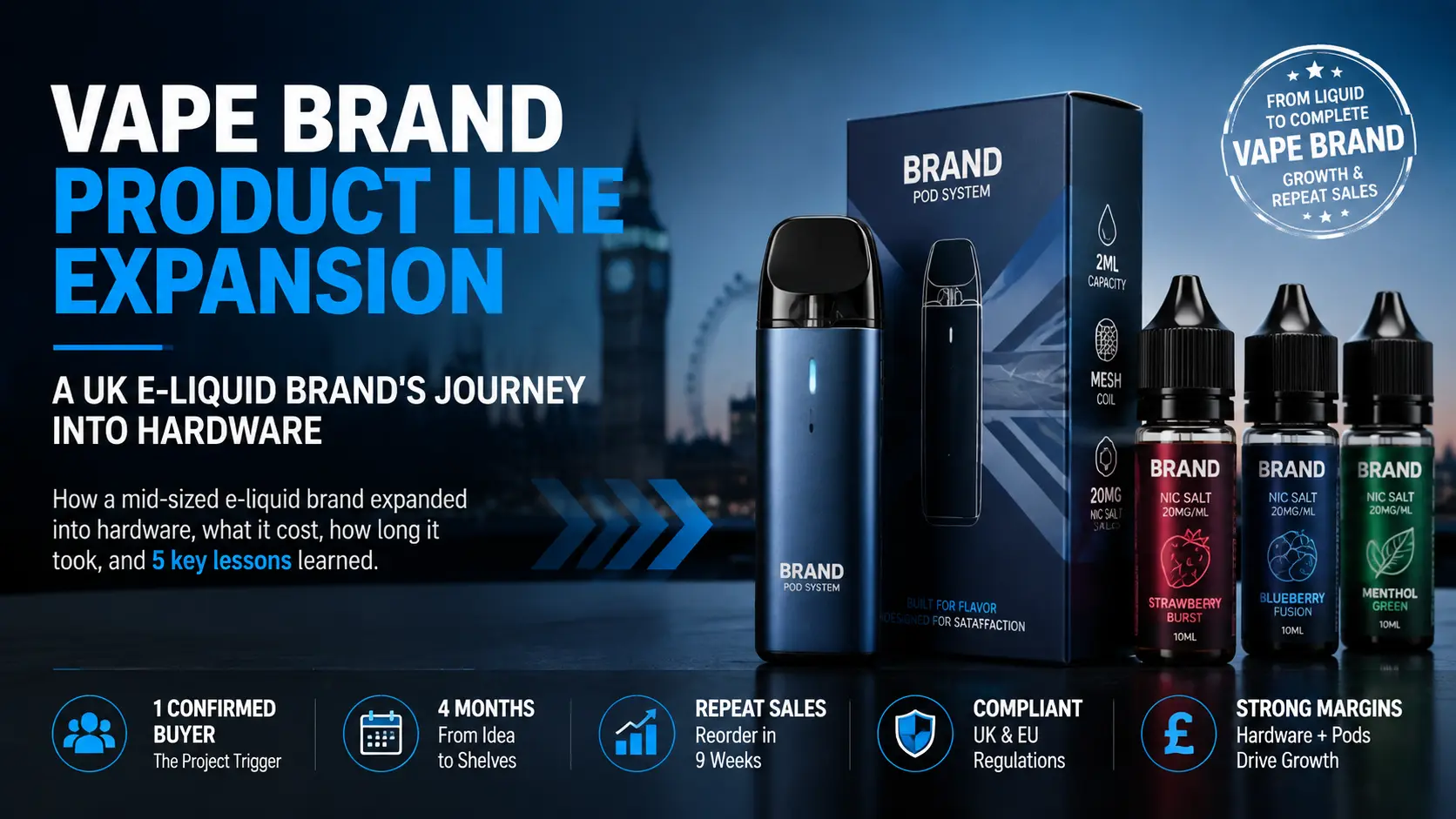
Every e-liquid brand hits the same ceiling. You can blend great liquid, you can win wholesale accounts, but the margins on bottled liquid keep shrinking while your retail partners keep asking for one thing: hardware.
A vape brand product line expansion is how a liquid company becomes a full brand. This case follows a UK e-liquid manufacturer through that exact journey, from first conversation to products on retail shelves, with the numbers and the mistakes left in.
Why E-Liquid Brands Expand into Hardware
The reasons to add hardware are consistent across the market, and they are stronger now than they were five years ago.
- Margin pressure on liquid. Wholesale liquid prices have compressed across Europe as the market matured, while production and compliance costs rose.
- Channel demand. Retailers prefer fewer suppliers. A shop that buys your liquid wants your pod kit on the same invoice.
- Brand stickiness. A customer who buys a device in your brand is more likely to keep buying your pods and your liquid.
- Disposable market shifts. Regulatory changes in several EU countries push retailers toward pod systems, opening shelf space that liquid brands can take.
For most liquid brands, the question is not whether to expand but how. The wrong path wastes twelve months and a six-figure budget. The right path compounds the brand you already built. A vape brand product line expansion is the strongest growth move a liquid company can make when the timing is right.
The Case: A UK E-Liquid Brand’s Vape Brand Product Line Expansion
Our case brand is a composite drawn from the typical UK and EU e-liquid manufacturers we work with: about eight years in liquid production, roughly 40 wholesale SKUs, a small retail presence, and a sales team that sold mainly to independent vape shops.
The starting point. Liquid revenue was flat. Retailer feedback was consistent: “we love your flavors, but we buy hardware from three other suppliers.” Every lost basket was lost margin.
The owner started pricing what a vape brand product line expansion would actually require. The first spreadsheet was discouraging; the second one, after factoring in reorder revenue, was the one that stuck.
The trigger. A distributor in Germany asked for a branded pod kit to bundle with their liquid. No existing supplier offered it. That single request turned an abstract idea into a project with a deadline and a customer attached.
The goal. Launch one pod kit with three matching nicotine salt flavors, ship a first order to the German distributor within four months, and keep total upfront cash below a defined budget. Those three constraints shaped every later decision.
The Decision: Should You Expand Your Product Line?
Before any factory call, the brand ran a simple decision framework. You can use the same four tests.
| Test | Question | Pass condition |
|---|---|---|
| Channel fit | Do your existing buyers want hardware from you? | At least one confirmed buyer |
| Margin math | Can hardware earn your target margin at realistic MOQ? | Yes at order size you can sell |
| Brand stretch | Does a device fit your brand promise? | Yes, coherent story |
| Cash runway | Can you fund samples, tooling and first stock? | Yes, without starving liquid |
The brand passed all four. Two of them passed only narrowly, and that honesty saved them money later. If you fail two or more tests, the expansion is premature, no matter how attractive the hardware looks.
One more consideration belongs in this decision: capacity. A vape brand product line expansion is a manufacturing project, not a marketing project. That is why the brand chose to work with an ODM partner instead of building its own production line, which would have required investment in a completely new skill set.
The brand’s own team stayed focused on flavors, accounts, and the distributor relationship; the factory handled device engineering, sourcing, and production planning. That division of labour is the pattern behind most successful liquid-to-hardware stories, and it is also the pattern behind a private label vape brand launch checklist that works.
How the Expansion Was Executed: 5 Phases
The execution followed five phases. Each phase had a clear exit gate: you did not move forward until the previous phase was signed off. The whole vape brand product line expansion was planned as a sequence of gates, not a single leap.
Phase 1 – Product brief (weeks 1–2). The brand defined the device: a closed pod system, 2 ml capacity for the EU market, nicotine strength at 10 mg and 20 mg, and three flavors carried over from its best-selling liquid range. The brief went to three factories, including Vape ODM Factory.
Phase 2 – Sample and selection (weeks 3–6). Two factories returned viable samples. The brand tested draw quality, coil life, and leak performance for two weeks. Price differences were smaller than quality differences, which settled the choice quickly. Quality gaps between samples decided the vape brand product line expansion supplier, not the quote sheet.
Phase 3 – Customization and artwork (weeks 7–9). Packaging, device shell color, and pod labels were customized around the brand identity. One revision round on the box artwork and one on the warning label area were enough to finalize everything.
The brand sent vector logo files, a color reference, and three approved flavor names in the first batch, which cut the revision cycle in half. Customization depth was deliberately moderate: recognizable branding without expensive tooling changes.
Phase 4 – First order and production (weeks 10–14). A first order of the agreed MOQ went into production after sample approval and deposit. Daily production photos were shared, and the batch passed the factory’s quality checks before shipping.
A random unit from each production lot was tested for draw activation, coil consistency, and leak resistance before the cartons were sealed.
Phase 5 – Launch and compliance (weeks 15–18). The product was notified for the UK and Germany markets while the shipment was in transit. The distributor’s first order was dispatched within two weeks of goods landing. Every phase of the vape brand product line expansion stayed inside the original four-month window.
What It Cost and How Long It Took
Costs below are typical ranges for a closed pod system project at a Chinese ODM factory. They are benchmarks to plan with, not quotes for your specific program. Every vape brand product line expansion carries one-time costs that do not show up on the unit price.
| Cost item | Typical range | Note |
|---|---|---|
| Sampling incl. tooling share | €800 – €2,500 | By customisation depth |
| Packaging plate fees | €300 – €800 | Carton + labels |
| Flavour development (per recipe) | €0 – €500 | By recipe complexity |
| First-order MOQ | 3,000 – 5,000 pcs | Common for closed pods |
| Unit price (pre-landing) | €2.5 – €4.5 / unit | By spec and volume |
| Sampling lead time | 2 – 4 weeks | Including freight |
| Production lead time (after approval) | 3 – 5 weeks | 30–45 working days |
The brand’s actual spend landed inside these ranges. The single biggest surprise was not tooling or MOQ but the compliance workload: preparing notification dossiers for two markets took longer than expected, which is why the smart move is to start those documents while production runs, not after.
Roughly a quarter of the total budget went to one-time costs that never appear on a unit price sheet, which is exactly why the benchmark table above separates the two.
Compliance: The UK and EU Angle
Hardware expansion resets your compliance position. A liquid brand already knows the notification routine for its liquids. Adding a device means new SKUs, new notification entries, and new labeling requirements, all under the EU Tobacco Products Directive framework. Compliance is the hidden third cost of any vape brand product line expansion.
Three compliance realities every liquid brand should price in:
- Nicotine cap. 20 mg/ml applies to the pods just as it applies to your bottles. Pod liquid must be formulated within the limit.
- Capacity cap. 2 ml e-liquid capacity is the ceiling for TPD-regulated products in the EU. Your device design has to respect it.
- Market-by-market notification. Every country you sell in needs its own notification. UK and EU are separate systems, so a UK brand selling into Germany files in both.
The notification process itself follows a rhythm most liquid brands already know: product composition, toxicological data, labeling, and batch information assembled into a dossier per market.
The difference with hardware is volume. One pod kit with three flavors and two strengths is six SKUs, and each SKU needs its own entry. A small line can multiply into ten or more notification files before you ship a single unit.
A factory that files the notification for you removes the biggest unknown from the calendar. That is a core part of the 0-to-1 model at vapeodmfactory.com: the client manages sales and the factory handles the compliance paperwork end to end.
Results and the 5 Lessons Learned
Eighteen months after launch, the case brand’s hardware line generated a meaningful share of total revenue, and reorder rates from the German distributor hit the target the owner set before production started. Results of this scale are typical for a well-executed vape brand product line expansion into an existing channel.
The first reorder arrived within nine weeks of the first shipment, which is the metric that matters: hardware earns once when sold and again every time a pod repeats.
Lesson 1 – Start with one confirmed buyer. The German distributor was the reason the project existed. Do not build a hardware line on hope; build it on a channel that is already asking.
Lesson 2 – Samples beat spec sheets. Two months of testing physical samples caught problems no datasheet could show: a coil that muted the strawberry note, a mouthpiece that felt cheap, a carton size that wasted freight space. Never skip the sample phase, even when the deadline hurts.
Lesson 3 – Compliance runs in parallel, not after. Notification paperwork can outlast production. Start the documents the day the sample is approved.
Lesson 4 – Keep liquid and hardware on one brand story. The pod kit reused the three best-selling flavors and the same visual identity. Customers recognized the brand instantly, which shortened the sell-in period.
Lesson 5 – Price the whole pipeline, not the unit. MOQ looked cheap until tooling, artwork revisions, and notifications were added. Budget for the full program, as the vape brand product line expansion table above shows.
Common Mistakes in Vape Brand Product Line Expansion
A vape brand product line expansion fails in predictable ways. Avoid these five mistakes and your odds improve dramatically.
- Choosing a factory on unit price alone. A cheap quote with no sample, no compliance support, and no quality checks costs more in the end.
- Skipping the market check. Building a pod kit nobody asked for wastes the whole budget. The distributor request was the green light here.
- Treating hardware as a one-off. A single SKU with no flavor system and no reorder plan dies on the shelf. Plan a family, not a product.
- Ignoring channel economics. If your retail partners need 40% margin and freight eats the rest, the unit price has to be engineered for the channel, not for the factory floor.
- Forgetting your own brand. A device that looks like every white label bar in the market adds nothing to your brand. Customization exists for a reason.
FAQ: Vape Brand Product Line Expansion
Q1:
No. Most liquid brands use an ODM partner for hardware and keep liquid production in-house. You need a factory with proven quality systems, sample capability, and compliance support, not a factory you own.
Q2: How much money do I need to start?
A realistic entry budget for a closed pod kit is roughly €5,000 – €15,000 when you add samples, tooling, packaging, first stock, and notifications. The exact number depends on MOQ and customization depth. Treat the full budget, not the unit price, as the real cost of your vape brand product line expansion.
Q3: How long does it take from idea to shelves?
A focused project runs 12–18 weeks: 4–6 weeks of samples and selection, 4–5 weeks of production, and 3–4 weeks for shipping and launch prep, with compliance running in parallel. The fastest way to shorten the calendar is to start the notification dossier while the factory builds your first order.
Q4: Should I start with a pod system or a disposable?
For European liquid brands, a closed pod system fits better because it creates repeat pod sales that your flavor range feeds. Disposables compete on price and turn your brand into a commodity. A pod kit also survives regulatory tightening better than a high-puff disposable, which several EU markets are restricting.
Q5: Can I reuse my liquid recipes in pods?
Yes, with adjustments. Pod systems need higher nicotine salt content and a viscosity tuned to the coil. Most flavor recipes transfer after 2–3 rounds of sampling. Recipe transfer is one of the cheapest parts of the vape brand product line expansion, because your liquid expertise already exists.
Q6: What if my first batch does not sell?
Mitigate before you order: start with the confirmed-buyer test, keep the first order at MOQ, and line up a second channel before goods ship. Reorder data from the first three months tells you whether to scale or stop.
Final Verdict: Do It, But Do It as a Program
A vape brand product line expansion turned a flat liquid business into a brand with a hardware anchor and a repeat revenue stream. The ingredients were simple: one confirmed buyer, disciplined sample testing, parallel compliance work, and a partner that handled the manufacturing side end to end.
None of it required a factory of their own, and none of it required betting the liquid business.
If you are an e-liquid brand considering hardware, start with the four decision tests, then read how to evaluate a vape ODM factory in China before you request any quotes. The factory choice determines 80% of the outcome, and the decision framework above keeps the vape brand product line expansion honest from day one.
When you are ready, a turnkey vape manufacturing solution that covers design, sampling, production, packaging, and compliance in one program is the fastest route from your first hardware idea to European retail shelves. Request a vape ODM quote and start your vape brand product line expansion on the right foot.