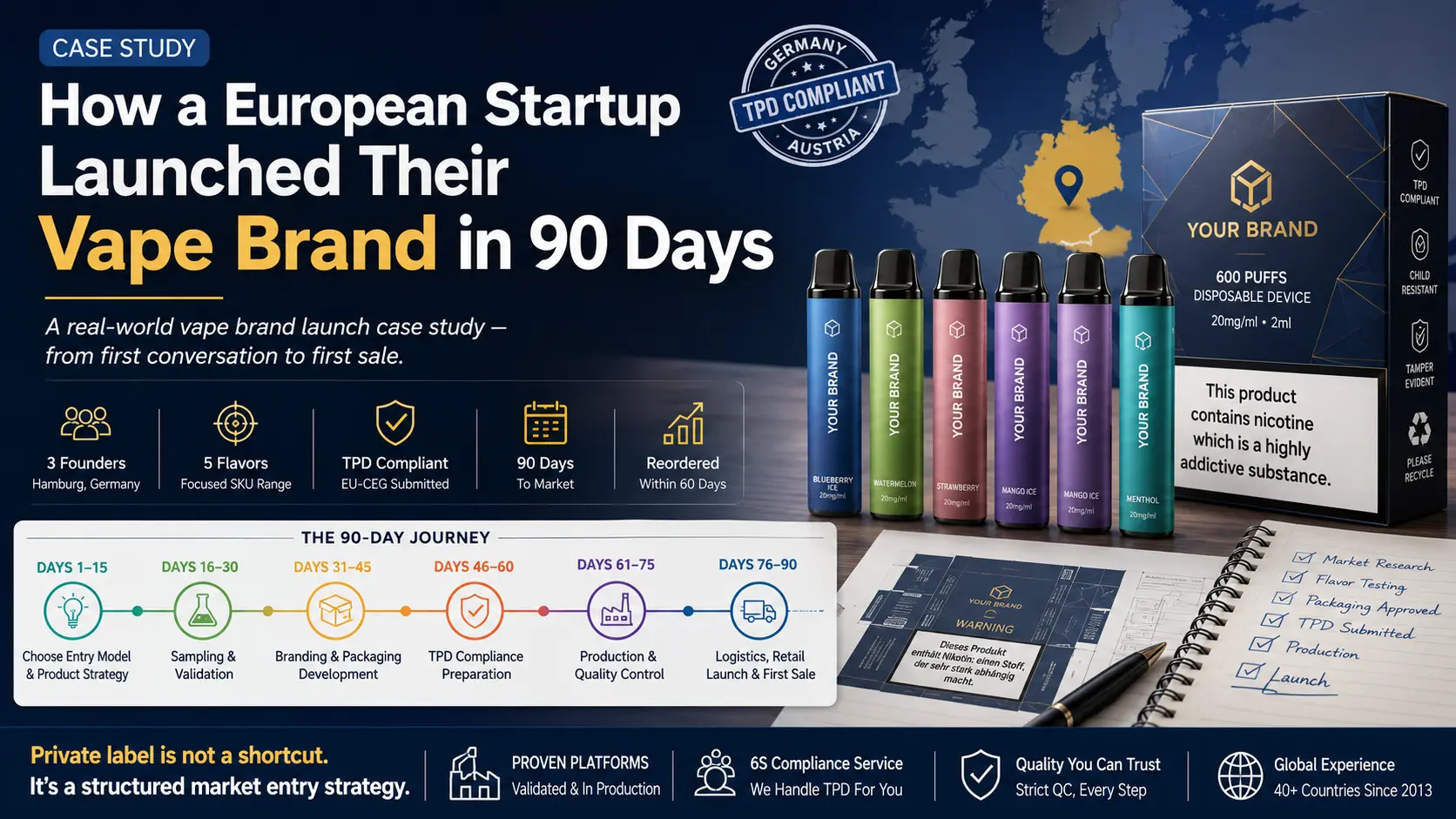
This vape brand launch case study is not a polished success story.
It is a real account of a three-person startup from Germany that went from zero product knowledge to a live market launch in exactly 90 days.
They made mistakes. They revised packaging twice. They almost chose the wrong entry model for their stage of business.
But they launched on time, passed TPD requirements, and placed a second order within 60 days of their first delivery.
If you are researching how other brands have done this, here is the full picture — including the parts most case studies leave out.
The Startup’s Background and Goal
The team consisted of three co-founders based in Hamburg.
One had a background in FMCG retail. One had experience in e-commerce logistics. The third had previously distributed a competitor’s vape brand for two years before deciding to build their own.
Their goal was straightforward:
- Launch their own vape brand for the German and Austrian markets
- Start with a focused SKU range — no more than five flavors
- Achieve shelf presence in at least three regional retail chains within six months
- Keep initial investment below €40,000 including samples, packaging, compliance, and first production
They had no existing supplier relationship and no product development experience.
What they had was market knowledge, a distribution network, and a clear idea of what their target consumer looked like.
The Biggest Challenges Before the Launch
Before contacting any manufacturer, the team spent two weeks mapping their challenges.
This step alone saved them significant time later.
The four challenges they identified were:
- No product experience — they had never selected or evaluated a vape device before
- Tight timeline — they had committed to a retail buyer with a Q3 delivery expectation
- TPD and EU-CEG requirements — they knew compliance was mandatory but did not know where to start
- Packaging uncertainty — they had a brand concept but no idea what a compliant EU package actually required
Most startups skip this mapping phase and jump straight to requesting quotes.
This team did not. That decision made the next 90 days much cleaner.
Days 1–15: Choosing the Right Entry Model
The first two weeks were entirely about strategy — not product selection.
The team had to answer one question before anything else:
Which product entry model fits our situation right now?
After research and early supplier conversations, four options emerged.
White label meant putting their logo on an existing product with minimal packaging changes. Fast to execute, but the same hardware would appear under dozens of other brand names. For a brand building identity in a competitive German retail environment, this offered almost no differentiation.
Private label meant selecting an existing, validated device platform and applying deep customization — brand packaging, flavor portfolio, device color, nicotine options, multilingual labeling, and retail display materials. The core hardware already existed and had production history. But the brand presentation, flavor story, and market positioning would be entirely their own.
ODM meant briefing a manufacturer’s R&D team to develop a new product from scratch — industrial design, structural engineering, private molds, e-liquid formulation, electronics. The result would be a device that did not exist before their brief. More differentiation, but also a longer timeline and higher upfront investment.
OEM meant arriving with completed design files and engineering specifications, then finding a factory to produce to those blueprints. This model assumed an in-house engineering team or a hired product design agency. For a three-person startup, this was not realistic.
The team mapped their situation honestly:
- No engineering capability → OEM ruled out immediately
- No time for 5–9 months of product development → full ODM ruled out for the first launch
- Strong brand and distribution focus → white label too generic
Private label was the clear answer.
Private label let them move fast without sacrificing brand identity. The device platform was already engineered, tested, and in production. They could focus their energy on what they were actually good at: building a brand that German and Austrian retailers would want to stock.
The key insight the team arrived at was this: private label is not a compromise. It is the right entry model when your strength is brand-building and distribution, not hardware development. It sits between white label and ODM — more brand control than simple logo replacement, without the investment timeline of full custom development.
The team connected with Vape ODM Factory during this phase. The initial conversation focused not on pricing but on product fit — which platform would suit their retail channel and price point, and what brand customization depth was possible.
For brands working through this same decision, the private label disposable vape supplier guide covers how to evaluate which entry model fits your brand stage and budget.
Key decisions made by Day 15:
- Entry model: Private label with deep brand, packaging, and flavor customization
- Product type: Existing platform, 600 puff disposable, TPD-compliant 2ml format
- SKU count: 5 flavors (reduced from an initial plan of 9)
- Target nicotine strength: 20mg/ml (EU legal maximum)
- Target markets: Germany and Austria
Reducing from 9 to 5 flavors was not an easy decision.
But with a limited first-order budget, fewer SKUs meant better per-unit economics, simpler inventory management, and a cleaner retail presentation. They could expand the range after reorder data showed which flavors actually sold.
Days 16–30: Sampling and Product Validation
With the product direction confirmed, the team submitted a formal sample request.
Because they were working with a validated existing platform, samples arrived within eight business days. This timeline reflects one of the core advantages of private label: the device is already engineered and in production, so sampling focuses on brand configuration rather than hardware development.
The evaluation process took five days and covered:
- Draw resistance and vapor output
- Flavor accuracy across all five variants
- Battery consistency — no dead-on-arrival units
- Physical durability — cap fit, mouthpiece quality, body finish
- Logo placement and surface print quality
One problem surfaced immediately.
One of the five selected flavors — a mint variant — had an intensity level that was too aggressive for the German retail market based on the team’s consumer research.
They requested a reformulation toward a softer menthol profile.
A revised sample arrived within six days. The second version was approved.
This is the part of the process most case studies skip.
Sample revision is normal. It is not a sign that something went wrong. It is how product validation is supposed to work, and it is a step that private label makes far easier than ODM — because the factory already has an established e-liquid library to draw from.
By Day 30, all five flavors were approved and locked for production.
Days 31–45: Branding and Packaging Development
The team had a brand name, a logo concept, and a color direction before this phase started.
What they did not have was a print-ready packaging file that met EU requirements.
This is where many startups lose weeks — and where the line between private label and white label becomes visible. White label would have meant minimal packaging involvement. Private label meant building a full brand identity across box structure, flavor communication, warning compliance, and multilingual labeling.
EU-compliant vape packaging requires:
- A minimum 30% health warning label area with specific wording
- Nicotine content declaration in a standardized format
- Childproofing and tamper-evident features
- German language content meeting BfR and local labeling standards
- Importer information and batch number formatting
- Recycling and disposal markings for the German market
The first packaging artwork submission failed the internal compliance review.
The warning area was undersized by approximately 4mm on one panel, and the German language warning text was using outdated wording from a pre-2021 format.
The team revised the artwork and resubmitted within three days.
The second version passed.
This process — artwork submission, compliance review, revision, approval — took 12 days total.
By Day 45, finalized packaging files were approved and sent to the print supplier.
Days 46–60: TPD Compliance Preparation
TPD notification is the step that stops most European vape startups cold.
The EU Tobacco Products Directive requires that every vape product sold in an EU member state be notified to the relevant national authority through the EU-CEG portal before it can be sold.
In Germany, the responsible authority is the Bundesministerium für Ernährung und Landwirtschaft (BMEL). The notification process through EU-CEG follows the same pan-European framework but requires country-specific submission routing.
The notification requires:
- Full product composition including all ingredients
- Technical documentation on the device
- Emissions testing data
- Manufacturer declarations
The team had no experience with this process.
Rather than trying to manage it independently, they relied on Vape ODM Factory’s 6S compliance service — a model where the factory handles the full TPD submission process directly, not just advises on it.
This distinction matters.
Many suppliers tell you the product is “TPD-ready” and hand you a folder of documents. A genuine compliance partner actually prepares and submits the notification, manages corrections, and tracks submission status for each target country.
For a detailed breakdown of what TPD compliance involves for European brands, the European Commission’s official TPD guidance is the authoritative reference.
By Day 60, EU-CEG notifications for both Germany and Austria were submitted.
Notification processing timelines vary by member state, but submission by Day 60 gave enough buffer before the target launch date.
Days 61–75: Production and Quality Control
With packaging approved and compliance submissions filed, production began.
First order quantity: 50,000 units across five SKUs (10,000 units per flavor).
This MOQ was deliberately conservative.
The team wanted enough inventory to supply their initial retail accounts without over-committing on flavors that had not yet been market-tested. One advantage of starting with private label rather than ODM is that first-order quantities can stay manageable — there is no mold investment requiring a minimum recovery volume.
Production took 14 days.
Quality control involved:
- Pre-production sample check against approved specification
- In-line inspection at the 20% and 60% production milestones
- Final batch testing: draw resistance, battery performance, leak test, fill weight verification
- Packaging inspection: print accuracy, warning label dimensions, barcode scan test
One packaging batch had a minor print registration issue on the warning label background.
The affected units were pulled before boxing. Reprint and replacement took two days.
This is exactly the kind of issue that never appears in competitor case studies.
It is also the kind of issue that, if missed at this stage, creates serious compliance risk in market.
Days 76–90: Logistics, Retail Onboarding, and Launch
Production completed on Day 75. Shipping began immediately.
The team had pre-arranged an express sea freight option with a 14-day transit time to Hamburg — one of Europe’s largest container ports and the natural entry point for goods destined for the German domestic market.
While the shipment was in transit, the team completed:
- Retail buyer presentations with physical samples
- Point-of-sale material development
- Staff training materials for three retail partner locations in Hamburg and Munich
- Social media content preparation for launch week
The shipment arrived on Day 87. Customs clearance at Hamburg port took one day.
Physical product reached the first retail locations on Day 89.
Official brand launch: Day 90.
First retail sell-through data came in at the end of week two post-launch. Two flavors — a fruit variant and the reformulated menthol — were outperforming the others significantly.
The second production order was placed 58 days after the first delivery.
What the Startup Would Do Differently
This section does not appear in most vape brand launch case studies.
We asked the founding team directly.
Three things they said they would change:
1. Understand the four entry models before the first supplier call.
The team spent nearly four days in their first two weeks researching ODM when private label was always the right answer for their situation. The time would have been better spent on brand brief development and channel planning. Knowing the difference between white label, private label, ODM, and OEM — and being honest about your own capabilities — is the most important strategic decision before anything else.
2. Start TPD preparation earlier.
Even though they hit their timeline, compliance documentation ran alongside packaging development instead of ahead of it. In hindsight, they would start EU-CEG groundwork by Day 20, not Day 46. Both processes can and should run in parallel.
3. Build a compliance document archive from Day 1.
By the end of the 90 days, compliance documents were scattered across email threads, shared drives, and messaging apps. Organizing this from the start would have saved significant time during the EU-CEG submission phase — particularly for the German BMEL routing requirements, and especially as they begin planning flavor extensions for the second order.
Lessons for Other Vape Startups Planning Their Own Launch
This vape brand launch case study is not a template. Every market, team, and product is different.
But several patterns from this experience apply broadly.
Choose your entry model based on your actual strengths.
Private label is the right starting point when your strength is brand-building, retail relationships, and distribution — not hardware engineering. It is a lesser version of ODM. It is the appropriate model for a first launch when you need to validate demand before committing to exclusive tooling and longer development timelines.
White label is faster but offers less differentiation. ODM gives more exclusivity but requires more time and investment. OEM assumes you have engineering capability. Map your situation honestly before choosing.
Use the first launch to collect the data that makes the second launch better.
Private label lets you learn which flavors sell, which channels reorder, and what your customers actually want — before investing in ODM development. The Hamburg team already knew after two weeks of sell-through data which flavors to scale and which to replace. That intelligence is exactly what makes a future ODM brief stronger.
Start with fewer SKUs than you think you need.
New brands consistently overestimate how many flavors they need at launch. Start with three to five. Add based on real sell-through data, not assumptions. Splitting MOQ across too many SKUs ties up capital before you have reorder demand.
Treat compliance as a launch dependency, not a launch afterthought.
EU-CEG notification is not something you file after you have inventory in a warehouse in Frankfurt or Düsseldorf. It should be in progress before production begins. Suppliers that handle submission directly — not just advise on it — remove the biggest single risk in a European timeline.
Partner selection matters more than unit price.
The Hamburg team chose their private label partner based on service capability, compliance support, and communication quality — not the lowest per-unit quote. That decision directly enabled the 90-day outcome.
Brands comparing their options can review our full product catalogue to understand what private label platform options are available for the European market.
Could Your Brand Launch in 90 Days?
This vape brand launch case study demonstrates one thing above all else:
Speed comes from choosing the right model, not from rushing.
The 90-day outcome was possible because the team made an honest assessment of their strengths in week one. They were brand builders and distributors — not hardware engineers. Private label was the right entry model. That clarity removed every false start that kills timelines for new vape brands.
Private label is not a shortcut or a fallback. It is a structured market entry strategy — and the strongest European brands have used it to prove demand before investing in ODM development.
If your team is planning a European vape brand launch — whether in Germany, Austria, or wider DACH region markets — and wants to understand what a realistic private label timeline and budget looks like for your specific situation, contact our team directly.
We work with new brands at the earliest stage — before product selection, before packaging, and before compliance. That is where the most important decisions happen.
Vape ODM Factory has supported private label and ODM vape brand launches across 40+ countries since 2013. Our production capacity, in-house compliance team, and full product catalogue are structured specifically for brands building from zero. You handle sales — we handle everything else.
The 90-day path exists. Whether it is right for your brand depends on your market, your timeline, and your willingness to make fast, well-informed decisions.