Most brands get burned not at mass production — but at the sample stage. They receive a prototype that looks polished, performs well in the hands, and passes a quick taste test. So they approve it, place the order, and discover three months later that the mass production batch draws differently, leaks under shipping conditions, or fails EU-CEG ingredient documentation requirements.
A vape ODM sample request is not a formality. It is your only real window into whether a factory can deliver what it promises — and whether the product you’ve designed on paper can actually be manufactured at scale. This guide covers what to prepare before you submit, what the factory does with your brief internally, how to distinguish between sample types, and how to evaluate what arrives on your desk with enough rigor to make a real go/no-go decision.
What Is a Vape ODM Sample Request?
A vape ODM sample request is a formal brief submitted to an ODM manufacturing partner asking them to develop a physical prototype of your product concept. Unlike a white-label inquiry — where you pick an existing product off a shelf — an ODM sample request initiates actual engineering work. The factory assigns R&D resources, reviews feasibility, and builds something that doesn’t exist yet.
The sample exists to answer one question before you commit capital: does this product work the way it needs to work, for the market it’s going into?
That question has more layers than most new brands expect. It includes hardware performance, flavor delivery consistency, structural integrity under stress, packaging compliance, and manufacturability at the volumes you’re planning. A prototype that answers all of those questions well is rare on the first attempt. That’s normal — and it’s the point.
Why Your First Prototype Matters More Than Most Brands Realize
The first prototype is not designed to prove your concept works. It’s designed to reveal where it doesn’t.
This framing matters because brands that approach the sample stage expecting a finished product make expensive decisions based on incomplete information. A factory that produces beautiful first samples without surfacing any problems should make you more skeptical, not less. Real engineering produces real tensions — between form and function, between flavor intensity and TPD ingredient limits, between draw resistance and coil longevity.
The brands that launch successfully in competitive European markets are almost always the ones that treated their first vape ODM sample request as a diagnostic exercise. They came in with specific questions. They tested against defined criteria. They gave structured feedback. And they expected to iterate.
For a deeper look at how the full ODM development process works before you reach the sample stage, the vape ODM manufacturer guide walks through the entire brief-to-production cycle.
What to Prepare Before Submitting a Vape ODM Sample Request
Factories produce better samples when they receive better briefs. Vague requests produce vague results. Here’s what to prepare before you submit.
Product concept and format
Specify the device category: disposable, closed pod system, refillable pod, or replacement cartridge. Include the form factor direction — slim pen, box shape, ergonomic grip — and any reference products or design directions. If you have brand guidelines, share them. If you don’t, a short description of your target aesthetic is enough to start.
Target market and regulatory requirements
This is the input most brands forget to include — and it has the most downstream consequences. For EU markets, the 2ml tank limit, 20mg/ml nicotine cap, and TPD ingredient restrictions affect structural engineering decisions made during the prototype phase. A sample built without this specification can look and perform perfectly while being structurally non-compliant.
State your target countries explicitly. If you’re entering Germany, France, and the Netherlands simultaneously, those markets have different notification requirements and the factory needs to know that before engineering decisions are locked.
Performance requirements
Define what success looks like technically:
- Puff count target (and whether that’s at 2ml fill or a different volume)
- Draw resistance preference (tight MTL, loose MTL, or DTL)
- Battery capacity requirements and charging spec (USB-C, capacity in mAh)
- Nicotine format (freebase or nicotine salt) and concentration
- Flavor profile direction (tobacco, menthol, fruit, or specific reference)
Branding and packaging requirements
Specify how much brand customization you want on the hardware: device color, mouthpiece shape, surface texture, logo placement. For packaging, note your target markets — this determines health warning language and format requirements. If you have existing brand assets (logo files, color codes), attach them.
The 4 Types of Vape ODM Samples — and What Each One Is Actually For
This is where most factory FAQ pages stop at “we’ll send you a sample.” In practice, there are four distinct prototype types in the ODM development cycle, each designed to answer different questions. Knowing which one you’re requesting — and what it can and can’t tell you — prevents a lot of misaligned expectations.
Type 1: Concept sample
A concept sample validates the industrial design direction before any tooling investment. It’s typically produced from existing mold components or 3D-printed parts with cosmetic finishing applied. The form factor, dimensions, ergonomics, and surface treatment are representative — but internal components may be placeholder hardware.
Use it for: visual direction sign-off, ergonomic feedback, color and finish decisions.
Don’t use it for: performance testing, compliance verification, or any engineering validation.
Type 2: Engineering sample
The engineering sample uses production-intent hardware in a prototype shell. This is where draw resistance, vapor output, battery performance, and leak resistance are tested for the first time under real conditions. The external finish may not be final, but every internal system should be representative of what mass production will deliver.
This is the most important sample type for technical validation. If an engineering sample has inconsistent draw resistance or flavor degradation after 200 puffs, those problems won’t resolve themselves in production — they’ll scale.
Type 3: Compliance sample
A compliance sample is built specifically to support regulatory submission. For EU markets, this means the e-liquid formulation is finalized with complete CAS number documentation, the nicotine concentration is confirmed at or below 20mg/ml, the tank capacity is verified at or below 2ml, and the packaging artwork carries the correct health warnings in the correct format.
This sample goes to the lab, not just to you. Emissions testing, toxicological assessment, and ingredient review all require a compliance-ready unit. Skipping this type — or conflating it with the engineering sample — is the most common reason TPD filings fail.
At Vape ODM Factory, compliance review runs in parallel with mold development rather than sequentially after it. This is part of how the 6S service system keeps launch timelines realistic for European brands.
Type 4: Pre-production sample (PPS)
The pre-production sample is built from final production tooling, using the exact materials, components, and processes that mass production will use. It’s the last checkpoint before the factory commits to a full production run.
A PPS that passes means: the product is manufacturable, the QC criteria are defined, and the factory can produce consistent units at volume. This is the sample that should trigger your purchase order — not the engineering sample, and definitely not the concept sample.
What Happens After You Submit a Vape ODM Sample Request
Most brands submit their brief and wait. Understanding what happens internally on the factory side helps you ask better questions and identify warning signs early.
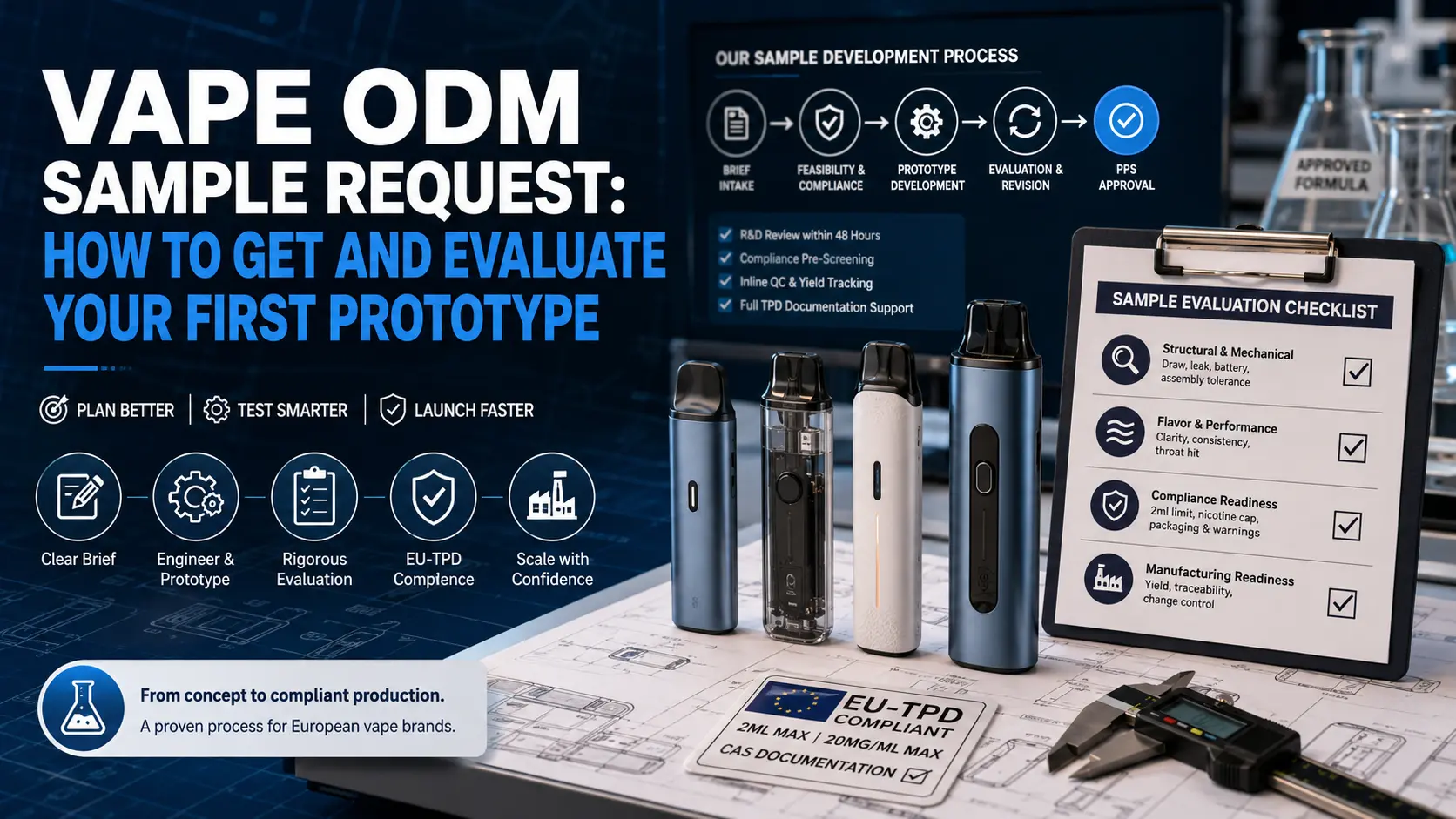
When a vape ODM sample request arrives at Vape ODM Factory, the project management team routes it through a structured intake process:
Requirement review and feasibility analysis
The R&D team reviews the brief against existing capabilities and target market requirements. If the brief specifies a 2ml fill with 600+ puffs for the EU market, the engineering team evaluates whether that’s achievable with the coil resistance and battery capacity proposed — not after production starts, but before tooling decisions are made.
If there’s a conflict between the brief and what’s technically feasible, this is when it surfaces. A factory that doesn’t flag feasibility issues at this stage is either not reviewing the brief carefully or not communicating what it finds.
Compliance pre-screening
For EU-bound products, the regulatory team reviews the target market specification against TPD requirements before engineering planning begins. This catches issues like restricted flavor compounds, nicotine format incompatibilities, or structural elements that would fail the 2ml verification test.
This step doesn’t replace formal compliance testing — but it prevents the factory from investing engineering time in a product architecture that would fail regulatory review anyway.
Prototype scheduling and development
Once the brief is confirmed and feasibility is established, prototype development is scheduled. Timeline depends on sample type: a concept sample from existing components can be ready in 5–7 days. An engineering sample with custom elements typically takes 2–3 weeks. A fully custom prototype requiring new mold work — the kind that comes before a PPS — runs approximately 35 days from tooling start to approved samples.
How to Evaluate Your First Vape Prototype
This is the section most guides skip. They tell you to “check quality” and move on. Here is an evaluation framework that actually surfaces the information you need.
Structural and mechanical checks
- Draw consistency: test 10+ draws in sequence. Resistance should be uniform, with no airflow variance between draws
- Leak resistance: fill the device to capacity, invert it for 30 minutes, and apply light pressure. No e-liquid should appear at the mouthpiece or airflow vents
- Assembly tolerance: check seam alignment, component fit, and mouthpiece attachment force. Loose tolerances in samples scale to defects in production
- Battery discharge: run the device to empty and measure actual puff count against the specification. A 15% variance is acceptable; anything beyond that needs investigation
Flavor and sensory performance
- Flavor clarity on first draw: the first puff should deliver the intended flavor profile, not a bland or muted version
- Flavor consistency across puff count: test at 10%, 50%, and 90% of rated capacity. Significant degradation before 80% of rated puffs indicates a coil or wicking issue
- Throat hit consistency: relevant if you’re targeting a smoker-transition consumer segment. Inconsistent throat hit correlates to inconsistent nicotine delivery
Compliance readiness checks
Before you evaluate aesthetics, verify these non-negotiable structural requirements for EU market entry:
- Confirm fill volume at or below 2ml (use a syringe to measure, not just the spec sheet)
- Confirm nicotine concentration matches the lab documentation (request the test certificate)
- Verify child-resistant packaging mechanism functions correctly under repeated use
- Check health warning placement, size, and language accuracy for each target country
Manufacturing readiness indicators
A good-looking sample doesn’t mean a manufacturable product. Ask the factory for:
- Yield rate from the prototype run (what percentage of units passed QC)
- Material traceability documentation (where do the cells, coils, and e-liquid come from)
- Change control record from brief to sample (what was modified and why)
For European brands, the EU TPD compliance requirements apply at this stage — not just at production. The sample evaluation phase is when you verify structural compliance, not when you assume it.
Common Mistakes When Reviewing a Vape Prototype
Evaluating aesthetics before performance
Color and finish decisions are reversible. Coil architecture and airflow engineering are not. Start your evaluation with mechanical and performance testing. Aesthetic feedback comes after the product works.
Treating the engineering sample as a production commitment
An engineering sample passing your evaluation does not mean the product is production-ready. It means the engineering concept is sound. You still need a pre-production sample built from final tooling before you can assess manufacturability with confidence.
Skipping the compliance checklist
Every vape ODM sample request for the European market should include a compliance verification step. Brands that skip this during sampling and discover non-compliance issues after production are looking at reformulation costs, repackaging, and a restarted TPD notification timeline. That’s a 6-month delay at minimum.
Giving vague feedback
“The flavor isn’t quite right” tells an engineering team nothing actionable. “The fruit note is present on the first draw but fades significantly by puff 150 — we need consistency maintained to at least puff 400” gives them a specific target to engineer toward. The quality of your revision feedback determines the quality of the next sample.
Testing only one unit
Request at least 5–10 units per sample batch. Evaluating a single unit tells you about that unit, not about the sample run. Variance across units reveals whether the factory’s prototype process is controlled — and gives you an early signal about what mass production consistency will look like.
How to Give Useful Revision Feedback to Your Factory
Revision rounds are normal. Most products go through 2–3 sample iterations before a PPS is approved. What matters is the quality of feedback you provide at each round.
Structure your feedback around three categories:
Must-fix (production blockers)
Issues that directly affect compliance, safety, or core performance. These must be resolved before the next sample. Examples: fill volume exceeds 2ml, battery fails to reach rated capacity, leak resistance fails under inversion test.
Should-fix (quality improvements)
Issues that affect brand experience but don’t block production. Examples: flavor degradation before rated puff count, draw resistance slightly tighter than brief specification, surface finish inconsistency.
Nice-to-have (optional refinements)
Aesthetic or preference adjustments that don’t affect performance. Examples: slight shift in device color tone, mouthpiece edge radius preference, packaging structural refinement.
Document each issue with a category, a description, and a target specification where possible. Send photos or video for visual issues. A factory that receives structured feedback can prioritize correctly — a factory that receives “make it better” has to guess.
Vape ODM Sample Request Timeline: What to Realistically Expect
| Sample Type | Timeline from Brief Confirmation | Notes |
|---|---|---|
| Concept sample (existing mold) | 5–7 working days | Visual direction only |
| Engineering sample (semi-custom) | 2–3 weeks | Performance testing ready |
| Full custom prototype (new tooling) | ~35 days | Includes mold development |
| Compliance sample | 2–4 weeks (lab testing) | Runs parallel to mold dev |
| Pre-production sample | 1–2 weeks after tooling approval | Final production validation |
These timelines assume a clean brief and no major feasibility issues. Briefs that require multiple feasibility clarifications before engineering can begin add days to every stage. Submit a complete brief the first time.
Compliance testing for EU-CEG submission should be initiated during the mold development phase — not after the PPS is approved. A factory that treats compliance as a post-sample step is adding months to your actual market entry timeline, regardless of how fast the sample arrives.
What Happens After Your Sample Is Approved
Sample approval triggers production planning — but a few things need to be confirmed before the factory can schedule a run.
Your purchase order specifies quantity, SKU breakdown, and requested delivery date. For first-time orders, production lead time for a standard run at Vape ODM Factory’s 9-million-unit monthly capacity is typically 2–3 weeks for orders between 50,000 and 200,000 units.
Packaging artwork must be finalized and compliance-checked before production begins. If you’re entering multiple EU markets, that means verified health warning translations, correct nicotine labeling in each language, and child-resistant packaging certification confirmed.
TPD notification, if not already submitted, needs to start now — the 6-month statutory waiting period cannot be shortened. If you’ve followed the parallel compliance approach and filed during mold development, you may already be 6–8 weeks into the notification period by the time production is scheduled.
For a detailed breakdown of what the full production process looks like after sample approval, the turnkey vape manufacturing guide covers every stage from production planning to European warehouse delivery.
How Vape ODM Factory Handles Your Sample Request
Submitting a vape ODM sample request to Vape ODM Factory initiates a structured process — not a form acknowledgment followed by silence. The 6S service system coordinates R&D, compliance, and QC teams from the moment a brief is received.
What this means practically:
- Your brief is reviewed by the R&D team for feasibility within 48 hours of submission
- Compliance pre-screening against your target market’s regulations happens before tooling begins
- You receive a written project specification — with timelines and technical parameters — before any prototype work starts
- Sample batches go through inline QC checks before shipment, with documented yield rates
- Revision feedback is tracked in a change log so that each iteration is traceable
Vape ODM Factory has operated from Dongguan since 2013, with 500+ staff and a national-standard certified laboratory running in-house emissions and ingredient testing. For European brands, that means compliance documentation for TPD submission is generated internally — the same team that built the sample produces the regulatory paperwork for it.
You can review the full product development range to understand what formats are available, or submit your brief directly to start the feasibility review.
The Only Metric That Matters When Evaluating a Prototype
A vape ODM sample request that leads to a thorough evaluation process is one of the highest-leverage activities in your product launch. It’s where engineering decisions get validated before they become expensive production realities.
The question is not “is this a good sample?” The question is: “does this sample tell me enough to commit capital to mass production?” That’s a harder standard — and it’s the right one.
If the engineering checks out, the compliance structure is verified, and the factory can show you a controlled, traceable sample process, you have what you need. If any of those three elements are missing, that’s what revision rounds are for.
A vape ODM sample request is not the end of the process. It’s the beginning of the production relationship. How a factory handles your prototype development tells you more about what the next two years of working together will look like than any sales conversation will.