A vape ODM factory red flag doesn’t announce itself. It doesn’t appear in the first WhatsApp message or the polished catalogue PDF. It surfaces later — when the samples don’t match production, when the TPD filing stalls because documentation is incomplete, or when you discover your “exclusive” mold is producing units for three other brands in neighboring markets.
The brands that avoid these outcomes share one behavior: they evaluate factories against specific warning signs before they commit capital. They don’t rely on sales conversations. They rely on structured due diligence that surfaces risks while there’s still time to walk away.
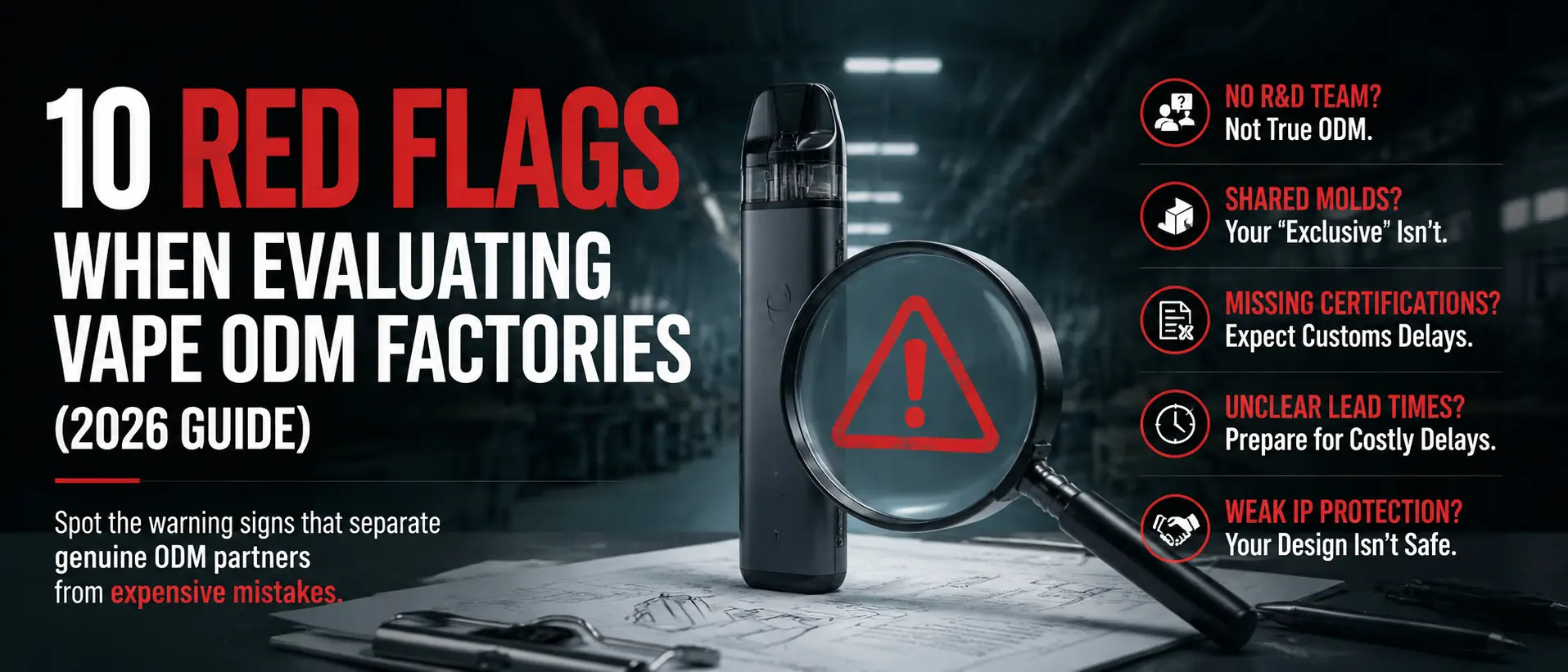
This guide covers ten specific vape ODM factory red flags, ranked by severity — from deal-breakers that should end a negotiation immediately to warning signs that demand deeper investigation. Each one includes what the red flag looks like in practice, what it actually costs if you miss it, and how to test for it before you sign anything
What Is a Vape ODM Factory — And Why Getting This Wrong Is Expensive
Before identifying red flags, you need to know what a genuine ODM factory actually looks like. The term is used loosely in the vape industry, and the gap between what’s claimed and what’s delivered is where most sourcing failures begin.
An ODM (Original Design Manufacturing) vape factory does more than manufacture. It maintains an in-house R&D team capable of developing products from scratch — industrial design, structural engineering, e-liquid formulation, mold development, electronics integration, and compliance testing. When you submit a product brief, the factory’s engineering team translates it into a manufacturable device with private tooling assigned exclusively to your brand in your designated market.
This is categorically different from what most factories calling themselves “ODM” actually offer. The private label disposable vape supplier guide explains the full spectrum — from white label (logo on existing product) through private label (brand customization on a validated platform) to genuine ODM (new product developed from your brief). Understanding this spectrum is the foundation for recognizing when a factory is misrepresenting its capabilities.
Vape Factory Maturity Levels: A Framework for Spotting Misrepresentation
Most vape ODM factory red flags become visible when you map a supplier against a maturity model. Here is a four-level framework that the industry doesn’t use openly but that experienced buyers apply instinctively.
Level 1 — Trading Company
No production capability. No R&D. No mold workshop. The business sources products from multiple factories, applies your logo, and handles export paperwork. They present factory photos that aren’t theirs. When you ask technical questions, they forward them to someone else and paraphrase the response.
Level 2 — White-Label Assembly Factory
Owns production lines but no R&D capability. Produces devices using shared public molds available to any buyer. Customization is limited to logo, color, and packaging. When you ask about modifying the device structure, they offer excuses rather than engineering solutions.
Level 3 — OEM Production Factory
Can manufacture to your specifications if you provide complete design files. Has some engineering capability for production optimization but cannot develop a product from a concept brief. Suitable when you already have in-house design resources.
Level 4 — True ODM Factory
Maintains in-house industrial design, structural engineering, mold development, e-liquid formulation, and compliance testing. Can take a written brief and return a finished, certified product. Assigns private molds exclusively to one brand per territory. Holds its own certifications and laboratory.
A factory operating at Level 1 or 2 while marketing itself as Level 4 is the most fundamental vape ODM factory red flag. Everything else on this list is downstream of this misrepresentation. For a deeper framework on how to distinguish these levels during supplier evaluation, the complete guide to evaluating vape ODM factories covers the verification process step by step.
10 Vape ODM Factory Red Flags (Ranked by Severity)
These are not theoretical risks. Each one represents a failure pattern that has cost real brands real money — delayed launches, seized shipments, reformulated products, and in several cases, complete market exits after a single failed production run.
The red flags are organized into three tiers:
- Critical (Red): Deal-breakers. Walk away.
- High Risk (Orange): May be resolvable with contract terms and verification — but treat as serious indicators.
- Warning Signs (Yellow): Demand deeper investigation before committing.
CRITICAL RED FLAGS
Red Flag 1: Catalog-Only “ODM” — No R&D Team, No Mold Development
This is the most common vape ODM factory red flag and the most expensive to discover late. The factory presents itself as an ODM partner but cannot show evidence of in-house R&D capability. Their “product development” process consists of showing you existing catalog items and offering color or logo changes.
How to test for it: Ask to see three products the factory’s R&D team developed from a client brief — with concept sketches, mold development records, and final production samples. A genuine ODM factory can produce this within one business day. A white-label operation will deflect, delay, or send a catalog PDF instead.
Real cost of missing this: You invest months in “product development” that is actually just catalog selection. You launch with a device that fifteen other brands are selling. Your pricing power collapses. Your brand differentiation never materializes. The mold you thought was yours was never yours.
Red Flag 2: No Compliance Infrastructure — TPD Is “Something We Can Support”
For European market entry, TPD compliance is not a form you fill out at the end. It’s a product requirement that affects e-liquid formulation, device specification, packaging design, and your legal ability to sell in any EU member state. A factory that treats compliance as a post-production checkbox rather than an embedded development function is a vape ODM factory red flag that will delay your launch by months.
How to test for it: Ask the factory to show you a complete EU-CEG submission package from a recent client — redacted for confidentiality, but showing the submission date, the notified member states, the emissions test report, and the toxicology documentation. Then ask whether they submit directly from their own EU-CEG account or advise you to find a third-party consultant.
Red Flag 3: No Mold Ownership Clarity — “We Handle That Internally”
Mold ownership is the most contentious issue in vape ODM relationships — and the one most brands don’t discover is a problem until they try to move production. A factory that won’t provide a written mold ownership agreement with territorial exclusivity terms is not treating your tooling investment as your asset.
How to test for it: Ask directly: “If I move production to another factory after 18 months, can I take the mold with me, and what is the documented process for doing so?” A credible factory provides a written answer with a defined process. A problematic one says “we’ll discuss that when the time comes” or implies transferring molds is not possible.
Real cost of missing this: You pay €10,000–€30,000 for tooling. You discover your “exclusive” device is being produced for a competitor in an adjacent market. When you try to move production, you’re told the mold “belongs to the factory.” You pay for tooling twice.
HIGH-RISK RED FLAGS
Red Flag 4: Certifications That Can’t Be Verified Through the Issuing Body
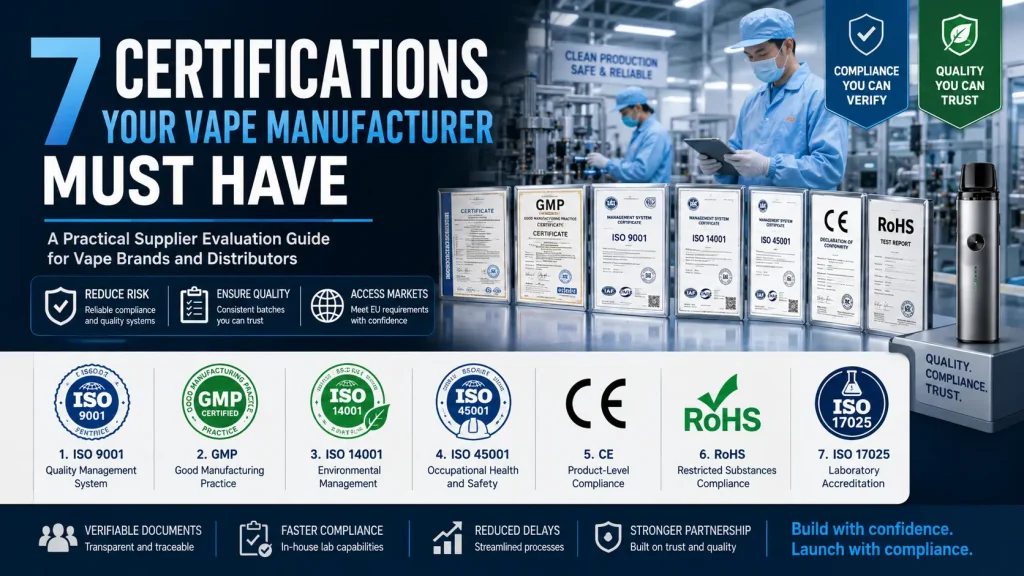
A PDF certificate proves nothing. Most ISO certificates, GMP certifications, and CE declarations can be verified through the issuing body’s public database within minutes. A factory that provides certificates but resists independent verification is a vape ODM factory red flag that usually indicates either expired credentials or fabricated documentation.
How to test for it: Take the certificate number. Look up the issuing body’s online register. Enter the number. Verify that the company name, scope, and validity dates match exactly. This takes five minutes. If the factory can’t provide verifiable certificate numbers, treat all compliance claims as unverified until independently confirmed.
The certifications for vape manufacturer guide covers which credentials matter, what they should look like, and how to run a verification process that takes about thirty minutes per supplier.
Red Flag 5: No Documented Quality Control System or Defect Data
When you ask about QC, the factory says “we have strict quality control.” When you ask for defect rate data, they can’t produce it. When you ask about their inspection process, the answer is vague. This is a vape ODM factory red flag that signals either no formal QC system or a system that exists on paper but not in practice.
How to test for it: Ask for documented defect rates for the last three production runs of a product similar to yours. Ask for the AQL sampling standard they use. Ask what happens when a batch fails inspection. A factory with real QC infrastructure answers all three questions with specific numbers and documented procedures.
Red Flag 6: Pricing 30–40% Below Market With No Clear Explanation
Vape manufacturing costs are relatively transparent. Battery cells, e-liquid ingredients, coil materials, and packaging all have known cost ranges. A factory quoting well below market is not more efficient — they’re cutting costs somewhere. The most common areas: B-grade battery cells instead of A-grade, nicotine from undocumented sources, coil wire of inconsistent quality, or filling lines without precision calibration.
How to test for it: Ask the factory to break down the unit cost by component — battery, e-liquid, coil, housing, packaging, labor. A legitimate factory can provide this breakdown. A factory that can’t or won’t is either hiding margin or doesn’t understand its own cost structure well enough to be a reliable partner.
Red Flag 7: Hidden Subcontracted Production
The factory you’re negotiating with is not the factory that will produce your order. They outsource coil winding, or e-liquid filling, or final assembly to a third party — and they don’t disclose this. When quality problems emerge, they have no direct control over the process that caused them.
How to test for it: Ask directly: “Is any part of production — coil winding, battery assembly, e-liquid filling, packaging — performed by a subcontractor?” Then ask to visit the subcontractor’s facility. A factory with nothing to hide will disclose subcontracting relationships. One that’s evasive has something to hide.
WARNING SIGNS
Red Flag 8: Vague or Shifting MOQ Without Commercial Logic
MOQ should be driven by production economics — mold amortization, production line setup, minimum material purchases. A factory that quotes 5,000 units one week and 20,000 the next without any change in the product specification is either making up numbers or optimizing for their production schedule rather than your commercial needs.
Red Flag 9: Slow or Inconsistent Communication During the Evaluation Phase
How a factory communicates before you place an order is the best indicator of how they’ll communicate when there’s a production problem. Slow responses, answers that don’t address the question asked, and shifting points of contact during the evaluation phase are all vape ODM factory red flags that predict a difficult relationship.
Red Flag 10: No European Client References You Can Verify
A factory claiming European market experience should be able to provide references — even if confidential, even if anonymized. A factory that has never supported a European brand’s TPD submission, packaging review, or market entry is learning on your project. That learning curve costs time and creates compliance risk.
Compliance Red Flags Specific to European Market Entry
Beyond the general vape ODM factory red flags above, European market entry carries its own set of warning signs. These are the ones that manifest at customs, not at the factory.
TPD ignorance disguised as confidence
The factory says they “fully support TPD” but can’t explain the difference between EU-CEG notification and UK MHRA registration. They don’t know that Italy requires separate ISS notification. They’re unaware that the Netherlands enforces packaging compliance at retail level. These aren’t minor knowledge gaps — they’re indicators that the factory has never actually managed a multi-country EU launch.
If you’re navigating TPD requirements for the first time, the TPD compliance guide for European market entry covers the full notification timeline, required documentation, and the member state variations that catch first-time entrants.
Missing emission test data for notified products
Every TPD notification requires emissions testing from an accredited laboratory. A factory that claims TPD experience but can’t produce test reports for similar products is a vape ODM factory red flag specific to EU compliance. The test report exists or it doesn’t.
Packaging that would fail in multiple EU markets
A factory sends you packaging samples with English-only health warnings and tells you “this works for Europe.” It doesn’t. Germany requires German-language warnings. France requires French. A packaging file that passes in one member state fails in another. A factory that doesn’t flag this is not doing compliance review.
For the full packaging compliance framework, the TPD compliant vape packaging guide covers health warning dimensions, language requirements, and the structural constraints that affect box design.
How to Vet a Vape ODM Factory: A Practical Verification Sequence
Identifying vape ODM factory red flags is only useful if you have a structured process for acting on them. Here is a verification sequence that experienced buyers use before committing capital.
Phase 1: Document Verification (Week 1)
- Request business license and cross-reference registered address with factory location
- Request all certifications with issuing body details and verification numbers
- Verify every certificate independently through the issuing body’s database
- Request compliance documentation from a recent EU shipment
- Request mold ownership policy in writing with territorial scope and breach terms
Phase 2: Capability Assessment (Week 1–2)
- Request evidence of in-house R&D capability — team size, development examples, mold workshop photos
- Request documented defect rates and QC procedures for a similar product
- Request a complete cost breakdown by component
- Ask the 5-point ODM test questions (see next section)
Phase 3: Live Verification (Week 2–3)
- Conduct a live video factory tour — not a pre-recorded walkthrough
- Request to see current production lines, not staged demonstration areas
- Speak directly with the QC manager and the R&D lead
- If possible, arrange a third-party audit for independent verification
A factory that passes all three phases without triggering any of the red flags in this article is worth shortlisting. One that fails at Phase 1 should not proceed to Phase 2.
The 5-Point Test: Is This Really an ODM Factory?
These five questions cut through marketing claims and reveal whether a factory has genuine ODM capability or is repackaging catalog products.
- “Show me a product your R&D team developed from a client brief — not from an existing catalog item. Show me the concept sketches, the mold development records, and the final production sample.”
- “What is your mold exclusivity policy in writing? Can you guarantee that my mold produces units only for my brand in my designated markets?”
- “Do you submit EU-CEG TPD notifications directly under your own account, or do you advise clients to find a consultant?”
- “What is your documented defect rate for the last three production runs, and what is your process when a batch fails QC?”
- “Can I visit your factory — not a showroom, not an office, but the actual production floor — and speak with your QC manager and R&D lead directly?”
A factory’s answers to these five questions separate genuine ODM partners from everything else. Deflection, delay, or vague reassurance on any of them is a vape ODM factory red flag that warrants walking away.
Good Answer vs Bad Answer: What Factory Responses Actually Mean
Most guides list questions to ask. Few explain what a strong answer sounds like versus a weak one. Here are real patterns from actual supplier evaluations.
| Question | Weak Answer | Strong Answer |
|---|---|---|
| “Who owns the mold?” | “We handle mold management internally.” | “The mold is registered to your brand for [specific countries] with a minimum [X]-year exclusivity term. Here’s the clause in our contract.” |
| “Do you handle TPD?” | “Yes, we support TPD compliance.” | “We file EU-CEG notifications directly under our account on behalf of clients. Here’s a redacted submission confirmation from a recent German market entry.” |
| “What’s your defect rate?” | “Very low, we have strict quality control.” | “0.8% across the last three production runs for [similar product]. Here are the batch QC reports.” |
| “Can I visit the factory?” | “We can arrange a showroom visit.” | “You’re welcome to tour the production floor. We can also arrange a third-party audit through SGS or TÜV if you prefer independent verification.” |
The pattern is consistent: weak answers use general assurances and passive language. Strong answers use specific data, documented processes, and verifiable references. When you hear a weak answer, ask the follow-up question immediately. If the second answer is also vague, that’s a confirmed vape ODM factory red flag.
Vape ODM Supplier Evaluation Scorecard
Here is a practical scoring system for comparing factories. Rate each dimension from 0–100 based on documented evidence, not sales conversations.
| Evaluation Dimension | Weight | What to Score |
|---|---|---|
| Compliance capability | 30% | TPD filing experience, lab testing, documentation quality |
| R&D and mold ownership | 25% | In-house R&D team, mold exclusivity policy, development examples |
| Quality control system | 20% | Documented QC procedures, defect data, certifications verified |
| Production capacity | 15% | Monthly output, scalability, lead time consistency |
| Communication and support | 10% | Response quality, English proficiency, account management |
A factory scoring below 60 on any individual dimension warrants serious investigation. A factory scoring above 80 across all dimensions, with verified documentation for every claim, is worth shortlisting. The compliance dimension carries the highest weight for European brands because a compliance failure doesn’t reduce your margin — it blocks your market access entirely.
The Real Cost of Ignoring Vape ODM Factory Red Flags
A vape ODM factory red flag that’s visible during evaluation and ignored during sourcing doesn’t disappear. It compounds. Here is what that compounding looks like in practice.
You choose a factory that quoted 25% below market. They can’t produce emissions test reports. They say they “support TPD” but mean they’ll email you a document package and you handle the rest. You file the notification yourself with incomplete ingredient data. It’s rejected. The six-month clock restarts.
Meanwhile, production is already running. The units arrive at your warehouse. You can’t legally sell them because the notification period hasn’t elapsed. Your distributor has shelf space reserved for a launch window that’s now closed. Your working capital is tied up in inventory that can’t move.
The €0.30 per unit you saved on the factory quote has now cost you six months of market absence, a damaged distributor relationship, and a restarted compliance process that will cost €3,000–€5,000 in additional testing and filing fees.
This is not a worst-case scenario. It’s a composite of real experiences from European brands that prioritized unit price over compliance infrastructure during supplier selection.
Pre-Contract Checklist: 10-Point Verification Before You Sign
Run through this checklist before committing to any vape ODM factory. Every item corresponds to a red flag or verification step covered in this guide.
- Business license verified and physical address confirmed
- ISO 9001, ISO 14001, and GMP certifications verified through issuing body databases
- In-house R&D team confirmed — development examples provided, not just catalog products
- Mold ownership policy documented in writing with territorial exclusivity terms
- TPD compliance capability confirmed — EU-CEG submission examples provided
- Emissions test reports for similar products reviewed
- Defect rate data and QC procedures documented
- Component cost breakdown provided and pricing is within market range
- Subcontracting disclosure received in writing
- European client references provided and verifiable
A factory that passes all ten items is rare. One that passes most, with documented explanations for any gaps, is worth serious consideration. One that can’t provide evidence for more than three or four items is a vape ODM factory red flag in itself — walk away.
The Factory You Don’t Choose Is Sometimes the Best Decision
Screening for vape ODM factory red flags is not about finding the perfect supplier. It’s about eliminating the ones that will create problems you can’t afford to fix. Every red flag in this article represents a real cost — a delayed launch, a seized shipment, a restarted compliance process, a lost distribution relationship.
The brands that move fastest through European market entry are not the ones that found the cheapest factory. They’re the ones that recognized the red flags early, walked away from suppliers who couldn’t support their compliance requirements, and committed only after verifying capability through a structured process.
Vape ODM Factory has been operating from Dongguan since 2013, with 500+ employees, 9 million units monthly capacity, and a regulatory team that handles TPD compliance directly on behalf of client brands. The 6S service system was built specifically so that European brands don’t need to become factory auditing experts — the infrastructure is there, verifiable, and documented.
If you’re evaluating suppliers for a European vape launch, you can review the product range to understand what ODM-developed platforms are already available, or submit your project brief to start the evaluation conversation. The first red flag to avoid is committing without verifying. Everything else follows from there.