When buyers search for certifications for vape manufacturer credentials, they are usually not buying products anymore. They are filtering suppliers. The real question behind the search is straightforward: is this factory actually capable of delivering consistent, compliant product to my market — or is it just claiming to be?
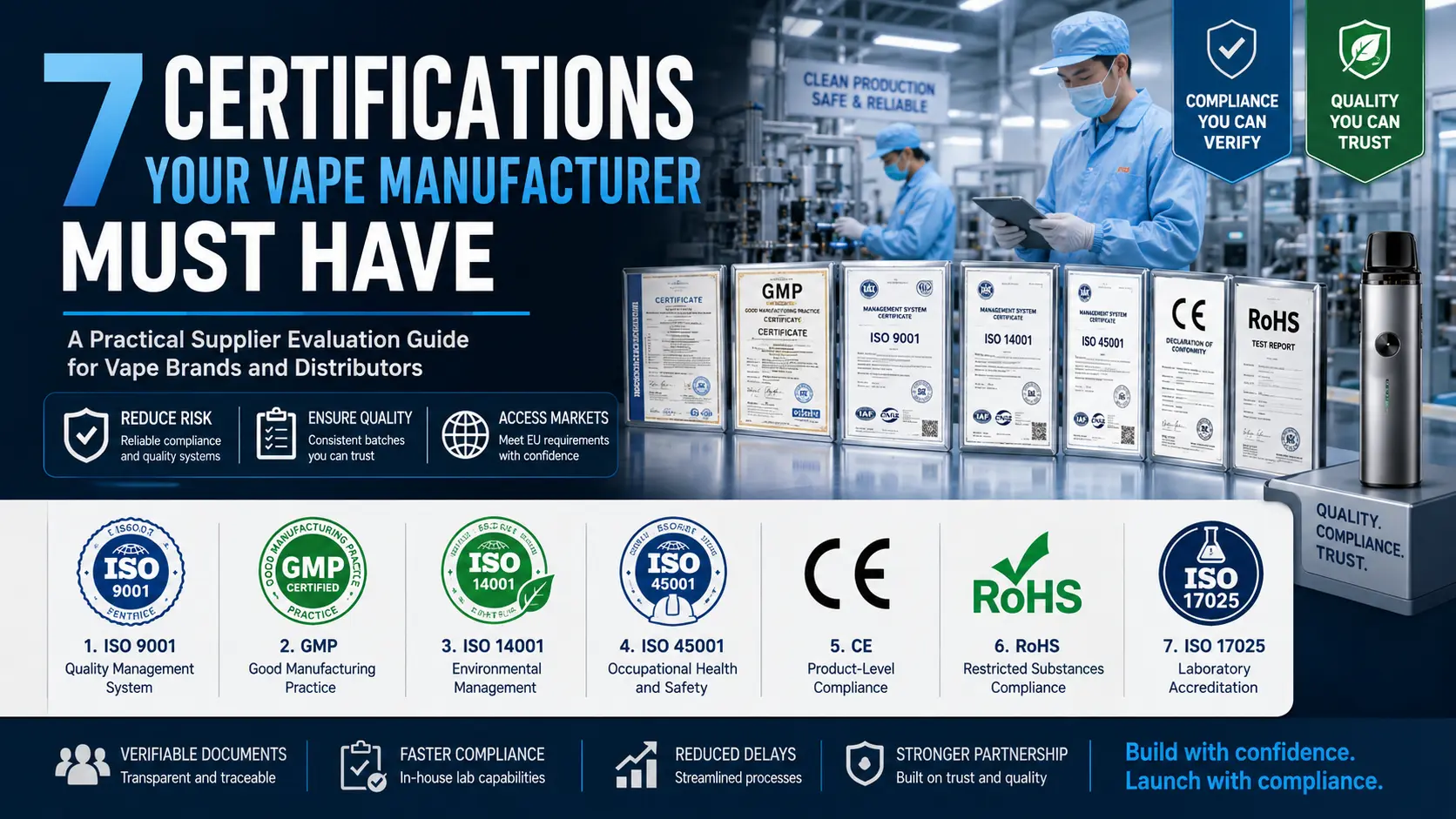
This article is built around that question. It is not a definitions list. It is a supplier due diligence framework structured around the seven certifications for vape manufacturer evaluation that genuinely matter, plus the practical methods to verify them and the items buyers commonly confuse with each other.
If you are evaluating manufacturers for the European market, the priority order matters even more. Some certifications are non-negotiable. Others are advantages. A few items that competitors put in their pitch decks are not factory certifications at all.
Let’s separate the signal from the noise.
Why Certifications for Vape Manufacturer Selection Actually Matter
Certifications are not academic credentials. For B2B buyers, they are risk indicators.
Each certification answers a specific question:
- Will batches be consistent across orders? (ISO 9001)
- Is hygiene controlled in the production environment? (GMP)
- Does the factory manage environmental risk responsibly? (ISO 14001)
- Are workers protected and is the operation stable? (ISO 45001)
- Does the product meet baseline EU technical requirements? (CE)
- Are restricted substances properly controlled? (RoHS)
- Can the factory test its own claims credibly? (ISO 17025)
A certification gap doesn’t always disqualify a supplier. But it tells you exactly where to ask harder questions.
For European brands operating under TPD, working with retail buyers, or supplying private label programs to multi-country distributors, certifications also serve a documentation purpose. Buyer audits, customs clearance, retailer onboarding, and insurance underwriting all reference these documents.
The cost of choosing the wrong supplier is rarely just the unit price difference. It is usually a recall, a customs hold, a failed retailer audit, or a market access blockage that arrives weeks after production.
actory Certifications vs Product Certifications: Know the Difference
This is the single most important concept in vape supplier evaluation, and it is where most published guides get the details wrong.
Factory certifications apply to the manufacturing organization itself. They certify that the company has documented systems, trained personnel, audit history, and management procedures. ISO 9001, ISO 14001, ISO 45001, and GMP all fall into this category.
Product certifications apply to specific products produced by the factory. They confirm that a particular SKU meets specific technical or regulatory requirements. CE, RoHS, FCC, and TPD compliance are product-level — not factory-level.
This matters because suppliers often blur the line. “CE certified factory” is technically incorrect language. The factory is not CE certified. Specific products are CE marked through conformity assessment procedures involving testing, technical files, and a Declaration of Conformity.
When reviewing certifications for vape manufacturer credibility, separate the two columns clearly:
| Type | Examples | What It Proves |
|---|---|---|
| Factory Certifications | ISO 9001, ISO 14001, ISO 45001, GMP | Management system maturity |
| Product Certifications | CE, RoHS, FCC, TPD notification | Specific SKU compliance |
| Lab Capability | ISO 17025, CNAS accreditation | Testing credibility |
A factory with strong management certifications but no product-level documentation cannot supply the EU market without third-party support. A factory with product test reports but no quality management system cannot guarantee batch consistency. You need both — applied at the right level.
Certification #1: ISO 9001 — Quality Management System
ISO 9001 is the foundational item in any list of certifications for vape manufacturer evaluation. If a factory does not hold it, treat that as a significant warning.
The certification means the manufacturer has documented procedures for design control, supplier qualification, production planning, inspection, non-conformance handling, corrective action, and management review. Independent auditors verify these procedures annually.
For buyers, ISO 9001 translates into batch consistency. The first 5,000 units should perform like the next 50,000. Defect rates should be measured, tracked, and trending toward improvement over time.
What to ask for:
- Current ISO 9001 certificate (not expired)
- Name and accreditation status of the issuing body
- Audit scope — does it cover the actual production lines you will use?
- Recent internal audit summaries
The official ISO 9001 standard is published by the International Organization for Standardization, which also lists accredited certification bodies for verification.
Certification #2: GMP — Good Manufacturing Practice
GMP is increasingly the defining certification for vape manufacturers serving regulated markets. It governs hygiene, contamination control, traceability, and production environment standards — particularly important for products containing e-liquid.
For vape production specifically, GMP addresses:
- Cleanroom-grade filling environments for e-liquid
- Air quality and particulate control
- Personnel hygiene and gowning protocols
- Raw material traceability from supplier to finished batch
- Batch records that allow full backward tracing of any unit sold
For brands selling in pharmacies, regulated retail chains, or markets where consumer protection authorities conduct audits, GMP documentation is often a buyer requirement. Distributors increasingly add it to their supplier qualification questionnaires.
A factory holding both ISO 9001 and GMP demonstrates that quality is managed both as a system (ISO) and as a production discipline (GMP). The combination is more meaningful than either alone — and that combination should be a baseline expectation in any list of certifications for vape manufacturer selection.
Certification #3: ISO 14001 — Environmental Management
ISO 14001 covers how the factory manages its environmental footprint — waste handling, energy use, emissions, hazardous material disposal, and regulatory compliance with environmental law.
For European buyers, this certification is becoming more relevant rather than less. EU sustainability legislation, extended producer responsibility schemes, and retailer ESG reporting all create downstream documentation needs. Single-use vape disposal regulations in particular are tightening across multiple member states.
ISO 14001 is rarely a blocker by itself, but its absence is increasingly noticeable in due diligence questionnaires from larger buyers and retail chains. For private label programs supplying tier-one retailers, expect this to become a hard requirement within the next two to three years if it is not already.
Certification #4: ISO 45001 — Occupational Health and Safety
ISO 45001 governs worker safety, accident prevention, and operational risk management within the factory.
For buyers, this certification serves two purposes. First, it indicates a stable, well-run operation — factories with serious safety problems experience disruptions that affect delivery reliability. Second, large retailers and brand groups increasingly require supply chain ethical compliance documentation, and ISO 45001 forms part of that package.
A small or medium brand may not face direct retailer pressure on this point yet. But it remains a useful indicator of overall operational maturity. Factories that invest in management certifications across all three ISO domains — 9001, 14001, and 45001 — typically run more disciplined operations than those holding only the minimum.
Certification #5: CE Compliance — A Product-Level Mark, Not a Factory Stamp
CE marking is one of the most misunderstood items in lists of certifications for vape manufacturer evaluation.
CE is not a factory certification. It is a Declaration of Conformity attached to specific products, indicating that the product meets applicable EU directives — for vape devices, primarily the Low Voltage Directive, EMC Directive, and Radio Equipment Directive where wireless features apply.
A factory does not become “CE certified.” The factory produces products that carry CE marks based on documented conformity assessments performed against specific directives.
When evaluating CE claims, ask for:
- The specific Declaration of Conformity for the SKU you are buying
- The technical file references behind the CE mark
- Test reports from a recognized testing laboratory
- The applicable directives the product was assessed against
A supplier who cannot produce SKU-specific CE documentation but still claims to be “CE certified” is a warning signal. They are either misunderstanding the system or hoping you do.
Certification #6: RoHS Compliance — Restricted Substances
RoHS (Restriction of Hazardous Substances) limits the use of lead, mercury, cadmium, hexavalent chromium, and certain flame retardants in electronic products. Like CE, it is a product-level requirement applied to specific SKUs, not a factory-level certification.
For vape devices, RoHS testing covers the device housing materials, PCBA components, battery casing, and any other electronic or printed circuit elements.
What you should request:
- RoHS test reports from a recognized laboratory for the specific SKU
- Test report dates — old reports may not cover current component sourcing
- Confirmation that the tested batch represents current production materials
If a supplier provides one RoHS report from three years ago for a different model and treats it as universal, that is a documentation gap worth raising before you place an order.
Certification #7: ISO 17025 or Accredited Laboratory Capability
This is the certification most published lists of certifications for vape manufacturer evaluation skip — and it is one of the strongest signals of a serious manufacturing partner.
ISO 17025 accreditation applies to testing laboratories. It certifies that the lab has the technical competence, equipment calibration, and procedural rigor to produce reliable test results. National accreditation bodies (CNAS in China, UKAS in the UK, DAkkS in Germany) confirm this status.
A vape manufacturer with in-house ISO 17025 or nationally accredited laboratory capability can:
- Test emissions, battery performance, and material composition without waiting weeks for third-party labs
- Catch quality issues at the production stage rather than after shipment
- Generate defensible documentation for TPD notifications, retailer audits, and customs queries
- Iterate on flavor formulations and device performance with rapid feedback loops
Vape ODM Factory operates a national-standard laboratory under this framework. For European brands needing rapid emissions testing for EU-CEG submission or batch verification before retail distribution, in-house laboratory capability eliminates one of the most common delay points in the launch timeline.
For a deeper view of how this integrates with end-to-end compliance support, the 6S compliance system walks through the full process Vape ODM Factory uses for European clients.
How to Verify Certifications for Vape Manufacturer Claims
Certificates can be downloaded, edited, expired, or fabricated. Verifying them is a basic due diligence step that many buyers skip — and one that pays back significantly when a supplier turns out to be misrepresenting itself.
A practical verification process:
- Check the certificate number against the issuing body’s database. Most accreditation bodies maintain online registers. Enter the certificate number and verify the company name, scope, and validity dates match.
- Confirm the issuing body is accredited. Not all certification bodies have equal credibility. The certificate should reference an accredited certifying body recognized under the IAF MLA framework.
- Review the scope statement carefully. A certificate may cover only specific facilities, product categories, or processes. “ISO 9001 certified” without scope context can mean very little.
- Check expiration dates. Certifications are typically valid for three years with annual surveillance audits. Review both issue date and expiration date.
- Request an audit summary or surveillance report. A factory with nothing to hide will share recent audit findings, including non-conformities and corrective actions.
- Match certificates to factory address. A common red flag is a certificate issued to a trading company rather than the actual production facility.
This verification process takes about thirty minutes per certificate. It is one of the highest-return uses of time in supplier evaluation.
Which Certifications for Vape Manufacturer Selection Matter Most in Europe?
Not all certifications carry equal weight for European buyers. Use this priority matrix when comparing suppliers:
| Certification | Priority for EU Brands | Reason |
|---|---|---|
| ISO 9001 | Critical — non-negotiable | Quality system foundation |
| GMP | Critical for e-liquid handling | Hygiene and traceability |
| TPD product notification | Required for market access | Legal requirement |
| CE marking (per SKU) | Required for market access | Legal requirement |
| RoHS compliance (per SKU) | Required for market access | Legal requirement |
| ISO 17025 lab capability | Strong advantage | Faster compliance and QC |
| ISO 14001 | Important and rising | ESG and retailer requirements |
| ISO 45001 | Useful indicator | Operational maturity |
Notice the structure: management system certifications (ISO 9001, GMP) sit at the top because they govern everything downstream. Product compliance documentation (TPD, CE, RoHS) is mandatory for legal market access. Laboratory capability accelerates everything in the middle.
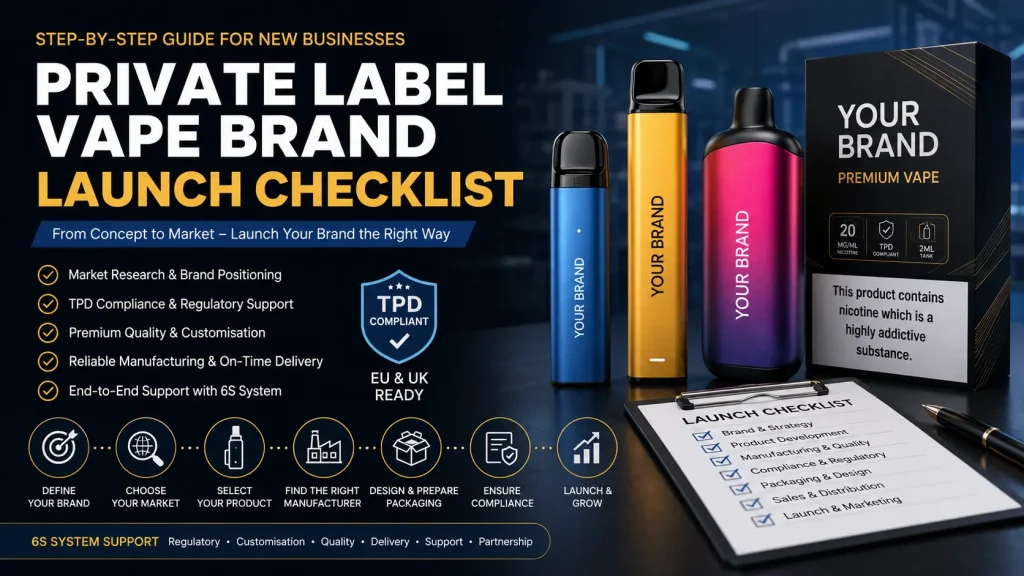
For a closer view of how certifications integrate with private label launches specifically, see the private label disposable vape supplier guide.
Certifications Are Important — But They Are Not Everything
A factory can hold every certification on this list and still be the wrong partner. Certifications confirm that systems exist on paper. They do not confirm that the supplier will actually fit your business.
When weighing certifications for vape manufacturer selection, also assess:
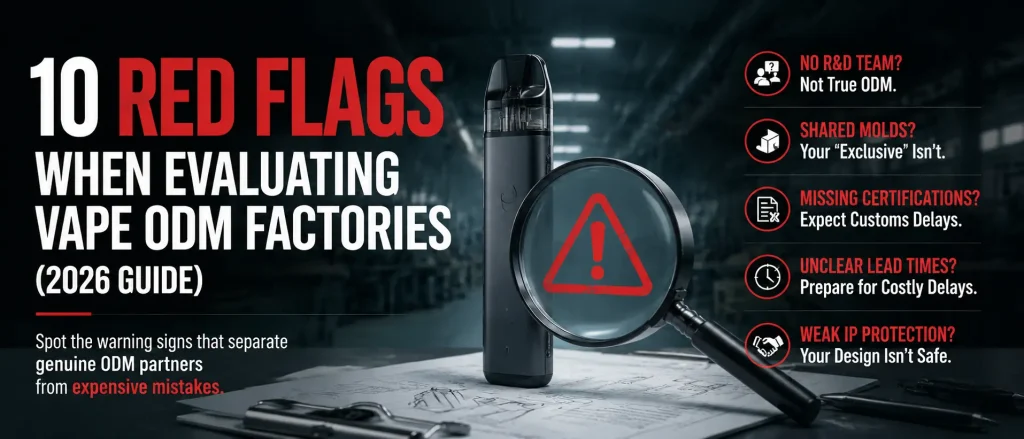
- R&D capability — Can the factory develop new products, refine flavors, and iterate on devices? Certifications cannot replace product development capability.
- Production capacity — Can monthly output match your reorder cycle? A certified factory at full capacity cannot help you scale.
- Compliance support depth — Will the supplier handle TPD notification submissions directly, or simply provide documents? This is one of the largest practical differences between vape suppliers.
- Communication quality — How fast and clear are responses? Project failures more often come from communication breakdowns than technical problems.
- Reference checks — Can the supplier provide European clients you can verify? References are more meaningful than catalogues.
Vape ODM Factory has operated since 2013 with 500+ employees and 9 million units monthly capacity, serving brands across 40+ countries. The combination of management certifications (ISO 9001, ISO 14001, ISO 45001, GMP) plus accredited laboratory capability plus direct TPD compliance handling under the 6S service model is the structural answer to most of the gaps above. You can review the company background on the about page.
Quick Supplier Certification Checklist
Use this checklist when shortlisting vape manufacturers for the European market.
Factory-level (mandatory):
- ISO 9001 — valid certificate
- GMP certification with vape-applicable scope
- ISO 14001 — strong advantage
- ISO 45001 — useful indicator
Product-level (mandatory for EU):
- CE Declaration of Conformity per SKU
- RoHS test report per SKU
- TPD notification capability for target countries
Laboratory:
- ISO 17025 or nationally accredited laboratory
- In-house emissions testing capability
Verification step:
- All certificates verified through issuing body databases
- Scope statements reviewed against your specific product line
- Recent audit findings shared
Print this checklist. Use it during initial supplier conversations. The full product catalogue is also a useful reference when matching certified platforms to your channel. Suppliers who answer all points clearly with documents are usually worth shortlisting. Suppliers who deflect or generalize are not.
Final Thoughts: Use Certifications as a Filter, Not the Final Answer
Certifications for vape manufacturer evaluation work best as a filter at the start of supplier selection — not as the conclusion.
Use the priority matrix to disqualify suppliers missing critical certifications. Use the verification process to confirm documents are real and current. Use the broader evaluation framework — R&D, capacity, compliance support, communication, references — to choose between qualified candidates.
A factory with strong certifications and weak service capability will frustrate your project. A factory with strong service but missing core certifications will create regulatory risk. The best European-facing vape manufacturers combine both, and they make this combination visible through documentation that survives buyer audits.
If you are evaluating certifications for vape manufacturer selection for an upcoming European launch and want to compare credentials, request a verified document pack, or discuss how Vape ODM Factory’s 6S service handles direct TPD compliance filing on behalf of clients, contact our team directly.
The brands that win in 2026 will be the ones that treated supplier evaluation as a structured process — not a quote comparison.