A European distributor recently told a brand: “If it doesn’t say 5000 puffs on the box, my retailers won’t stock it.” That same brand’s first compliance submission was rejected because the notified e-liquid volume didn’t match the declared puff count in the technical file. The product was real. The documentation was the problem.
A high puff disposable vape sits at the intersection of what European consumers want and what TPD regulations allow. Brands that understand this intersection build products that comply. Brands that don’t lose months resubmitting notifications while competitors fill their shelf space.
This guide covers what actually defines a high puff disposable vape, the engineering constraints that make them compliant or non-compliant in Europe, the product architectures that pass TPD review consistently, and the development process for bringing one to market without triggering rejection. No marketing claims. No hypotheticals. Just the technical and regulatory reality brands need to work with.
What Actually Defines a High Puff Disposable Vape
The term “high puff disposable vape” gets used loosely in the industry. For some, it means anything above 2000 puffs. For others, it starts at 8000 or 10000. Before discussing compliance, the definition needs to be grounded in engineering reality — not marketing language.
A high puff disposable vape is a disposable device engineered to deliver significantly more puffs than the standard 600–800 puff format that dominated the European market from 2020–2023. This is achieved through a combination of larger e-liquid capacity, higher battery capacity, and optimized coil efficiency — not through a bigger number printed on the box.
The most common configurations in production today:
- 3000–5000 puffs: 8–12ml e-liquid, 500–650mAh battery, mesh coil optimized for liquid efficiency
- 5000–8000 puffs: 12–16ml e-liquid, 650–850mAh battery, dual mesh or advanced coil architecture
- 8000–12000 puffs: 16–20ml e-liquid, 850mAh+ battery, often includes adjustable airflow or power modes
- 15000+ puffs: 20ml+ e-liquid, typically requires rechargeable battery design, approaches pod-system territory
The puff count claim on a product must be verifiable. A factory that declares “10000 puffs” without documented testing methodology is relying on a number that TPD reviewers can and will challenge during notification. Puff count testing follows defined parameters — puff duration, puff volume, and inter-puff interval — and the result must be consistent with the declared e-liquid volume and coil consumption rate.
The TPD Puff Count Problem: High Volume, Small Tank
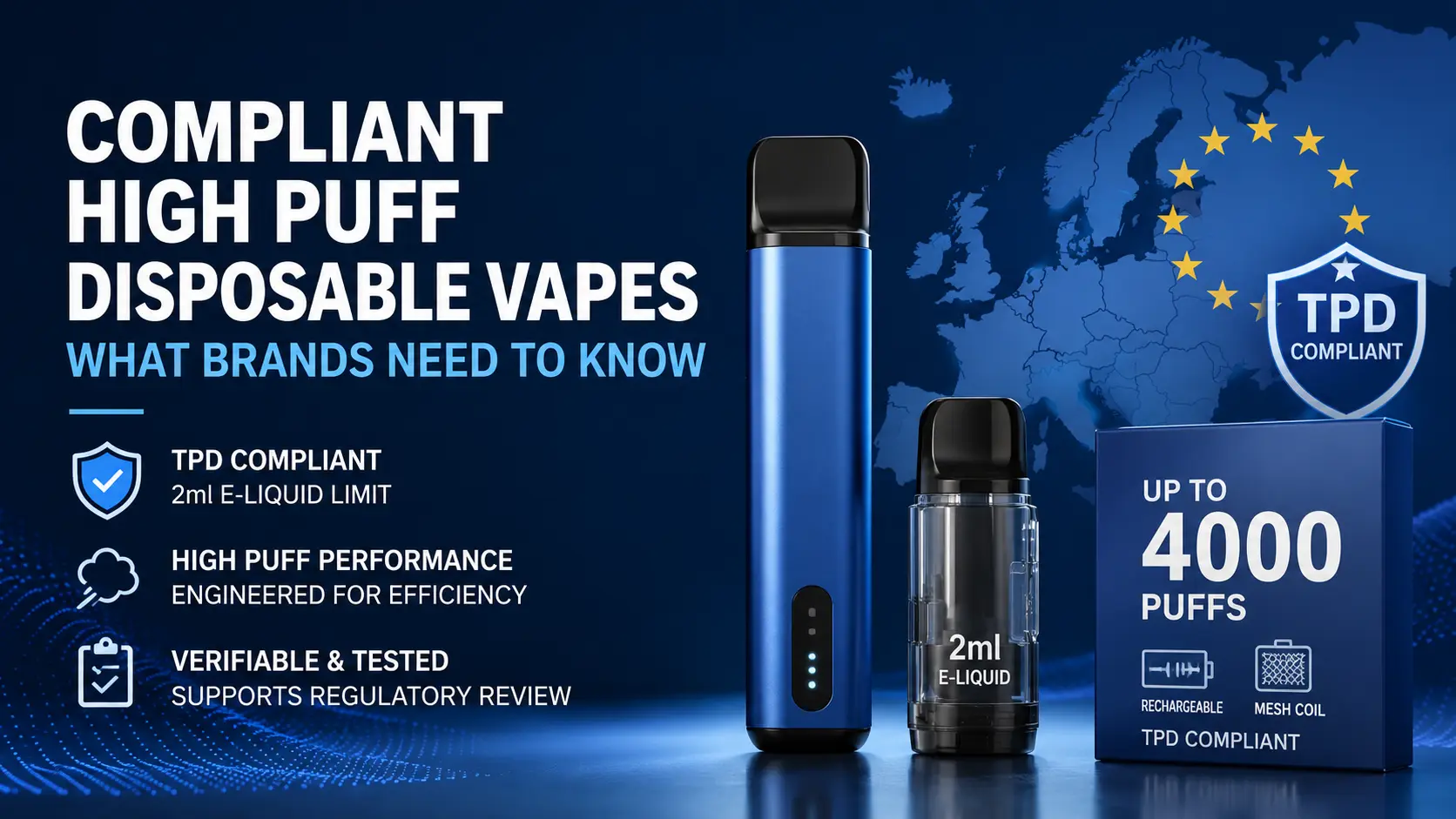
This is the core tension every brand developing a high puff disposable vape for Europe must confront. TPD Article 20 sets a maximum e-liquid capacity of 2ml for disposable devices and pre-filled cartridges. A 2ml tank, regardless of coil efficiency, cannot deliver 5000 puffs by any honest measurement.
A standard mesh coil at optimal efficiency consumes approximately 0.3–0.5ml of e-liquid per 100 puffs under standardized testing conditions. At 0.4ml/100 puffs, a 2ml tank delivers roughly 500 puffs — not 5000.
Brands that claim 5000, 8000, or 10000 puffs from a 2ml device are making a demonstrably false claim. TPD enforcement authorities in several member states now verify puff count claims against notified e-liquid volume. Germany’s enforcement body has issued compliance notices specifically targeting inflated puff counts. The Netherlands tests products at retail for consistency between declared specifications and actual content.
This doesn’t mean high puff disposable vape products are impossible in Europe. It means the product architecture must be designed around TPD constraints — and the puff count must be technically achievable within those constraints. The brands succeeding in this category are not the ones with the biggest number on the box. They’re the ones with a puff count the notified technical file can support.
Compliant Product Architectures for High Puff Counts in Europe
Four product architectures currently enable legitimate high puff disposable vape products that pass TPD notification in European markets. Each has different cost implications, development timelines, and compliance pathways.
Architecture 1: Large-Capacity Disposable (Non-TPD Markets Only)
10–20ml e-liquid in a single sealed unit. This is the dominant format in markets without TPD-equivalent restrictions — the US, parts of the Middle East, and some Asian markets. It is not compliant for sale in any EU member state, the UK, or any market that has adopted TPD-style e-liquid volume limits. Brands often ask whether these can be “modified for TPD.” The answer is structural: the 2ml limit is not negotiable.
Architecture 2: Rechargeable Disposable with 2ml Pre-Filled Pod
This is the most common compliant architecture for brands targeting the high puff disposable vape positioning in Europe. The device consists of a rechargeable battery body (often 500–850mAh) paired with replaceable or fixed 2ml pre-filled pods. Each pod delivers 600–800 puffs. A kit containing the device plus multiple pods can legitimately offer 2000–4000+ total puffs across the consumables included in the package.
This architecture is TPD-compliant because each individual pod contains 2ml or less. The total puff count across the kit is verifiable by multiplying pod count by per-pod puff delivery. The pricing and packaging guide for TPD compliant vape packaging covers the specific labelling requirements for multi-pod kits — health warnings per pod, ingredient listings, and the batch traceability markings that must appear on each component.
Architecture 3: Open-System Pod Device Marketed as “Disposable Experience”
A rechargeable pod system designed to replicate the draw and convenience of a disposable but with user-replaceable 2ml pods. This is not technically a disposable device, but it occupies the same retail category and consumer use case. The device body passes TPD as electronic equipment. Each pod passes as a pre-filled cartridge under the 2ml limit. Total puff count across the starter kit can exceed 3000 puffs.
Architecture 4: Dual-Tank or Sequential-Fire Design
A single device body containing two or more separate 2ml e-liquid chambers with a mechanism that empties tanks sequentially. Each chamber is individually sealed and compliant at 2ml. The total e-liquid volume across chambers is higher, but no single tank exceeds the limit. This architecture is newer and requires careful technical documentation during TPD notification — but it is passing review in multiple member states when supported by detailed engineering diagrams and per-tank emissions data.
The development process for any of these architectures requires genuine ODM capability — not catalog customization. The private label disposable vape supplier guide explains how different manufacturing models affect your ability to implement compliant high-puff architectures. White-label catalog products will not solve the TPD puff count problem. An ODM-developed platform designed around the 2ml constraint from the start will.
Engineering Factors That Determine Actual Puff Count
A declared puff count is only as credible as the engineering behind it. Understanding these factors separates brands that can defend their product claims from brands that rely on marketing numbers a regulator can dismantle.
Coil resistance and e-liquid consumption rate
Lower resistance coils produce more vapor per puff — and consume more e-liquid. A 0.8ohm mesh coil at 12W will drain a 2ml tank faster than a 1.2ohm coil at 9W. Puff count is inversely proportional to e-liquid consumption rate. A device delivering larger clouds will produce fewer puffs from the same tank. There is no free lunch in physics.
Airflow design and puff duration
Standardized puff count testing assumes a 3-second puff duration with a 55ml puff volume. But actual consumer puffing behavior varies significantly. A device with a tight MTL draw encourages shorter puffs. A device with open airflow encourages longer draws that consume more liquid per puff. The same 2ml tank could deliver 500 puffs at 3-second draws or 350 puffs at 5-second draws.
Battery capacity and output consistency
A high puff disposable vape that loses power output as the battery drains produces weaker puffs in the second half of its life. Consumers stop using it before the e-liquid is fully consumed, effectively reducing the usable puff count below the theoretical maximum. Constant-output battery management resolves this — but adds cost and requires validated discharge curve data for the technical file.
E-liquid formulation and vaporization efficiency
Higher VG ratios produce denser vapor but require more energy to vaporize efficiently. A 70VG/30PG formulation in an underpowered device wastes e-liquid through incomplete vaporization. Puff count suffers. The formulation must be matched to the coil and power output — not chosen independently and assumed to work.
Market Reality: What European Buyers and Distributors Actually Want
The high puff disposable vape market in Europe is not driven by consumer demand for a specific e-liquid volume. It’s driven by what retail buyers and distributors consider commercially viable. Understanding this is essential for product specification decisions.
A European convenience retail chain evaluates disposable vape products on shelf productivity — revenue generated per facing per week. A 600-puff device at €6.99 retails generates one purchase event. A multi-pod kit delivering 3000+ total puffs at €19.99 generates a larger transaction and keeps the consumer in that brand’s ecosystem longer.
Distributors care about reorder velocity. A single-use 2ml device is consumed in 2–3 days by a regular user. That user returns to the store and may purchase a different brand. A multi-pod system with the same device body and multiple 2ml pods extends brand engagement and increases the probability of repeat purchases of the same brand’s pods.
This is why brands pursuing the high puff disposable vape category gravitate toward Architecture 2 (rechargeable body + replaceable pods) or Architecture 3 (pod system positioned as disposable alternative). The 2ml limit applies per pod, the pod is the repeat-purchase consumable, and the brand builds a recurring revenue stream within TPD-compliant parameters.
The unit economics are favorable. Development cost is higher than a standard 2ml disposable — the device body requires battery management, pod connection mechanism, and industrial design — but the lifetime value per consumer is significantly higher. A full breakdown of the costs for different product architectures is covered in the guide to vape brand startup costs, including mold investment, per-unit pricing, and the compliance costs that vary by architecture.
The Development Timeline for a Compliant High Puff Product
A high puff disposable vape built on Architecture 2 or 3 follows a development timeline similar to other ODM vape products — with additional engineering and compliance steps for the multi-component design.
Phase 1: Product Architecture Decision (Weeks 1–2)
Select the architecture based on target market, price point, and distribution channel. This decision determines everything downstream — mold requirements, compliance pathway, per-unit cost, and packaging specification.
Phase 2: Industrial Design and Engineering (Weeks 2–6)
Device body design, pod connection mechanism, battery specification, airflow system, and PCB layout. For Architecture 2 products, the pod-to-body interface is the critical engineering challenge — it must be secure enough for pocket carry, resistant to e-liquid leakage across shipping, and simple enough for consumer pod changes.
Phase 3: Mold Development and Sampling (Weeks 6–12)
Tooling for the device body and the pod. Mold development for a multi-component system typically runs 4–6 weeks for first samples. The 6S product development process handles the full engineering-to-sampling workflow — including 3D prototyping, mold flow analysis, and first-article inspection before production tooling is finalized.
Phase 4: E-Liquid Development and Emissions Testing (Weeks 8–14)
E-liquid formulation matched to the coil and power output. Emissions testing at an accredited laboratory generates the data required for TPD notification. This phase runs parallel to mold development to avoid timeline stacking.
Phase 5: TPD Notification Preparation (Weeks 12–16)
Technical file compilation, EU-CEG submission, and packaging compliance review. For multi-pod kits, each pod variant requires emissions data and ingredient documentation. The device body requires separate compliance as electronic equipment. If you’re developing a product that requires full TPD notification support, the TPD compliance guide for European market entry covers the complete documentation package and typical review timelines.
Phase 6: Production and Quality Control (Weeks 16–20)
First production run with full QC inspection — pod fit testing, battery capacity verification, e-liquid fill accuracy, puff count validation per batch, and packaging compliance check. A high puff disposable vape with multiple components has more QC checkpoints than a single-unit disposable.
Phase 7: TPD Notification Period + Logistics (Weeks 20–26)
The mandatory 6-month TPD notification period begins when the submission is complete and acknowledged. Product can ship during this period but cannot be sold until it expires. Air freight from factory to European warehouse typically adds 5–7 days.
Total timeline: approximately 6–7 months from architecture decision to products available for legal sale in EU markets. The 6-month TPD notification period is the pacing item — everything upstream must be completed before it begins.
Common Mistakes Brands Make When Developing High Puff Products
These mistakes appear repeatedly in TPD notification rejections and post-launch compliance actions. Each one is avoidable with the right development process.
Mistake 1: Designing the product first, checking TPD compliance later
The 2ml limit is a design constraint, not a paperwork checkbox. A 10ml sealed disposable cannot be made TPD-compliant through clever notification language. The architecture must be built around the limit from day one. Brands that develop the product first and ask about compliance afterward are rebuilding from scratch.
Mistake 2: Declaring puff counts inconsistent with e-liquid volume
A product with 2ml of e-liquid claiming 3000 puffs will be challenged. The math doesn’t work, and a TPD reviewer can calculate the implied consumption rate. Declare a puff count consistent with the e-liquid volume, coil specification, and testing methodology documented in the technical file.
Mistake 3: Treating multi-pod kits as a single product for notification
Each pod variant requires separate emissions testing and ingredient documentation. A kit containing three different flavors needs three sets of emissions data. The device body needs separate notification. Treating the kit as one SKU for notification purposes will result in rejection.
Mistake 4: Ignoring packaging language requirements for multi-country EU launches
A kit sold in Germany, France, and Italy requires health warnings in all three languages if the packaging is uniform across markets. Alternatively, market-specific packaging must be produced. The cost difference is significant and should factor into the distribution strategy before packaging design begins.
Mistake 5: Choosing a supplier that can’t support Architecture 2 or 3 compliance
Many factories that produce high-capacity disposables for non-EU markets cannot support the pod-based architectures required for TPD compliance. They have no mold development capability for multi-component systems, no emissions testing relationships, and no EU-CEG filing experience. Verifying supplier capability before committing to development is essential — a framework for this is covered in the guide to evaluating vape ODM factories.
The Products That Win Don’t Just Have High Puff Counts — They Have Defensible Puff Counts
European vaping is entering an enforcement phase. The regulators who processed TPD notifications as administrative exercises three years ago now test products at retail, compare declared specifications against physical content, and issue compliance actions requiring products to be removed from sale. A high puff disposable vape that cannot defend its number in a technical file is a withdrawal order waiting to happen.
The products winning shelf space in 2026 are the ones with puff counts that match their e-liquid volume, pod architectures that pass TPD review without amendment, and compliance documentation that a distributor can show to an enforcement authority without hesitation. The number on the box matters less than the confidence behind it.
Vape ODM Factory has been developing TPD-compliant pod architectures since 2013, with a regulatory team that handles EU-CEG notification directly on behalf of brand clients. If you’re evaluating product architectures for a European launch and need to understand which pathway fits your target market and budget, you can review the product range to see existing compliant platforms, or submit a development brief to start the architecture discussion. The best time to align puff count with compliance is before the first design sketch.