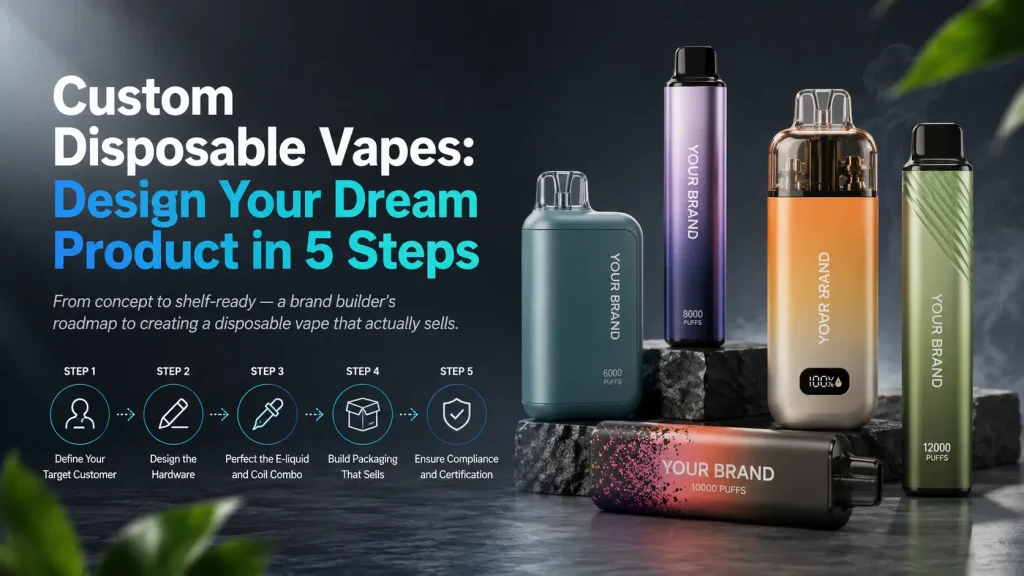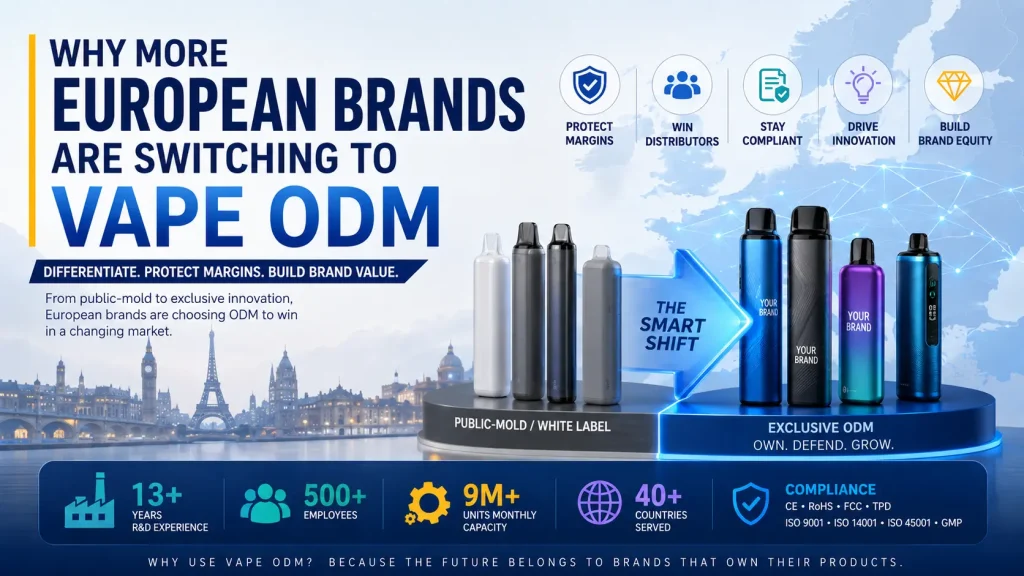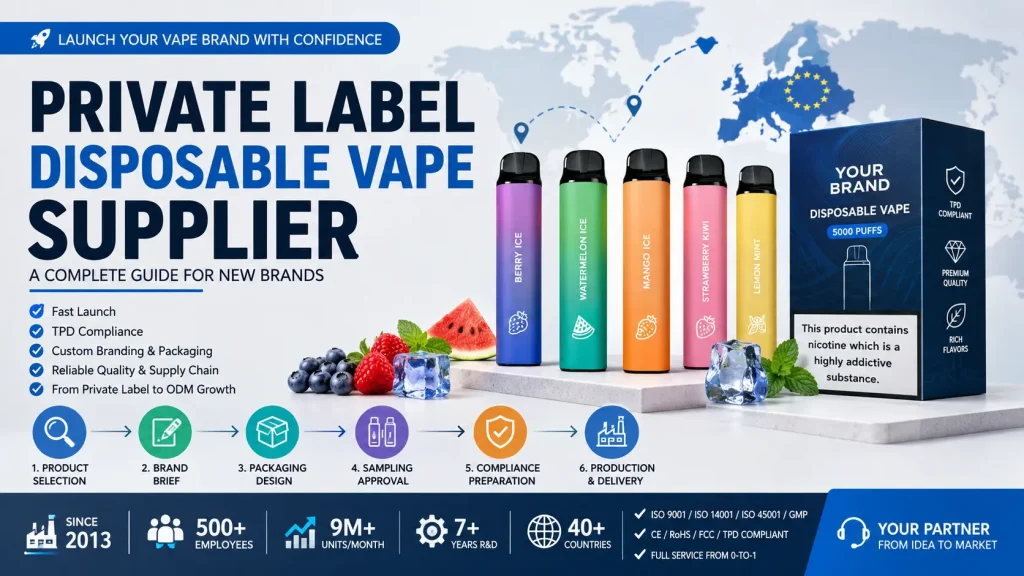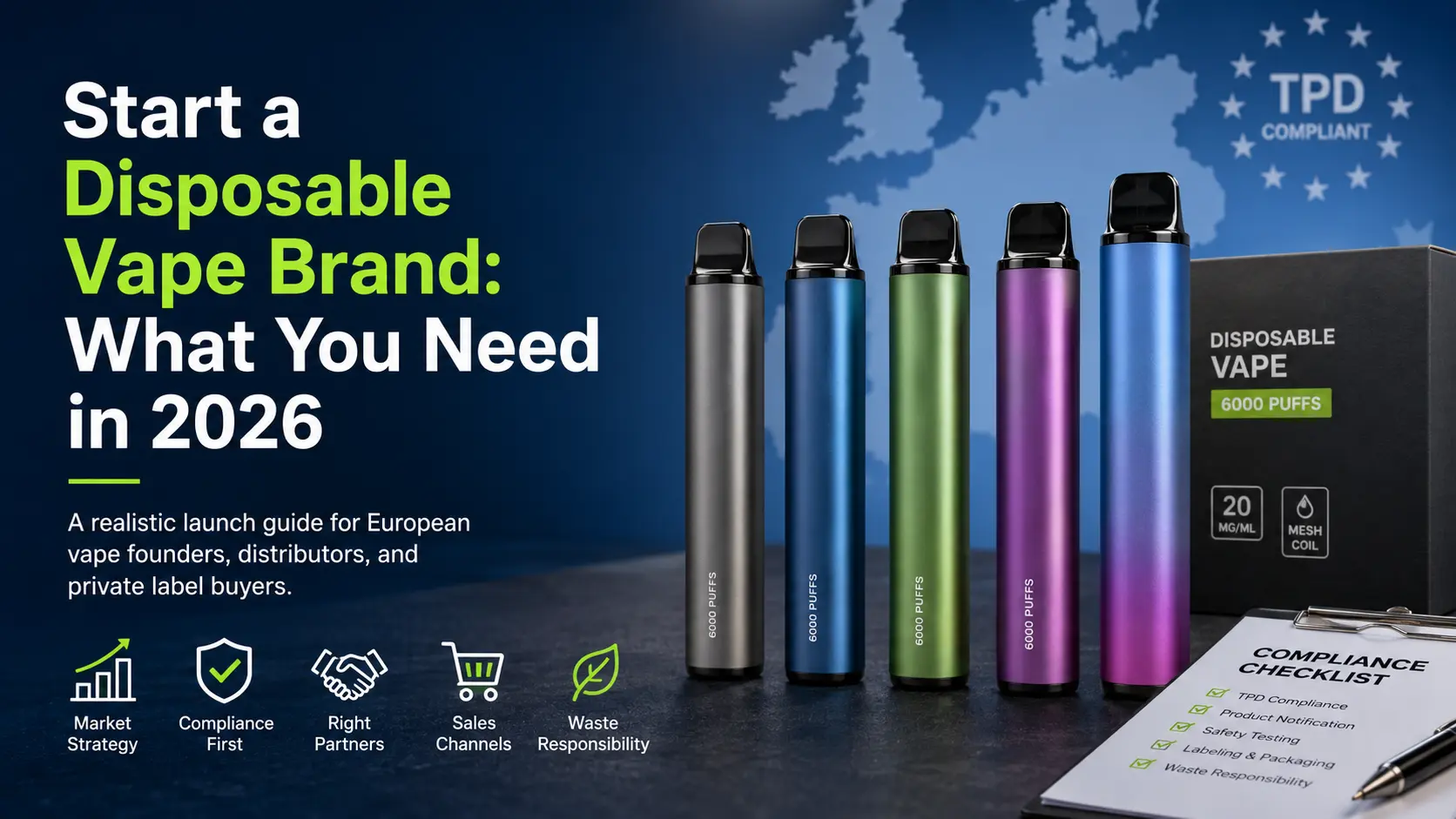
If you want to start a disposable vape brand in 2026, the opportunity still exists — but the rules have changed. The old playbook of choosing a high-puff device, printing a logo, and pushing stock into wholesalers is no longer enough.
Disposable vape buyers are more selective. Regulators are more active. Retailers are asking harder questions about compliance, product documentation, and waste responsibility. That means the brands that win in 2026 will not be the fastest to order stock. They will be the best prepared.
This guide explains what you need before you start a disposable vape brand, including market selection, product strategy, supplier choice, real startup budget, compliance planning, sales channels, and the mistakes that kill new brands before their second order.
Why 2026 Is Different for Disposable Vape Brands
Three years ago, many brands entered the disposable category by copying what already sold: bright packaging, sweet flavors, high puff claims, and aggressive wholesale pricing.
That model is weaker in 2026. The market is not disappearing, but it is becoming more regulated, more competitive, and more channel-driven.
The biggest shift is regulation. Several European markets have restricted or banned single-use vape products. The UK disposable vape ban came into force in 2025. Belgium and France have also moved against disposable formats. Other EU markets are reviewing environmental and youth-access concerns.
At EU level, the Tobacco Products Directive remains the core framework for nicotine-containing e-cigarettes. You can review the official directive through EUR-Lex Directive 2014/40/EU.
The second shift is retail discipline. Distributors and chain stores no longer want random new brands with weak documentation. They want products that can be reordered, traced, tested, and supported.
The third shift is product evolution. Traditional single-use devices still exist, but more buyers are considering rechargeable disposables, closed pod systems, and hybrid models that reduce waste pressure while keeping a simple user experience.
So yes, you can still start a disposable vape brand. But you need a 2026 strategy, not a 2021 strategy.
Can You Still Start a Disposable Vape Brand Profitably?
The honest answer is yes — if you already understand your channel.
Most disposable vape brands fail because they begin with the product. They ask suppliers for catalogues, choose flavors, approve packaging, and only then ask how to sell disposable vapes.
That sequence is backwards.
A profitable disposable brand usually starts with one of these advantages:
- Existing distributor relationships
- Access to vape shops, tobacconists, petrol stations, or convenience chains
- Regional wholesale experience
- A strong private label buyer network
- A clear online B2B lead generation plan
- A market where disposable products remain legally viable
If you do not have at least one of these advantages, you can still enter the category, but your first priority should be channel validation — not product selection.
A practical rule: before you start a disposable vape brand, speak with at least 20 potential buyers. These can be distributors, shop owners, wholesalers, or category managers. Ask what they already stock, what margins they expect, what compliance documents they need, and which formats they refuse to carry.
Those conversations will save more money than any supplier negotiation.
Step 1: Define Your Market and Distribution Strategy
Your target market decides almost everything: product format, nicotine strength, packaging language, TPD process, SKU count, and launch budget.
A brand targeting Germany cannot use the same strategy as a brand targeting the Middle East. A distributor-led launch is different from a DTC brand. A petrol station product is different from a vape shop product.
Before you start a disposable vape brand, answer these four questions:
- Which countries will you sell in first?
- Which channel will create the first 80% of revenue?
- Who controls access to that channel?
- What product formats are still accepted in that market?
Wholesale and Distributor Launches
A distributor-led launch is usually the most realistic path for new B2B vape brands.
The distributor already has retailer relationships, local market knowledge, and reorder behavior data. Your job is to provide a product line that is easy to sell, compliant, and commercially attractive.
For this model, keep the first range simple: 3–5 flavors, clear packaging, stable pricing, and strong documentation. Do not launch 15 SKUs before your distributor has proven demand.
Vape Chain and Retail Launches
Retail chains care about margin, shelf clarity, complaint rates, and supply continuity.
If this is your route, product appearance matters, but operational reliability matters more. A retailer will not reorder a product that creates returns, unclear labeling issues, or inconsistent stock availability.
Online and B2B Lead Generation
Online selling is restricted in many markets, especially for nicotine products. That does not mean digital is useless.
For B2B brands, SEO, product catalogues, LinkedIn outreach, trade directories, and landing pages can generate distributor leads. The goal is not always direct checkout. The goal is buyer conversations.
Step 2: Choose the Right Disposable Vape Product
Once the channel is clear, product selection becomes much easier.
A common mistake is choosing the device with the biggest puff count or most dramatic design. That may work in some non-EU markets, but it often fails in Europe because TPD limits nicotine-containing e-liquid containers to 2ml.
For EU markets, a disposable product strategy usually starts with TPD-ready formats, verified documentation, compliant packaging, and realistic flavor selection.
You can compare available formats through the Vape ODM Factory product catalogue when matching product platforms to your market and channel.
Puff Count
Puff count is a marketing signal, but it must match legal capacity and real device performance.
In Europe, exaggerated puff claims create risk if they do not align with 2ml capacity and actual testing. In non-EU markets, higher puff count devices may be viable, but retailers still expect consistency.
Nicotine Strength
In the EU, nicotine-containing e-liquids are limited to 20mg/ml under TPD.
Other markets may allow different levels, but you should never select nicotine strength only by competitor observation. Ask your supplier which strengths are supported by documentation and testing for the target country.
Flavor Portfolio
New brands almost always want too many flavors.
A better first range usually includes:
- 1–2 fruit flavors
- 1 mint or menthol profile
- 1 ice profile where legally permitted
- 1 signature flavor for brand differentiation
Five well-chosen SKUs are easier to sell than twelve unproven ones. SKU discipline protects cash flow.
Rechargeable vs Traditional Disposable
Traditional single-use devices face more pressure in Europe. Rechargeable disposable formats may offer a more practical bridge in some markets, depending on local rules.
For brands planning beyond the first order, consider whether the disposable launch should eventually lead into a closed pod system or refillable alternative.
Step 3: Choose the Right Supplier Before You Start a Disposable Vape Brand
Supplier selection is not about finding the lowest unit price. It is about reducing launch risk.
A weak supplier may still deliver samples that look good. Problems usually appear later: packaging errors, unclear TPD responsibility, late production, inconsistent flavors, missing batch documents, or slow communication when a retailer asks for proof.
When you start a disposable vape brand, compare suppliers across five areas:
- Product platform maturity
- Compliance support
- Production capacity
- Quality control process
- Communication and project management
For private label launches, a supplier should help you choose an existing validated product platform, customize packaging, confirm flavors, prepare compliance documents, and schedule production. The private label disposable vape supplier guide explains this model in more detail.
For ODM launches, the factory develops a more customized product based on your brief. This takes longer and costs more, but it can create stronger differentiation once your brand has proven demand.
If you are unsure which route fits your stage, use this simple rule:
| Brand Stage | Best Manufacturing Model | Why |
|---|---|---|
| First market test | White label or simple private label | Fast validation |
| First serious launch | Private label | Brand control without full tooling cost |
| Proven demand | ODM | More differentiation |
| Mature technical team | OEM | You own the design files |
Vape ODM Factory positions itself as a 0-to-1 ODM and private label partner for brands that want manufacturing, packaging, compliance, and production support in one place. The company has operated from Dongguan since 2013, with 500+ employees and 9 million units monthly capacity.
Step 4: Build a Brand That Retailers Can Understand
Branding is not only a logo. For disposable vape products, branding must help retailers and buyers understand the range quickly.
Your brand identity should answer:
- Who is the product for?
- Which channel is it built for?
- What price point does it support?
- Why should a retailer stock it instead of another brand?
- How will the range expand after the first order?
Packaging must carry both brand and compliance weight. In Europe, health warnings, nicotine declarations, importer details, batch codes, and local language requirements can take significant space.
This is why early packaging design should involve compliance review. A box that looks attractive but fails label requirements can delay production and create expensive reprints.
Do not overdesign the first launch. Clear flavor communication, readable warnings, consistent colors, and professional structure are more important than complex artwork.
A good brand system also prepares for future expansion. If your first five flavors perform well, can the design support ten? Can it support a pod line later? Can it work across German, French, Spanish, and Italian packaging versions?
Step 5: Calculate Your Real Startup Budget
This is the section many supplier blogs avoid.
The cost to start a disposable vape brand is not just the product unit price. Your real budget includes samples, packaging design, compliance work, testing, first inventory, freight, marketing, distributor support, and working capital for reorders.
A realistic first-launch budget often looks like this:
| Cost Area | Practical Range | Notes |
|---|---|---|
| Market research and buyer outreach | €500–€3,000 | Travel, samples, buyer meetings |
| Samples and revisions | €100–€1,000 | Depends on supplier and customization |
| Branding and packaging design | €1,000–€10,000 | Higher for multi-country packaging,but suppliers typically provide this service free of charge. |
| Compliance and testing | €2,000–€10,000+ | Depends on SKU count and markets |
| First production order | €10,000–€80,000+ | Driven by MOQ and flavor count |
| Freight and customs | €2,000–€15,000+ | Air is faster; sea is lower cost |
| Launch marketing and sales support | €2,000–€50,000+ | POS, trade shows, sales materials |
| Working capital reserve | 20–30% of project cost | Protects reorder timing |
A controlled private label launch with 50,000 units across five flavors may require 25,000–60,000 before meaningful revenue appears, depending on freight, compliance scope, and packaging complexity.
The biggest budget mistake is launching too many SKUs. If MOQ applies per flavor, a ten-flavor range can double your inventory exposure before you know which flavors sell.
If you want to start a disposable vape brand with limited capital, reduce SKU count first. Do not reduce compliance work, packaging review, or quality control.
Step 6: Plan Compliance Before Production
Compliance is not something you handle after the goods are finished. For European markets, it must be built into the launch timeline.
A compliant disposable vape launch may require:
- TPD notification through EU-CEG
- Ingredient and emissions data
- Product technical files
- CE documentation for the device
- RoHS test reports
- Packaging warning review
- Local language label checks
- Importer and traceability information
The key question is not whether the product is “TPD-ready.” That phrase can mean different things.
Ask the supplier:
- Do you submit TPD notifications directly, or only provide documents?
- Which countries have you supported before?
- Who pays if a file needs correction?
- Are packaging checks included before printing?
- Do you provide batch traceability reports?
Vape ODM Factory’s 6S service system is designed for this exact issue. The team supports direct TPD compliance operations for European clients instead of only telling brands what to prepare.
For a new brand, that difference can decide whether the launch stays on schedule or stock sits waiting for paperwork.
Step 7: Launch Your First Production Run
Your first production run should validate the business, not maximize ambition.
A disciplined first run usually has:
- 3–5 flavors
- One core device format
- One or two target markets
- Approved packaging before production
- Confirmed compliance route
- Clear reorder trigger points
- A written QC inspection plan
Do not approve production based only on photos. Physical samples should be checked for draw resistance, flavor accuracy, mouthpiece feel, body finish, print quality, battery consistency, and packaging fit.
A typical timeline for a private label disposable launch may look like this:
| Phase | Timeline | Main Work |
|---|---|---|
| Market validation | Weeks 1–2 | Buyer interviews, channel check |
| Product selection | Weeks 2–3 | Platform, flavors, pricing |
| Sampling | Weeks 3–5 | Physical tests and revisions |
| Packaging | Weeks 4–7 | Artwork and compliance review |
| Compliance preparation | Weeks 4–10 | Testing, files, notification |
| Production | Weeks 8–11 | Manufacturing and QC |
| Shipping | Weeks 11–14 | Freight and customs |
The 90-day launch is possible when decisions are fast, the product platform is already validated, and compliance work runs in parallel. It is not possible if every step waits for the previous one to finish.
For a real example of this timeline, the vape brand launch case study shows how a European startup reached market in 90 days using a private label entry model.
Step 8: How to Sell Disposable Vapes in 2026
Knowing how to sell disposable vapes matters more than knowing how to buy them.
Most failed brands did not fail because the factory could not make the product. They failed because they had no repeatable channel strategy.
Distributors
Distributors want margin, reliable supply, compliant paperwork, and products that retailers understand quickly.
Give them a clear wholesale price list, flavor sheet, compliance pack, product images, barcode data, reorder MOQ, and delivery schedule. Make the product easy to evaluate.
Vape Shops and Chains
Vape specialty retailers often care about flavor quality, complaint rates, and product presentation.
They may test small volumes first. Support them with display boxes, staff product sheets, and fast reorder communication.
Trade Shows
Trade shows still work for B2B vape brands when used correctly.
Do not attend only to hand out samples. Book meetings before the event, prepare buyer packs, bring compliance documents, and follow up within 48 hours.
SEO and B2B Lead Generation
If your brand sells to distributors or wholesalers, organic search can support long-term lead generation.
Build pages around target countries, product categories, wholesale terms, compliance readiness, and private label capabilities. Buyers search before they contact.
7 Mistakes That Kill New Disposable Vape Brands
The market does not forgive weak planning. These are the mistakes that destroy most new brands.
Mistake 1: Starting with products instead of channels.
A product with no route to market is inventory, not a business.
Mistake 2: Launching too many flavors.
Too many SKUs split MOQ, increase compliance cost, complicate forecasting, and trap cash in slow-moving stock.
Mistake 3: Competing only on price.
There is always a cheaper supplier or brand. If your only argument is price, your margin will disappear quickly.
Mistake 4: Choosing a supplier without checking certifications.
Factory certifications and product documentation affect batch consistency, market access, and buyer trust.
You can use the certifications for vape manufacturer guide to evaluate ISO, GMP, CE, RoHS, and laboratory capability before signing.
Mistake 5: Treating compliance as paperwork.
Compliance affects product design, packaging, timing, market selection, and sales permission.
Mistake 6: Ignoring reorder economics.
The first order does not prove the business. The second and third orders prove whether your pricing, channel, and product quality work.
Mistake 7: Not planning the next product format.
If your market starts restricting disposables, you need a path into rechargeable, pod, or hybrid systems before the rule changes hit.
Disposable Vape vs Pod Systems: Which Model Has More Future?
This is one of the most important strategic questions for 2026.
Disposable vapes still offer a fast entry model in markets where they remain legal and commercially accepted. They are simple to launch, easy for retailers to explain, and effective for first-range testing.
Pod systems offer stronger long-term brand value. They create repeat pod sales, support more distinctive hardware, and reduce some of the environmental criticism associated with single-use products.
The best answer may not be either/or.
A practical growth path looks like this:
- Start with a focused disposable or rechargeable disposable range.
- Use sell-through data to identify winning flavors and channels.
- Move into private label pod systems for repeat purchase.
- Develop ODM hardware once the brand has proven demand.
- Build a product family instead of a single disposable line.
If you want to start a disposable vape brand in 2026, think of it as a market entry point. Do not treat it as the entire company strategy.
Final Thoughts: Start Small, Validate Fast, Scale Carefully
To start a disposable vape brand in 2026, you need more than a supplier and a logo.
You need a target market where the format is still viable. You need a channel before inventory. You need a focused first range, realistic budget, compliance plan, and supplier that can support documentation, production, and reorder growth.
The strongest path is often simple: start with private label to validate demand, keep SKU count controlled, collect real sell-through data, and move into ODM only when the market proves the opportunity.
Vape ODM Factory supports brands at this 0-to-1 stage with product selection, packaging, production, accredited laboratory capability, and direct TPD compliance operations through its 6S system. The company serves clients across 40+ countries and is structured for brands that want to focus on sales while the factory manages the rest.
If you are planning to start a disposable vape brand for Europe or another regulated market, prepare your market brief before requesting a quote. Define your target country, channel, budget, SKU count, and launch date.
Then speak with a supplier that can challenge weak assumptions, not just accept your order. To discuss a realistic launch plan, contact Vape ODM Factory with your market requirements.
The brands that survive 2026 will not be the ones with the longest flavor list. They will be the ones that validate carefully, document properly, and scale only after the numbers prove the next move.