Most brands entering the disposable vape market repeat the same mistake: they buy a stock model, print their logo on it, and expect it to stand out. A custom disposable vape designed the right way is different. It commands attention, justifies a higher price, and brings customers back. This guide breaks down the five decisions that separate forgettable products from memorable ones. No fluff. No generic factory marketing. Just the design logic, cost realities, and market-specific details you need.
What Is a Custom Disposable Vape?
A custom disposable vape is a single-use device manufactured to your specifications, rather than a generic product taken straight from a factory catalogue. The level of customization can range from surface-level branding to a fully unique device chassis. Understanding the spectrum is essential before you brief a manufacturer.
There are three tiers, and the difference between them defines your timeline, budget, and competitive edge.
- White Label – A fully ready-made device with your logo printed on it. Fast and cheap, but no differentiation. This is not what most brands mean when they pursue a custom disposable vape.
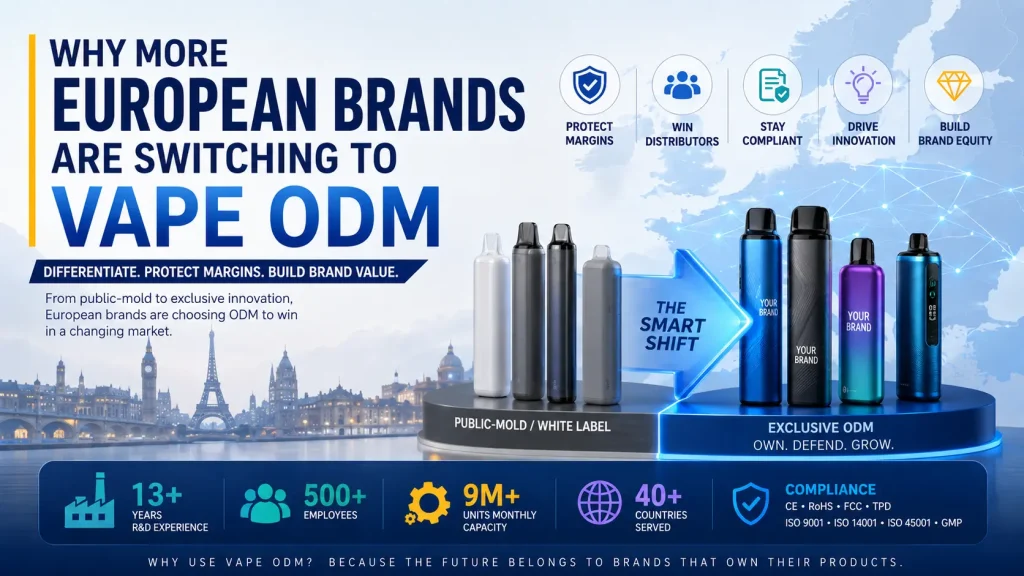
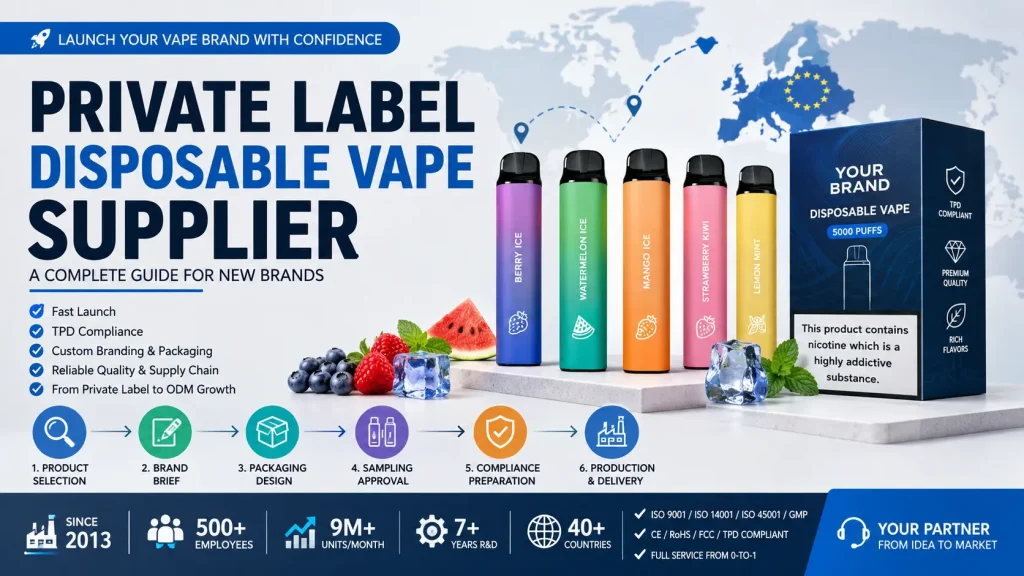
- Private Label – You start with an existing, validated platform (a specific device chassis, coil, and battery system). You then apply deep customization: your own branding, packaging, flavours, and often device colour and finish. The core hardware remains unchanged, meaning tooling is already done. This is the quickest path to a custom-feel product without funding new moulds. For most new European brands, this is the most practical entry point. The private label disposable vape supplier guide covers this model in depth.
- ODM (Original Design Manufacturing) – You brief a factory’s R&D team, and they develop a new product from scratch. This can include a unique device shape, mouthpiece, airflow design, coil architecture, and e-liquid formulations. The factory creates private moulds exclusive to your brand in your target territories. Your custom disposable vape becomes a product that literally does not exist anywhere else — the ultimate expression of differentiation.
Choosing which tier you’re operating at is the single most consequential early decision. Private label delivers speed and commercial realism. ODM delivers maximum brand defensibility. Both are valid; the right choice depends on your market access, budget, and competitive environment.
Why More Brands Are Choosing Custom Disposable Vapes
A shelf full of lookalike devices pushes consumers to make decisions on price alone. That dynamic destroys margins. A custom disposable vape — whether built on a private label platform or an exclusive ODM design — changes the equation.
Differentiation that registers instantly. On a crowded shelf, consumers make snap judgments based on device silhouette, colour, and finish. A unique form factor or an unexpected material stops the eye. Generic devices blend into the background.
Margin protection through perceived value. A product that looks bespoke can command a retail price €2–€5 higher than a generic alternative. That premium flows directly to your bottom line.
Repeat purchase driven by brand recognition. When a consumer remembers the shape of your device after it’s finished, they ask for it by name next time. One memorable custom disposable vape can anchor brand loyalty for years.
Exclusive retail partnerships. European distributors are increasingly selective. They prefer products that aren’t available from three other suppliers. An exclusive device — one mould, one brand, one country — gives them a reason to commit marketing and shelf space.
This is not just a manufacturing model; it’s a commercial strategy. Brands that invest in customisation are protecting their margins and building assets that competitors cannot easily replicate.
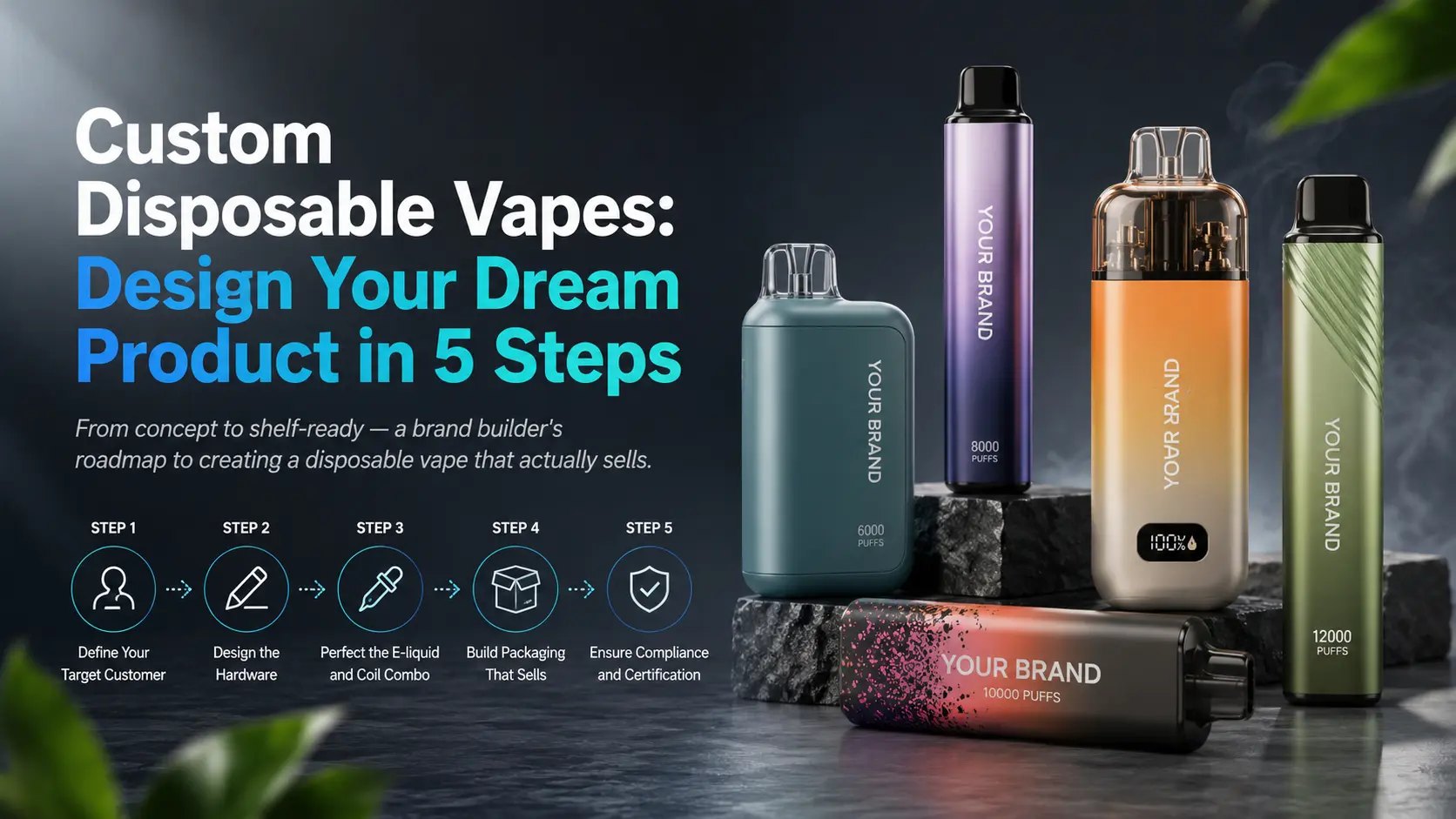
Step 1: Define Your Target Customer Before You Define the Product
Everything else flows from who you’re selling to. A custom disposable vape designed for a vape specialty shop in Hamburg needs a completely different approach from one built for a petrol station in Manchester.
UK buyers lean toward familiar fruit profiles, compact formats, and TPD-compliant 2+10ml tanks. Distributors expect clean compliance documentation and clear nicotine labelling. Shelf appeal matters, but legal readiness matters more.
German buyers reward restraint. Minimal packaging, matte finishes, and transparent oil chambers signal honesty. Bright, busy graphics often backfire. In this market, a custom disposable vape should look technical, clean, and premium.
French and Italian markets show stronger demand for dessert and tobacco-cream flavour profiles. Packaging should carry a sense of sophistication, not novelty.
Eastern European markets remain more price-sensitive. Higher puff counts and bold flavour intensity drive volume. Rechargeable disposable architectures that offer lower cost per puff can be a strong play here.
Map your consumer and channel before you open a catalogue. A product that performs brilliantly in one market may sit unsold in another — not because the hardware failed, but because the design language missed.
Step 2: Design the Hardware Around the User Experience
The physical form of your custom disposable vape is the biggest driver of perceived value. Consumers interact with it for hundreds of puffs; the logo matters for seconds.
Device shape and ergonomics. Flat profiles feel modern and fit pockets cleanly. Rounded profiles feel more organic in the hand. The silhouette itself can become a brand signature. Private label platforms offer a curated selection of existing shapes. Full ODM lets you invent one.
Battery and puff count alignment. In Europe, TPD restricts nicotine e-liquid to 2ml capacity. That realistically supports around 600–700 puffs on a standard coil. Claims of 1500+ puffs on a 2ml device are physically implausible and trigger creditability issues with distributors and consumers. An honest puff count — backed by a properly sized battery — builds trust. For non‑EU markets, higher capacities are possible but should be engineerd, not invented.
Coil technology. Mesh coils deliver more even heating, denser vapour, and better flavour consistency across the device’s lifespan. The per‑unit cost increase is modest (approx. 0.08–0.15). For a premium custom disposable vape, mesh is the default choice unless a specific throat‑hit profile demands round wire.
Airflow and draw resistance. This is invisible engineering that defines satisfaction. An experienced ODM partner calibrates airflow to match the coil resistance and liquid viscosity. The difference between a tight MTL draw and a loose DTL pull is not an accident — it’s a design parameter you control.
Optional features — displays and rechargeability. A small display screen showing battery and liquid level can add 0.20–0.50 per unit, but consumer testing consistently shows it boosts perceived value by more than the cost. Rechargeable disposable architectures are also growing fast, especially in markets under regulatory pressure. They satisfy consumer convenience while easing environmental concerns.
Every hardware decision should be traceable to a user need. If a feature doesn’t make the experience better, it’s only adding cost.
Step 3: Create a Visual Identity That Survives the Shelf
A custom disposable vape that blends in is a wasted investment. The visual system — colour, material, finish, logo, and packaging — works as a complete package.
Colour strategy. Many new brands default to gradient colours because they look dramatic on a screen. On a retail pegboard, a sea of gradients becomes a blur. Solid, distinctive colours create stronger “shelf blocking” — a single colour per SKU that registers instantly. Think of the most recognisable consumer brands; they own a color, not a rainbow.
Material and finish. Matte soft‑touch coatings feel premium and resist fingerprints. Glossy finishes photograph well but show handling wear faster. Transparent shells that reveal the liquid level build consumer trust, which is particularly valued in Germany and Scandinavian markets. Each finish costs differently and communicates a different quality signal.
Logo placement and proportion. Too small, and it’s invisible. Too large, and it looks like a knockoff. A logo placed on a single face, sized between 15% and 30% of the visible surface area, generally projects confidence. Test the device on a shelf mockup from two metres away. Can you read the brand? If not, the logo is too small.
Packaging as the first physical interaction. For many European consumers, the box is the first brand touchpoint. A matte‑finish slide box feels more considered than a glossy flip‑top. The unboxing moment shapes brand perception before the first puff. One brand that shifted from standard packaging to a textured slide box (an ~0.12 per‑unit cost increase) saw a measurable uplift in retail reorder rates within the first quarter. Small details compound.
Step 4: Customize Packaging for Retail Success
Packaging for a custom disposable vape has four jobs: attract on a crowded shelf, communicate compliance, convey brand positioning, and survive supply‑chain handling from factory to store.
Shelf impact by retail environment. A package designed for a vape shop counter — where staff hand products to customers — behaves differently from one on a convenience store pegboard where the consumer scans dozens of SKUs unaided. In self‑serve, the top third of the front face does the heaviest work. Put the brand element there, not the nicotine warning.
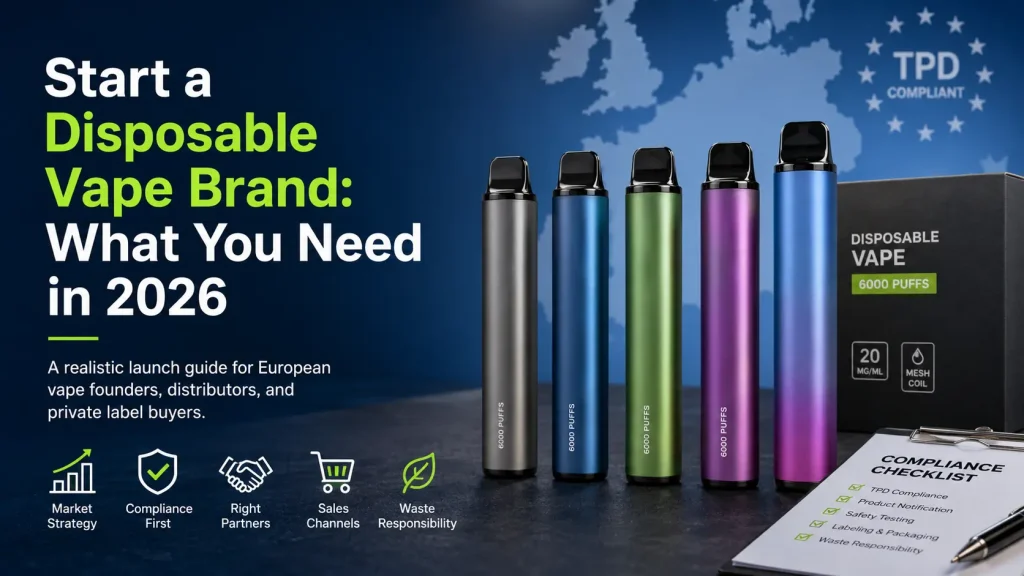
Compliance without destroying design. TPD mandates specific health warnings, nicotine declarations, and ingredient listings. Smart packaging integrates these requirements into the layout rather than treating them as last‑minute stickers. A well‑designed compliance panel frames the brand, it doesn’t fight it. For a full breakdown of what EU‑compliant vape packaging must include, the TPD compliant vape packaging guide explains warning area sizes, language requirements, and child‑resistant standards.
Sustainability pressures. European retailers increasingly ask about packaging recyclability. Cardboard and paper‑based packaging is becoming the default expectation in markets like Germany and the Netherlands. The material choice now carries brand positioning weight, not just logistics weight.
Multilingual realities. If you launch in France and Germany simultaneously, the packaging must carry warnings in both languages — or you run separate print runs. Plan this before artwork goes to the printer. Reprinting post‑production is a costly delay.
Step 5: Prototype, Test, and Refine Before You Commit
A spec sheet is not a product. Prototyping is where your decisions get validated or corrected. Rushing this stage is the most common reason custom disposable vape projects fail in the real world.
Sample types and what they reveal. A hand‑built sample proves fit and finish but not production consistency. A pilot‑run sample from actual tooling and assembly lines shows the product as it will reach consumers. Always evaluate both. A beautiful hand sample that can’t be reproduced at production speed is a design that needs rework.
Consumer testing outperforms internal opinion. Internal teams fall in love with their own designs. Real consumers notice different things: the mouthpiece feels sharp after ten puffs, the flavour drops off at 60% battery, the LED glows too bright in a dark room. A panel of 15–20 target‑market consumers, given devices with no branding, will surface issues that an office review misses. Fixing them during prototyping costs thousands; fixing them after a production run is exponentially more expensive.
The pilot order. Before committing to a full production volume, place a small pilot order (typically 3000–5000 units). Run it through your actual distribution channel. Monitor retailer feedback and defect rates for 30 days. If the pilot performs, scale with confidence. If it reveals issues, you’ve contained them to a manageable batch.
Vape ODM Factory’s 6S service system integrates compliance documentation and testing into this prototyping stage. You don’t develop the product and then check regulations — compliance runs in parallel, preventing the six‑month delays that occur when TPD notification is filed after production completes.
5 Common Custom Vape Design Mistakes to Avoid
Even experienced brand owners make these errors in their first custom disposable vape development.
Mistake 1: Designing for yourself, not the buyer. Your personal taste is less relevant than the preferences of the 25‑to‑35‑year‑old consumer at a shop counter in Birmingham or Bordeaux. Test with target consumers, not colleagues.
Mistake 2: Inflated puff counts. Claiming 2000 puffs on a 2ml TPD device destroys credibility with informed buyers and invites regulatory scrutiny. Honest puff counts build trust. Exaggerated numbers trigger chargebacks and distributor disputes.
Mistake 3: Compliance as an afterthought. Designing the product first and checking regulations later is an expensive sequence. TPD notification must be filed well before goods ship. Build compliance into the design brief from day one.
Mistake 4: Focus on ink, not structure. Brands pour energy into logo and colour while ignoring device shape, mouthpiece comfort, and draw consistency. Consumers interact with the physical product for hundreds of puffs. The structural experience matters more than the surface graphics.
Mistake 5: Choosing the wrong factory for the scope. A high‑volume ODM factory optimized for speed may struggle with a low‑volume custom project requiring intensive engineering support. A small boutique factory may overpromise on capacity. Match the partner to the brief.
How Much Does a Custom Disposable Vape Cost?
Cost visibility is rare in factory marketing. Here is an honest breakdown to set realistic expectations.
| Cost Element | Private Label (existing platform) | ODM (new design) |
|---|---|---|
| Tooling & moulds | Already amortised, minimal setup fee | €5,000 – €30,000+ |
| Unit production cost | €1.10 – €1.50 per device | €1.30 – €2.00 per device |
| Packaging design & print | Varies with complexity | Varies with complexity |
| Compliance & testing | In‑house if partner has lab | In‑house if partner has lab |
| Typical first‑order MOQ | 10,000 – 50,000 units | 10,000 – 50,000 units |
These are directional figures. The key takeaway: a custom disposable vape built via ODM involves a one‑time tooling investment that pays back over multiple production cycles. Private label avoids the tooling cost but offers a bit less structural uniqueness. Both can produce a strong, own‑brand product that competitors can’t easily replicate.
Custom Disposable Vape Design Checklist
Before approving samples or placing an order, run through this list.
- Target market and consumer profile defined in writing
- Device shape, battery, puff count, coil type, and airflow specified
- Colour, material, finish, and logo placement confirmed on physical samples
- Flavour portfolio (3–8 SKUs) reflects regional consumer preferences
- Packaging artwork includes correct health warnings, language, and compliance information
- TPD compliance pathway confirmed; notification submitted where required
- Pilot run scheduled before full‑scale production
- Logistics, incoterms, and customs clearance responsibility agreed in writing
- Reorder process and lead times confirmed
- Post‑launch feedback loop established to capture consumer and retailer input for V2
From Concept to Shelf — The Custom Disposable Vape Path
A custom disposable vape project is a system, not a series of isolated choices. Shape affects flavour delivery. Colour affects shelf visibility. Packaging affects perceived value. Compliance affects market access. When these elements reinforce each other, the product feels coherent and desirable. Coherent products earn trust. Trust earns repeat purchase.
You don’t need to design everything from scratch to create a device that performs in market. Many of today’s strongest European brands began with private label — a focused launch on a proven platform, with sharp branding and careful market targeting. They collected sell‑through data, refined their positioning, and then invested in exclusive ODM tooling once demand was proven.
The brands that win are not necessarily those with the biggest first budget. They are the ones that define their consumer clearly, execute the fundamentals without cutting corners, and build relationships with manufacturing partners who can handle design, compliance, and production as one coordinated process.
If you’re ready to develop a custom disposable vape for the European market, contact Vape ODM Factory with your product brief. Define your target market, preferred format, flavour direction, and budget range. The strongest projects begin with a clear brief and a partner able to take it from concept to shelf without gaps.