Getting a vape product onto European shelves involves more than finding a manufacturer and shipping units. Every nicotine-containing product sold in the EU must meet TPD vape compliance requirements before a single unit can be legally marketed — and the process takes longer, involves more documentation, and has more failure points than most new brands anticipate.
This guide covers what the regulation actually requires, what the notification process looks like from the inside, where submissions commonly fail, and how the most experienced brands structure their product development to avoid the delays that derail EU market entry.
What TPD Vape Compliance Actually Means for Your Brand
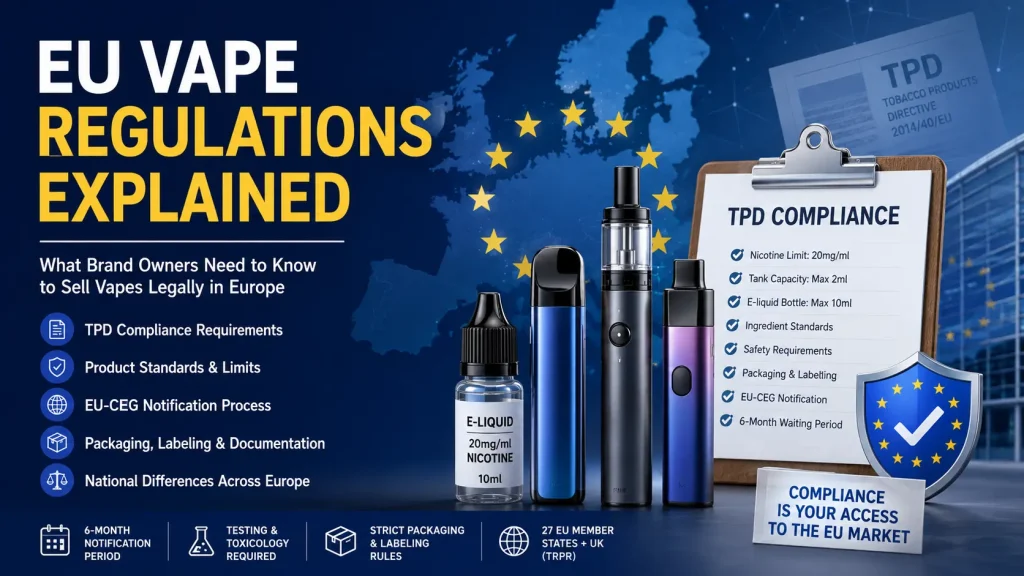
The EU Tobacco Products Directive (2014/40/EU) is the legislative framework governing all tobacco and nicotine products sold across EU member states. For e-cigarettes and refill containers, Article 20 sets out the product requirements, notification obligations, and packaging rules that apply to every brand — regardless of where the product was manufactured.
TPD vape compliance is not a certification. There is no pass/fail test at the end of the process. What the regulation requires is that you notify the relevant authority in each target member state before placing a product on market, and that the product you notify meets all defined requirements at the point of notification. If the product changes after notification — different nicotine concentration, reformulated e-liquid, revised packaging — you notify again.
The distinction matters because many brands approach compliance as something that happens at the end of development. The brands that move fastest through EU market entry treat it as something embedded in product definition from the beginning.
Which Vape Products Fall Under TPD Regulation?
This is more nuanced than most guides acknowledge. Not everything in a product range triggers the same requirements.
Products fully covered under Article 20
- Disposable e-cigarettes containing nicotine
- Closed pod systems with nicotine-containing pods
- Open system devices sold with or marketed alongside nicotine e-liquid
- Nicotine refill containers (e-liquids)
- Heated tobacco products (separate but related framework)
Products in regulatory grey zones
Nicotine-free e-liquids are not subject to Article 20 notification — but if the same product line includes both nicotine and nicotine-free variants under the same brand, packaging compliance requirements can still apply to the full range depending on how member states implement the directive locally.
Devices sold without e-liquid and without any nicotine content are generally outside the Article 20 scope — but may still require CE marking, RoHS compliance, and national safety registration depending on the market. Germany, France, and the Netherlands each have specific requirements here that go beyond the baseline directive.
If you’re building a product range that spans nicotine and non-nicotine variants, it’s worth establishing which SKUs trigger full TPD vape compliance from the start. Retrofitting this analysis after design is finalized adds cost.
The Core TPD Requirements Every Product Must Meet
Product capacity and nicotine limits
These are the numbers most guides repeat without context:
- E-cigarette tanks and pods: maximum 2ml capacity
- Nicotine concentration: maximum 20mg/ml
- Refill containers: maximum 10ml volume per unit
The 2ml limit is verified physically — not from a specification sheet. During the prototype and sampling phase, fill volume is measured under testing conditions, accounting for thermal expansion and fill variation. A device that holds 2.05ml under lab conditions fails, even if the nominal specification says 2ml. This is a known failure point in first-sample submissions from factories that don’t run internal compliance testing.
For brands requesting prototypes before launching, the vape ODM sample request process should include physical volume verification as a mandatory checkpoint — not an afterthought.
Ingredient and emissions standards
All ingredients in the e-liquid formulation must be listed with CAS numbers. Certain additives are explicitly prohibited under the directive, including vitamins and other additives that create the impression of health benefits, colorants that affect inhalation aerosol color, and caffeine, taurine, or other stimulants.
Emissions testing is required to demonstrate that the aerosol does not contain substances at levels harmful to human health in the context of intended use — the testing framework specifically covers carbonyl compounds, metals, and other aerosol constituents. This testing must be performed by an accredited laboratory and the results submitted as part of the notification technical file.
Changing the e-liquid formulation after notification — even a minor ingredient adjustment — triggers a new submission. This is why formulation lock happens before testing, not after.
Safety and construction requirements
- Child-resistant closures on all refill containers, compliant with EN ISO 8317
- Tamper-evident packaging on retail units
- Leak-resistant filling mechanism on refillable devices (the design must prevent e-liquid release during normal use)
- Protection against breakage and leakage for devices with a tank component
- A mechanism that ensures even and consistent dosing where relevant to the device type
The leak-resistant mechanism requirement is design-dependent. Some device architectures — particularly certain pod formats with side-fill or top-fill mechanisms — have structural characteristics that make leak resistance harder to achieve consistently under real-world conditions. This is something that engineering review during the development phase surfaces; it rarely appears in standard factory product catalogues.
Packaging and labeling
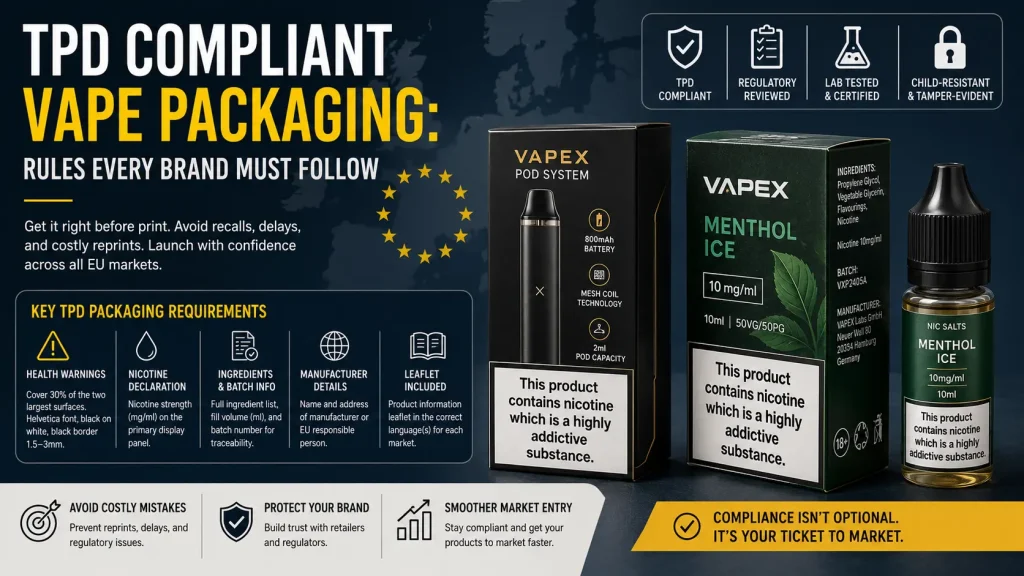
TPD vape compliance extends directly to how a product is packaged and labeled. The requirements include health warnings covering 30% of the two largest external surfaces, nicotine concentration statements on the primary display panel, full ingredient listings in descending weight order, batch numbers, and EU-authorized importer or manufacturer details.
The packaging requirements are detailed enough to deserve their own treatment. For a full breakdown of what must appear, what’s prohibited, and where brands consistently make avoidable mistakes before going to print, the TPD compliant vape packaging guide covers the execution requirements in detail.
How the TPD Notification Process Works
The notification requirement is often described as “submit to EU-CEG six months before launch.” That’s technically accurate and operationally incomplete. Here’s what the process actually involves.
Step 1: Product and formulation finalization
Nothing can be submitted until the product is fully defined. This means confirmed e-liquid formulation with locked ingredients and concentrations, confirmed device specifications including verified fill volume and nicotine delivery mechanism, and confirmed packaging artwork in final form. Changes after submission require a new notification.
Step 2: Accredited laboratory testing
Emissions testing must be conducted by an EU-recognized accredited laboratory. The testing covers aerosol constituents at defined puff parameters. Depending on the laboratory’s current workload and the complexity of the product, testing timelines typically run 2–4 weeks. Rush scheduling is possible at some labs but adds cost.
Note: testing is product-specific. If you’re launching three nicotine concentrations across two device variants, that’s six separate products — each requiring its own test report.
Step 3: Technical file compilation
The submission file includes the emissions test report, full ingredient list with CAS numbers, toxicological data for each ingredient, product specifications, packaging artwork, and manufacturer details. Assembling this file correctly — in the format required by the EU Common Entry Gate (EU-CEG) system — is where many brands encounter delays. Missing documents, incorrect formatting, and incomplete ingredient declarations are the most common reasons for rejection at this stage.
Step 4: EU-CEG submission
Submissions are made through the EU-CEG portal, separately for each member state where the product will be sold. If you’re entering Germany, France, and the Netherlands simultaneously, that’s three separate submissions — each potentially with different language requirements on supporting documentation and local-language packaging files.
The submission triggers the six-month statutory notification period. The clock starts from the submission date. The product cannot be placed on market in that member state until the period has elapsed.
Step 5: Waiting period and parallel production planning
Six months is a long window. Brands that use it well are running production planning, inventory buildup, logistics setup, and retailer partnership conversations in parallel. Brands that wait for notification confirmation before planning production add six months to their actual market entry — not the statutory waiting period, but an additional six months of inactivity.
The notification period is not a passive waiting phase. It’s a production window.
Documents Required for a Successful TPD Submission
| Document | Who Provides It | Common Failure Point |
|---|---|---|
| Emissions test report | Accredited laboratory | Wrong puff parameters used in testing |
| Full ingredient list with CAS numbers | Manufacturer / e-liquid supplier | Missing CAS, incomplete sub-component listing |
| Toxicological data per ingredient | Manufacturer + toxicologist | Insufficient data for novel or uncommon ingredients |
| Device technical specifications | Manufacturer | Fill volume mismatch between spec and physical verification |
| Packaging artwork (final version) | Brand + packaging supplier | Warning format errors, wrong language for target market |
| Manufacturer declaration | Manufacturer | Missing or outdated ISO certification |
| EU responsible person / importer declaration | Brand’s EU entity or appointed representative | Incorrect registered address or outdated appointment |
The ingredient listing requirement is stricter than many brands expect. It requires declaration of every ingredient in the e-liquid, including trace components in carrier materials and flavoring compounds. If your e-liquid manufacturer uses a proprietary flavoring blend without full sub-ingredient disclosure, that creates a documentation gap that will block your submission.
This is worth verifying with your manufacturer before testing begins — not after the test report is complete and the file is ready to submit.
The Most Common TPD Vape Compliance Failures
Nicotine concentration declared incorrectly
The declared concentration must match the laboratory-verified concentration within an acceptable tolerance. A product specified at 18mg/ml that tests at 19.2mg/ml may not fail the 20mg/ml limit — but if the declaration says 18mg/ml and the test report says 19.2mg/ml, the submission has an inconsistency that triggers rejection.
Declare what the product actually contains, verified by testing — not what the formulation was designed to contain.
Incomplete ingredient disclosure
A submission that lists “flavoring” as a single ingredient without sub-component CAS numbers is incomplete under the directive requirements. Regulators in Germany and the Netherlands have both rejected submissions on this basis — requiring resubmission with full flavoring ingredient disclosure, which resets the six-month clock.
The fix is straightforward: require full ingredient transparency from your e-liquid supplier before agreeing to use any flavoring compound. This should be a contractual requirement in your supply agreement, not a question asked during the submission process.
Packaging artwork submitted before final version
Brands under time pressure sometimes submit packaging files before artwork is fully locked. If the artwork changes after submission — even a minor revision to health warning placement or a language correction — the submission is invalidated. The packaging file submitted must be exactly what goes to print.
For this reason, packaging compliance review and artwork finalization should be completed before the submission file is assembled — not in parallel with it.
Submitting only to EU-CEG and assuming coverage
EU-CEG submission covers most member states, but some markets have additional national requirements. Italy requires ISS notification separately. Spain’s AEMPS process has specific documentation requirements for certain product categories. Assuming that a successful EU-CEG filing means you’re compliant across all 27 member states is a mistake that creates legal exposure in specific markets.
Treating notification as a one-time event
TPD vape compliance is ongoing, not a one-time milestone. Any material change to a notified product — formulation adjustment, device modification, packaging revision — requires a new notification. Brands that make incremental product improvements without tracking notification implications discover the problem when products are pulled from market by national regulators. Build a change management process that flags TPD implications for every product modification decision.
How Long TPD Compliance Actually Takes
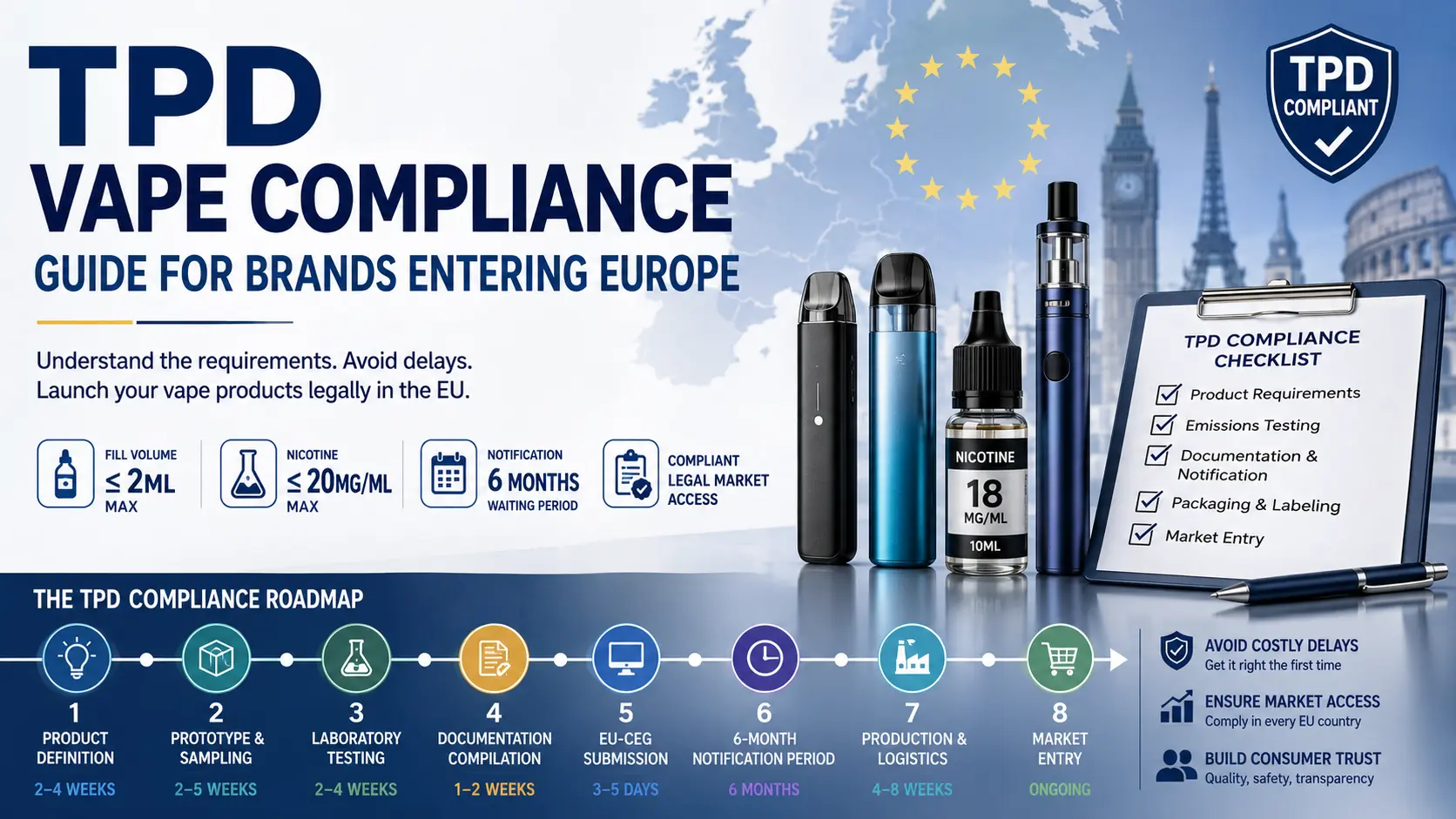
Most guides quote the six-month notification period and stop there. Here’s the realistic full timeline from product concept to legal market entry:
| Phase | Activity | Realistic Timeline |
|---|---|---|
| Product definition | Formulation lock, spec confirmation, device engineering | 2–4 weeks |
| Prototype and sampling | Physical verification of fill volume, leak resistance, CRC | 2–5 weeks |
| Accredited laboratory testing | Emissions testing, aerosol analysis | 2–4 weeks |
| Documentation compilation | Technical file assembly, toxicology, artwork | 1–2 weeks |
| EU-CEG submission | Portal submission, per-market filing | 3–5 working days |
| Statutory notification period | Six-month waiting period | 6 months |
| Production and logistics | Manufacturing run, QC, freight, customs | 4–8 weeks |
| Market entry | Retailer onboarding, first shipment | Ongoing |
From product definition to first sale: realistically 9–11 months for a brand doing this for the first time, running steps sequentially.
Brands that run testing in parallel with documentation prep, and production planning in parallel with the notification period, can compress this to 7–8 months. That compression requires tight coordination between the brand, the manufacturer, the laboratory, and the regulatory filing team — and it requires knowing exactly what needs to happen and when, from the first week of development.
The six-month notification period is not the bottleneck. For most brands, the bottleneck is the time between product concept and a submission-ready technical file. Emissions retesting after a formulation change, artwork revisions that delay packaging sign-off, ingredient documentation gaps that surface during file assembly — these are what push timelines to 12 or 14 months.
How to Build a TPD-Ready Product from Day One
The fastest path through TPD vape compliance is not to move faster at the end — it’s to build correctly at the start.
Lock formulation before engineering is complete
E-liquid formulation and device engineering interact. A formulation change affects which coil resistance delivers the intended vapor output. A coil change affects emissions results. If these are developed sequentially — formulation finalized after device engineering is locked — you’re likely to face at least one formulation revision cycle. Develop them in parallel, with a hard lock date for both before testing is commissioned.
Design capacity compliance into the hardware specification
The 2ml limit is not just a fill volume number — it’s an engineering constraint that affects tank geometry, fill port design, and the physical construction of the device. A device designed to hold 2ml exactly, measured under testing conditions including thermal variation and fill tolerance, requires deliberate engineering. Request verification from your manufacturer that the device architecture achieves the specified fill volume under standardized testing conditions, with documentation. Don’t accept “nominal 2ml” without a physical verification process.
Start packaging design with compliance constraints, not after
Warning block dimensions, mandatory information placement, and language requirements should be defined before any design work begins. A packaging designer who receives these constraints upfront produces a compliant layout. A designer who receives a finished concept and is then asked to add a 30% warning block produces a compromised design that often requires structural revision. The constraint is the brief, not a revision note.
Build traceability into production planning
Batch numbers, ingredient traceability, and manufacturing records are compliance requirements — but they’re also production management tools. A manufacturer with ISO 9001-certified quality management systems will have these processes in place as standard. A manufacturer without documented batch traceability creates a compliance gap that only becomes apparent when a regulatory audit requests production records. Verify this before signing any production agreement.
How the Right Manufacturing Partner Affects Your Compliance Timeline
TPD vape compliance is not purely a brand-side responsibility. A significant portion of the technical file — emissions testing, ingredient documentation, device specification verification, manufacturing declarations — is generated by the manufacturer. How your factory handles compliance support directly affects how fast you can move.
The practical differences between a manufacturer that has done this and one that hasn’t:
| Task | Experienced Factory | Factory Without EU Experience |
|---|---|---|
| Fill volume verification | Physical testing, documented results | Nominal specification only |
| Ingredient documentation | Full CAS list, sub-ingredient disclosure | “Flavoring” as a single entry |
| Emissions testing coordination | In-house pre-testing, lab liaison | Brand arranges independently |
| Packaging compliance review | Pre-print review as standard process | Not included |
| TPD notification filing | Handled directly by regulatory team | Brand’s responsibility |
| Change management | Flags TPD implications of product changes | Not tracked |
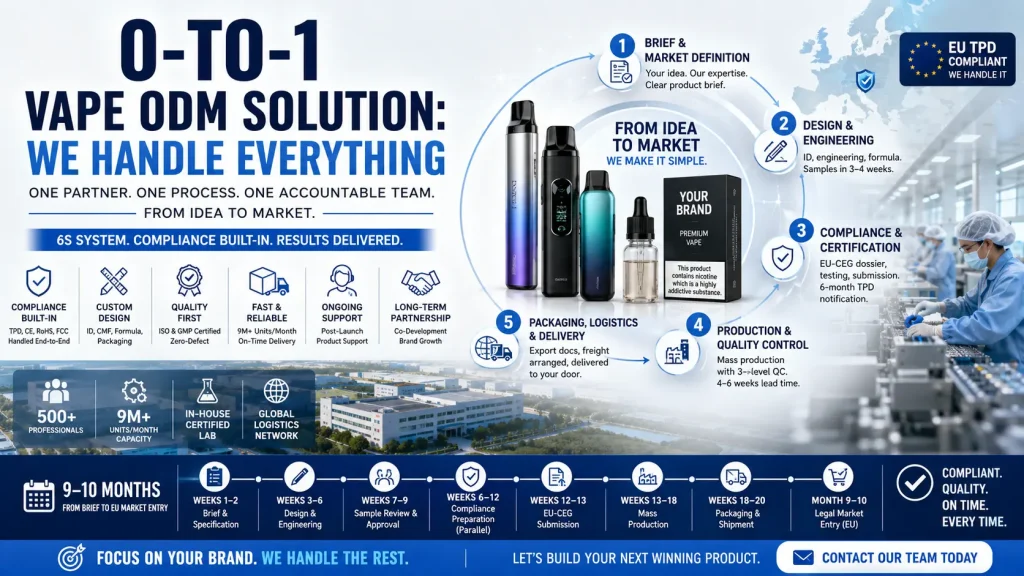
At Vape ODM Factory, TPD vape compliance support is part of the 6S service system — which means the regulatory team handles notification filing directly, not as a recommendation to seek external help but as an executed service. Brands working with the factory for EU market entry don’t need a separate regulatory consultant for the notification process. The factory runs it.
This matters most at the documentation stage. The technical file assembly that typically takes brands 1–2 weeks to compile — coordinating between manufacturer, laboratory, e-liquid supplier, and packaging supplier — is managed from one location when all those functions sit within the same production and compliance infrastructure.
The full product range available through the factory covers disposables, closed pod systems, and open devices — all developed with EU market requirements embedded in the engineering brief from the start.
TPD Vape Compliance Checklist Before You Launch
Run through this before any product goes to market in the EU. Every item corresponds to a real enforcement point.
Product compliance
- Fill volume verified at ≤2ml under laboratory testing conditions (physical measurement, not specification only)
- Nicotine concentration confirmed at ≤20mg/ml by accredited laboratory
- All ingredients declared with CAS numbers, sub-components of flavoring compounds included
- Prohibited additives verified absent from formulation
- Emissions test report complete from an EU-recognized accredited laboratory
- Leak resistance verified under physical testing (not assumed from design)
- Child-resistant closure certified to EN ISO 8317
Notification compliance
- EU-CEG submission completed for each target member state
- Six-month notification period elapsed before any product placed on market
- Additional national notifications confirmed for Italy (ISS) and Spain (AEMPS) if applicable
- Technical file complete and internally consistent — no discrepancies between declared specs and test results
Packaging compliance
- Health warnings covering ≥30% of the two largest external surfaces (measured on finished box)
- Warning format correct: Helvetica, black on white, 1.5–3mm black border
- Nicotine concentration on primary display panel
- Ingredient list, batch number, fill volume, manufacturer details all present
- Leaflet included in correct language(s) for each market
- Packaging artwork submitted to EU-CEG matches final printed version exactly
Ongoing compliance
- Change management process in place to flag product modifications that trigger new notification
- Batch records maintained for production traceability
- Market surveillance monitoring active for regulatory updates in each target country
What Happens When You Get This Right
TPD vape compliance is a market-entry requirement, not a competitive disadvantage. Every brand selling legally in Europe has cleared the same bar. What determines whether compliance becomes a constraint or a launchpad is when you start working on it and how well your manufacturing infrastructure supports the process.
Brands that embed TPD vape compliance into their product brief from day one — with a manufacturer who handles the technical documentation, manages the notification filing, and reviews packaging before print — reach market in 7–8 months. Brands that treat compliance as a final step discover it’s not a step at all — it’s a recursive loop of retesting, revisions, and resubmissions that can push launch well past 12 months.
The six-month notification period is fixed. Everything before it is within your control.
If you’re planning an EU market entry and want to understand what the compliance process looks like for your specific product category and target markets, the team at Vape ODM Factory handles this process directly — from prototype compliance verification through notification filing and production planning.