Most European brands entering the vape market don’t fail because of bad products. They fail because they underestimate how many moving parts sit between a product idea and a finished unit on a retail shelf. A turnkey vape manufacturing service exists to solve exactly that problem — one factory, one system, one point of accountability from concept through delivery. But what does that actually look like on the inside? This article breaks down the real mechanics: what happens at each stage, who does what, where projects typically stall, and how parallel execution separates a genuine turnkey vaping solution from a factory that simply lists services on a webpage.
What Is a Turnkey Vape Manufacturing Service?
A turnkey vape manufacturing service means a single manufacturing partner handles every function required to bring a vape product from zero to market-ready. Design, engineering, mold tooling, e-liquid formulation, compliance filing, quality control, packaging, production, and logistics — all executed under one roof.
The word “turnkey” comes from real estate: you get the keys, you turn them, and everything works. In vape manufacturing, it means the brand provides the market vision and sales strategy. The factory delivers finished, certified, shelf-ready products.
This is fundamentally different from traditional sourcing, where a brand coordinates between an industrial designer in one country, a mold shop in another, a separate e-liquid lab, a third-party compliance consultant, and a contract manufacturer. That fragmented model creates gaps — in communication, in timelines, and especially in regulatory accountability.
If you’re still unclear on how ODM fits into this picture, our guide on what a vape ODM manufacturer actually does explains the foundational model. A turnkey vaping solution builds on that ODM framework by adding compliance execution, logistics, and post-production support into a single integrated system. The brand’s job becomes clear: define the market, approve milestones, and sell the product.
Why Multi-Vendor Sourcing Breaks Down for Vape Products
Before understanding how a turnkey vape manufacturing service works internally, it helps to understand why brands seek one in the first place. The answer is almost always the same: multi-vendor coordination collapsed.
Vape products are uniquely complex. They combine consumer electronics (battery, chipset, sensors), chemical formulation (e-liquid, nicotine salts), precision engineering (airflow, coil resistance), and heavy regulatory requirements (TPD, EU-CEG, TRPR). No other consumer product category packs this many disciplines into a single SKU.
When brands try to manage these disciplines across separate vendors, common failure points emerge:
- The industrial designer creates a form factor the mold shop can’t produce at target cost
- The e-liquid lab finalizes formulations before the compliance team reviews ingredient restrictions
- TPD notification gets filed after production starts, triggering a 6-month market entry delay
- Packaging artwork doesn’t meet country-specific labeling requirements
- Nobody owns the overall timeline, so delays compound silently
A full service vape factory eliminates these gaps by keeping every discipline inside one coordinated system. When the design team, mold engineers, formulation chemists, and compliance specialists sit in the same building and report to the same project manager, conflicts get resolved in hours rather than weeks.
The 7 Stages of a Real Turnkey Vape Project
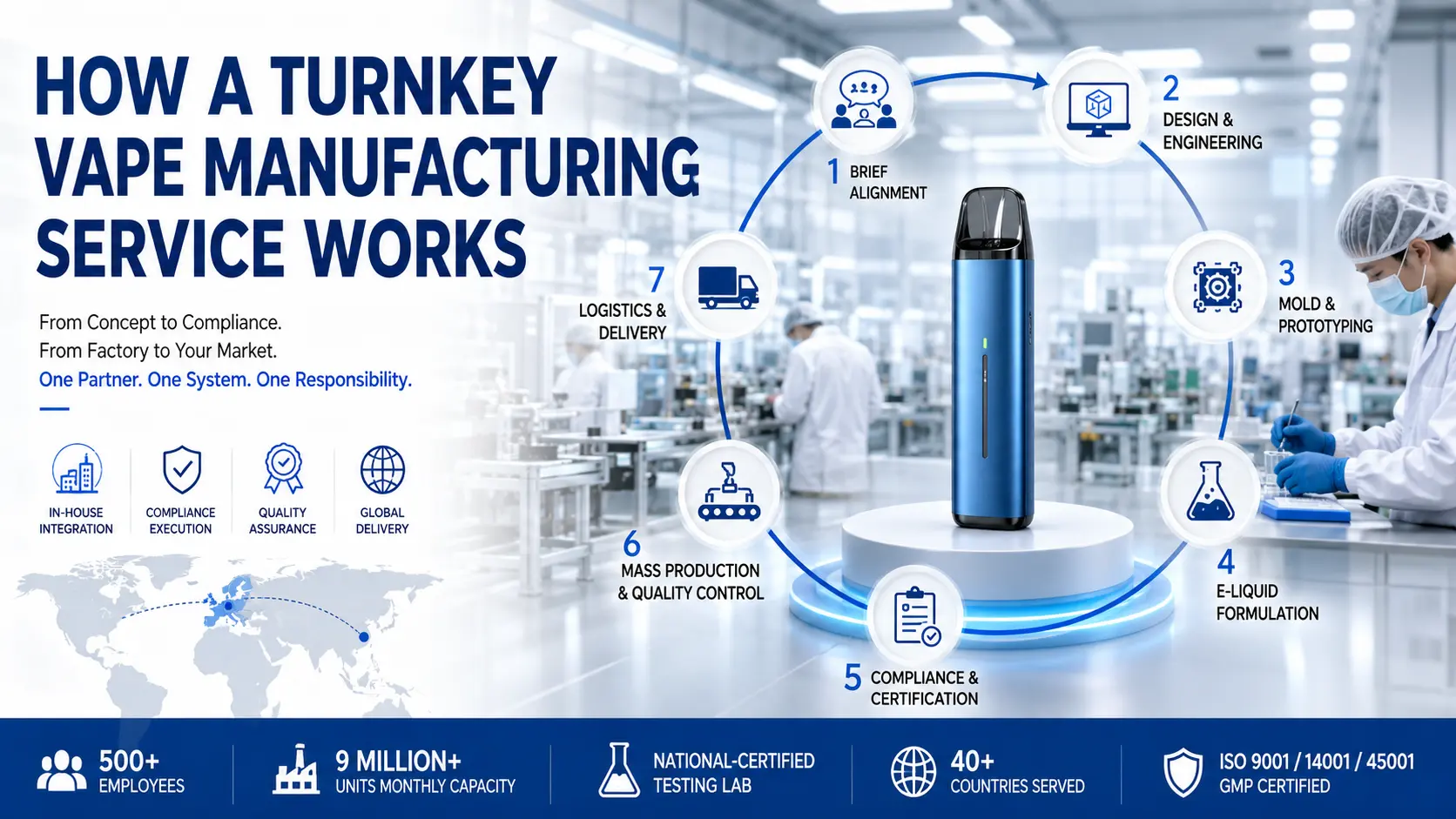
Most articles about turnkey manufacturing list the stages. Few explain what actually happens inside each one, who is responsible, and where the handoff points are. Here’s how a real end to end vape production project unfolds — based on how Vape ODM Factory has executed projects for brands across 40+ countries since 2013.
Stage 1 — Market & Product Brief Alignment (Week 1–2)
The project starts with a structured brief, not a casual conversation. The factory’s project team needs specific inputs from the brand:
- Target market and country-specific regulations
- Product category (disposable, pod system, replacement pod)
- Puff count or pod capacity targets
- Flavor direction and nicotine strength
- Price positioning and target unit cost
- Packaging requirements and branding assets
- Estimated annual volume
This stage matters more than most brands realize. A vague brief is the single most common reason turnkey projects get delayed later. The factory uses this brief to determine mold complexity, compliance filing strategy, and production planning.
Who is responsible: Brand provides market inputs. Factory’s project management and R&D teams translate them into a technical specification.
Stage 2 — Industrial Design & Technical Planning (Week 2–4)
Once the brief is locked, the factory’s industrial design team produces 3D renderings, ergonomic studies, and material specifications. Simultaneously, the hardware engineering team defines the internal architecture: battery capacity, chipset selection, coil type, airflow design.
This is where a turnkey vape manufacturing service differs most from outsourced design. The designers and engineers work in the same team. They don’t create beautiful concepts that can’t be manufactured — they design for production from day one.
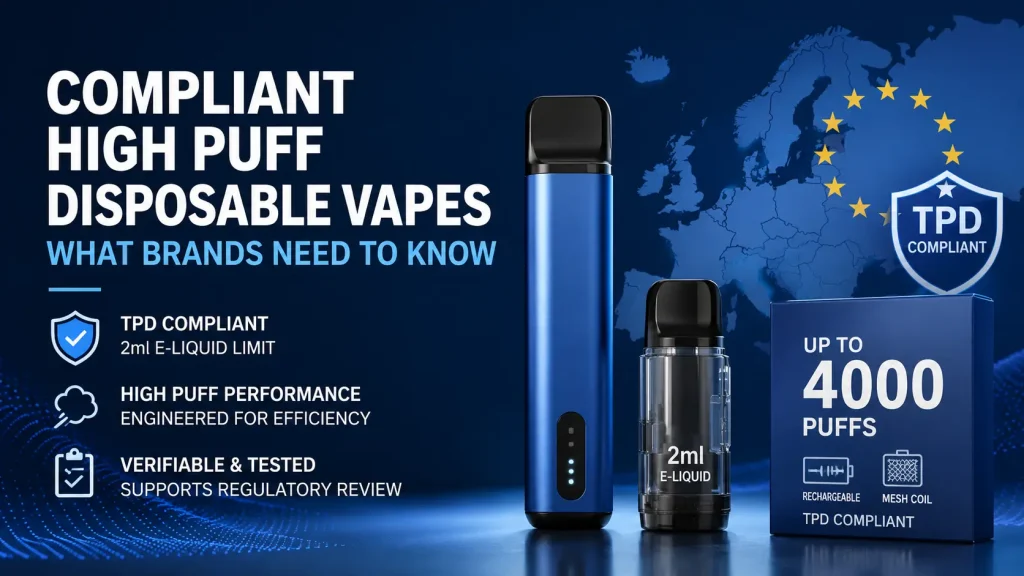
At Vape ODM Factory, this stage also triggers the compliance team. They review the proposed specifications against target market regulations before any tooling investment begins. If a 2ml tank limit applies (EU TPD), the design accounts for it now — not after the mold is cut.
Who is responsible: Factory’s design, engineering, and compliance teams. Brand approves visual direction and confirms specifications.
Stage 3 — Mold Development & Prototyping (Week 4–9)
Mold development is the most capital-intensive stage. Tooling costs range from €5,000 for simple single-cavity molds to €50,000+ for complex multi-cavity production tools. Development takes approximately 35 days. For a detailed breakdown of where your investment goes at each stage, see our article on how vape manufacturing costs are structured.
During this period, the factory produces T1 samples (first shots from the mold), evaluates dimensional accuracy, tests assembly fit, and refines surface finish. Most projects require 2–3 sample iterations before approval.
Critical point: mold development and TPD compliance filing should run in parallel. At Vape ODM Factory, the compliance team initiates EU-CEG notification during Week 4–8, while the mold is being cut. This parallel execution prevents the 6-month TPD waiting period from sitting on top of the production timeline.
Who is responsible: Factory’s tooling department and QC team. Brand approves samples at each iteration.
Stage 4 — E-Liquid Formulation & Optimization (Week 4–8)
Formulation runs parallel to mold development. The factory’s flavor chemists develop recipes based on the brand’s flavor direction, then optimize for the specific hardware. Coil resistance, wicking material, and airflow all affect flavor delivery — so formulation can’t happen in isolation from hardware.
This is another area where a full service vape factory outperforms fragmented sourcing. When the formulation lab and hardware team are in the same facility, they iterate together. A flavor that tastes flat on a 1.2Ω coil might perform perfectly at 1.0Ω — and that adjustment happens in days, not weeks of back-and-forth emails between separate vendors.
The compliance team also reviews all ingredients against EU TPD restricted substance lists and CLP classification requirements during this stage.
Who is responsible: Factory’s formulation lab and hardware team. Brand approves final flavor profiles.
Stage 5 — Compliance & Certification Filing (Week 4–14)
For European markets, compliance isn’t a checkbox at the end — it’s a parallel workstream that starts early and runs throughout the project. A properly structured turnkey vape manufacturing service integrates compliance into the development process rather than bolting it on after production.
Key compliance activities include:
- EU-CEG/TPD notification submission (6-month statutory waiting period)
- Emissions testing in certified laboratories
- CLP-compliant labeling and packaging review
- CE marking documentation
- TRPR registration (UK market)
- Country-specific requirements (France ANSES, Belgium notification, etc.)
At Vape ODM Factory, the compliance team doesn’t advise — they execute. The factory holds its own EU-CEG account and directly submits notifications on behalf of client brands. This eliminates the common bottleneck where brands hire third-party consultants who don’t understand the product’s technical specifications.
Who is responsible: Factory’s regulatory team handles all filings. Brand provides company registration details and market selection.
Stage 6 — Mass Production & Quality Control (Week 10–16)
Once samples are approved and compliance filings are submitted, production begins. For a factory with 500+ employees and 9 million units monthly capacity, scaling from sample to mass production is a matter of scheduling — not capability building.
Quality control in a turnkey system means the same team that developed the product also oversees its production. At Vape ODM Factory, the national-certified testing laboratory runs inline inspections, not just final audits. Every batch undergoes:
- Leak testing
- Battery safety verification
- Puff count consistency checks
- Flavor output measurement
- Visual inspection against golden samples
The factory’s ISO 9001, ISO 14001, ISO 45001, and GMP certifications provide the management system framework. But what actually prevents defects is the fact that QC engineers participated in the development stages — they know exactly what to look for.
Who is responsible: Factory’s production and QC teams. Brand receives inspection reports and can request third-party audits.
Stage 7 — Logistics & Market Delivery (Week 14–18)
Vape products contain lithium batteries and liquid — both classified as restricted cargo. Air freight (5–7 days to Europe) is the standard shipping method, handled through carriers certified for DG (dangerous goods) shipments.
A genuine turnkey vaping solution includes logistics coordination: export documentation, customs classification, carrier booking, and delivery tracking. The brand receives goods at their warehouse, ready for distribution.
Who is responsible: Factory’s logistics team manages export. Brand handles import clearance and local distribution.
What Happens Behind the Scenes: Parallel Execution
The timeline above shows 14–18 weeks from brief to delivery. But that’s only possible because multiple workstreams run simultaneously. In a sequential process, the same project would take 9–12 months.
Here’s what parallel execution looks like inside a real turnkey vape manufacturing service:
| Week | Design Team | Mold/Hardware | Formulation Lab | Compliance | Production |
|---|---|---|---|---|---|
| 1–2 | Brief alignment | — | — | Regulation mapping | — |
| 2–4 | 3D design + DFM | Material sourcing | Flavor direction | Pre-filing review | — |
| 4–8 | Design freeze | Mold cutting | Recipe development | EU-CEG submission | — |
| 8–10 | Packaging design | T1–T3 samples | Hardware-flavor matching | Emissions testing | Pilot run planning |
| 10–14 | Artwork finalization | Tooling refinement | Final approval | Documentation | Ramp-up |
| 14–18 | — | — | — | — | Full production + ship |
This parallel structure is what separates a genuine end to end vape production partner from a factory that simply offers multiple services but executes them sequentially. The difference is 3.5–5 months versus 9–12 months to market.
Turnkey vs OEM vs White Label: Understanding the Models
Brands searching for a turnkey vape manufacturing service often compare it against OEM and white label options. Here’s how they differ:
| Factor | Turnkey/ODM | OEM | White Label |
|---|---|---|---|
| Product design | Factory creates from scratch | Brand provides design | Pre-existing product |
| Mold ownership | Private mold, exclusive to brand | Brand-owned or shared | Factory’s existing mold |
| Customization level | Full (form, function, formula) | Partial (brand specs) | Minimal (logo/color only) |
| Compliance handling | Factory manages | Shared responsibility | Usually brand’s problem |
| Time to market | 3.5–5 months | 2–4 months | 2–6 weeks |
| Upfront investment | €30,000–€50,000 | €15,000–€30,000 | €5,000–€10,000 |
| Brand differentiation | Maximum | Moderate | Low |
| Exclusivity | One brand, one country | Negotiable | None |
If you’re weighing these models against each other, our article on OEM vs ODM for vape brands goes deeper into the strategic tradeoffs. The short version: a turnkey vaping solution makes sense when the brand wants a unique product that competitors cannot replicate. The private mold policy (one client, one country) ensures market exclusivity.
White label works for testing a market quickly. OEM sits in between — suitable when the brand has internal design capability but needs manufacturing support. For European brands building long-term market positions, the turnkey model typically delivers the strongest ROI despite higher initial investment.
Common Reasons Turnkey Vape Projects Fail
Not every turnkey project succeeds. Understanding failure patterns helps brands avoid them:
1. Vague or Shifting Product Brief
When the brand hasn’t defined its target market, price point, or product category clearly, the factory builds on unstable ground. Every change after mold cutting costs time and money. A brief that changes three times can add 6–8 weeks to the timeline.
2. Compliance Filed Too Late
The EU TPD requires a 6-month notification period before a product can legally be sold. If a brand waits until production is complete to file, they sit on finished inventory for half a year. This is the most expensive mistake in European vape market entry — and it’s entirely preventable through parallel execution.
3. Unrealistic Timeline Expectations
Some brands expect finished products in 6 weeks. A genuine end to end vape production process — with custom tooling, original formulation, and proper compliance — takes 3.5–5 months minimum. Factories that promise faster timelines are usually cutting corners on testing or compliance.
4. Sample Approval Loops
Every sample revision adds 1–2 weeks. Brands that involve too many internal stakeholders without clear decision authority can get stuck in approval loops. The fix: designate one person with final sign-off authority before the project starts.
5. Choosing a Factory Without Integrated Compliance
Many factories offer “compliance support” — meaning they’ll connect you with a third-party consultant. That’s not turnkey. A real turnkey vape manufacturing service includes direct regulatory execution: the factory files your TPD notifications, manages your EU-CEG submissions, and ensures packaging meets CLP requirements. If compliance is outsourced, it’s not truly turnkey.
How to Evaluate a Turnkey Vape Manufacturing Partner
Not every factory claiming “turnkey” actually delivers it. Here’s a practical evaluation framework:
Capability checklist:
- Does the factory have in-house industrial design (not outsourced)?
- Do they own their mold shop, or subcontract tooling?
- Is there an on-site e-liquid formulation laboratory?
- Do they hold ISO 9001, ISO 14001, and GMP certifications?
- Can they show a national-certified testing lab?
- Do they directly submit EU-CEG notifications, or just “advise”?
- What is their monthly production capacity?
- Can they provide references from European brand clients?
- Do they offer private mold exclusivity per market?
- What is their standard project timeline from brief to delivery?
The answers to these questions separate genuine full service vape factory operations from assemblers who coordinate subcontractors and call it “turnkey.”
How the 6S System Executes a Turnkey Vape Manufacturing Service
At Vape ODM Factory’s 6s system, the turnkey process is structured around the 6S operational framework. Each “S” represents a functional pillar that runs throughout the project:
Regulatory — Compliance team engages from Week 1. They map target market requirements, initiate TPD filings in parallel with development, and ensure every component meets regulatory standards before production begins.
Customization — Industrial design, hardware engineering, and formulation teams create a product that is exclusively yours. Private mold, proprietary recipe, unique form factor — one brand, one country.
Quality — National-certified laboratory conducts testing at every stage. Not just final inspection — inline quality gates from prototype through mass production. ISO 9001 and GMP systems provide the framework.
Delivery — Production planning locks timelines at project kickoff. With 9 million units monthly capacity and 500+ employees, scaling is a scheduling decision, not a capability constraint.
Support — Dedicated project manager serves as single point of contact. Weekly progress updates, milestone approvals, and issue resolution without the brand needing to coordinate between departments.
Partnership — Long-term relationship structure. The factory invests in understanding your market, your consumers, and your growth trajectory. Repeat orders benefit from established tooling, approved formulations, and streamlined compliance renewals.
This system has been refined since 2013 across projects for brands in 40+ countries. The core principle: the brand focuses on sales and market building. The factory handles everything else.
What the Brand Must Provide at Each Stage
Most articles about turnkey manufacturing focus entirely on what the factory does. But the brand has responsibilities too. Here’s a clear responsibility matrix:
| Stage | Factory Delivers | Brand Provides |
|---|---|---|
| Brief | Technical specification, feasibility analysis | Market data, target consumer profile, budget range |
| Design | 3D renders, DFM analysis, material specs | Visual direction approval, brand guidelines |
| Mold/Sampling | T1–T3 samples, dimensional reports | Timely sample feedback (within 3–5 days) |
| Formulation | Recipe development, stability testing | Flavor direction, taste approval |
| Compliance | EU-CEG filing, emissions testing, documentation | Company registration details, market list |
| Production | Finished goods, QC reports | Purchase order, payment milestones |
| Logistics | Export handling, carrier coordination | Import clearance, warehouse receiving |
The fastest turnkey projects are ones where the brand responds quickly at approval gates. A 2-week delay in sample approval pushes the entire timeline by 2 weeks. The factory can’t compress physics — mold steel still needs 35 days to cut.
What a Genuine Turnkey Partner Actually Delivers
A turnkey vape manufacturing service isn’t a marketing label — it’s an operational commitment. The factory takes ownership of every function between your product idea and your warehouse receiving finished goods. Design, engineering, tooling, formulation, compliance, production, quality, and logistics — all coordinated under one system, one timeline, one point of accountability.
The brands that launch successfully in European markets are the ones that choose partners with proven systems rather than impressive service lists. They look for parallel execution capability, direct compliance handling, certified quality infrastructure, and transparent timelines.
If you’re evaluating a turnkey vape manufacturing service for your next product launch, start with the questions in this guide. And if you want to see how the 6S system works in practice, explore the product range already developed for brands across Europe — or reach out directly to discuss your project brief.