When you’re building a vape brand for the European market, the factory you choose matters more than almost any other decision. The wrong partner can cost you a product launch, a compliance filing, or your entire market entry. To evaluate a vape ODM factory in China, you need a framework — not a brochure.
This guide gives you that framework. We’ll cover what separates a real ODM factory from a white-label operation, how to verify compliance capability, what red flags to watch for, and the exact questions to ask before you sign anything.
Why Choosing the Right Vape ODM Factory Matters
Most brands that get burned in China didn’t choose a bad product. They chose the wrong factory.
The consequences show up later: samples that don’t match mass production, TPD filings that stall, packaging that fails EU labeling checks, or a supplier that quietly outsources your order to a third party.
For European brands specifically, the stakes are higher. TPD compliance, MHRA registration, multilingual packaging, nicotine limits — these aren’t optional. A factory that can’t support them isn’t just inconvenient. It’s a liability.
OEM vs ODM vs White Label: Know the Difference First
Before you evaluate any factory, you need to know what you’re actually buying.
| Type | What It Means | Real Capability |
|---|---|---|
| White Label | Add your logo to an existing product | No customization |
| OEM | Manufacture to your design specs | You provide the design |
| ODM | Develop the product from scratch with you | Full engineering capability |
Most factories in China market themselves as ODM. Very few actually are.
A real ODM factory has in-house R&D engineers, mold development capability, formulation labs, and the ability to take a brief and turn it into a finished, compliant product. If a factory can only change the color and add your logo, that’s white label — regardless of what their website says.
10 Key Factors to Evaluate a Vape ODM Factory in China
Use these criteria as your evaluation framework. Each one tells you something specific about whether a factory can actually support your brand long-term.
1. Factory Experience and Background
Years in operation matter, but context matters more. A factory founded in 2013 that has shipped to 40+ countries and holds ISO 9001, ISO 14001, and GMP certifications has built real infrastructure. A factory founded in 2010 that only serves domestic clients hasn’t.
Ask for: export history, key markets served, and reference clients in your target region.
2. Real ODM Capability
This is the most important factor and the one most factories misrepresent.
To verify real ODM capability, ask:
- Do you have an in-house engineering team?
- Can you develop a new mold from a brief?
- Do you own your tooling, or do you use shared molds?
- Can you show me a product you developed from scratch for a client?
If the answers are vague, you’re probably talking to a white-label operation.
3. R&D Team and Innovation Infrastructure
A credible ODM factory should have dedicated R&D staff — not just a “design team” that reskins existing products.
Look for: patent filings, mesh coil development, chipset integration, hardware-software co-development. Seven or more years of R&D experience is a reasonable baseline for a factory targeting the EU market.
4. Compliance Support — TPD, CE, and Beyond
This is where most factories fall short, and where the risk is highest for European brands.
Compliance support doesn’t mean a factory has a CE certificate on file. It means they can actively support your market entry — preparing EU-CEG submissions, coordinating toxicology reports, ensuring 2ml tank limits, supporting multilingual packaging, and adapting to UK MHRA requirements post-Brexit.
Ask specifically:
- Who prepares the EU-CEG notification files?
- Do you work with a toxicology partner?
- Can you support UK MHRA registration separately from EU TPD?
- Who is responsible if a compliance filing is rejected?
A factory that answers these questions clearly has real regulatory infrastructure. One that says “we support TPD” without specifics does not.
5. Quality Control System
QC documentation is easy to fake. The process behind it is harder to fake.
Ask for their QC flow: incoming material inspection, in-process checks, leak testing, battery cycle testing, aging tests, and outgoing QC. Then ask what their defect rate is and how they handle batch failures.
A factory with a national-standard certified laboratory and documented QC procedures will answer these questions without hesitation.
6. Production Capacity and Scalability
Monthly capacity tells you whether a factory can scale with you. A factory producing 9 million units per month with 500+ employees has the infrastructure to handle growth without compromising lead times.
But capacity alone isn’t the metric. Ask: what’s your current utilization rate? Can you guarantee my lead time during peak season? What happens if I double my order in month six?
7. Supply Chain Stability and Transparency
This is the factor almost no one asks about — and one of the biggest sources of quality inconsistency.
Find out: where do your coils come from? Who supplies your batteries? Do you manufacture your own e-liquid, or do you source it? Is any part of production subcontracted?
Factories that outsource coil winding or battery assembly to third parties introduce quality variables they can’t fully control. That inconsistency shows up in your product.
8. Communication Efficiency
A factory that responds slowly during the sales process will respond slowly when there’s a production problem.
Evaluate: English proficiency of the team you’ll actually work with (not just the sales rep), average response time, whether they assign a dedicated account manager, and how they handle time zone differences with European clients.
9. Delivery Performance
Ask for their on-time delivery rate and what their process is when delays occur. A factory with real logistics infrastructure will have data. One that gives you vague reassurances won’t.
Also ask: do you handle export documentation, customs paperwork, and freight coordination, or is that left to the buyer?
10. After-Sales Support
What happens after the shipment arrives? Can they support warranty claims, replacement parts, or product recalls if needed?
For EU brands, after-sales support also includes regulatory updates — if TPD requirements change, will your factory proactively notify you and help you adapt?
How to Verify if a Vape Factory Is Truly Compliant
Certificates on a website prove nothing. Here’s how to actually verify compliance capability.
Request original certificates with issuing body details. Then verify them directly with the issuing organization. ISO certificates, GMP certifications, and CE declarations all have verifiable registration numbers.
Ask for a sample EU-CEG submission. A factory that has genuinely filed TPD notifications can show you a redacted example. If they can’t, they haven’t done it.
Check their testing lab. A factory with a national-standard certified in-house lab can run compliance tests internally. One without a lab depends entirely on third-party testing — which adds time, cost, and risk.
Ask about the EU TPD Directive specifically. Can they explain Article 20 requirements? Do they understand the difference between EU notification and UK MHRA registration? Factories with real compliance knowledge will engage with these questions. Others will deflect.
Red Flags When Selecting a Vape ODM Factory in China
These are the warning signs that experienced buyers learn to recognize — usually after getting burned once.
- Pricing that’s 30–40% below market rate with no explanation
- Certificates that can’t be verified or have expired dates
- Factory photos that don’t match the address on their business license
- No clear answer on who owns the molds after production
- Sales team that can’t answer basic TPD questions
- No dedicated QC documentation or defect rate data
- Reluctance to allow factory audits or third-party inspections
- Production that’s partially or fully subcontracted without disclosure
The most dangerous scenario: a trading company presenting itself as a factory. They can show you impressive photos, quote competitive prices, and disappear when quality problems emerge. Always verify factory ownership and physical address independently.
If you are sourcing for Europe specifically, this guide on finding a reliable disposable vape manufacturer explains the key factors that separate experienced EU suppliers from general exporters.
Vape ODM Factory Audit Checklist
Use this checklist before committing to any factory — whether you visit in person or conduct a remote audit.
| Audit Category | What to Check |
|---|---|
| Factory Ownership | Business license, physical address verification |
| Certifications | ISO 9001/14001/45001, GMP — verify originals |
| R&D Infrastructure | Team size, patents, mold development capability |
| QC Process | Incoming, in-process, outgoing — documented procedures |
| Compliance Capability | TPD filing experience, lab certification, regulatory team |
| Production Capacity | Monthly output, utilization rate, scalability |
| Supply Chain | Coil/battery/e-liquid sourcing, subcontracting disclosure |
| Traceability | Batch tracking system, recall capability |
| Logistics Support | Export documentation, freight coordination |
| Communication | English proficiency, response time, account management |
Questions You Should Ask Before Choosing a Vape ODM Supplier
These questions separate factories that can actually support your brand from those that can’t.
- Who owns the molds after production — us or you?
- Can you support EU-CEG TPD filing directly, or do we need to handle that ourselves?
- What is your current defect rate, and how do you handle batch failures?
- Can I inspect production during manufacturing, not just at final QC?
- What happens to our formulation and product specs if we switch suppliers?
- Do you manufacture your own coils and batteries, or source them externally?
- Can you provide references from European brand clients?
- How do you handle regulatory updates that affect products already in production?
Case Study: How a European Brand Got It Wrong — Then Right
A mid-sized European vape brand was expanding into Germany and France. They selected a factory based on price and a fast sample turnaround. The samples were excellent.
Mass production told a different story. Battery consistency dropped. Flavor profiles shifted between batches. When they submitted TPD notifications, the factory couldn’t provide the toxicology documentation required for EU-CEG filing. The launch was delayed by four months. Repackaging cost them an additional €40,000.
They eventually moved to a factory with dedicated regulatory support — one that handled EU-CEG submissions directly, maintained a certified in-house lab, and assigned a compliance manager to their account. The second launch went through without issues.
The lesson: sample quality is not a proxy for factory capability. Compliance infrastructure, supply chain transparency, and regulatory experience are what determine whether a factory can actually support a European market entry.
How Vape ODM Factory’s 6S System Supports Long-Term ODM Partnerships
Most factories sell you a product. A real ODM partner builds your brand infrastructure.
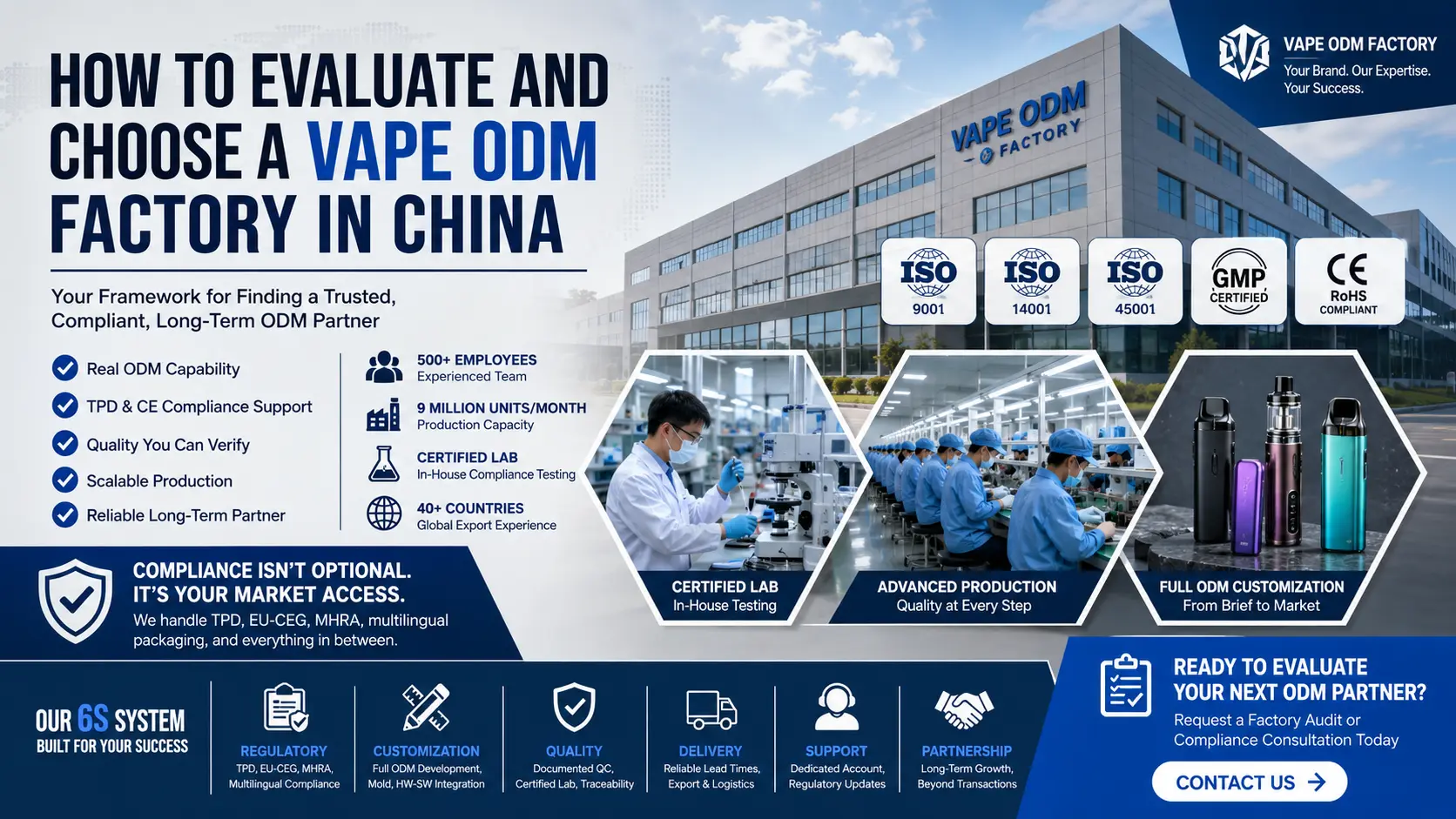
Vape ODM Factory was founded in Dongguan in 2013, bringing over 13 years of vape manufacturing experience to every client engagement. The team is the original manufacturer behind the WPUFF product line — including the WPUFF-600 and WPUFF-800 — having led the full R&D, design, and production of those devices from the ground up. Today the operation employs 500+ people, runs a monthly capacity of 9 million units, and holds ISO 9001, ISO 14001, ISO 45001, and GMP certifications, backed by a national-standard certified in-house laboratory.
The 6S system is the operational framework behind every client engagement:
- Regulatory — Direct TPD filing support, EU-CEG preparation, MHRA registration, multilingual packaging compliance
- Customization — Full ODM development from brief to finished product, in-house mold development, hardware-software integration
- Quality — Documented QC at every production stage, certified lab testing, traceable batch management
- Delivery — Reliable lead times, export documentation, freight coordination for EU markets
- Support — Dedicated account management, proactive regulatory updates, after-sales response
- Partnership — Long-term brand development focus, not transactional order fulfillment
The model is built around one principle: the client handles sales. Everything else — product development, compliance, quality, logistics — is handled by the factory. You can explore the full 6S framework here or view the product range to see how it applies across different product categories.
Ready to Evaluate Your Next ODM Partner?
Choosing the right factory is the most important supply chain decision a vape brand makes. The framework in this guide — covering ODM capability, compliance infrastructure, supply chain transparency, and long-term partnership fit — gives you the tools to evaluate a vape ODM factory in China without relying on marketing materials.
Use the audit checklist. Ask the hard questions. Verify the certificates. And prioritize factories that treat compliance as an operational capability, not a sales talking point.
If you’re ready to start the evaluation process with a factory that has built its entire model around supporting European brands, contact Vape ODM Factory to request a factory audit or compliance consultation.