Selling vapes in Europe is not complicated — but getting it wrong is expensive. EU vape regulations set hard limits on what you can sell, how you package it, and what paperwork you need before a single unit crosses a border. This article breaks down the full regulatory framework, explains what it means for your product design and supply chain, and gives you a practical path to market. No legal jargon. No generic summaries. Just what brand owners actually need to know.
What Are EU Vape Regulations? A Quick Overview
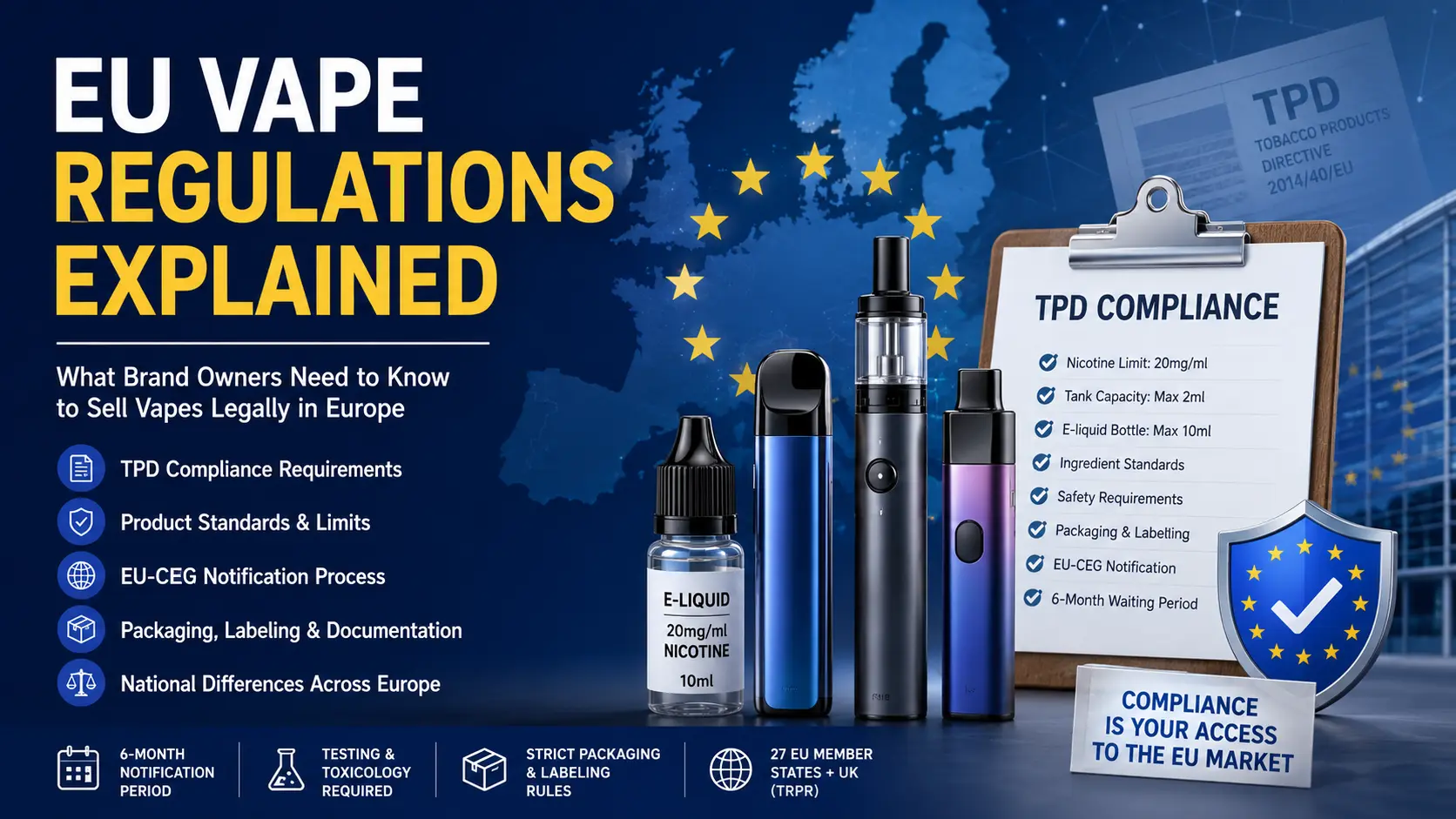
EU vape regulations are built on a single piece of legislation: the Tobacco Products Directive, or TPD (Directive 2014/40/EU). It came into force in May 2016 and applies across all 27 EU member states, plus the UK under its retained version (TRPR).
The TPD does not ban vaping. It regulates it — setting product standards, notification requirements, packaging rules, and advertising restrictions. Every e-cigarette or e-liquid sold legally in the EU must comply with these rules before it reaches the shelf.
Think of the TPD as the floor. Member states can add stricter national rules on top of it, but they cannot go below it. That distinction matters a lot when you’re planning a multi-country launch.
The Foundation: Understanding the TPD Directive (2014/40/EU)
The TPD was designed to protect public health by standardizing how tobacco and nicotine products are manufactured, presented, and sold across the EU. For vapes specifically, it covers four main areas: product composition, device specifications, packaging and labeling, and market notification.
The directive applies to any product that contains nicotine and is intended for inhalation — including disposable vapes, pod systems, refillable devices, and e-liquids sold separately. Zero-nicotine products fall outside TPD scope, though they may still be subject to national consumer product safety laws.
One thing the TPD does not do: it does not require pre-market approval. Products are notified, not approved. The distinction is important — you submit your product data to a central EU database, and after a six-month waiting period, you can sell. There is no authority that signs off and says “approved.” The responsibility for compliance sits with the brand or importer.
Key Product Compliance Requirements Under EU Vape Regulations
This is where most brands either get it right or get it wrong. The TPD sets hard technical limits that directly affect how your product is designed and manufactured.
Nicotine Concentration
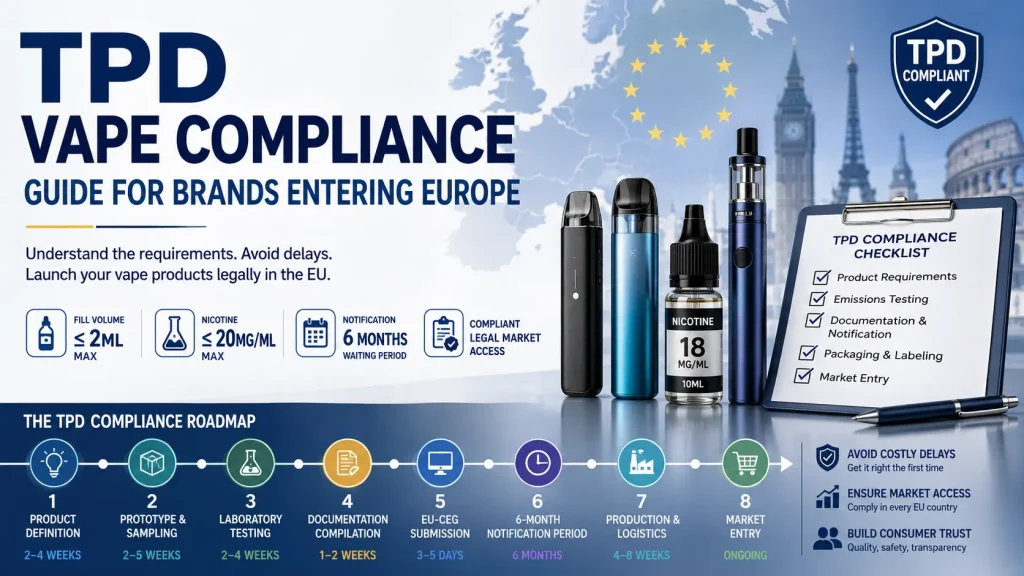
The maximum nicotine concentration for any e-liquid sold in the EU is 20mg/ml. This applies to both pre-filled devices and standalone e-liquids. There are no exceptions for specific product types or markets within the EU.
For brands sourcing from manufacturers in China, this is a critical spec to confirm early. Many factory-standard formulations are produced at 50mg/ml for non-EU markets. Ordering the wrong concentration — even by mistake — creates a compliance failure that cannot be fixed after production.
Tank and E-Liquid Volume Limits
The TPD sets two volume limits:
- Refillable tanks: maximum 2ml capacity
- E-liquid bottles (sold separately): maximum 10ml per unit
For disposable vapes, the 2ml tank limit is the binding constraint. A device filled with more than 2ml of nicotine-containing e-liquid cannot legally be sold in the EU, regardless of puff count or battery size.
This limit has a direct impact on product design. A 2ml fill at 20mg/ml delivers roughly 600 puffs under standard testing conditions. If your product brief calls for 800 or 1,000 puffs with nicotine, you need to either reduce nicotine concentration, optimize coil efficiency, or accept that the EU version will have a lower puff count than your non-EU SKU.
This is why working with an experienced disposable vape manufacturer is critical for brands selling into Europe.
Ingredient and Quality Standards
E-liquids sold in the EU must meet specific ingredient standards. The TPD prohibits certain additives including:
- Vitamins and other additives that create the impression of health benefits
- Caffeine, taurine, and other stimulants associated with energy drinks
- Colorants for inhalation
- CMR substances (carcinogenic, mutagenic, or toxic to reproduction) at any level
All ingredients must be listed with CAS numbers and submitted as part of the product notification. Your manufacturer needs to provide full ingredient documentation — not just a flavor name, but a complete breakdown of every compound in the e-liquid formulation.
This is where working with a manufacturer who has in-house lab capability matters. Ingredient documentation that is incomplete or inaccurate will cause your notification to fail.
Device Safety Requirements
Beyond e-liquid, the TPD also sets requirements for the device itself:
- Child-resistant and tamper-evident packaging
- Protection against breakage and leakage
- A mechanism to ensure leak-free refilling (for refillable devices)
- Consistent nicotine delivery across the product’s rated puff count
The consistent delivery requirement is often overlooked. It means your device must deliver a measurable, repeatable dose of nicotine per puff — not just at the start of the product’s life, but throughout. This is a coil and airflow engineering requirement, not just a formulation one
Packaging, Labeling, and Documentation Requirements
Every TPD-compliant product needs packaging that meets specific requirements. Getting this wrong is one of the most common reasons products are pulled from shelves or rejected at customs.
Required Label Elements
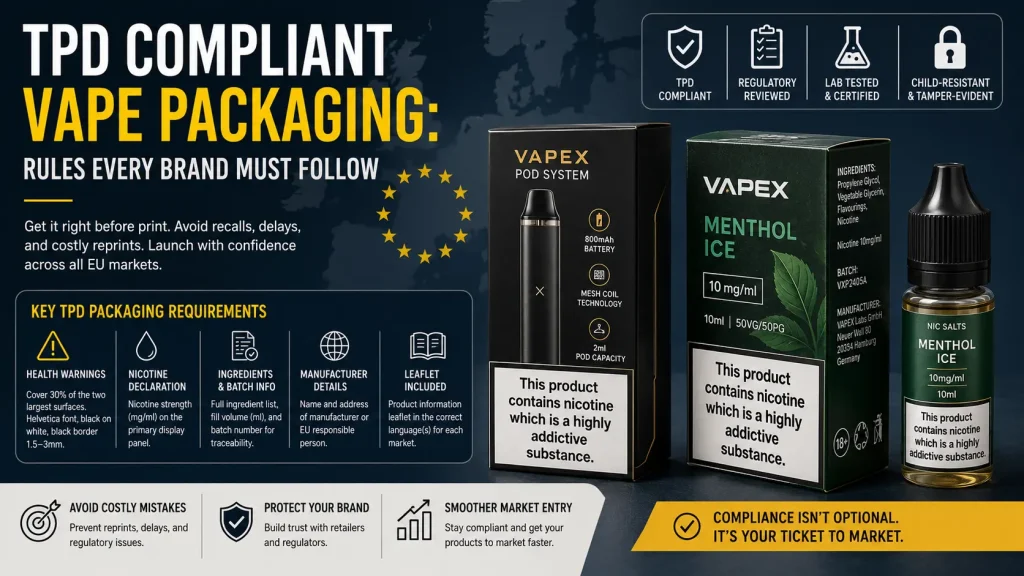
The following must appear on every unit of packaging:
- A health warning: “This product contains nicotine which is a highly addictive substance.” (exact wording, translated into the language of the destination market)
- A list of all ingredients in descending order of weight
- Nicotine content per dose and per unit
- Batch number and date of manufacture
- Manufacturer name and address (or EU importer if the manufacturer is outside the EU)
- Instructions for use and storage
- A recommendation to keep the product out of reach of children
The health warning must cover at least 30% of the front and back of the packaging. Font size, contrast, and placement are all specified. This is not a design suggestion — it is a legal requirement.
Leaflet Requirements
In addition to packaging text, every product must include a printed leaflet containing:
- Instructions for use
- Contraindications (who should not use the product)
- Warnings for specific risk groups
- Possible adverse effects
- Addictiveness and toxicity information
- Contact details for the manufacturer or importer
The leaflet must be in the official language(s) of every country where the product is sold. If you’re selling in five EU markets, you need five language versions — or a multi-language leaflet that covers all of them.
The EU-CEG Notification Process: Step by Step
The EU Common Entry Gate (EU-CEG) is the centralized portal where all TPD product notifications are submitted. Before you can legally sell a nicotine-containing vape product in any EU member state, it must be notified through this system.
Here is how the process works in practice:
Step 1: Prepare Your Product Dossier
You need to compile a complete technical file for each product. This includes:
- Full ingredient list with CAS numbers and quantities
- Toxicological data for each ingredient
- Emissions data (TNCO: tar, nicotine, carbon monoxide, and other required parameters)
- Device technical specifications (dimensions, battery, coil resistance, power output)
- Manufacturing process description
- Quality and safety monitoring plan
- Packaging artwork with all required label elements
This dossier is not a summary. It is a detailed technical submission. Missing or incomplete data will result in a failed notification.
Step 2: Submit via EU-CEG
Submissions are made through the EU-CEG portal, managed by the European Commission. You submit once to the central system, then select which member states you want to notify. Each member state receives the data automatically.
The submitter must be either the manufacturer (if based in the EU) or an EU-based importer acting as the responsible party. If your manufacturer is in China, your EU entity — or your EU importer — is the legal submitter.
Step 3: Wait Six Months
After submission, there is a mandatory six-month notification period before the product can be placed on the market. This is not a review period — no authority approves or rejects your submission during this time. But you cannot sell until the six months have elapsed.
This timeline has significant implications for product launches. If you want to be on shelf for Q4, your notification needs to be submitted by Q2 at the latest. Many brands miss their launch windows because they underestimate how long documentation preparation takes.
Step 4: Maintain and Update
Notifications are not one-time events. Any material change to the product — a new flavor, a reformulated e-liquid, a change in nicotine concentration, updated packaging — requires a new or amended notification. The six-month clock restarts.
This is why SKU discipline matters. Every new variant you add to your range is a new notification, a new six-month wait, and a new documentation package.
National Differences Across Europe: Why EU ≠ One Market
The TPD sets the baseline. But each EU member state can — and does — add its own rules on top. This is the part that catches most brands off guard.
Here is a snapshot of how national rules vary:
| Country | Notable Additional Rules |
|---|---|
| Germany | Strict advertising restrictions; online sales heavily regulated |
| France | Vaping banned in certain public spaces; flavor restrictions under discussion |
| Netherlands | Flavor ban in effect since 2023 (tobacco flavor only for most products) |
| Hungary | Additional excise tax on e-liquids |
| Finland | Strict retail licensing requirements |
| Italy | High excise duty on e-liquids; specific labeling additions |
| Sweden | Snus is legal; vape rules align with TPD but enforcement is active |
The Netherlands flavor ban is the most significant recent development. Since October 2023, only tobacco-flavored e-cigarettes can be legally sold there. Fruit, menthol, and other flavors are prohibited. Brands that built their EU range around fruit-ice combinations had to either reformulate or exit the Dutch market.
This is not an isolated case. Belgium, Denmark, and other member states are actively considering similar restrictions. If you’re building a multi-country EU brand, your flavor strategy needs to account for the possibility that your best-selling SKU may become non-compliant in one or more markets within your planning horizon.
How EU Vape Regulations Impact Your Product Design and Cost
This is the section most compliance guides skip. EU vape regulations are not just a legal checklist — they directly shape what your product can be and what it costs to make.
The 2ml Constraint and SKU Proliferation
The 2ml tank limit forces a structural decision for any brand selling in both EU and non-EU markets. Your EU SKU and your non-EU SKU will have different fill volumes, different puff counts, and potentially different battery sizes. That means different production runs, different packaging, and different documentation.
Many brands end up with two parallel product lines — a 2ml / 600-puff EU version and a 3.5ml / 800-puff version for other markets. Both need separate notifications, separate packaging artwork, and separate quality control documentation. The cost of running two lines is real and needs to be factored into your pricing model from day one.
Testing and Documentation Costs
TPD compliance is not free. The main cost categories are:
- Emissions testing (TNCO and other parameters): typically €500–€2,000 per product per lab
- Toxicological assessment: €1,000–€3,000 per formulation depending on complexity
- EU-CEG submission preparation: varies widely depending on whether you use in-house staff, a consultant, or a manufacturer who handles it for you
- Translation of packaging and leaflets: €200–€500 per language per SKU
For a brand launching with 10 SKUs across 5 EU markets, compliance costs can easily reach €50,000–€100,000 before a single unit is sold. This is not a reason to avoid the EU market — it is a reason to plan your SKU range carefully and choose a manufacturing partner who can absorb some of this cost.
The Manufacturer’s Role in Your Compliance Cost
Here is something most compliance guides do not tell you: your manufacturer determines a large part of your compliance cost.
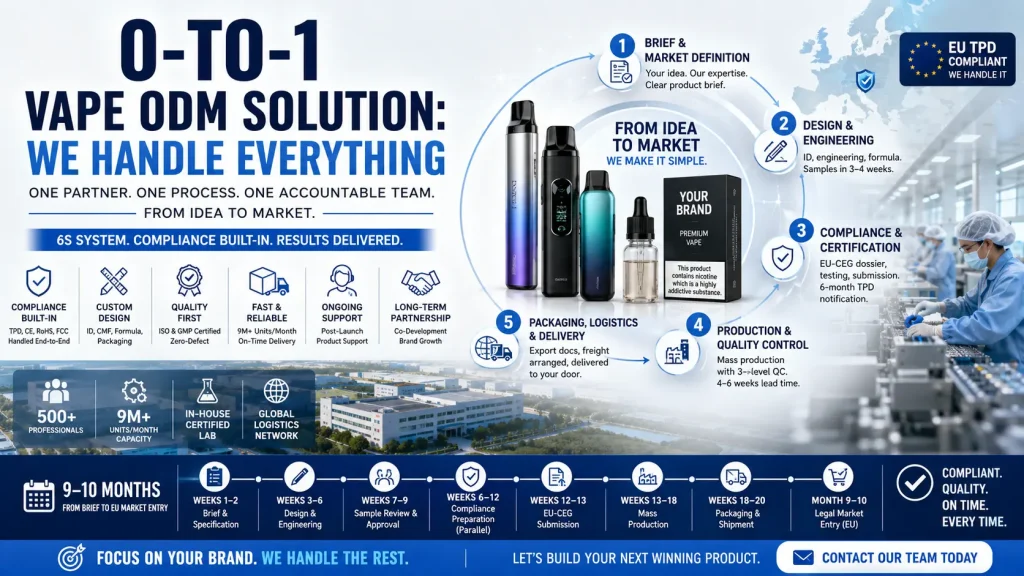
A manufacturer with in-house lab capability, existing ingredient documentation, and experience with EU-CEG submissions can dramatically reduce your time and cost to market. A manufacturer without these capabilities pushes all of that work — and cost — onto you.
When evaluating ODM partners for EU-bound products, ask specifically: Do you have existing TNCO test reports for this product? Do you have full ingredient documentation with CAS numbers? Have you submitted EU-CEG notifications before? The answers will tell you more about your real compliance cost than any price sheet.
Common Compliance Mistakes That Derail EU Market Entry
Most compliance failures are not caused by ignorance of the rules. They are caused by process gaps — things that were known but not executed correctly.
Submitting Incomplete Ingredient Data
The most common notification failure. Flavor compounds are often submitted as proprietary blends without full CAS number breakdowns. EU-CEG requires complete ingredient disclosure. If your flavor supplier will not provide a full ingredient list, you cannot complete a valid notification.
Underestimating the Six-Month Timeline
Brands regularly plan product launches without accounting for the notification waiting period. The six months starts from the date of submission — not from when you decide to submit. If your documentation takes three months to prepare, you are looking at nine months from decision to legal sale. Plan accordingly.
Treating EU as a Single Market for Packaging
Printing one packaging design for “the EU” and assuming it covers all member states is a mistake. Health warning translations, language requirements, and national additions vary. A packaging design that is compliant in Germany may not be compliant in France or Poland without modification.
Not Updating Notifications After Product Changes
Changing your e-liquid formulation, updating your packaging, or switching flavor suppliers without filing an amended notification puts your product in a legally grey area. Enforcement agencies in several EU countries have become more active in checking notification status against products on shelf.
Choosing a Manufacturer Based on Price Alone
A lower unit cost from a manufacturer with no compliance infrastructure often results in higher total cost once you factor in third-party testing, documentation preparation, and delayed market entry. The cheapest factory quote is rarely the cheapest route to market in the EU.
How to Build a Compliance-Ready Vape Brand for the EU Market
Here is a practical action plan for brands entering or expanding in the EU market.
Phase 1: Product Design (Months 1–2)
Define your EU SKU specifications before production begins:
- Set e-liquid capacity at or below 2ml
- Confirm nicotine concentration at or below 20mg/ml
- Select flavors from formulations with existing ingredient documentation
- Confirm device dimensions, battery, coil resistance, and power output
- Identify which EU member states you are targeting (this determines language requirements)
Work with your ODM partner to confirm that all device specifications meet TPD device safety requirements. Get this in writing before tooling is finalized.
Phase 2: Documentation Preparation (Months 2–3)
Compile your product dossier:
- Request full ingredient lists with CAS numbers from your manufacturer
- Commission TNCO emissions testing (your manufacturer may have existing reports)
- Prepare toxicological assessments for each formulation
- Finalize packaging artwork with all required label elements
- Prepare multi-language leaflets for each target market
If your manufacturer handles EU-CEG submissions as part of their ODM service — as Vape ODM Factory does through its 6S compliance system — this phase can run in parallel with production tooling, saving 4–6 weeks.
Phase 3: EU-CEG Submission (Month 3–4)
Submit your product notifications through the EU-CEG portal. Select all target member states in a single submission. The six-month waiting period begins from the submission date.
Use this time to finalize packaging production, arrange logistics, and brief your distribution partners on the product range.
Phase 4: Market Entry (Month 9–10)
Six months after submission, your products can legally be placed on the market. Have stock ready to ship before the notification period ends — not after. Delays in production or logistics after the notification clears are wasted compliance runway.
Review your full product range against your target market list and confirm that every SKU has a valid, current notification before shipping.
Future Trends in EU Vape Regulations (2025–2027)
The regulatory environment is not static. Several developments are likely to affect EU vape regulations within the next two to three years.
Disposable Vape Restrictions
Multiple EU member states are moving toward restrictions or outright bans on single-use disposable vapes, primarily on environmental grounds. Belgium has already announced a ban. France, Germany, and others are in active legislative discussion. Brands building their EU strategy around disposables need a contingency plan — either a rechargeable alternative or a market pivot.
Flavor Restrictions
The Netherlands flavor ban is likely to be followed by other member states. The EU Commission is also reviewing whether flavor restrictions should be incorporated into a revised TPD (sometimes referred to as TPD3). Brands with heavy exposure to fruit and menthol SKUs should monitor this closely and consider how quickly they could pivot to tobacco-flavored alternatives if required.
Excise Tax Harmonization
The EU is actively working toward harmonized excise duties on e-cigarettes across member states. Currently, tax rates vary enormously — from near-zero in some countries to significant per-ml levies in others. Harmonization would likely increase the tax burden in low-tax markets and could affect retail pricing and margin structures across the board.
TPD Revision (TPD3)
The European Commission is expected to propose a revised TPD within the current legislative cycle. Key areas under discussion include stricter flavor rules, updated nicotine limits, and potentially tighter device specifications. Brands and their manufacturing partners should be tracking the Commission’s consultation process and preparing for possible product reformulation requirements.
Getting EU Vape Regulations Right From the Start
EU vape regulations are not a barrier to entry — they are a filter. Brands that understand the framework, plan their product design around it, and work with manufacturing partners who can support the compliance process will move faster and spend less than brands that treat compliance as an afterthought.
The six-month notification period, the 2ml tank limit, the ingredient documentation requirements — none of these are surprises if you plan for them. The brands that struggle are the ones that discover these constraints after production has started.
If you are building a vape brand for the European market and want to understand how a compliance-integrated ODM partnership works in practice, the team at Vape ODM Factory handles EU-CEG submissions, ingredient documentation, and TPD-ready product development as part of a single service. You can also learn more about our manufacturing capabilities and compliance infrastructure before starting a conversation.
EU vape regulations will continue to evolve — flavor restrictions, disposable bans, and a potential TPD revision are all on the horizon. The brands that build compliance into their product strategy from day one will be the ones best positioned to adapt.