The European vape market crossed €8 billion in 2025 — with the UK alone accounting for one of the largest single-country shares. If you’ve been researching how to start a vape brand in the UK or Europe…
But most new entrants hit the same two walls: TPD compliance feels like a legal maze with no clear exit, and finding a trustworthy manufacturing partner feels like guesswork with high stakes.
This guide removes both obstacles.
You’ll get a complete, action-oriented breakdown — from defining your product and navigating UK and EU regulations, to securing a certified ODM manufacturer, designing compliant packaging, and planning your budget. No filler. No vague advice. Just a clear path from idea to shelf.
This guide covers the full journey — from market selection to your first shipment. For deep dives on specific stages, we’ve published separate guides on budgeting, compliance, and factory evaluation throughout.
Is Starting a Vape Brand in the UK or Europe Still a Good Idea in 2026?
The short answer is yes — if you go in prepared.
The European vaping market is projected to grow at a CAGR of over 11% through 2030. The UK remains one of the most developed vape markets globally, with high consumer awareness, established retail infrastructure, and a clear regulatory framework through the MHRA. Consumer demand across the UK, Germany, France, Poland, and the Netherlands continues to expand — particularly in rechargeable, refillable, and closed-pod formats as the market structurally shifts away from single-use disposables.
Why the entry window is still open in 2026:
- Challenger brands are actively taking market share from legacy players through stronger design, better flavour ranges, and sharper price positioning
- The rechargeable pod system segment is growing as sustainability concerns shift consumers — and regulators — away from single-use formats
- Regulatory tightening is raising the compliance barrier to entry, which actually protects brands that build their infrastructure correctly from day one
- Several mid-tier European markets remain underserved by brand-conscious, design-led positioning
The risk isn’t the market. The risk is entering without infrastructure. Regulations are getting stricter across both EU member states and the UK. Brands that get compliant early, and build with a product that’s genuinely exclusive rather than a reskinned catalog item, are the ones building sustainable positions.
What You Need to Start a Vape Brand in the UK or Europe
Before getting into the step-by-step, here’s a clean overview of every element your new European vape brand requires:
| Requirement | What It Means |
| Product direction | Disposable vape, pod system, e-liquid, or a focused combination |
| Legal entity or EU representative | A registered European company, or an EU Authorised Representative |
| TPD compliance | Mandatory for all EU and UK markets before products can legally be sold |
| Certified ODM manufacturer | A partner that designs and produces your product from scratch, with direct EU compliance experience |
| Brand identity and packaging | Logo, visual system, and fully compliant packaging for each target market |
| Starting capital | Typically €30,000–€50,000 for a first exclusive product launch |
Each element has its own set of decisions, timelines, and costs. The steps below walk through all of them in the order you’ll actually encounter them.
Step 1: Define Your Product and Niche
The most common mistake new vape brand founders make is trying to cover everything at once — three product formats, five markets, fifteen SKUs. Start with one product category, one clear market, and one defined positioning. That’s how you build traction before spreading resources thin.
Choose Your Product Category
Three main formats dominate the European vape market in 2026:
- Disposable vapes — high consumer demand, relatively fast supply chain. Regulatory restrictions are tightening in France, Belgium, the UK (ban in effect from mid-2025), Ireland, and the Netherlands. Volume demand remains active in Eastern Europe and some Southern European markets, but the long-term regulatory trend is against single-use formats
- Rechargeable pod systems — reusable devices with replaceable or refillable 2ml pods. Growing consumer appeal, stronger sustainability positioning, better brand loyalty, and more forward-compatible with TPD revision discussions. This is where the product development opportunity is largest in 2026
- E-liquids — lower capital entry point, high margin potential, but requires strong flavour development capability and a separate TPD notification for every individual SKU
Choose Your Starting Market
Rather than targeting all of Europe simultaneously, pick one or two countries to pilot:
- UK — one of the largest single-country vape markets in Europe, with high consumer awareness and strong retail infrastructure. Regulatory framework is managed by the MHRA, with a single national notification process. English-language packaging applies across the entire market. A UK Responsible Person is required for businesses based outside the UK. The disposable vape ban came into effect mid-2025, making rechargeable pod systems the primary growth format
- Germany — high consumer sophistication, strong demand for pod systems and refillable formats, growing regulatory framework
- France — flavoured disposable restrictions now in effect; better suited for rechargeable pod and e-liquid launches
- Wider CEE — faster-growing markets, lower brand competition, more accessible entry point for smaller initial volumes
Find Your Differentiation
What makes your brand worth choosing over the fifty other options already on a retailer’s shelf? Competing on price alone as a new brand is a losing strategy — established factories with their own retail brands will always undercut you. Compete on identity:
- A distinctive flavour range, localised to your target market’s preferences
- Premium design and device ergonomics that command a higher retail price point
- A specific consumer segment — adult smokers switching, not existing heavy vapers
- A clear sustainability story through rechargeable, recyclable, or low-waste formats
Step 2: Understand TPD Compliance — The Most Critical Part of Entering Europe
If you learn one thing from this guide, let it be this: do not commission a product without understanding how TPD compliance applies to it. Brands that treat compliance as an afterthought end up with products stuck at customs, pulled from retail shelves, or facing legal liability they weren’t prepared for.
What Is the TPD?
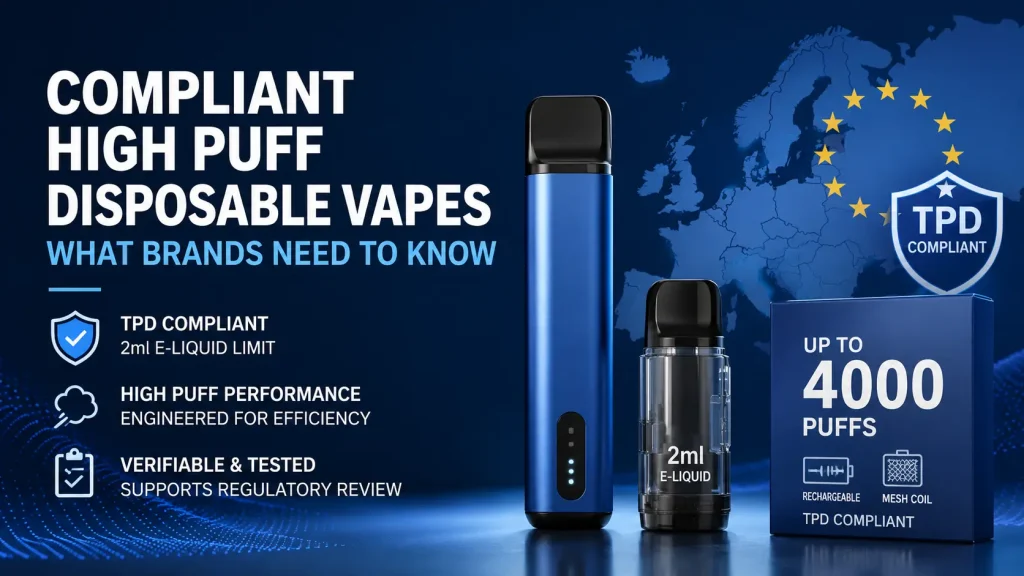
The Tobacco Products Directive (TPD) — specifically Article 20 — is the EU legal framework governing all electronic cigarettes and e-liquids sold across EU member states. The UK operates its own equivalent, enforced by the MHRA. Both frameworks share the same core requirements, with some regional procedural differences.Full EU TPD legislation is available at EUR-Lex: Directive 2014/40/EU
The Core Rules That Affect Your Products
| Requirement | Specification |
| E-liquid capacity (tanks/pods) | Maximum 2ml per unit |
| Nicotine concentration | Maximum 20mg/ml |
| Refill container size | Maximum 10ml |
| Packaging health warnings | Minimum 30% of pack surface, TPD Article 13 specified text |
| Pre-market notification | 6-month statutory waiting period via EU-CEG before legal sale |
| Ingredient and emissions reporting | Mandatory for all notified products |
| Packaging format | Child-resistant and tamper-evident |
EU vs UK: The Key Procedural Difference
For EU markets, you notify through the EU-CEG portal, and notifications apply to individual member states. Selling in Germany, France, and the Netherlands means three separate notification records. Some member states charge per-SKU notification fees; others don’t.
For the UK, all notifications go through the MHRA’s system. It’s a single process — but it requires an appointed UK Responsible Person if your business is based outside the UK.
Full MHRA guidance is available at gov.uk/guidance/nicotine-inhaling-products
The Single Most Important Timing Decision: Start TPD in Parallel
The 6-month statutory waiting period is fixed. You cannot shorten it. What you can control is when you start the clock.
Brands that submit TPD notifications after production is finished end up with containers sitting in European warehouses, unable to sell legally. The right approach is to submit notifications in parallel with mold development — around Week 4–8 of your product development timeline. That way, the regulatory clock runs concurrently with production, not sequentially after it.
This is one area where your ODM manufacturing partner makes a tangible operational difference. At Vape ODM Factory, TPD compliance filing is handled directly through the 6S service system — the factory submits notifications on your behalf, not just advises you on what to do. That distinction matters: it means the process starts earlier and runs without you needing to coordinate a separate compliance consultant.
Step 3: Find the Right Manufacturing Partner
Your manufacturing partner is the single most consequential decision in launching a vape brand. The wrong factory costs you time, capital, and market credibility. The right one compresses your timeline, manages compliance complexity, and produces a product that’s genuinely differentiated.
Understanding the Three Manufacturing Approaches
These terms get used interchangeably in the market — they shouldn’t be.
| Approach | What It Actually Means | Best For |
| ODM (Original Design Manufacturing) | The factory’s R&D team designs and engineers an entirely new, exclusive product from your brief. Private molds are developed for your brand — one mold per client per country. The product doesn’t exist before you commission it. | Brands that want a genuinely differentiated product without building their own R&D team |
| OEM (Original Equipment Manufacturing) | You provide the completed product design — CAD files, engineering specs, firmware requirements — and the factory manufactures to your blueprints. You own the design; they own production capability. | Brands with existing in-house engineering teams and production-ready designs |
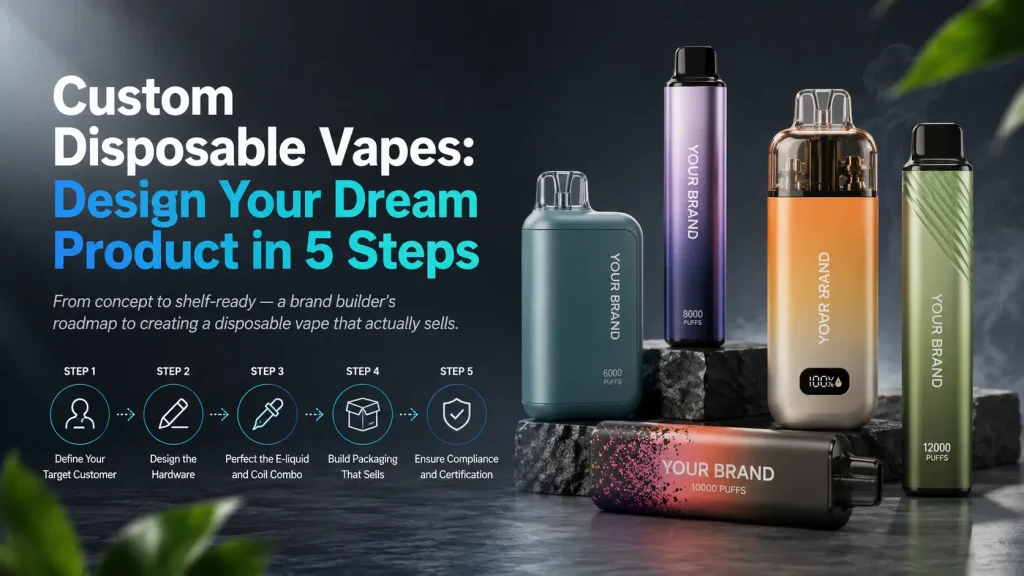
| White Label | You pick an existing product from the factory’s catalog and add your logo. No exclusivity — the same hardware may be sold to dozens of other brands simultaneously. | Fastest and cheapest, but no product differentiation |
Why New European Brands Should Prioritise ODM
For most new brand founders, ODM is the right model — not because it’s the easiest option, but because it delivers the commercial outcome you actually need.
White-labeling puts your logo on a product that fifteen other brands are already selling. In markets like Germany, France, and the UK where shelf space is competitive and consumers are brand-conscious, there’s no sustainable position in that. Your device needs to look, feel, and perform differently from everything else available.
ODM delivers that exclusivity without requiring you to fund a full R&D department. You work from a professional brief; the factory’s engineers handle industrial design, mold engineering, electronics, firmware, and e-liquid formulation. Your private molds are assigned exclusively to your brand in your designated markets — no competitor in the same country gets the same hardware.
How to Evaluate a Manufacturing Partner
When assessing potential ODM manufacturers, verify the following:
- In-house R&D team — a minimum of 30+ engineers is the baseline for genuine ODM capability (not just catalog selection)
- Private mold policy — confirm in writing that molds are one-client-per-country exclusive. Get territorial exclusivity, duration, and breach penalties documented
- Direct TPD compliance handling — not advice, but executed submissions via EU-CEG. Ask to see documentation of previous successful notifications
- EU certifications — CE marking, RoHS, REACH compliance, CLP labeling capability
- National-standard laboratory — in-house testing capability for emissions, ingredients, and toxicological assessment
- Production scale — 5M+ units per month capacity is the meaningful threshold for reliable European supply
- ISO certifications — ISO 9001, ISO 14001, ISO 45001, and GMP for e-liquid production
- European client references — ask for verifiable examples of products developed for EU market brands
- Post-launch support — ongoing production, flavour extensions, and product iterations as your brand scales
Questions to Ask Before Signing Anything
- “Show me three products you developed from scratch for European clients.”
- “What is your mold exclusivity policy? Can you confirm territorial exclusivity in writing?”
- “Do you handle TPD notifications directly, or do I need a separate consultant?”
- “What’s your current defect rate?”
- “Can I visit the factory or arrange a live video audit?”
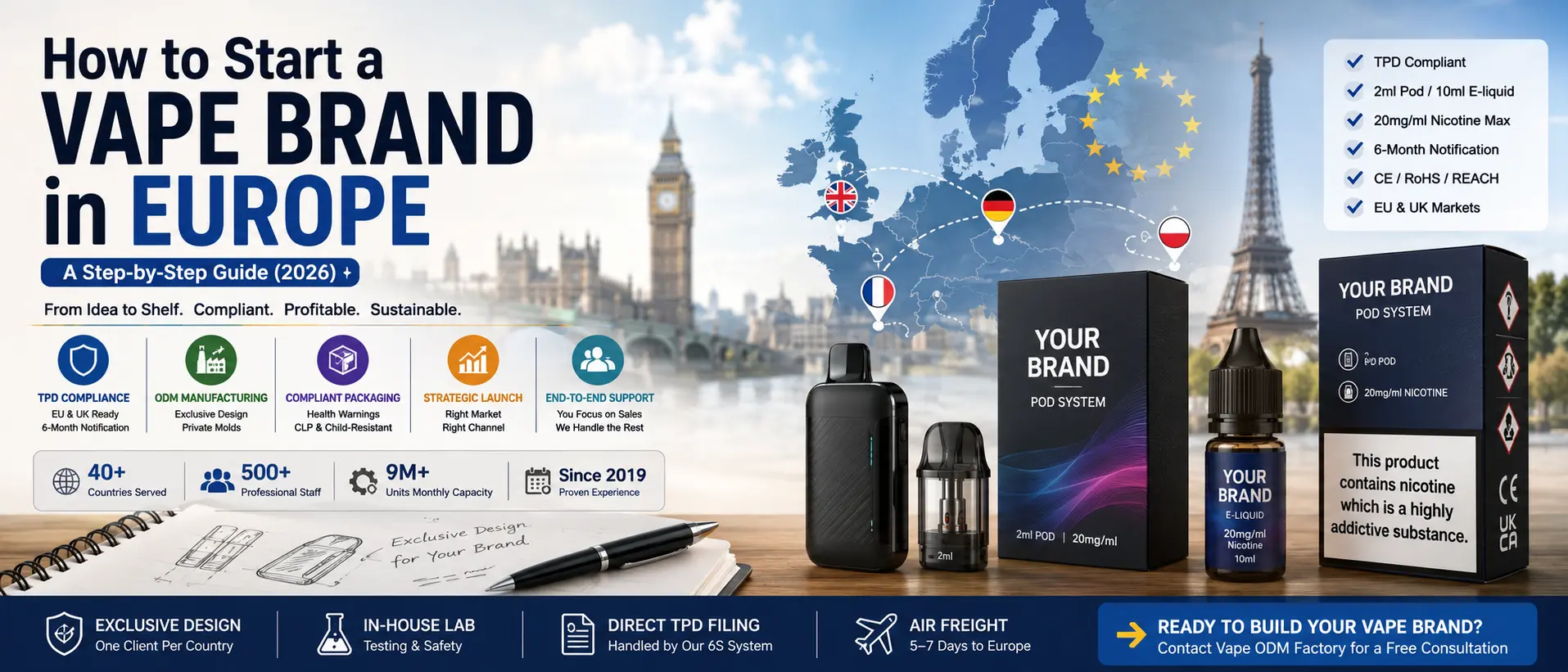
Vape ODM Factory has operated from Dongguan since 2013, with 500+ staff, 9 million units of monthly production capacity, and an active client base across 40+ countries. Their 6S service system is designed around a single principle: you handle sales and brand development; they handle everything else from first sketch to goods delivered to your European warehouse — including direct TPD filing.
Step 4: Build Your Brand Identity and Packaging
Your product hardware can be technically identical to a competitor’s at the component level. Your brand is what creates preference, retail visibility, and willingness to pay a premium price. Brand identity is not a cosmetic step — it’s a commercial asset that starts paying returns from the first product your customer picks up.
Core Brand Elements
- Brand name — memorable, trademarkable, and not already registered in your target markets. Check EUIPO for EU-wide trademark availability before committing
- Logo and visual system — colour palette, typography, and surface textures that translate well across device formats and packaging dimensions
- Tone of voice — how your brand communicates in product descriptions, retail materials, and any consumer-facing content
- Flavour naming conventions — particularly important in markets where flavour marketing is subject to restrictions (France, Germany, etc.)
Packaging Compliance Requirements
Every unit of packaging sold in EU or UK markets must include:
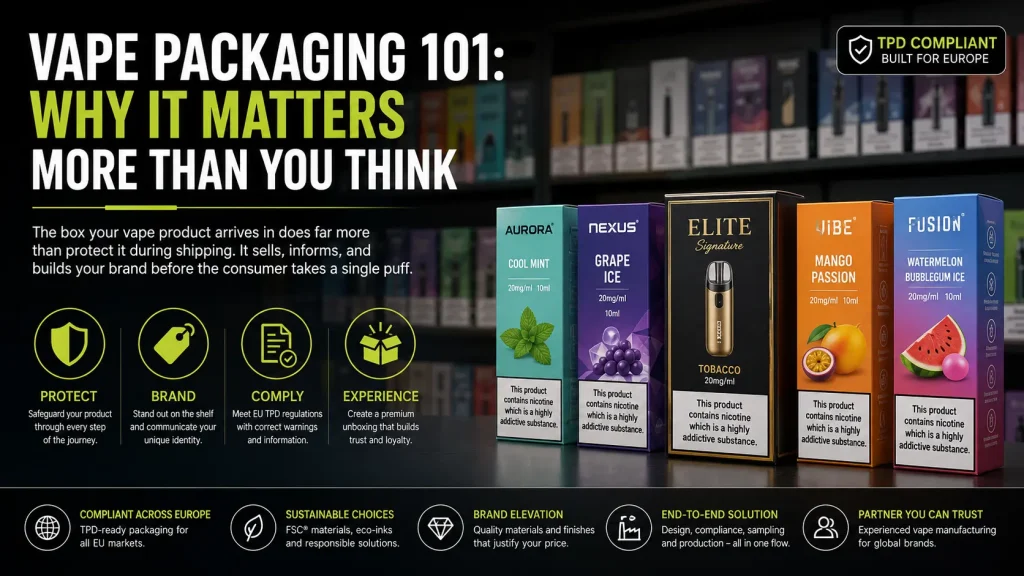
- Health warning statement per TPD Article 13 (minimum 30% of pack surface, specified text)
- CLP hazard labeling for nicotine-containing products
- Nicotine content clearly stated (e.g. “Contains nicotine: 20mg/ml”)
- Full ingredients list
- Batch number and manufacture date
- Country-specific language requirements for each target market
- Manufacturer contact details and EU Authorised Representative information
Non-compliant packaging is one of the most common reasons products are detained at customs or pulled from retail. Established ODM factories offer integrated packaging design services and compliance review before print files go to production — verify this is included in your manufacturing agreement before signing.
Step 5: Budget and Cost Planning
Your budget breaks into five categories: product development and manufacturing, branding and packaging, compliance and legal, marketing and launch, and operations buffer.
For a genuine ODM launch — exclusive product, private molds, first production run — most first-time European brand founders land in the €30,000–€80,000 range. The largest single investment is mold and tooling (€5,000–€50,000+ depending on product complexity), followed by your first production run.
We’ve published a separate deep dive that breaks down every cost category with line-item estimates, allocation models for different budget tiers, and a full profitability calculation:
Read the complete cost breakdown: How Much Does It Cost to Start a Vape Brand? (2026 Full Breakdown)
The key principle: file your TPD notifications in parallel with mold development. The compliance clock should never delay your launch because of a budgeting oversight.
Step 6: Launch, Register, and Start Selling
Production is confirmed, packaging is approved, TPD notifications have been submitted. Now it’s time to build your route to market — and the choices you make here determine how efficiently your first product gains commercial traction.
Pre-Launch Checklist
Before your first unit ships to a customer, confirm:
- TPD notifications submitted (six-month statutory period being observed)
- EU Authorised Representative appointed, or UK Responsible Person confirmed
- Trademark registered in target markets
- Packaging print files compliance-checked and approved
- Distributor or retail agreements in place, or DTC setup operational
- Age verification in place for any direct-to-consumer channel
Sales Channel Options
| Channel | Pros | Cons |
| B2B wholesale / distributors | Fast market penetration, lower operational overhead | Margin shared, less direct brand control |
| Independent vape retail | Strong brand visibility, direct retail relationship | Requires field sales capability |
| Direct-to-consumer (DTC) e-commerce | Higher margin, direct customer data | Paid vape advertising restrictions limit acquisition channels | Paid vape advertising restrictions limit acquisition channels |
| Marketplaces (Amazon EU, etc.) | High existing traffic | Category restrictions, strong competition |
Starting with one or two countries and one primary channel is strongly recommended. Understand the unit economics fully before expanding. Brands that scale across multiple markets simultaneously run into inventory imbalances, compliance gaps, and cash flow pressure that a more focused launch avoids.
How Long Does It Take to Launch a Vape Brand in Europe?
Here is a realistic timeline for a standard ODM product launch in 2026, based on how the development process actually runs:
| Phase | Timeline | Key Activities |
| Discovery & Brief | Week 1–2 | Define product requirements, target market, price positioning — ODM partner proposes initial product directions |
| Concept Design | Week 2–4 | Industrial designers produce 2–3 concepts with full 3D renders; you select final direction |
| Mold Development & Flavour Tuning | Week 4–9 | Private mold tooling + e-liquid formulation run in parallel (~35 days) |
| Compliance & Certification | Week 8–14 | CE, RoHS, TPD notification submitted via EU-CEG — start this in parallel with mold development, not after |
| Production & QC | Week 12–16 | Full manufacturing run with inline quality inspection and AQL sampling |
| Air Freight & Customs | Week 14–18 | Air freight is standard for vape products (lithium battery + liquid content): 5–7 days transit to Europe |
| Goods at European warehouse | 3.5–5 months | From first meeting to delivery |
| Legally on sale in TPD markets | From ~Month 2–6 | Depends on when TPD notification was submitted — filing in parallel with mold dev minimises the gap |
The critical takeaway: the development-to-warehouse timeline is 3.5–5 months. The variable that can extend your legal sales start date is when you submitted TPD notifications. File them at the start of your mold development phase — not after production is complete.
Common Mistakes First-Time Vape Brand Owners Make
These are the errors that consistently derail new brands — every one of them is avoidable:
- Confusing white-labeling with ODM — putting your logo on an existing product that fifteen other brands are already selling is not brand-building. If your “ODM partner” shows you a catalog and asks you to pick, find a different partner
- Skipping the exclusivity agreement — without a written territorial exclusivity clause, nothing stops the manufacturer from selling your mold’s output to a competitor in the same market. Get it in writing, with penalties for breach
- Submitting TPD after production is finished — the six-month clock can’t be shortened. Brands that start compliance late end up with containers in European warehouses they can’t legally distribute from. Start in parallel
- Choosing on price alone — the cheapest quote often reflects cheaper materials or corners cut on QC. A device that leaks or fails compliance testing costs far more than the per-unit savings on the original order
- Overcommitting on initial volume — ordering 100,000 units before validating the market creates cash flow and inventory pressure. Start with what your first distribution channel can realistically absorb
- Non-compliant packaging — wrong health warning placement, missing language variants, incorrect nicotine labelling. One of the most common reasons goods are stopped at customs
- Skipping trademark registration — brand name conflicts in key markets are slow and expensive to resolve. Register before launch, not after a competitor files against you
The brands that navigate all of this well share a common trait: they treat launch infrastructure as seriously as they treat product development. The operational foundation — compliance, exclusivity, and manufacturing quality — is what makes brand-building on top of it possible.
Before placing your first order, make sure you understand how to evaluate a reliable disposable vape manufacturer for the EU market.
Ready to Start Your Vape Brand in the UK or Europe? Here’s Your Next Step
Starting a vape brand in the UK or Europe in 2026 is a structured process with a clear path. Build your compliance foundation in parallel with development, not after. Work with a certified ODM manufacturer who designs an exclusive product for your brand — not one who hands you a catalog.
The brands that succeed aren’t necessarily the ones with the largest budgets. They’re the ones that execute the fundamentals correctly: a genuinely differentiated product, solid compliance infrastructure, and a manufacturing partner who handles the complexity so the brand owner can focus on building market presence.
If you’re evaluating how to start a vape brand in the UK or Europe and want to understand what an ODM partnership looks like in practice — timelines, mold costs, TPD support, product options — contact the team at Vape ODM Factory. From Dongguan since 2013, 500+ staff, 9 million units of monthly capacity, and an active client base across 40+ countries. You handle sales. They handle everything else — from first sketch to goods at your European warehouse, including direct TPD filing through the 6S service system.
The next step is a conversation, not a commitment.