Every successful vape brand in Europe started with the same challenge: how do you bring a unique product to market without building a factory or spending two years in R&D?
The answer is working with a vape ODM manufacturer — a partner that develops an entirely new, exclusive product from scratch for your brand. This isn’t about picking a generic device off a shelf and adding your logo. A genuine ODM partner designs, engineers, molds, and produces a product that exists nowhere else in your market.
For European brands facing tightening regulations, disposable bans, and growing competition, this model offers product differentiation backed by professional R&D — without the overhead of doing it yourself.
This guide covers what ODM means in vaping, how it compares to OEM, real costs and timelines, and how to choose the right partner for the European market in 2026.
What Is ODM in the Vaping Industry?
ODM stands for Original Design Manufacturing. In vaping, a vape ODM manufacturer takes your brand from zero to a finished, market-ready product. They handle the entire development cycle: industrial design, structural engineering, mold creation, electronics, e-liquid formulation, testing, and mass production.
The key distinction: the product they create is new and exclusive. It doesn’t exist before you commission it. The factory’s R&D team designs it from the ground up based on your market requirements, target consumer, and competitive positioning.
This is what separates genuine ODM from white-labeling or catalog-based sourcing. When you work with a real ODM development partner:
- – A dedicated design team creates your product concept
- – Private molds are developed exclusively for your brand
- – That mold is assigned to one client per country — no one else in your market sells the same hardware
- – You get a product that looks, feels, and performs differently from everything else on the shelf
For European brands, this exclusivity matters. In markets like Germany, France, and the UK where shelf space is competitive and consumers are brand-conscious, having a device that’s visually and functionally unique is a real commercial advantage.
ODM vs OEM Vape: What’s the Real Difference?
These terms get confused constantly. Here’s the actual distinction:
ODM (Original Design Manufacturing): The manufacturer’s R&D team designs and develops the product from scratch. You define the brief — they execute the entire technical development. The result is a new, exclusive product built for your brand.
OEM (Original Equipment Manufacturing): You provide the completed product design — CAD files, engineering specs, firmware requirements — and the manufacturer produces it to your blueprints. You own the design; they own the production capability.
| Factor | ODM | OEM |
| Who designs the product? | Manufacturer’s R&D team | Your in-house team |
| Design exclusivity | One mold per client per country | Fully exclusive (you own the design) |
| R&D investment from brand | Low — included in partnership | High — you fund your own R&D |
| IP ownership | Negotiable (typically shared or transferred) | Brand owns 100% |
| Time to market | 3–5 months | 6–12 months |
| Upfront cost | Moderate (mold investment) | High (full R&D + mold + tooling) |
| Best for | Brands without in-house engineering | Brands with existing R&D teams |
| Technical risk | Low (factory’s proven expertise) | Higher (your design, your risk) |
When ODM Is the Right Choice
ODM makes sense when your strength is brand-building, marketing, and distribution — not hardware engineering. This applies to new brands entering Europe, established distributors launching private-label lines, brands pivoting from disposables to rechargeable systems, and companies that want unique products but can’t justify a full R&D department.
When OEM Makes More Sense
OEM fits when you already have a product design developed by an in-house team or third-party agency, and you need manufacturing capacity.
Why This Matters for Europe Specifically*
In the European market, where TPD compliance adds complexity to every launch, working with an ODM partner that handles both development AND regulatory certification removes significant friction. One partner manages the entire chain instead of you coordinating between a design house, a manufacturer, and a compliance consultant.
What Vape ODM Services Include (From Concept to Container)
A full-scope vape ODM service covers every stage between “I need a product” and “it’s on the shelf.” Here’s what that looks like:
Market Analysis & Product Brief
Before design work begins, a capable ODM partner helps you define what to build. What’s selling in your target market? What price point? What form factor suits your distribution channel?
Industrial Design
The external appearance — shape, dimensions, ergonomics, surface textures, color schemes. Expect 2–3 concept directions with 3D renderings before selecting a final direction.
Structural Engineering
Internal architecture: battery placement, e-liquid reservoir, airflow path, coil positioning, and component integration. This determines draw resistance, vapor production, battery life, and leak
Private Mold Development
Your exclusive tooling. These molds produce parts only for your brand in your assigned market. Mold development takes around 35 days from tooling start to approved samples.
PCBA & Firmware Engineering
Circuit board design, chipset selection, draw-activation sensitivity, output power curves, battery management, and safety protections. For advanced products: Bluetooth connectivity, puff tracking, or child-lock features.
E-Liquid Formulation
Flavor development tailored to European preferences, nicotine salt optimization, VG/PG ratio calibration for the specific coil design, and compliance with EU ingredient restrictions. Flavor tuning runs in parallel with mold development, so both finalize within the same ~35-day window.
Regulatory Compliance & Certification
CE marking, RoHS testing, REACH compliance, TPD notification filing via EU-CEG, emissions testing, and toxicological risk assessment. The best ODM partners handle TPD submissions directly — not as advice, but as an executed service.
Packaging & Labeling
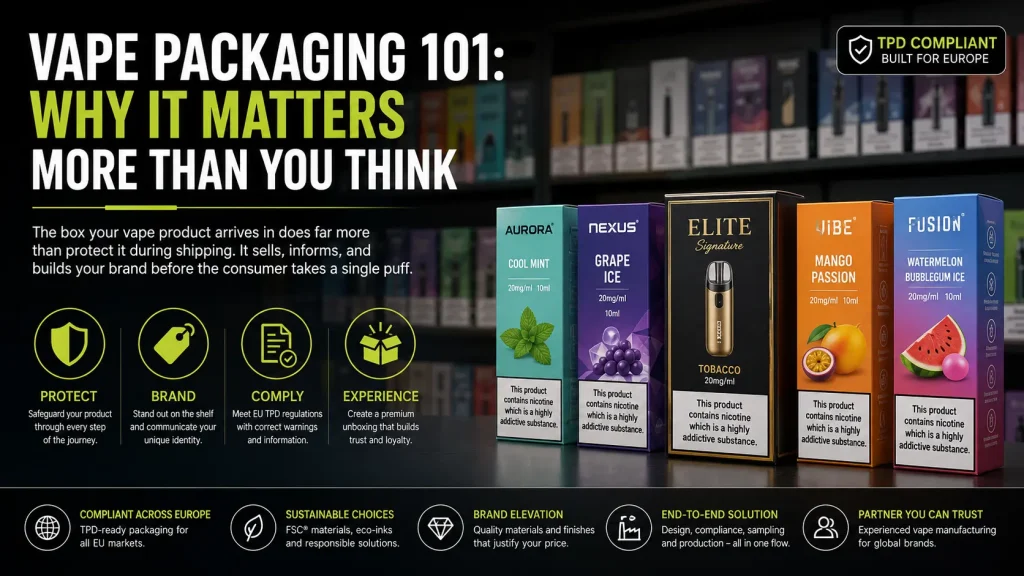
Child-resistant packaging, multilingual health warnings per TPD Article 13, CLP hazard labeling, country-specific requirements, and retail-ready presentation.
Development Timeline and Real Costs
Timeline: Phase by Phase
Phase 1: Discovery & Brief (Week 1–2)
Share your market requirements, target consumer, and price positioning. The ODM team proposes initial directions.
Phase 2: Concept Design (Week 2–4)
Industrial designers create 2–3 concepts with full 3D renders. You review, give feedback, and select the final direction.
Phase 3: Mold Development & Flavor Tuning (Week 4–9)
The core development phase. Mold tooling, sample production, and e-liquid adjustment happen in parallel — approximately 35 days from start to finalized samples with approved flavors.
Phase 4: Compliance & Certification (Week 8–14)
Products are submitted for CE, RoHS, and TPD testing. TPD notification timelines vary by country. Start this in parallel with development — not after.
Phase 5: Production & QC (Week 12–16)
Full-scale manufacturing with inline quality inspection and AQL sampling. A factory producing 9 million units monthly can fulfill orders of 50,000–200,000 units within 2–3 weeks.
Phase 6: Logistics (Week 14–18)
Air freight to Europe takes 5–7 days — the standard method for vape products due to battery and liquid content regulations.
Total: 3.5–5 months from first meeting to goods at your European warehouse.
Costs: What European Brands Should Budget
Mold & Tooling Investment
Includes all design, engineering, and tooling:
- – Simple disposable/pod device: €5,000–€10,000
- – Complex pod system with multiple components: €10,000–€20,000
- – Premium device with metal housing: €20,000–€50,000+
These molds are exclusive to your brand in your assigned market.
Unit Production Costs
- – Disposable vapes: €1.10–€1.30/unit
- – Rechargeable pod systems (device): ~€2.00/unit
- – Replacement pods (2ml TPD-compliant): €0.90–€1.00/unit
Compliance Costs
Every product requires TPD project testing before notification in any EU member state. Beyond testing, notification fees vary by country — some portals are free, others charge per-SKU fees. Your ODM partner should provide country-specific quotes based on your launch plan.
The ROI Math
A typical project with €30,000–€50,000 total investment (molds + first production run) yields an exclusive product. Selling 50,000 units at €5–€10 retail with healthy margins, the investment pays back within the first or second order.
How to Choose the Right Vape ODM Manufacturer
Essential Capabilities
- 1. In-house R&D team (30+ engineers minimum for genuine ODM capability)
- 2. Private mold policy — confirm one-mold-one-client-per-country exclusivity
- 3. TPD compliance team that handles notifications directly
- 4. EU certifications — CE, RoHS, REACH, CLP labeling capability
- 5. National-standard laboratory for in-house testing
- 6. Production scale — 5M+ units/month capacity
- 7. European client references you can verify
- 8. ISO 9001, ISO 14001, ISO 45001, GMP certifications
- 9. Dedicated project managers with English fluency
- 10. Post-launch support — ongoing production, flavor extensions, iterations
Questions to Ask Before Signing
- – “Show me 3 products you developed from scratch for European clients.”
- – “What is your mold exclusivity policy? Can you guarantee territorial exclusivity?”
- – “Do you handle TPD notifications directly or do I need a separate consultant?”
- – “What happens if the product fails compliance testing — who bears the cost?”
- – “What’s your current defect rate?”
- – “Can I visit the factory or arrange a live video tour?”
Red Flags and Common Mistakes
Red Flags
- – Offering “ODM” but only showing a catalog of existing products (that’s white-labeling)
- – No clear mold exclusivity policy
- – Unable to provide TPD documentation or unfamiliar with EU-CEG
- – Factory established less than 3 years ago with claimed “massive” capacity
- – Unwilling to share client references or third-party audit reports
- – Pricing dramatically below market (cutting corners on materials or compliance)
Common Mistakes to Avoid
Confusing white-labeling with ODM.* Putting your logo on an existing product that 15 other brands sell is not ODM. If your “ODM partner” shows you a catalog and asks you to pick, find a different partner.
Skipping the exclusivity agreement.* Without a written territorial exclusivity clause, nothing stops the manufacturer from selling your mold’s output to a competitor next door. Get exclusivity in writing — specifying countries, duration, and penalties for breach.
Underestimating compliance timelines.* TPD notification has a 6-month statutory waiting period. Brands that start compliance after production is finished end up with containers sitting in warehouses. Start compliance in parallel with mold development.
Choosing on price alone. The cheapest quote often means cheaper materials or corners cut on QC. A device that leaks or fails testing costs far more than the per-unit savings.
For brands targeting the European market, choosing the right disposable vape manufacturer requires additional attention to TPD compliance, shipping stability, and product consistency.
EU Regulatory Landscape in 2026: What Your ODM Strategy Must Address
Current TPD Requirements
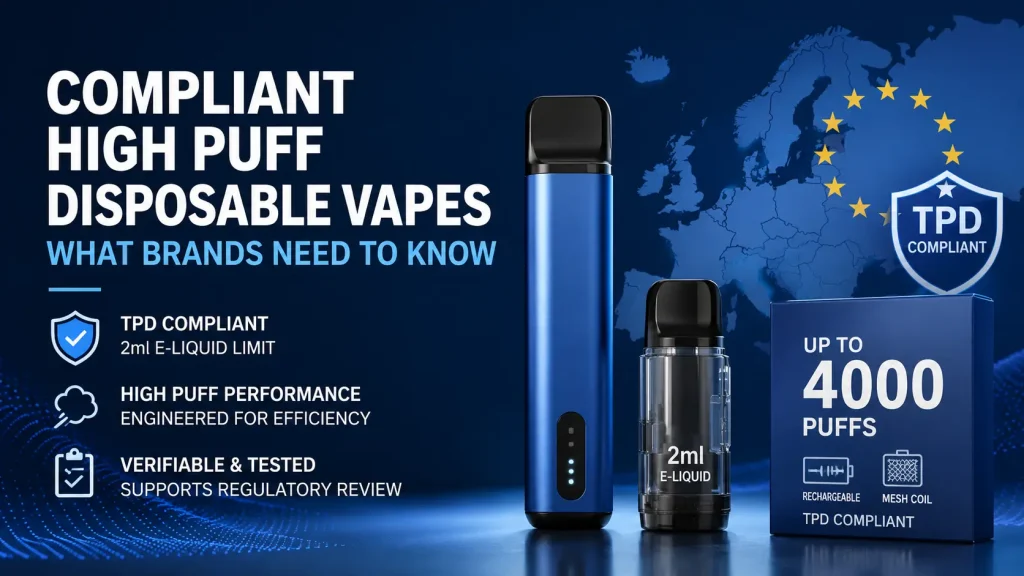
- – 2ml maximum e-liquid capacity (tanks and pods)
- – 20mg/ml maximum nicotine concentration
- – 10ml maximum refill container size
- – Mandatory health warnings (30%+ of pack surface)
- – 6-month pre-market notification via EU-CEG
- – Emissions and ingredient reporting
- – Child-resistant and tamper-evident packaging
The Disposable Ban Wave
Multiple EU markets have banned or restricted single-use vapes: France, Belgium, the UK (from mid-2025), Ireland, and the Netherlands (flavor ban in force). Germany continues tightening flavor and disposable restrictions.
What This Means for Your Product Brief
The market is moving clearly toward rechargeable, refillable, and closed-pod systems. If you’re commissioning a new ODM product in 2026, prioritize:
- – Rechargeable devices with replaceable/refillable pods
- – TPD-compliant 2ml pod capacity
- – Sustainable materials and recyclability
- – Longer device lifespan (addressing waste arguments used by regulators)
- – Child-resistant pod attachment mechanisms
A forward-thinking ODM partner is already developing platforms around these requirements — not scrambling to adapt.
TPD Revision on the Horizon
The European Commission is reviewing TPD with potential updates including standardized flavor categorization, enhanced traceability requirements, stricter environmental provisions, and possible changes to nicotine concentration limits.
Your ODM partner should design products with regulatory headroom — products that comply today and can adapt to tighter rules without complete redesigns.
When to Consider Moving Beyond ODM
Stay with ODM WHEN your core strength is marketing and distribution, you want new products every 6–12 months without an R&D team, your volume per SKU is under 500,000 units, or you value speed over absolute IP control.
Consider OEM WHEN you’ve developed proprietary technology, have in-house engineers producing production-ready designs, your volume justifies higher upfront investment, or you need full IP ownership for investors.
The smart APPROACH: Many successful European brands maintain long-term ODM partnerships — not because they can’t do it themselves, but because it’s more efficient. A dedicated partner that understands your brand gets better over time. Each new product launches faster than the last.
Ready to Build Something Exclusive?
The European vaping market in 2026 belongs to brands with differentiated products, solid compliance, and efficient supply chains. A vape ODM manufacturer gives you all three — a product built from zero, certified for your market, and produced at scale while you focus on building your brand.
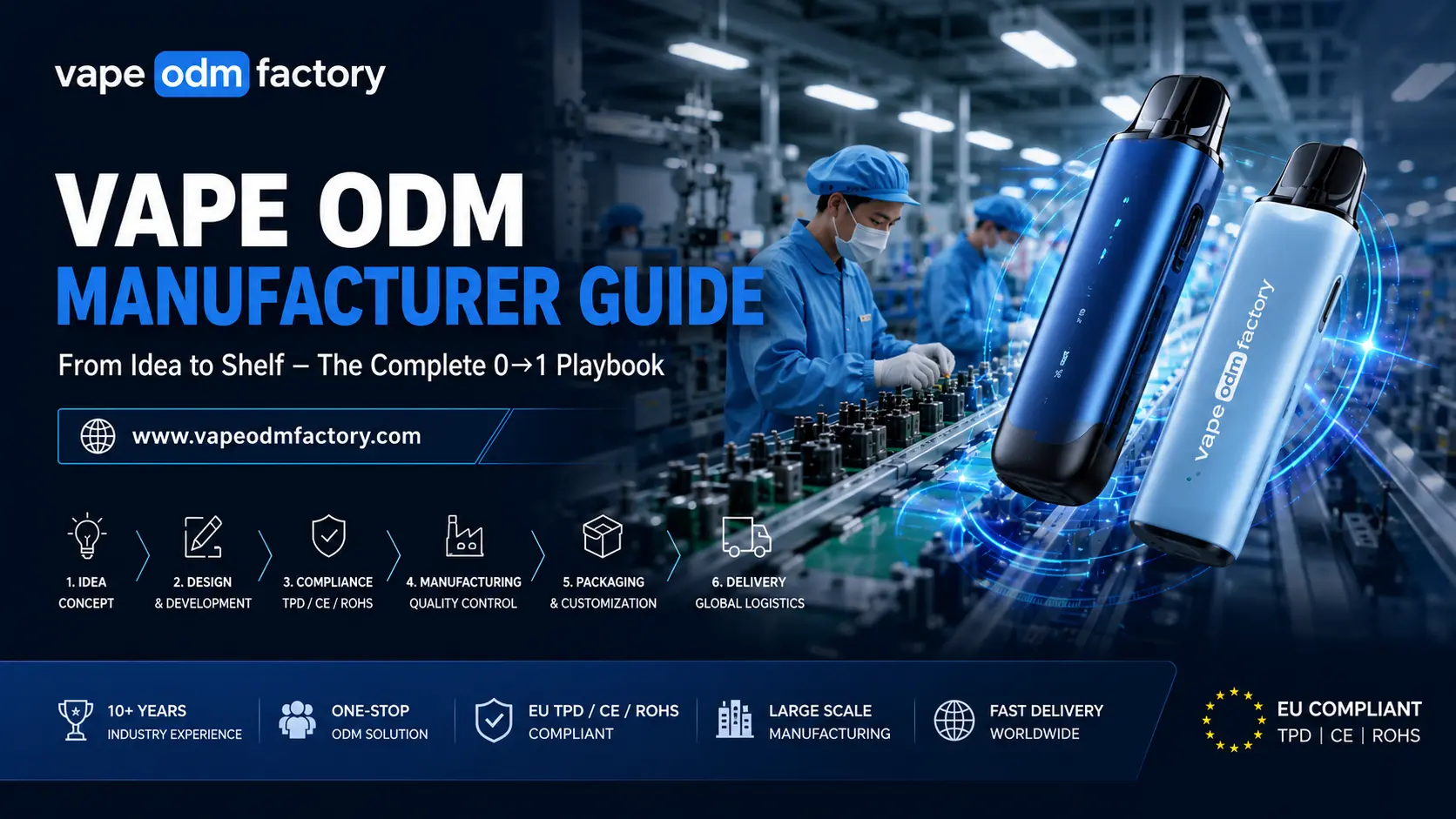
Vape ODM Factory has operated from Dongguan since 2013, serving brands across 40+ countries with a 500+ person team and 9 million units monthly capacity. You handle sales — they handle everything else, from first sketch to delivered goods, including direct TPD compliance filing through their 6S service system.
If you’re serious about launching an exclusive product for the European market, start with a conversation. Define your market, your consumer, and your price point — and let a proven ODM partner turn that brief into reality.